
Nitrile Glove Procurement Shortlist: 5 Certified Options Compared
Grand View Research values the global nitrile gloves market at a projected USD 7.0 billion in 2026 and forecasts USD 13.2 billion by 2033. At that scale, nitrile has stopped being a spot-buy consumable and become a qualification file that procurement teams maintain, renew and audit.
At the decision stage, the difficult question is rarely whether to buy nitrile. It is which of the certified formats on a supplier line card actually matches the compliance scope of the task. Medical exam, box exam, heavy duty, food grade and industrial nitrile formats share a polymer but not a regulatory footprint. This shortlist compares five certified options on exactly that basis: documented compliance, intended use, and the point at which each option stops being the correct choice.

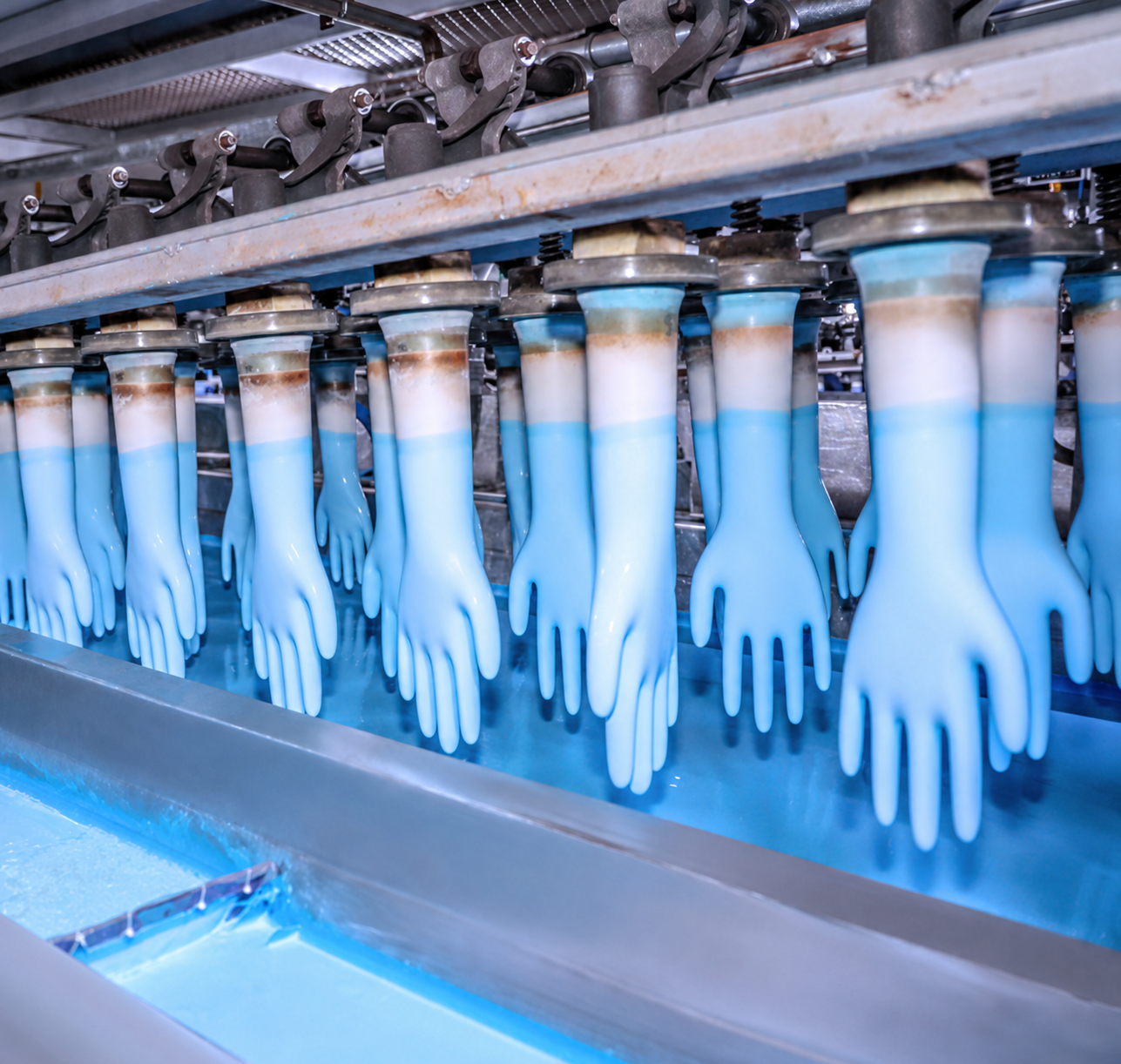
Nitrile glove manufacturing line. A five-format catalogue is only useful to buyers when each format carries its own compliance file.
Why the Shortlist Is Now a Compliance Exercise
Three data points explain the shift away from unit-price selection.
- Powder-free is the default specification. Powder-free nitrile accounted for a 74.8% revenue share of the category in 2025 (Grand View Research). A specification held by three-quarters of the market no longer separates suppliers; the documentation behind it does.
- The price band is too wide to function as a decision rule. 2026 wholesale benchmarks place standard exam-grade nitrile at USD 80 to USD 140 per case of 1,000 gloves (Schneider Direct). A spread that wide reflects differences in specification, origin and documentation that a per-case comparison conceals.
- Origin changes landed cost. US tariffs on Chinese-origin medical-grade nitrile gloves reached 100% in January 2026, according to the same 2026 pricing benchmark. Two suppliers quoting an identical FOB price can therefore deliver very different landed costs.
A defensible shortlist runs four filters in sequence: intended use first, documented compliance for that specific product second, the quality system behind it third, and landed cost after origin and duty fourth. Everything below is organised around those four filters.
The Five Certified Options at a Glance
| Option | Documented compliance | Intended use | Where it stops |
|---|---|---|---|
| Medical Exam Nitrile Gloves | ISO 13485, EN 455, FDA 510(k), EU MDR | Patient examination and clinical procedures | Clearance covers the submitted product, not every SKU |
| Box Exam Gloves | ISO 13485, FDA, EU food contact | High-volume non-sterile examination, budget-capped | Food contact is not medical clearance |
| Heavy Duty Industrial Gloves | ISO 13485, EU food contact | Industrial durability, abrasion and tear exposure | Not a medical device; reduces dexterity |
| Food Grade Nitrile Gloves | FDA 21 CFR, Japan MHLW 370 | Direct food handling, US and Japan exports | No medical or chemical-protective claim |
| Industrial Nitrile Gloves | Halogen test report | General chemical resistance in industrial handling | Material test, not permeation certification |
Option 1 - Medical Exam Nitrile Gloves: The Clinical Reference Point
Medical exam nitrile gloves are single-use examination gloves manufactured and documented as medical devices, intended for patient examination and diagnostic or therapeutic procedures rather than general handling.
Documented compliance: ISO 13485 quality management system certification; EN 455, the European standard series for single-use medical gloves; FDA 510(k) premarket clearance, held by ANBOSON for its disposable nitrile gloves under K222557, dated 31 May 2023; and EU MDR conformity for CE-marked medical devices.
Why the file matters more than the label: FDA guidance for nitrile examination gloves asks whether the product meets ASTM D6319 or an equivalent consensus standard, and CDC PPE-Info describes ASTM D6319 as covering nitrile rubber gloves used in medical examinations and diagnostic and therapeutic procedures. A supplier that can produce a 510(k) number alongside EN 455 test evidence is auditable at tender stage; a supplier citing medical grade without a file is not.
Boundary: medical documentation is specific to the product and specification described in the submission. A 510(k) clearance does not extend automatically to every nitrile SKU in a catalogue, and chemotherapy drug handling is a separate claim that appears only where a glove has been tested against the named drugs.
Option 2 - Box Exam Gloves: The Economical Exam Format
Box exam gloves are non-sterile examination-format gloves supplied in high-volume dispenser boxes and positioned for routine, high-turnover use where the full clinical documentation package is not the deciding criterion.
Documented compliance: ISO 13485, FDA, and EU food contact.
Intended use fit: high-volume non-sterile examination settings, clinical support functions, and food-adjacent handling where EU food-contact compliance is the applicable requirement rather than medical-device clearance. For buyers running mixed tenders, box exam gloves are the format that keeps a routine-consumption line inside budget without leaving the quality system.
Boundary: the economical position comes from the specification envelope and the documentation scope, not from a different polymer. Buyers should confirm which intended-use claims a specific SKU carries, because food-contact approval and medical-device clearance are separate regulatory routes and do not substitute for one another.
Option 3 - Heavy Duty Industrial Gloves: Durability Over Dexterity
Heavy duty industrial gloves are thickened, wear-resistant nitrile formats built for mechanical exposure such as abrasion, tearing and repeated grip in workshop and maintenance environments.
Documented compliance: ISO 13485 and EU food contact.
Intended use fit: assembly, workshop, warehousing, maintenance and general industrial handling, including colour-coded operations where black nitrile work gloves are used to separate lines, shifts or task zones. Texture options within the format help maintain grip where surfaces are wet or oily.
Boundary: heavier gauge trades tactile sensitivity for wear resistance, so tasks requiring fine manipulation are better served by a standard-gauge exam or industrial format. Heavy duty industrial gloves are not medical devices and should not be substituted into clinical use on the basis of thickness alone.
Option 4 - Food Grade Nitrile Gloves: Two Markets, Two Documents
Food grade nitrile gloves are documented for direct contact with food, which is a separate compliance route from medical-device clearance and from industrial protective claims.
Documented compliance: FDA 21 CFR food-contact compliance for the United States and Japan MHLW 370 for the Japanese market.
Intended use fit: food processing, catering, hospitality and food retail, including exporters shipping to both the United States and Japan, where buyers increasingly request both documents inside a single qualification file rather than accepting one as evidence of the other.
Boundary: food-contact compliance establishes the suitability of the material for contact with food. It does not confer medical clearance, and it does not establish protective performance against a named chemical.
Option 5 - Industrial Nitrile Gloves: General Chemical Handling
Industrial grade nitrile gloves cover general industrial handling where resistance across a range of chemicals is required but the task is not governed by a medical or food-contact file.
Documented compliance: a halogen test report, which is a material-level laboratory test document.
Intended use fit: general chemical resistance in maintenance, cleaning support, painting preparation and workshop tasks, including colour-differentiated disposable nitrile gloves for line separation.
Boundary: a halogen test report documents a property of the material. It is not a permeation or breakthrough certification against a specific chemical. Where a named chemical is handled, buyers should request breakthrough data for that chemical instead of relying on the general phrase chemical resistant.
How to Read the Evidence Behind Each Option
The five formats look similar on a line card because the differentiating information sits in documents rather than in photographs. A practical reading order separates what each document proves from what it does not.
| Document | What it proves | What it does not prove |
|---|---|---|
| ISO 13485 | The manufacturer operates a certified quality management system for medical devices | That any individual SKU is cleared or CE-marked |
| EN 455 | Conformity with the European standard series for single-use medical gloves | US market access |
| FDA 510(k) | The named product was cleared for the intended use in that submission | Coverage of other SKUs or of additional claims |
| EU MDR conformity | Conformity assessment for the EU medical device market | Food-contact compliance |
| FDA 21 CFR | Material compliance for contact with food | Suitability for medical examination |
| Japan MHLW 370 | Japanese regulatory position for the food grade product | EU or US market access |
| Halogen test report | A tested material property of the industrial product | Breakthrough resistance to a named chemical |
| AQL 1.5 inspection record | The outgoing defect level the supplier accepts at the factory gate | Certification of any regulatory kind |
Two process documents sit underneath the certificates and are often read incorrectly. AQL 1.5 outgoing inspection, applied against 100% full-scale inspection before shipment, describes sampling-based quality control rather than regulatory approval. Secondary dipping technology, used to control wall thickness and barrier integrity, explains how consistency is achieved rather than what has been approved. Neither document replaces a certificate, and neither substitutes for the other.
Production line with in-process inspection. Outgoing defect levels and regulatory approvals answer two different questions.
Where ANBOSON Fits in a Five-Option Shortlist
Huizhou Anboson Technology Co., Ltd. (ANBOSON) is a nitrile glove manufacturer based in Huizhou, China, producing medical, examination, industrial and food grade nitrile gloves for export markets. The company operates a 42,000 square metre automated production facility with more than 300 employees, a research and development team of 5+ certified engineers, and annual capacity above 3.2 billion gloves. Around 70% of output is exported, with North America, Europe and Japan as principal markets.
The relevance to a five-option shortlist is coverage rather than a single hero product: all five formats in this comparison sit inside one quality system instead of across five suppliers. ANBOSON holds ISO 13485 certification, FDA 510(k) clearance for its disposable nitrile gloves, CE marking, and is verified by SGS and TÜV SÜD, with RoHS and BSCI compliance. The company is also a recognised Chinese National Little Giant Enterprise and a designated Provincial Engineering Technology Research Center.
Customisation is the second reason buyers consolidate formats with one manufacturer. Thickness, colour, logo, carton and custom packaging can be specified, along with direct printing on the glove and compact two-pack formats used in medical, catering and hospitality channels. Where a tender specifies individually packed nitrile gloves for single-procedure dispensing, that packaging requirement has to be quoted alongside the product file rather than assumed.
On the operational side, the company works with US and EU regulatory agents for compliance, undergoes regular third-party audits, and reports delivery as fast as five days against confirmed orders, supported by Trade Assurance and a factory verified on site. Company documentation is published at szanboson.com.
Nitrile vs Latex, Vinyl and Cloth: What the Comparison Actually Shows
| Compared with | Measured difference | Cost consequence | Best fit |
|---|---|---|---|
| Latex gloves | Latex-free and hypoallergenic, zero allergy risk, 3x puncture resistance, stronger chemical and body-fluid barrier | Slightly higher unit cost; bulk orders cost-effective through reduced allergy management | Medical, industrial and food handling where allergy sensitivity matters |
| Vinyl gloves | 2-3x higher tensile strength, better fit, higher elasticity for stable barrier protection during long shifts | Higher unit cost offset by lower breakage and fewer replacements | Medical examination, laboratory and heavy-duty work |
| Cotton and cloth gloves | Disposable, 100% waterproof versus absorbent fabric, chemical-resistant | Higher single-use cost, but zero washing and maintenance labour | Clean rooms, food preparation, medical scenarios |
Read together, the comparisons explain why nitrile displaced latex and vinyl in procedure-driven environments without becoming the cheapest option per pair. The substitution case rests on barrier reliability and on the labour and risk costs that disappear when gloves are disposable, latex-free and consistent in strength.
Where Nitrile Stops: Boundaries Buyers Should Plan For
- Unit economics are not in nitrile's favour at the lowest tier. Nitrile carries a higher unit cost than vinyl and a higher single-use cost than cloth. The case depends on breakage rates, replacement frequency, allergy management and cleaning labour - not on the invoice line alone.
- Compliance scope does not transfer between formats. Medical clearance, food-contact approval and industrial material testing are separate routes. A buyer who awards one format across all sites inherits a documentation gap at some of them.
- Chemical protection is chemical-specific. Nitrile resists many substances better than latex, but general chemical resistance is not the same as breakthrough data for a named substance.
- Landed cost is origin-specific. With US tariffs on Chinese-origin medical-grade nitrile gloves at 100% as of January 2026, a shortlist that ignores origin will misprice the award even when the product file is correct.
Matching Each Option to a Procurement Scenario
| Scenario | Recommended format | Evidence to request |
|---|---|---|
| Hospital or clinic examination tender | Medical Exam Nitrile Gloves | 510(k) number, EN 455 test report, ISO 13485 certificate |
| High-volume non-sterile examination on a fixed budget | Box Exam Gloves | ISO 13485, intended-use statement per SKU, EU food contact where relevant |
| Manufacturing, assembly and maintenance | Heavy Duty Industrial Gloves | ISO 13485, gauge and thickness specification, EU food contact |
| Food processing exporting to the US and Japan | Food Grade Nitrile Gloves | FDA 21 CFR documentation and Japan MHLW 370 |
| General chemical and cleaning support | Industrial Nitrile Gloves | Halogen test report plus breakthrough data for any named chemical |
| Multi-site portfolio with mixed tasks | Split award across formats | A separate qualification file per SKU, not one file per supplier |
The practical conclusion of this shortlist is that a mixed portfolio should be split by intended use rather than awarded as one line item. Splitting typically costs a buyer one additional file per site and removes the much larger risk of a clinical, food-safety or chemical-handling auditor finding that the wrong format was deployed.
Market Signals Shaping the 2026 Shortlist
Category growth is not the constraint. Grand View Research projects the market moving from USD 7.0 billion in 2026 to USD 13.2 billion by 2033, and powder-free formats already hold a 74.8% revenue share. What changes inside that growth is where differentiation sits: in documentation, in origin and in packaging configuration rather than in the polymer itself.
Trade policy is the visible pressure point. The 100% US tariff rate on Chinese-origin medical-grade nitrile gloves recorded in January 2026 forces buyers to model landed cost by origin, and it pushes part of the medical-grade volume toward alternative supply regions. A second, quieter pressure is consolidation of supplier lists: manufacturers that already serve as OEM and ODM partners to tier-one international brands in North America, Europe and Japan can carry several glove formats under one audited quality system, which reduces the number of files a procurement team has to maintain.
What Changes Next
The direction of travel is toward the qualification file as the unit of procurement. Buyers are moving from asking whether a supplier is certified to asking which document covers which SKU, which market and which intended use. Once that question is standard, three things follow: dual-origin sourcing becomes a documented requirement rather than a contingency, packaging specifications such as individually packed or two-pack formats enter the tender as line items, and material test reports are read for what they cover rather than as generic proof of protection.
FAQ
What is the difference between medical exam nitrile gloves and box exam gloves?
Medical exam nitrile gloves are documented as medical devices and carry a market-access file such as FDA 510(k) clearance, EN 455 conformity and EU MDR conformity for the specific product. Box exam gloves are non-sterile examination-format gloves supplied in dispenser boxes, documented under ISO 13485, FDA and EU food contact. The polymer is the same; the regulatory scope and the specification envelope are not.
Which documents should a buyer verify before shortlisting a nitrile glove supplier?
Verify four layers separately: the quality system (ISO 13485 certificate), the product standard evidence (for nitrile exam gloves, ASTM D6319 or an equivalent consensus standard), the market-access file for the destination market (FDA 510(k) or EU MDR conformity for medical use, FDA 21 CFR or Japan MHLW 370 for food contact), and the outgoing quality record such as AQL 1.5 inspection. Each layer answers a different question and none replaces another.
Are food grade nitrile gloves suitable for medical examinations?
No. Food-contact compliance establishes that the material is suitable for contact with food. Medical use requires a medical device file for the specific product, such as FDA 510(k) clearance or EU MDR conformity. A food grade glove can be manufactured to the same quality system as a medical glove, but its documented intended use is different.
Is a halogen test report the same as chemical resistance certification?
No. A halogen test report is a material-level laboratory test document. It does not certify breakthrough or permeation resistance against a named chemical. Where a specific substance is handled, the buyer should request test data for that substance rather than accept general chemical-resistant wording.
Are nitrile gloves latex-free, and does that matter for workforce safety?
Nitrile gloves are latex-free and hypoallergenic, with zero allergy risk compared with latex gloves, and they provide roughly 3x the puncture resistance of latex along with a stronger barrier against chemicals and body fluids. For workforces with latex sensitivity, this removes allergy-related management costs, which is why nitrile is preferred in medical, industrial and allergy-sensitive food handling even though its unit cost is slightly higher.
How should landed cost be compared when tariffs apply?
Compare landed cost rather than FOB price. Since US tariffs on Chinese-origin medical-grade nitrile gloves reached 100% in January 2026, two suppliers quoting the same case price can deliver very different totals once duty and origin are applied. The comparison should use the per-case benchmark (USD 80 to USD 140 for standard exam grade in 2026) as a reference point, then adjust for duty, freight and the documentation cost of qualifying the specific SKU.
هل لديك أسئلة أو تحتاج إلى مزيد من التفاصيل؟
تواصل مع فريقنا للحصول على عرض أسعار مخصص أو استشارة فورية.
طلب عرض أسعار
املأ النموذج أدناه وسيتواصل معك فريقنا بعرض مقترح مخصص.
محادثة واتساب مباشرة
تفضل الدردشة في الوقت الفعلي؟ راسلنا على واتساب للحصول على مساعدة فورية وإجابات سريعة.
- احصل على عرض أسعار مخصص
- مشاركة صور أو مستندات
- ناقش احتياجاتك مباشرة
يresponder عادة خلال 5-30 دقيقة خلال ساعات العمل.