
Non-Dairy Creamer Compliance: A Global Import Verification Guide
Non-Dairy Creamer Compliance: A Global Import Verification Guide
Non-dairy creamer is traded as an ingredient but assessed at the border as a labelled food. This guide sets out the three checkpoints that decide most import files — ingredient declaration, trans-fat value and moisture threshold — and explains how buyers can use specification sheets and certificate scopes to confirm what a supplier actually holds, instead of relying on the word “certified”.
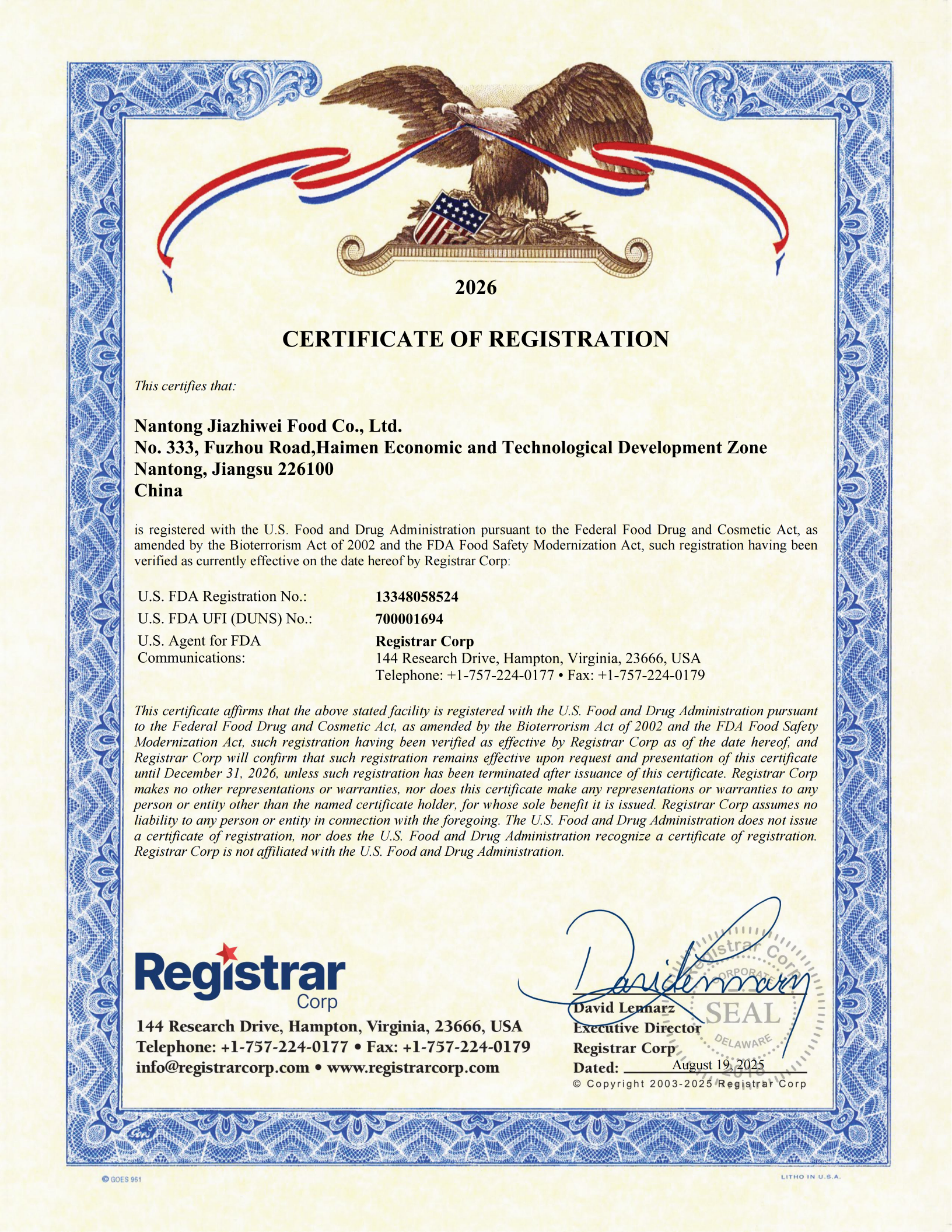
A U.S. FDA Food Facility Registration certificate (No. 13348058524) issued to Nantong Jiazhiwei Food Co., Ltd. Facility registration is a U.S. import eligibility step, not a product approval — a distinction that shapes how importers read the rest of a compliance file.
Non-dairy creamer moves through international trade as a commodity ingredient but is assessed at the border as a formulated food. Buyers who treat the category as one product class — one specification, one certificate, one label — usually find during their first shipment review that compliance is decided document by document: the ingredient declaration, the nutrient values on the specification sheet, and the exact scope of the certificates held by the manufacturing site.
Cograin non-dairy creamers are produced by Jiahe Foods Industry Co., Ltd., a food ingredient manufacturer founded in 2001 and headquartered in Suzhou, Jiangsu Province, listed on the main board of the Shanghai Stock Exchange since 2021 under stock code 605300. The company operates three production bases and five factories across Suzhou, Nantong and Singapore, with annual production capacity above 300,000 tons and an export ratio of approximately 50%, with Southeast Asia as its main market. That structure matters to an import file for a practical reason: certificates, specification sheets and batch records are issued against legal entities and facilities, not against product names.
Why “Non-Dairy” Is a Formulation Convention, Not a Compliance Status
The most common assumption in import review is that “non-dairy” means “contains no milk-derived material”. Two publicly documented regulatory positions show why that assumption fails on its own.
- Under U.S. FDA labelling rules, a product containing a milk derivative such as sodium caseinate may still carry the term “non-dairy”, provided the derivative is declared on the label as “a milk derivative” (FDA 21 CFR, as referenced in FDA labelling guidance).
- Under kosher rules applied by OU Kosher, a creamer labelled “non-dairy” that contains sodium caseinate is treated as Dairy — commonly marked OU-D — because the derivative is considered milk under halachic definitions.
These positions are not contradictory; they answer different questions. The FDA rule governs what may appear on a package sold in the United States. Kosher certification answers whether a product qualifies for a dietary scheme. An importer therefore has to read the ingredient declaration first and decide the claim second — a sequence that reverses the instinct most buyers have when they see a clean-looking front-of-pack label.
Working rule for buyers: never accept the front-of-pack term as evidence. Read the ingredient list, then match it to the claim your destination market actually applies.
Three Checkpoints That Decide Most Import Files
Across the creamer specifications reviewed here, three data points cause the majority of documentation queries: the ingredient declaration, the trans-fat value, and the moisture content threshold. Each is listed on a supplier specification sheet, and each is interpreted differently by different destination markets. The rest of this article works through them in that order, then shows how the same logic applies to certificates.
Checkpoint 1 — Ingredient Declaration and Derivative Disclosure
The ingredient list is the first document that tells an importer which regulatory route applies. In the Cograin range, formulations differ in a way that is directly relevant to dietary qualification: some models list sodium caseinate or milk powder, and one model lists neither.
| Model | Type | Ingredients as declared |
|---|---|---|
| K60 | Standard non-dairy creamer | Glucose syrup, hydrogenated vegetable oil, milk powder, sodium caseinate, emulsifier, stabilizer, anti-caking agent |
| FC22 | Foaming creamer | Glucose syrup, hydrogenated vegetable oil, milk powder, emulsifier, stabilizer, salt, flavouring |
| S35 | Vegan non-dairy creamer | Glucose syrup, hydrogenated vegetable oil, emulsifier, oxidised hydroxypropyl starch, anti-caking agent |
| Kosher K80 | Kosher product | Glucose syrup, hydrogenated vegetable oil, sodium caseinate, emulsifier, stabilizer, anti-caking agent |
| 60A | High fat | Hydrogenated vegetable oil, glucose syrup, sodium caseinate, emulsifier, stabilizer |
| C960 | Whipping cream | Glucose syrup, hydrogenated vegetable oil, emulsifier, sodium caseinate, stabilizer, salt |
| DT35 | Low sugar | Glucose syrup, hydrogenated vegetable oil, emulsifier, stabilizer, anti-caking agent (551), food flavour |
| Cold-soluble creamer | Cold-soluble | Glucose syrup, refined vegetable oil, sodium caseinate, emulsifier, stabilizer, anti-caking agent |
Ingredient declarations as stated on the manufacturer’s product data. Buyers in markets that require derivative disclosure should compare this list against the label text proposed for their own packaging.
Two practical consequences follow. First, models such as K60, K80, 60A, C960 and the cold-soluble creamer list either milk powder or sodium caseinate; under the FDA position above, that does not prevent a “non-dairy” descriptor, but it does trigger the derivative-disclosure condition. Second, S35 lists no milk-derived ingredient at all and declares protein at 0 g/100 g, which is the type of documented evidence a vegan qualification scheme asks an importer to produce. The distinction is a documentation distinction, not a marketing one: the S35 ingredient list and the 0 g/100 g protein declaration are the two facts a reviewer will check.
Checkpoint 2 — Trans-Fat Values on the Specification Sheet
Trans-fat declarations are among the most frequently queried items in creamer import files, because the acceptable format differs by market and because a specification sheet may state the value without stating the analytical basis. In the Cograin range, four models carry an explicit trans-fat figure of 0 g/100 g on their product data: the foaming creamer FC22, the standard creamer K60, the high-fat creamer 60A, and the vegan creamer S35.
The kosher K80 specification sheet, by contrast, states fat at 32.0 g/100 g and protein at 2.5 g/100 g without listing a trans-fat value. That is not a defect — it is a gap in one document. A buyer whose destination market requires a trans-fat declaration should request the figure explicitly rather than assume it from another model in the same range, because specifications are published per model, not per brand.
Importers should also note that a specification figure expressed per 100 g is a formulation statement. How it converts into a label declaration depends on the serving basis and rounding conventions applied in the destination country, so the correct action is to hand the per-100 g figure to the label reviewer rather than to transcribe it directly onto a pack.
Checkpoint 3 — Moisture Content Thresholds: ≤5.0% or ≤6.0%
Moisture content is the specification line most often overlooked at the sampling stage and most often raised at the receiving stage. Within the Cograin range, the published thresholds fall into two groups:
- ≤5.0: the standard creamer K60 and the cold-soluble creamer (stated as ≤5.0 g/100 g).
- ≤6.0: the foaming creamer FC22 and the whipping cream C960 (Moisture ≤6.0/100 g).
The threshold is a functional parameter as much as a quality parameter: moisture content influences how a powder flows, how it resists caking during storage and transport, and how it disperses in the customer’s process. For importers this has a direct procurement implication — a threshold that satisfies one application may not satisfy another, so “lower is better” is not a useful rule. A foaming creamer built for a ≤6.0 threshold is specified that way for a reason, and a buyer comparing quotes across models should compare the threshold against the intended application rather than against the smallest number on the page.
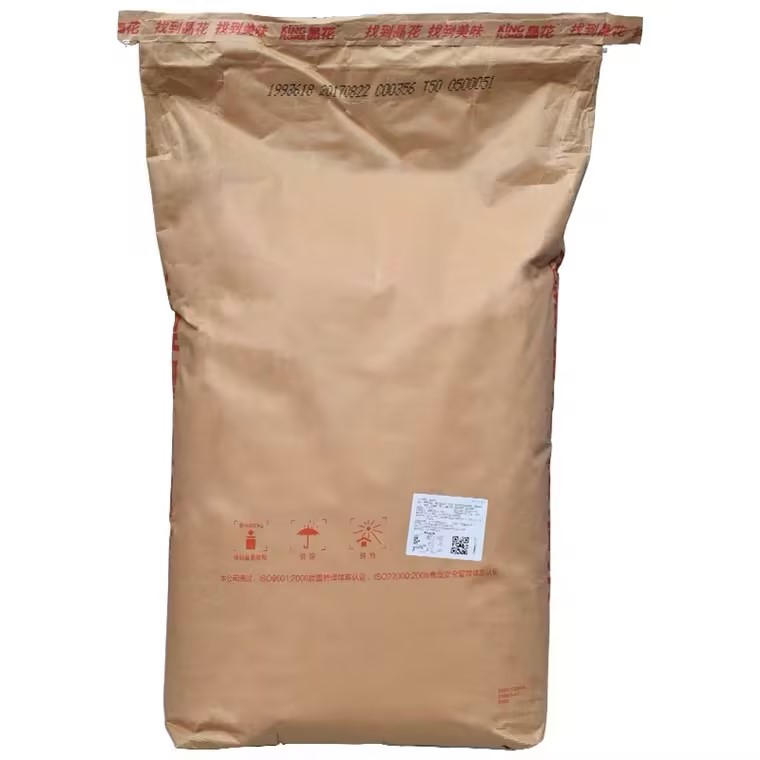
Packaging panel on a 25 kg non-dairy creamer bag. Importers should reconcile the label text with the specification sheet and the ingredient declaration before release.
Matching Creamer Categories to Dietary Qualification Schemes
Vegan and plant-based schemes
S35 is documented as a vegan non-dairy creamer with fat 35.0 g/100 g, trans fat 0 g and protein 0 g. Its stated applications include vegetarian products, alcoholic beverages, milk tea, coffee and baking. For a buyer qualifying a product under a vegan scheme, the two verifiable facts are the ingredient list (no milk-derived entries) and the 0 g/100 g protein declaration.
Sugar-reduction schemes
DT35 is documented as a low-sugar creamer with fat 35.0 g/100 g, protein 2.5 g/100 g and carbohydrate 4.3 g/100 g, with stated applications in milk tea, coffee, beverage and baking. The carbohydrate figure is the number a nutrition reviewer will work from; it should be requested as a specification line rather than inferred from the model name.
Kosher schemes
The kosher K80 specification lists fat 32.0 g/100 g and protein 2.5 g/100 g. A kosher certificate numbered KC#529705-1 has been issued by KOSHER AUSTRALIA PTY LTD, referencing non-dairy creamer model K80 in 25 kg packaging, batch JW26558 with a production date of 20260311, and citing Australian and international kosher dietary compliance standards. The certificate carries an issue date of 22 March 2026 and an expiry of 1 April 2027.
Halal and quality-scheme alignment
At company level, the manufacturer states that it has passed multiple quality management and food safety system certifications, including ISO 9001, FSSC 22000, HACCP, HALAL, ISO 14000 and OHSAS 18000. Facility-level systems such as these support a buyer’s supplier approval file, but they answer a different question from product-level dietary qualification — a point developed in the next section.
Reading a Certificate Correctly: Issuer, Scope, Validity
A certificate is useful to an importer only when its scope is read to the end. The documents below illustrate why the four fields that matter are the issuing body, the named legal entity, the standard or scheme, and the validity window.
| Certificate | Number | Issuing body | Scope as stated | Issued | Expiry |
|---|---|---|---|---|---|
| Kosher certificate | KC#529705-1 | KOSHER AUSTRALIA PTY LTD | Non-dairy creamer model K80 (25 kg), batch JW26558, production date 20260311 | 2026-03-22 | 2027-04-01 |
| Quality Management System Certificate | 00125Q32624R1M/3200 | CQC | Quality Management System of Nantong Jiazhiwei Food Co., Ltd. — ISO 9001:2015 | 2025-04-24 | 2028-05-04 |
| ISO 9001:2015 Certificate (IQNET) | CN00125Q32624R1M/3200 | CQC | Quality Management System (Nantong Jiazhiwei Food Co., Ltd.) — ISO 9001:2015 | 2025-04-24 | 2028-05-04 |
| FSSC 22000 Food Safety System Certification | 162006008 | Intertek Certification Limited | Food Safety Management System (Nantong Jiazhiwei Food Co., Ltd.) — FSSC 22000 V6, ISO 22000:2018, ISO/TS 22002-1:2009 | 2025-07-03 | 2026-06-17 |
| U.S. FDA Food Facility Registration | 13348058524 | Registrar Corp | Food Facility Registration (Nantong Jiazhiwei Food Co., Ltd.) — FD&C Act as amended by the Bioterrorism Act of 2002 and FSMA | 2025-08-19 | 2026-12-31 |
Certificate fields as recorded in the supplier’s compliance file. Importers should verify the current status of each document at the time of purchase order, not at the time of first enquiry.
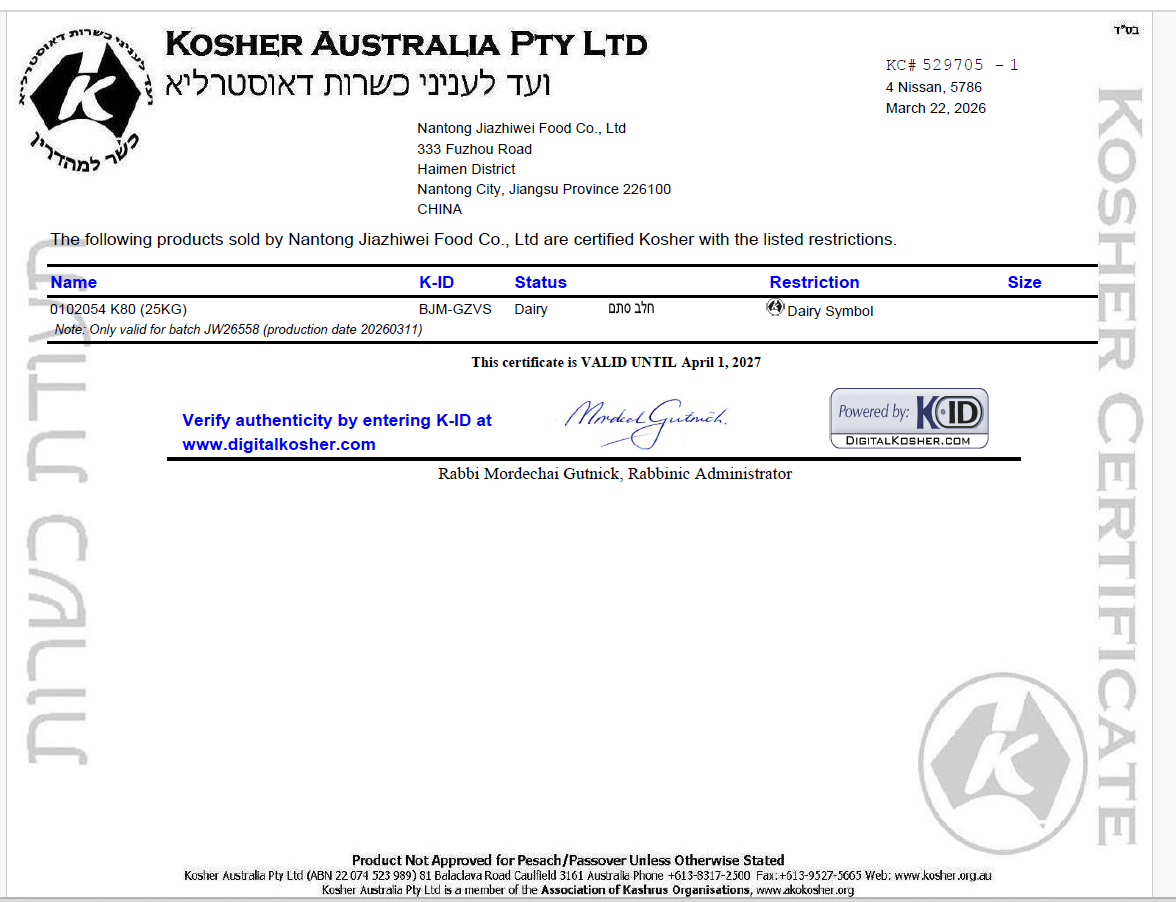
Kosher certificate KC#529705-1. Note the scope: it names one model, one pack size and one production batch, not the whole product range. That granularity is typical of kosher certification and is the reason batch traceability appears in import checklists.
How to Avoid Unsubstantiated Certification Language
Because certificate scopes are narrow, summary claims tend to overstate them. The following six questions filter most of that risk before a claim reaches a buyer’s own marketing material or a customs response.
- Does the certificate name the legal entity, or only a brand name that appears on the pack?
- Does it name a product model, pack size or batch — or only a facility and a management system?
- Which standard and which version is cited? FSSC 22000 V6 and ISO 22000:2018 are versioned documents.
- Who issued the certificate, and is that issuer recognised for the scheme in the destination market?
- What are the issue and expiry dates, and is the file current at the time of shipment?
- Does the certificate claim match the claim printed on the specification sheet and the pack?
The fourth and fifth questions catch a common timing failure. The FSSC 22000 certificate on file cites an expiry of 17 June 2026. An importer assembling a supplier file later in 2026 should request the current certificate rather than work from a historical PDF, even where the underlying facility has not changed. The same discipline applies to the FDA food facility registration recorded with an expiry of 31 December 2026, and to the kosher certificate expiry of 1 April 2027. Certification documents are time-bounded evidence; a compliance file is only as current as its oldest page.
Scope and validity are the two failure points. A certificate that is genuine, correctly issued and still valid can nevertheless be irrelevant to a specific shipment if the scope names a different model, pack size or site.
What the Documents Do Not Prove
Any credible verification framework has to state its own limits, and three apply here.
- A management-system certificate is not a product approval. ISO 9001:2015 and FSSC 22000 certifications are issued against the quality and food safety management systems of Nantong Jiazhiwei Food Co., Ltd. They provide evidence about how the facility is controlled. They do not certify that any individual creamer model complies with the labelling or additive rules of a specific importing country.
- FDA food facility registration is not a product registration. The certificate numbered 13348058524 confirms facility registration under the FD&C Act as amended by the Bioterrorism Act of 2002 and FSMA. Registration is a precondition for U.S. market entry; it is not a statement that a finished product meets U.S. labelling requirements.
- A specification value is a formulation statement, not a label. Figures such as 0 g/100 g trans fat, 0 g/100 g protein or a moisture threshold of ≤5.0 or ≤6.0 describe the product as manufactured. Converting them into a compliant label for a destination market remains the importer’s responsibility.
A buyer comparing suppliers against a general reputation benchmark will therefore find that a facility and a product answer different questions. The practical trade-off is review effort: a supplier with a narrow, well-documented scope costs more time to verify, while a broad, vaguely worded claim costs less time upfront and more time later.
Application Scenarios: What the Case Record Shows About Document Fit
The value of a compliance framework becomes visible when it is applied to real buyer types, because each one prioritises different documents.
| Buyer type | Markets served | Volume | Application | Relationship | Reported outcome |
|---|---|---|---|---|---|
| Bubble tea chain | Singapore, Vietnam, United States | 1,000 mt | Bubble tea shops | 3 years | Consistent quality, competitive pricing |
| 3-in-1 coffee manufacturer | Singapore, Malaysia, Indonesia, Philippines, Kazakhstan, UAE, Ukraine, Russia | 9,000 mt | Instant coffee, instant oatmeal, instant milk tea | 5 years | Consistent quality, good pricing |
| Beverage production factory | South Africa | 1,000 mt | Alcoholic beverages | 5 years | Steady sales, good reputation |
| Animal feed production plant | Singapore | 4,000–5,000 mt/year | Animal feed | 3 years | Consistent quality, good pricing |
Buyer scenarios as recorded by the manufacturer. Each scenario implies a different document emphasis: label and nutrient review for beverage and instant-drink buyers; ingredient and specification review for feed buyers.
The eight-market instant-drink case is the clearest illustration of why a single compliance file rarely covers every destination. A 3-in-1 coffee or instant milk tea manufacturer selling into Southeast Asia, the Middle East and Eastern Europe faces several labelling regimes from one formulation, and the specification sheet becomes the shared source document from which each market’s reviewer works. The animal feed case shows the opposite pattern: the buyer’s priorities concentrate on high-fat functionality and consistency of supply, with the 60A high-fat model (fat 60.0 g/100 g, protein 3.0 g/100 g, trans fat 0 g/100 g) recorded as the relevant product.
Market Context: Why Compliance Review Is Getting More Attention
Compliance workload is rising in proportion to category growth. The global non-dairy creamer market was valued at USD 2.4 billion in 2024 and is projected to reach USD 4.4 billion by 2034, according to Future Market Insights. Within that total, powdered non-dairy creamers held a 68.4% share in 2024, a position attributed to long shelf life and ease of storage, while coffee applications accounted for approximately 41% of global utilisation. Medium-fat variants in the 21–50% range were the most widely used type, holding a share of roughly 43.6% to 46% on the basis of balanced texture and flavour performance.
Adjacent categories show the same direction. The global MCT powder market was valued at USD 585 million in 2024, growing at a CAGR of 5.7%, per Intel Market Research. For importers, a growing and increasingly segmented category means more model-level variation — and more model-level variation means more specification sheets and certificate scopes to reconcile.
One caveat is worth recording for buyers who benchmark market data. Published estimates diverge by scope: Future Market Insights cites USD 2.4 billion for the non-dairy creamer market in 2024, while Grand View Research cites USD 4.95 billion for the broader coffee creamer market in the same year. The gap reflects definition, not contradiction. Buyers using market data in an internal business case should state which definition they are using, because a supplier’s addressable volume depends on it.
The competitive landscape is also concentrated among established food groups, with Nestlé (Coffee-Mate), Danone (Silk), FrieslandCampina Kievit and Kerry Group identified among the notable global players. Consolidation at the branded end of the market tends to push private-label and industrial buyers toward manufacturers whose value lies in documentation, formulation flexibility and batch traceability rather than in consumer brand equity.
Supplier Capability Behind the Documents
Documentation is only as good as the production system that generates it. Jiahe Foods Industry Co., Ltd. reports a factory area of 77,333.33 m², 310 employees and a research and development team of 22 engineers, with annual output capacity including 200,000 tons of starch sugar and 200,000 tons of non-dairy creamer, alongside solid beverage, liquid milk and flavoured syrup packaging capacity. Export accounts for approximately 50% of business, with Southeast Asia as the main market.
On the production side, the manufacturer offers OEM, ODM and customised production services. Documented customisation options include syrup DE value, creamer formula, packaging specification and product flavour. Monthly capacity is stated at 16,700 tons of creamer, with lead time of around 7–15 working days after order confirmation and an MOQ that is negotiable based on product type and packaging. Quality control is described as full-process inspection with 100% metal and weight checks plus third-party testing, and after-sales support covers technical guidance, quality tracking and customisation adjustment.
For an importer in the evaluation-to-execution stage, these are the facts that connect a specification sheet to a repeatable supply. A customised formula is only useful if the specification sheet, the batch record and the certificate scope stay aligned across shipments — which is why buyers increasingly write document-currency requirements into supply agreements rather than treating them as a one-time onboarding step.
Future Outlook
Three directions are likely to shape creamer compliance work over the next several years. First, trans-fat and nutrition labelling scrutiny continues to tighten across major importing regions, which places more weight on specification sheets as the primary evidence document and less on summary claims. Second, demand for plant-based and sugar-reduced formulations is expanding the number of qualification schemes a single supplier range must satisfy, increasing the value of clearly separated model-level documentation — a range that already spans vegan, low-sugar, foaming, whipping, high-fat and cold-soluble types illustrates how this plays out in practice. Third, as the category grows toward the projected USD 4.4 billion by 2034, the practical bottleneck for importers is unlikely to be product availability; it will be the speed at which a buyer can assemble a defensible, current and correctly scoped compliance file for each destination market.
Frequently Asked Questions
Does a “non-dairy creamer” label mean the product contains no milk-derived ingredients?
No. Under the FDA position, a product containing a milk derivative such as sodium caseinate may carry the term “non-dairy” provided the derivative is declared as “a milk derivative”. Under kosher rules applied by OU Kosher, a creamer described as non-dairy but containing sodium caseinate is treated as Dairy. The ingredient declaration, not the front-of-pack term, is the document that answers the question.
How should an importer verify a trans-fat value of 0 g per 100 g?
Request the figure as a written specification line for the specific model being purchased. Within the Cograin range, 0 g/100 g trans fat is stated for FC22, K60, 60A and S35. The K80 specification sheet lists fat at 32.0 g/100 g and protein at 2.5 g/100 g without a trans-fat value, so that figure should be requested separately rather than assumed from another model. A per-100 g formulation figure also has to be converted by the label reviewer according to the destination market’s serving and rounding rules.
What do moisture thresholds of ≤5.0% and ≤6.0% indicate in a creamer specification?
They indicate the maximum moisture content the product is specified to carry, which relates to flowability, resistance to caking during storage and transport, and dispersion behaviour in the customer’s process. In this range, K60 and the cold-soluble creamer are stated at ≤5.0 (the cold-soluble model as ≤5.0 g/100 g), while FC22 and C960 are stated at ≤6.0. Lower is not automatically better; the appropriate threshold depends on the intended application.
How do vegan, low-sugar and kosher qualification schemes apply to the same non-dairy creamer range?
Each scheme draws on different documented facts. For vegan qualification, S35 lists no milk-derived ingredient and declares protein at 0 g/100 g. For sugar-reduction schemes, DT35 declares carbohydrate at 4.3 g/100 g alongside fat 35.0 g/100 g and protein 2.5 g/100 g. For kosher, certificate KC#529705-1 issued by KOSHER AUSTRALIA PTY LTD covers non-dairy creamer model K80 in 25 kg packaging, batch JW26558, production date 20260311, valid from 22 March 2026 to 1 April 2027. The schemes are not interchangeable and each is evidenced by a different document.
What should be checked in a supplier compliance file before a first shipment?
Six checks cover most risk: whether the certificate names the legal entity rather than only a brand; whether it names a model, pack size or batch rather than only a facility; which standard and version is cited; who issued it and whether that issuer is recognised for the scheme in the destination market; whether the file is current; and whether the certificate claim matches the specification sheet and the proposed pack text. As an illustration of the validity check, the FSSC 22000 certificate on file cites an expiry of 17 June 2026 and the FDA food facility registration cites an expiry of 31 December 2026, so a buyer reviewing the file later in 2026 should request reissued documents rather than rely on historical PDFs.
Reference Document
The manufacturer’s product and capability brochure, covering the creamer range, specifications and facility information discussed in this article, is available for reference and download: 2025 Cograin Brochure. Company information is published at cograin.cn.