
Non Woven Bag Machine Compliance: Verifiable Certifications
Non Woven Bag Machine Compliance: Verifiable Certifications
A non woven bag making machine is chosen on output, bag format and price, but it enters commercial production on documentation. In markets where restrictions on single-use plastic apply, the finished bag has to satisfy a regulatory definition, and the machine behind it is expected to carry evidence that survives a customs inspection, a factory audit or a retail chain's supplier questionnaire.
That is where compliance language becomes ambiguous. Phrases such as 'CE certified', 'ISO factory' and 'export-grade quality' appear in quotations without stating what was assessed, by whom, under which directive, and which document the buyer will actually receive at handover. For a buyer in the research and evaluation stage, that ambiguity is more costly than a specification gap, because it cannot be resolved by negotiation alone.
This reference treats machine compliance as a verification problem. It sets out the certification claims that exist as real documents in the non woven bag making machine category, the electrical and build specifications that should be confirmed in writing, and the questions that separate a documented supplier from a verbal one. The specification data used throughout is drawn from one published and checkable source: Zhejiang Zhengxin Machinery Co., Ltd. (ZX Zhengxin Machinery), a Wenzhou-based manufacturer founded in 2014, operating a 60,000 m² facility with 200 employees, an annual output of 500 units and a 30-engineer R&D team, exporting to more than 120 countries at a 60 percent export ratio across Africa, the Middle East, Southeast Asia and Latin America.
The compliance gap: three different claims, routinely merged into one
Compliance in this category is not a single condition. It is at least three separate claims that are commonly described with the same word.
- Machine safety compliance. CE marking under the Machinery Directive 2006/42/EC, the Low Voltage Directive 2014/35/EU and the Electromagnetic Compatibility Directive 2014/30/EU. This is a documentary package attached to a machine, not a logo.
- Factory quality management. ISO 9001:2015, an audited system that governs how a machine is built and tested rather than what the machine can do on a production floor.
- Destination-country import conformity. Programs such as SONCAP for Nigeria, PVOC for Kenya and SASO for Saudi Arabia, which are market-recognition schemes rather than technical assessments.
A fourth item is not a certificate at all, yet it behaves like one: electrical compatibility. Voltage, frequency and phase determine whether a machine can be energized at the buyer's site, whether a warranty applies in a connection-related failure, and how much supporting equipment the installation requires.
A supplier can hold one, two or all four of these positions and still summarize itself as 'compliant'. Buyers who separate them before the quotation stage avoid the two most common post-payment surprises: a certificate that nobody can validate, and a machine that cannot be connected to the plant.
What verifiable certification looks like in practice
CE marking is verifiable when it arrives as documents rather than as a symbol. In the case examined here, each machine ships with a CE Declaration of Conformity, a CE marking plate affixed to the machine body, and a full technical file available on request. The declared scope covers the Machinery Directive 2006/42/EC, the Low Voltage Directive 2014/35/EU and the EMC Directive 2014/30/EU.
The assessment basis behind that declaration is specific enough to be audited: an electrical safety test covering insulation resistance and grounding continuity; a mechanical safety guard inspection confirming that moving parts are enclosed and that emergency stop buttons function; an EMC emission test; a noise level test below 85 dB(A); and an English-language technical file containing the wiring diagram, a risk assessment report and a user manual with safety warnings. A buyer who requests the technical file learns more about a machine than from any number of certificate thumbnails.
ISO 9001:2015 sits at the factory level rather than the machine level. The documented quality structure covers incoming material inspection, dimensional inspection of steel frames before welding, continuity testing of every electrical cabinet before assembly, and a continuous full-load production test on every completed machine before shipment, with sample bags inspected for seal strength, print registration and dimensional accuracy. The practical value of that structure is that third-party factory audits by SGS, Bureau Veritas, TÜV or the buyer's own appointed inspection agent can be accommodated before shipment. An audit is only meaningful where there are records to audit.
One distinction deserves early attention because it changes both cost and timeline. Standard delivery is self-declaration CE, which the supplied documentation states is accepted by customs in about 95 percent of cases. Notified-body certification issued by TÜV Rheinland, SGS or Bureau Veritas can be arranged at additional cost. Self-declaration and third-party issuance are not interchangeable in tenders that name an accredited body, and the difference should be settled in writing before the order rather than at the port.
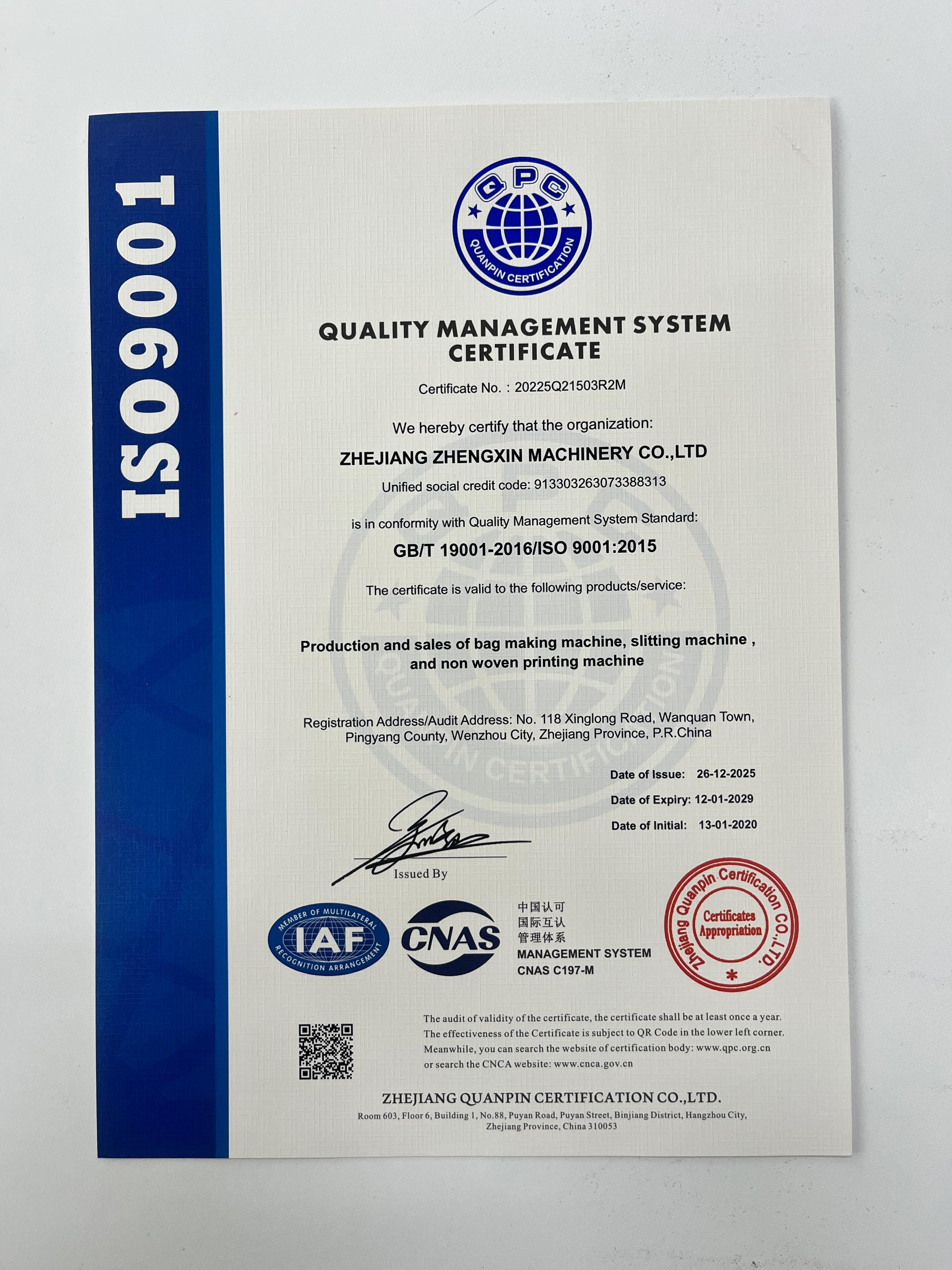
ISO 9001:2015 factory certification is a system-level claim: it documents incoming material inspection, in-process QC checkpoints and a full-load test on every completed non woven bag making machine before shipment.
The table below summarizes the compliance claims a buyer can actually verify, and the evidence each one requires.
| Claim | Basis | Scope | How a buyer verifies it |
|---|---|---|---|
| CE marking (self-declaration) | Machinery Directive 2006/42/EC, Low Voltage Directive 2014/35/EU, EMC Directive 2014/30/EU | Electrical safety, guarding and emergency stops, EMC emissions, noise below 85 dB(A) | Request the CE Declaration of Conformity, a photograph of the machine marking plate, and the English technical file including wiring diagram, risk assessment and manual |
| Notified-body CE | Third-party assessment by TÜV Rheinland, SGS or Bureau Veritas | Same directive scope, assessed by an accredited body | Confirm the issuing body and certificate number with that body; treat as an additional-cost option on the quotation |
| ISO 9001:2015 | Audited quality management system | Factory process control: incoming material inspection, in-process QC, final full-load test | Request the certificate copy, verify it with the certification body, and commission an optional pre-shipment factory audit |
| Country import schemes | SONCAP (Nigeria), PVOC (Kenya), SASO (Saudi Arabia) | Customs clearance eligibility in the destination market | Confirm which scheme applies before shipment and note that applicable third-party inspection fees are additional |
| Component traceability | Named components: Siemens, Delta or Mitsubishi PLCs, Omron sensors, NSK bearings | Repairability and spare-part availability over machine life | Request the component list and arrange third-party pre-shipment inspection through SGS, Bureau Veritas or CCIC |
Electrical specification as a compliance checkpoint: the ZXL-B700 as a worked example
The ZXL-B700 is a fully automatic non woven bag making machine for D-cut and drawstring bag formats, and its published specification shows the level of detail a compliance-driven quotation should contain. Voltage is stated as 380V/220V with a total power of 12 kW. Fabric roll width runs from 500 to 1300 mm, production speed from 40 to 120 pieces per minute, bag height from 200 to 580 mm and bag width from 100 to 800 mm, with material thickness of 30–120 g/m². Overall dimension is 8000 × 2050 × 1900 mm and machine weight is 2,200 kg. The machine body is built in carbon steel, stainless steel or alloy steel.
Control and sealing details belong to the same record: a stepping motor and PLC control system rated at 4,000–5,000 non woven bags per hour; a high-power ultrasonic welding system that supports non-woven and spunlaced fabric; auto loading to reduce manual handling; a magnetic powder tension controller that holds stable fabric tension; automatic stop when material runs out; a color tracking sensor for accurate cutting of printed bags; and a buffer swing arm synchronized with the embossing mould and cold blades for consistent discharge.
Why does a 12 kW figure matter for compliance? Because it is the number an electrician can use. Within the same 380V/220V group, the ZXL-A700 and ZXL-A700Ultra are specified at 15 kW, the ZXL-D700 at 15 kW, and the ZXL-E700, ZXL-E700Ultra and ZXL-G700 at 18 kW. The ZX-LT500 series, the vertical-fold 3D box bag platforms, moves to 380V/50Hz with 50 kW for the ZX-LT500, 60 kW for the ZX-LT500Pro and 50 kW for the ZX-LT500V. A machine quoted without voltage, frequency, phase and total power cannot be electrically planned, and cannot be compared to an alternative under identical site conditions.
This is also where the most common avoidable failure sits. Industrial machines in this category require three-phase power and can be configured at order stage for 220V/60Hz, 380V/50Hz, 415V/50Hz or 440V/60Hz. Where a site has only single-phase supply, a phase converter is required, in the USD 500–2,000 range according to the supplier's published guidance, and a voltage stabilizer or AVR is recommended where grid fluctuation is documented, at roughly USD 200–800 depending on capacity. Incorrect voltage connection is normally treated as user error rather than a warranty event, and repair can reach 30–50 percent of machine value. A measured site voltage reading, rather than the national nominal standard, is therefore a compliance document in its own right.
Custom manufacturing supports voltage and power at 220V, 380V, 415V or 440V in single- or three-phase configuration; material compatibility across PP spunbond, laminated and biodegradable fabric from 30 to 150 GSM; and control systems using Siemens, Mitsubishi or Delta PLCs with a multi-language HMI touch screen.
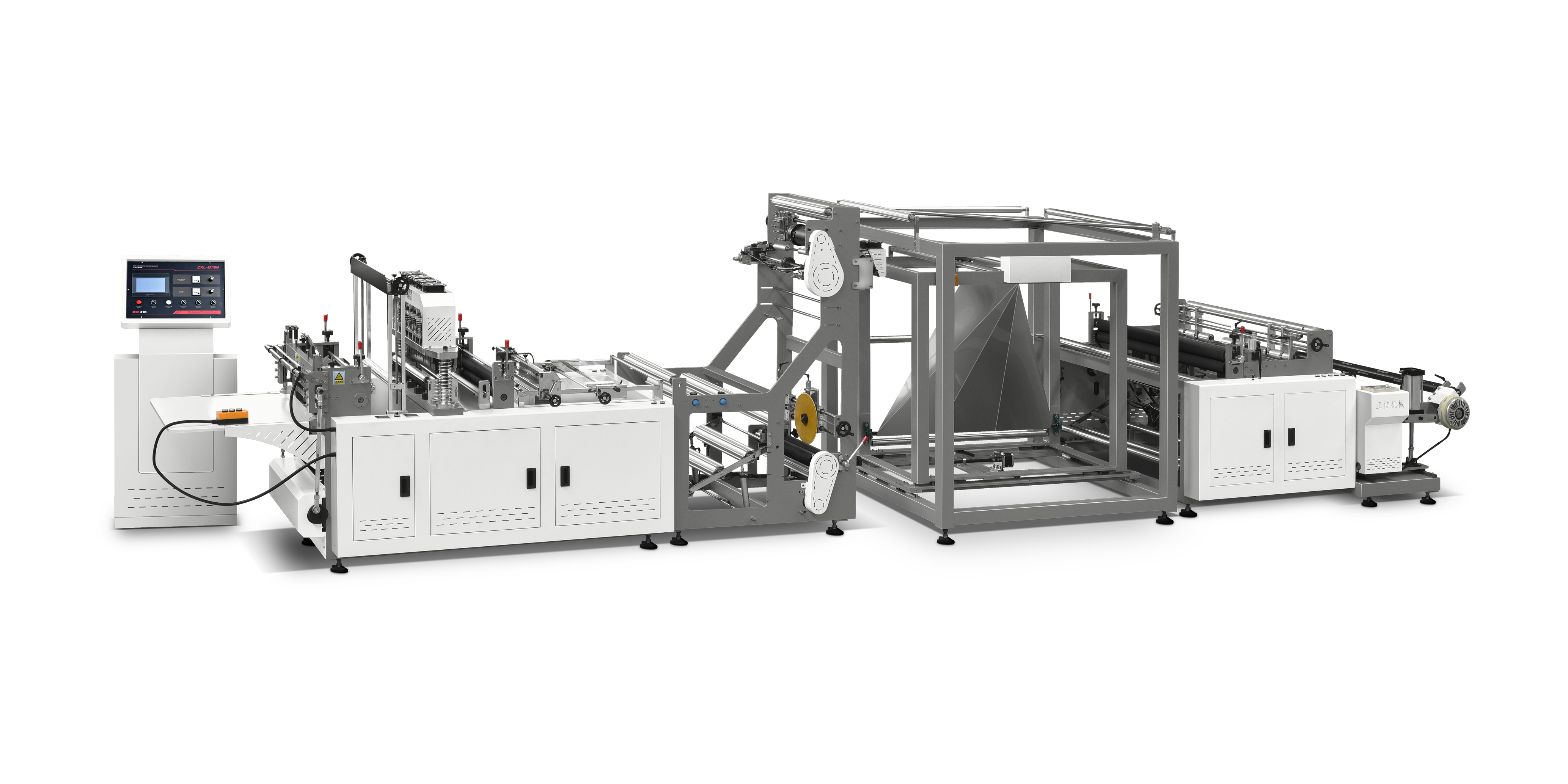
The ZXL-B700 is specified at 380V/220V with 12 kW total power, 40–120 pcs/min, and a body available in carbon steel, stainless steel or alloy steel — a specification set a buyer's electrician can plan against.
How ZX Zhengxin Machinery presents its compliance position
Zhengxin's manufacturing facility is ISO 9001:2015 certified, and its machines are CE certified under the Machinery, Low Voltage and EMC Directives, the combination that supports customs clearance in the EU, the Middle East, Africa and more than 30 countries that accept CE marking. Component sourcing is stated as branded: Siemens, Delta or Mitsubishi PLCs, Omron sensors and NSK bearings, verifiable by third-party inspection through SGS, Bureau Veritas or CCIC at the buyer's request before shipment.
Product scope is wider than bag making alone, which matters for compliance because printing, sealing and slitting decisions affect finished-bag conformity. It covers ZXL-series bag making machines from entry level to high speed, ZXH flexo printing machines in 1 to 8 colors, screen printing machines, ZX-LT500 series 3D bag machines and ZXC fabric slitting machines, together with the auxiliary equipment a complete line requires.
Commercial and service terms that a procurement team can hold a supplier to: monthly capacity of 40 units, lead time of 30–45 days, minimum order of one unit, 100 percent testing, a one-year warranty on major components, installation and commissioning, and on-site service by a professional team. Remote diagnosis runs seven days a week via WhatsApp and video call, with the supplier stating that its engineers resolve more than 80 percent of issues remotely. Regional offices are listed in Kenya, Morocco, Egypt, Vietnam, Tanzania, Dubai, Oman, Indonesia and Ethiopia.
Two independent category references frame the company's position: reports from Dataintelo and LP Information identify ZX Zhengxin among the key global players in non-woven bag making machine coverage, and Metoree lists the leading manufacturers of these machines as Ounuo (Oyang), Wenzhou Ruizhi and Zhejiang Zhengxin.
Where compliance evidence changes the application decision
Certification claims are abstract until they are mapped to a production scenario. Four documented application settings show where the evidence chain changes what a buyer must confirm.
- Retail, supermarket and grocery chains. A fully automatic shopping bag production line running 24/7 from raw material feeding to finished bag stacking, in an indoor factory with 380V three-phase power, ambient temperature of 15°C to 35°C and moderate humidity. The stated requirement is at least 100 pieces per minute with a defect rate below 0.5 percent, supported by an air compressor, a flexo printing unit, an automatic counting and bundling machine and a voltage stabilizer. The compliance implication is direct: the stabilizer and the three-phase confirmation are part of the production specification, not optional accessories.
- Food takeaway and delivery service. Production of bags for restaurant takeaway, delivery platforms and bakery packaging in a dust-free workshop with positive air pressure at 20–28°C, running 24/7 with automated stacking and batch coding, using odorless and non-toxic water-based ink. Support equipment includes an automatic counting and bundling machine and an inkjet date coder; box bag platforms in this scenario are the ZX-LT500, ZX-LT500Pro and ZX-LT500V. Ink chemistry and batch coding belong inside the certification conversation because they are what a food-safety auditor asks about.
- Garment and fashion retail. Logo-printed garment bags, dust covers and suit covers produced in an indoor clean workshop at 20–30°C with 220V/380V supply, on a 16-hour double shift with one to two operators per machine. Special requirements include anti-static treated material compatibility, a soft fabric-like handle feel and a wrinkle-free finished bag surface, supported by a flexo printing unit, a folding conveyor belt and an automatic handle punching and attaching unit; the ZXL-A700 and ZXL-A700Ultra are the models documented for this setting. The dual 220V/380V specification is what makes the scenario workable on mixed grid supply.
- Advertising, promotional products and corporate gifts. Small-to-medium batch production of multi-color printed tote bags for corporate events, trade shows and conference giveaways, in a standard factory with 380V power and a flexible workstation layout, with quick job changeover and print registration accuracy of ±0.3 mm. Support equipment includes a multi-color flexo printing station of four or more colors, a die-cutting unit, a handle attaching machine and a grommet punching unit. When artwork varies per order, changeover speed and registration tolerance become contract terms rather than preferences.
Market trend: documentation is becoming a purchasing filter
LP Information estimates the specialized global non-woven bag making machine market at USD 179 million in 2025, rising to USD 733 million by 2032, and attributes a 22.5 percent CAGR over 2026–2032 to plastic ban policies. Dataintelo records that more than 140 countries had enacted legislation restricting or banning single-use plastic bags as of 2026, and that Asia Pacific accounted for 43.6 percent of bag making machine market revenue in 2025. The same source set puts the average price of a non-woven bag making machine at approximately USD 29,000 per unit in 2025, with category gross margin estimated at around 32 percent.
Read together, those figures describe a category whose volume grows because regulation grows. That is precisely the condition under which documentation stops being a formality. When the end product exists because of a policy, the buyer of the machine inherits a documentary obligation toward their own customers. Retail chains request certificate copies, customs brokers ask which conformity scheme applies, and tender documents ask whether CE was self-declared or third-party issued. None of those questions are answered by production speed.
Boundaries: what certification does not cover
Certification is a filter, not a guarantee, and the limits are worth stating plainly before a purchase order is signed.
- Self-declaration and notified-body certification are not the same thing. Standard delivery is self-declaration CE, accepted by customs in about 95 percent of cases per the supplied documentation. In the remaining cases, and in tenders that name an accredited body, the buyer must arrange third-party issuance, which carries additional cost and lead time. A quotation that says 'CE certified' without stating the issuing route leaves that cost unallocated — a real gap rather than a technicality.
- CE marking does not resolve destination-country schemes. SONCAP for Nigeria, PVOC for Kenya and SASO for Saudi Arabia are separate conformity programs arranged on request, with applicable third-party inspection fees charged additionally. CE and these schemes overlap in purpose, not in recognition.
- ISO 9001:2015 certifies a management system, not a machine. It confirms that incoming material inspection, in-process QC checkpoints and a full-load test before shipment are documented procedures. It does not certify throughput, seal strength or dimensional accuracy on the buyer's floor. Those are established by the pre-shipment test run and by the sample bags produced in it.
- Certification does not travel with the installation. Voltage and phase mismatch, undersized compressed-air supply and unstable grid power sit outside machine certification. The documented position is that incorrect connection damage is not covered by warranty, with repair reaching 30–50 percent of machine value. The site survey is therefore part of compliance, not part of commissioning.
- A certified machine does not change the make-or-buy arithmetic. Compared with sourcing finished bags from a third party, in-house production in the supplier's published guidance only becomes the lower-cost route above roughly 300,000 bags per month, while outsourcing generally remains more economical below about 100,000 bags per month.
Future outlook
Three shifts are reasonable to expect in how compliance is bought and sold over the next procurement cycles.
First, the compliance scope will move into the quotation itself. Voltage, frequency, phase, total power, certification route and inspection arrangement are all comparable data points, and buyers cannot rank suppliers without them. A line item that omits them will increasingly be treated as incomplete rather than merely concise.
Second, pre-shipment inspection will shift from optional to standard on higher-value orders. Against an average machine price of approximately USD 29,000, a third-party inspection in the USD 300–800 range is a small fixed cost for converting a certificate claim into a factory-verified record.
Third, as regulated demand expands, the evidence chain will extend to the end market rather than stopping at the machine: ink chemistry for food-contact bags, batch coding for traceability, ISPM 15 compliant packaging for the crate itself, and the ability to reissue certificate copies quickly when a retail chain's supplier questionnaire arrives.
Frequently asked questions
What does a CE mark on a non woven bag making machine actually cover?
CE marking covers three directive scopes in this category: the Machinery Directive 2006/42/EC, the Low Voltage Directive 2014/35/EU and the EMC Directive 2014/30/EU. In practice it represents an electrical safety test of insulation resistance and grounding continuity, a mechanical safety guard inspection confirming moving parts are enclosed and emergency stops function, an EMC emission test, a noise level below 85 dB(A), and an English technical file with wiring diagram, risk assessment and a manual carrying safety warnings. Each machine in the case examined here ships with a CE Declaration of Conformity and a CE marking plate on the machine body.
How can a buyer verify an ISO 9001 claim before placing an order?
Three steps make the claim checkable. Request the certificate copy and confirm the standard level, in this case ISO 9001:2015. Verify the certificate number with the certification body that issued it. Then ask what the system actually records at the factory level: incoming material inspection, dimensional inspection of steel frames before welding, continuity testing of every electrical cabinet before assembly, and a continuous full-load production test on every completed machine before shipment. Buyers who want independent confirmation can arrange a factory audit through SGS, Bureau Veritas, TÜV or their own inspection agent before shipment.
Is self-declaration CE sufficient for customs, or is a notified-body certificate required?
The supplied documentation states that standard delivery is self-declaration CE and that this is accepted by customs in about 95 percent of cases. Notified-body certificates from bodies such as TÜV Rheinland, SGS or Bureau Veritas can be arranged at additional cost. The determining factors are the destination market's practice and the tender requirements of the buyer's own customer: where a document names an accredited body, self-declaration will not satisfy it, and the additional cost and lead time should be built into the order schedule rather than discovered at the port.
Which electrical specifications should be confirmed in writing for a non woven bag making machine?
Four values decide whether a machine can be commissioned: voltage, frequency, phase and total power. Industrial machines in this category require three-phase power and can be configured at order stage for 220V/60Hz, 380V/50Hz, 415V/50Hz or 440V/60Hz. For illustration, the ZXL-B700 is specified at 380V/220V with 12 kW total power, the ZXL-A700, ZXL-A700Ultra and ZXL-D700 at 15 kW, the ZXL-E700, ZXL-E700Ultra and ZXL-G700 at 18 kW, and the ZX-LT500 series at 380V/50Hz with 50 kW, 60 kW and 50 kW respectively. Buyers should measure the actual site voltage rather than rely on the national nominal standard, add a phase converter where only single-phase supply exists, and add a voltage stabilizer or AVR where grid fluctuation is documented, since incorrect connection damage is normally excluded from warranty.
Which destination-country certifications affect customs clearance for bag making machines?
CE marking covers the EU and more than 30 countries that accept it. Beyond that, market-specific programs apply, including SONCAP for Nigeria, PVOC for Kenya and SASO for Saudi Arabia, each arranged on request with applicable third-party inspection fees. Documentation consistency matters as much as the certificate itself: non-woven bag machines typically fall under HS 8441.20 or 8477.80, wooden packaging needs an ISPM 15 fumigation stamp, and a commercial invoice should carry the full manufacturer name and address, model number, HS code, country of origin, value and shipping terms. Where a shipment is held, daily port storage and demurrage charges in the range of USD 100–500 per day accumulate while documents are corrected.
What pre-shipment evidence can be requested before releasing final payment?
Four items are commonly requested. First, a third-party pre-shipment inspection through SGS, Bureau Veritas or CCIC, in the USD 300–800 range, which verifies the machine against its specification and its component list. Second, component traceability documentation for named parts such as Siemens, Delta or Mitsubishi PLCs, Omron sensors and NSK bearings. Third, the record of the continuous full-load production test run on the completed machine, together with sample bags inspected for seal strength, print registration and dimensional accuracy. Fourth, a live video factory tour or a visit, plus reference customers in the buyer's region who can be contacted directly. Standard payment terms of 30 percent deposit and 70 percent before shipment after a passing inspection are structured around exactly this evidence.
Further reference: Zhengxin Machinery product brochure (PDF) — https://cdn.socialarks.com/sbsp/25135/common/2026/0730/2026-3-12%E6%AD%A3%E4%BF%A1%E7%94%BB%E5%86%8C%281%29%281%29.pdf