
Non Woven Bag Printing Machine: 4 Supplier Types Compared
Non Woven Bag Printing Machine: 4 Supplier Types Compared
A non woven bag printing machine is the unit that turns plain PP spunbond fabric into branded packaging: it unwinds the roll, applies ink through a flexographic plate or a screen, dries the printed surface, and rewinds fabric that then feeds a bag making machine. The same search term is answered by four structurally different businesses — unbranded small workshops, used-equipment dealers, major Chinese brands such as Oyang, Allwell and Ounuo, and CE/ISO-certified direct factory brands. The machine on the quotation often looks comparable; the certification, warranty and service structure behind it does not.
This independent reference compares those four supplier types against the criteria that decide a three-year production outcome: market access and certification, warranty coverage, customization turnaround, spare-parts latency and total cost. It is written for importers, distributors, brand owners and procurement managers working through the research and evaluation stage, and it states the limits of every option — including the certified-factory option.
The Buyer Problem: One Search Term, Four Different Businesses
Most first-time importers compare specifications first — printing width, colour count, running speed. Those figures matter, but they are the part of the comparison where the four supplier types look most alike. The differences appear after shipment: whether the documents clear customs, whether a failed sensor arrives in three days or five weeks, and whether the supplier can reproduce a machine configuration when the second production line is ordered.
Market data explains why the category is crowded. LP Information projects the global non-woven bag making machine market growing from USD 179 million in 2025 to USD 733 million by 2032, a CAGR of 22.5% from 2026 to 2032. Dataintelo places the automatic segment at 52.4% of the bag making machine market in 2025, with Asia-Pacific holding a 43.6% revenue share in the same year. The average price of an automated non-woven bag making machine was approximately USD 29,000 in 2025, according to LP Information — and printing equipment is usually quoted as a separate line item, which is why supplier-type choice has a direct budget consequence.
Three variables drive the decision: how much unplanned downtime the buyer's order book can absorb, whether the destination market requires CE marking or a national conformity scheme at import, and what the three-year total cost looks like once spares, freight and customs documentation are included.
What a Non Woven Bag Printing Machine Actually Does in a Line
In a roll-to-roll configuration the printing machine sits upstream of the bag making machine. Fabric is unwound under controlled tension, ink is transferred by an anilox roller to a flexographic plate or pushed through a screen mesh, the printed surface passes through a drying section, and the fabric is rewound as a printed roll. The bag making machine then cuts, seals and attaches handles in one continuous flow — which means a printing defect becomes a finished-bag defect, not a printing-station problem.
Registration, the alignment between printed artwork and the cut, is the quality variable that decides whether a printed roll is usable. A photocell reads a printed eye mark as the fabric moves; the PLC calculates the delay between mark detection and the cutting or sealing action from the known mark-to-cut distance and the current line speed. Registration stability therefore depends on three shop-floor conditions rather than on the printing method itself: clean optics, consistent registration-mark print quality, and stable fabric tension. Faded marks, dust on the lens or tension variation shift the cut relative to the logo, and the error compounds as line speed rises.
Configuration language maps to measurable differences in capacity, footprint and power draw:
- Two-colour flexo (ZXH-C21200): max fabric roll width 1,200 mm, max printing width 1,160 mm, printing length 250–1,000 mm, plate thickness 2.28/3.94 mm, printing speed 10–60 m/min, 380 V, total power 8 kW, 3,500 × 2,200 × 2,200 mm, 1,500 kg.
- Four-colour flexo (ZXH-C41200): the same 1,200 mm roll width and 1,160 mm printing width, printing length 220–1,000 mm, 10–60 m/min, 380 V, total power 18 kW, 4,600 × 2,200 × 2,400 mm, 3,000 kg.
- One-colour screen (ZXH-A1200): max printing size 1,100 × 1,200 mm, continuous or intermittent printing, 30 m of fabric in the drying oven, material thickness 60–150 g/m², printing speed 1,500–4,000 m/hour, 380 V/50 Hz, total power 26 kW, 4,800 kg.
- Two-colour screen (ZXH-B1200): two colours are applied in a single pass by running two units together; rated 1,500–3,000 m/hour on 70–150 g/m² material, 380 V, total power 52 kW, 9,600 kg.
The energy and floor-space consequences follow directly. A compact two-colour flexo draws 8 kW on a roughly 3.5 m footprint; a two-unit screen configuration draws 52 kW and occupies substantially more space. For a buyer calculating cost per printed metre across three years, the power rating belongs in the specification alongside the colour count. Zhengxin's customization documentation lists flexo configurations from one to six colours, single-side or double-side, with voltage and frequency options of 220 V, 380 V, 415 V or 440 V in single-phase or three-phase supply.
Four Supplier Types, Four Risk Profiles
| Supplier type | Certification and documentation | Warranty | Customization response | Principal trade-off |
|---|---|---|---|---|
| Unbranded small workshop | Certification frequently not verifiable; documentation limited | Typically none or undefined | Fast on standard builds; changes often agreed verbally | Lowest upfront price; highest compliance, spare-parts and downtime risk |
| Used / second-hand machine | Inherits the original build; may predate current directive requirements | None | Not applicable — changes come from local fabrication | 50–70% lower upfront cost; typically 70–80% uptime on machines over three years old |
| Major Chinese brand (e.g. Oyang, Allwell, Ounuo) | CE / ISO on established product lines | Per brand terms | 7–14 days, routed through layered processes | Wider catalogue and scale; higher minimum order requirements; dealer-routed after-sales |
| CE/ISO direct factory brand (e.g. Zhengxin) | CE Declaration of Conformity (Machinery, Low Voltage, EMC) plus ISO 9001:2015 factory certificate | 12 months on major components | 3–5 days through in-house engineering | Stated 10–15% lower price at equivalent configuration; 25–45 day production lead time; consumables excluded from warranty |
Figures in the major-brand and direct-factory rows come from the direct factory's own comparison record. They describe structural differences, and buyers should still re-test them against their own quotations.
Type 1 — Unbranded small workshops
This category is defined by the absence of a verifiable quality system rather than by geography. Buyers should expect limited English documentation, certificates that may not survive verification with the issuing body, and electrical components with no traceable supply chain. The trade-off is genuine: for a single-colour job in a market with no import conformity requirement, a workshop build can be the lowest-cost way to begin. It becomes the wrong choice the moment the destination country requires CE at import, or the moment a supermarket client audits the supplier's process documentation.
Type 2 — Used and second-hand machines
Used printing machines are commonly quoted at 50–70% below new price. In Zhengxin's own buyer-risk documentation, machines more than three years old are described as averaging 70–80% uptime against 95%+ for new equipment, with discontinued control components, missing parameter backups and spare parts that may require custom fabrication. The category is not automatically irrational — it is rational for buyers who employ maintenance staff capable of independent diagnosis, can inspect the machine in person, and can confirm that the PLC and drive models are still in active production. It is a poor fit for anyone whose customer contracts carry delivery penalties.
Type 3 — Major Chinese brands (Oyang, Allwell, Ounuo)
Larger established manufacturers offer wider product catalogues, more standard export documentation on mainstream models, and scale advantages in component purchasing. In the comparison record cited above, customization requests routed through layered internal processes are quoted at 7–14 days against 3–5 days for a direct factory, minimum order requirements are higher, and after-sales is frequently delivered through regional dealers whose response quality varies by market. For a buyer whose order mix changes monthly, that response gap is a commercial cost, not an administrative detail.
Type 4 — CE/ISO-certified direct factory brands
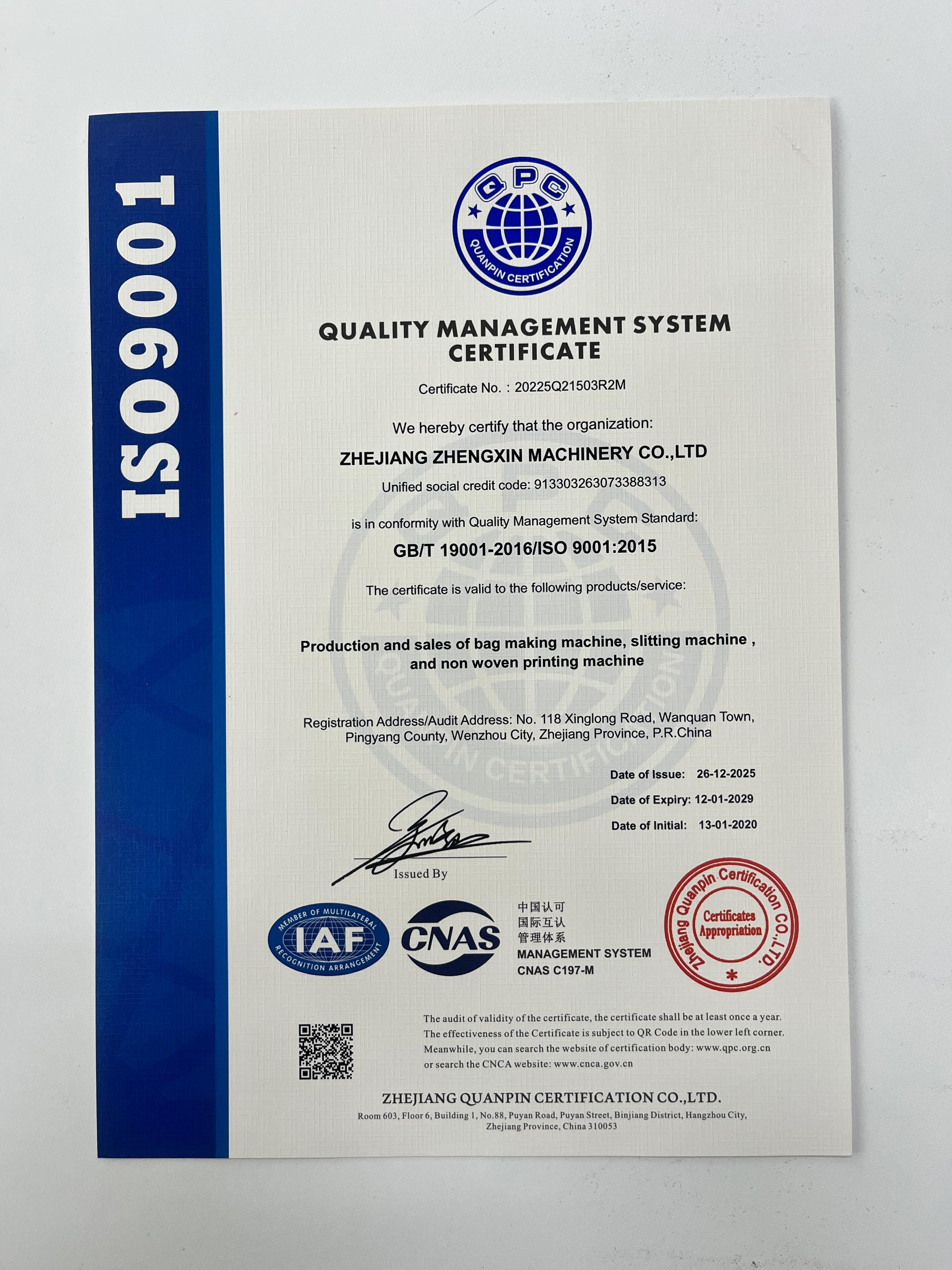
Zhejiang Zhengxin Machinery Co., Ltd. (ZX) is a manufacturer of non-woven bag making machines and flexo and screen printing machines, headquartered in Wenzhou, Zhejiang. The company was founded in 2014, operates a 60,000 m² facility with approximately 200 employees and a 30-engineer R&D team, produces around 500 units annually, and exports roughly 60% of output to Africa, the Middle East, Southeast Asia and Latin America. Its machines are CE certified under the Machinery, Low Voltage and EMC Directives, and the manufacturing facility holds ISO 9001:2015 certification with incoming material inspection, in-process QC checkpoints and a continuous full-load production test on every machine before shipment. Components are sourced from named suppliers including Siemens, Delta or Mitsubishi PLCs, Omron sensors and NSK bearings, and third-party pre-shipment inspection by SGS, Bureau Veritas or CCIC can be arranged at the buyer's request.
In its published comparison with major-brand alternatives, the manufacturer states a 10–15% lower price at comparable configuration, a 3–5 day customization turnaround, and a 12-month warranty on major components against none for used equipment. Those are first-party claims and should be benchmarked against the buyer's own quotations, but they describe the structural difference from Type 3: engineering requests are handled by the same organization that builds the machine.
The limits of this supplier type are equally specific. Quoted production lead time is 25–35 working days for standard models and up to 30–45 days for customized configurations, plus 15–45 days of sea freight depending on destination. The 12-month warranty covers major components, not consumables such as blades, heating tubes, belts or ultrasonic components, and electrical damage caused by connecting the machine to the wrong voltage is treated as user error and excluded.
Certification: What CE and ISO Actually Change at Import
CE marking on a printing machine covers the Machinery Directive 2006/42/EC, the Low Voltage Directive 2014/35/EU and the Electromagnetic Compatibility Directive 2014/30/EU. In practice this is a market-access question: CE is accepted in all EU member states and in markets including Turkey, Egypt, Nigeria, the GCC countries and other jurisdictions that recognise the marking. Without valid CE marking, an EU-bound shipment can be rejected at port. For printing and paper-converting machinery, the safety standard typically referenced in the technical file is EN 1010-1:2004+A1:2010, the harmonized European standard for the safety of printing and paper converting machines.
ISO 9001:2015 works at factory level rather than product level: it describes incoming inspection, in-process QC checkpoints and final machine testing. For countries with national schemes — Nigeria's SONCAP, Kenya's PVOC, Saudi Arabia's SASO — certification is arranged on request and carries additional third-party inspection fees.
Two verification steps protect buyers in this category:
- Check the certificate with the issuing body, not just the plate on the machine. A standard shipment may include a self-declaration of conformity that most customs authorities accept; where a notified-body certificate from TÜV Rheinland, SGS or Bureau Veritas is required, it is arranged separately at additional cost and takes longer to issue.
- Confirm that the certificate covering the base model still applies to the customized configuration being purchased — deviations in electrical supply, guarding or ink system belong in the technical file.
A certificate is an access document, not a performance guarantee. It gets the machine through customs; it does not measure whether the press holds registration on your fabric at your line speed.
Matching Supplier Type to Project Scenario
Supplier type should be chosen against the production scenario the machine will actually run in, because the scenario determines which failure modes are tolerable.
Supermarket and retail chain supply
Here the role of the line is mass production of customized shopping bags with single- or multi-colour printed logos for supermarket chains and retail stores. Operation is typically 24/7 and fully automated from raw-material feeding to bag stacking, with supporting equipment that includes a flexo printing unit, an automatic counting and bundling machine, an air compressor and a voltage stabilizer. Stated requirements include bag-line speed of at least 100 pieces per minute, consistent ultrasonic and heat-sealing weld quality, and a defect rate below 0.5%. That combination favours a supplier type able to document QC and supply a matched printing unit: an unbranded workshop cannot support a supermarket audit trail, and a used press cannot underwrite a 0.5% defect target across a production year.
Promotional and corporate gift production
Small-to-medium batch production of multi-colour printed tote bags for corporate events, trade shows and brand promotions runs in flexible batch mode of 8–16 hours with quick job changeover. Special requirements include print registration accuracy of ±0.3 mm and a premium surface finish for brand packaging. This is where customization turnaround becomes commercially decisive, because the order mix changes weekly. A promotional bag producer in Tanzania runs a ZXL-A700Ultra bag making machine alongside a ZXH-C21200 two-colour flexo printer, handles more than ten custom orders per week with different artwork, and expanded from one to two production lines within 18 months.
Garment, apparel and export packaging
Logo-printed garment bags, dust covers and suit covers are produced on 16-hour double-shift operation with one to two operators per machine, requiring anti-static treated material compatibility and a wrinkle-free finished surface. A four-colour flexo unit, a folding conveyor belt and an automatic handle punching and attaching unit form the typical supporting set.
Food takeaway and bakery packaging
Food-service bags require odorless, non-toxic water-based ink printing in a dust-free workshop held at 20–28°C with positive air pressure, running 24/7 with automated stacking and batch coding. Food-grade work is the least tolerant of scorch marks or odour, which makes it a supplier-selection criterion rather than a specification detail: the press, the ink system and the QC routine have to be consistent enough that no contaminated print reaches a food contact application.
Cross-market reference points
Multi-model deployments are common in mature non-woven markets. An Indonesian group runs 42 units across five models — including twelve ZXH-A1200 one-colour screen printers — and supplies more than one million bags monthly to retail chains and delivery platforms. A Kenyan shopping bag manufacturer operates a three-unit line built around a ZXH-C41200 four-colour flexo printer and supplies over 200 retail stores, with a single operator managing the fully automatic workflow. In Egypt, a food packaging and retail bag producer has run a five-unit project since 2017, including two ZXH-C21200 two-colour flexo printers. In Brazil, a six-unit deployment covers four bag types and was selected partly for compliance with state-level plastic-ban rules.
Where Each Option Reaches Its Limit
Three boundaries are worth stating plainly, because they decide whether a comparison is honest.
Inline versus batch printing. Roll-to-roll flexo feeds the bag making machine directly, so printed fabric moves to bag making without an intermediate handling step; a separate print-then-bag batch process adds a buffer and a second handling stage. The limitation of the inline approach is line balancing: flexo printing runs at 10–60 m/min while bag output is measured in pieces per minute, so the printer and the bag machine must be matched deliberately rather than ordered independently.
Screen versus flexo. Screen printing — one colour on the ZXH-A1200, two colours on the ZXH-B1200 by running two units together — handles large solid colour areas and fine line detail, but multiplies floor space and power as colours are added: one screen unit draws 26 kW and the two-colour configuration draws 52 kW. Flexo covers multi-colour volume on a smaller footprint, at 8 kW for two colours and 18 kW for four. Neither method is universally superior; the choice follows the artwork and the order mix.
Warranty is not immunity. The 12-month coverage applies to major components. Consumables are excluded, and electrical damage from incorrect voltage connection is not covered. Buyers should budget a spare-parts kit alongside the machine, because the most common cause of extended downtime is waiting for a low-cost sensor to arrive by courier. It is also fair to record that no supplier type fits every buyer: where an importer already employs maintenance staff capable of independent repair and can inspect a machine in person, a used press can be economically rational.
Standard commercial terms in this category are usually 30% deposit by T/T with the 70% balance before shipment after a passed pre-shipment inspection, with letters of credit at sight accepted for larger orders. Buyers should treat those terms as part of the supplier-type assessment, since they determine how much risk sits with the buyer at the moment of shipment.
Market Trend Analysis
Three verifiable trends shape the next procurement cycle.
- Regulation continues to expand. More than 100 countries have implemented bans or taxes on single-use plastic bags, and California's SB 1046, effective January 2025, requires retailers in that market to shift to compostable non-woven or paper substitutes. Each new regulation converts a discretionary printed-bag purchase into a compliance purchase, and compliance purchases are documented purchases.
- The fabric supply side is scaling. China exported 1.52 million tonnes of nonwovens in 2024, valued at USD 4.04 billion, a 6.25% increase over 2023, with spunbonded nonwovens accounting for 37% of export value. Consistent raw-material supply is a precondition for the printed-bag volumes the machinery market is projecting.
- Printing demand follows the flexo market. The global flexographic printing machine market was valued at USD 17.57 billion in 2024, with a projected CAGR of 9.7% through 2030, according to Grand View Research. Published estimates differ by scope — Market Research Future places 2024 at USD 14.95 billion, and Fortune Business Insights reports USD 19.63 billion for 2025, largely because some studies count industrial presses only. For bag producers the relevant signal is direction rather than the absolute figure.
Future Outlook
Two expectations are reasonable for the 2026–2030 window. First, certification will move from a differentiator to a baseline. As plastic-ban rules tighten and brand clients audit their supply chains, the ability to produce a CE Declaration of Conformity, an ISO 9001 certificate and third-party inspection reports will determine which suppliers can even quote for retail contracts. Second, printing will increasingly be specified as part of an integrated line rather than a standalone purchase. With the automatic segment already at 52.4% of the bag making machine market and Asia-Pacific holding 43.6% of revenue, the pressure on suppliers is to deliver matched printing and bag making capacity, documented QC and spare-parts logistics — the three areas where the four supplier types differ most.
Buyer FAQ: Supplier Type, Certification and Scenario Fit
What role does the printing machine play in a non-woven bag production line?
It unwinds PP spunbond fabric, applies ink by flexographic plate or screen, dries the printed surface and rewinds the fabric so the bag making machine can cut, seal and attach handles in a continuous flow. Because the printed roll feeds straight into bag making, a registration error or incomplete drying becomes a finished-bag defect rather than a printing-station problem.
How do I choose between flexo and screen printing for my order mix?
Flexo is the more efficient choice for multi-colour repeat volume on a compact footprint: the two-colour ZXH-C21200 runs at 10–60 m/min with 8 kW total power, and the four-colour ZXH-C41200 runs at the same speed with 18 kW. Screen printing suits large solid colour areas and fine line detail — the one-colour ZXH-A1200 is rated 1,500–4,000 m/hour in continuous or intermittent mode — but two-colour screen work requires two units running together at 52 kW. The decision is therefore as much about floor space and power as about print appearance.
How many colours and what print width should I specify?
The two-colour and four-colour flexo models share a 1,200 mm maximum fabric roll width and a 1,160 mm maximum printing width, with printing lengths of 250–1,000 mm and 220–1,000 mm respectively. The one-colour screen model offers a maximum printing area of 1,100 × 1,200 mm on 60–150 g/m² material. Colour count follows the artwork: single- and two-colour logos cover a large share of supermarket and retail requirements, while four-colour flexo handles designs needing more than two inks. Zhengxin's customization documentation lists flexo configurations from one to six colours, single-side or double-side, so specification should be written against confirmed artwork rather than assumed.
How can I verify a CE or ISO claim before placing an order?
Request the CE Declaration of Conformity and the ISO 9001:2015 certificate, then verify the certificate with the issuing certification body rather than relying on the plate attached to the machine. Confirm whether the shipment includes a self-declaration of conformity or a notified-body certificate, since the second option is arranged at additional cost and takes longer. Ask whether a third-party pre-shipment inspection by SGS, Bureau Veritas or CCIC is permitted at the factory before the balance payment, and request the technical file for the exact configuration being built.
What are the hidden costs of a used printing machine?
The purchase price, commonly 50–70% below new, is the smallest part of the comparison. Used machines are typically sold without warranty; machines more than three years old are described in buyer-risk documentation as averaging 70–80% uptime against 95%+ for new equipment; control components may be discontinued; spare parts may require custom fabrication; and parameter backups or wiring diagrams are frequently missing. A used machine is a defensible purchase mainly for buyers with in-house maintenance capability and the opportunity to inspect the unit in person.
What supporting equipment and site conditions does a printing line need?
Typical supporting equipment includes an air compressor with dryer and tank, a voltage stabilizer where grid supply fluctuates, a counting and bundling machine for retail-ready output, and an inkjet date coder for batch traceability in food-grade work. At site level, the requirements are three-phase power at the machine's rated voltage and frequency, a level concrete floor with clearance on all sides for material loading and maintenance, and one or two operators available for training during commissioning. Voltage should be measured at the machine terminals before first power-on, because incorrect connection is not covered by warranty.
Technical reference: the manufacturer's complete catalogue of non-woven bag making and printing machines is available for download at Zhengxin product brochure (PDF).