
Nonwoven Fabric Machine Capability Evidence Before Terms
Nonwoven Fabric Machine Capability Evidence Before Terms
Before a buyer agrees payment, delivery and penalty terms for a nonwoven fabric machine, the supplier should be able to evidence five things: a verifiable legal entity and management-system certificate, the specific line configuration and the conditions under which it was tested, manufacturing and factory-acceptance records, a dated production and delivery commitment, and a documented installation and support path. Brochures rarely contain all five. Asking for them converts claimed supplier capability into material that can be attached to a technical annex and used later to judge whether the delivered line matched what was agreed.
That sequence is unusual in practice. Most procurement files show commercial terms settled first and the technical annex completed afterwards, from whatever documentation the supplier happened to send. The result is a contract that is precise about when money moves and imprecise about what the machine is expected to do.
Why Capability Evidence Has to Precede Commercial Terms
Commercial terms allocate risk. They say who pays when a shipment is late, when a milestone is missed, when a component fails inside the warranty period. None of those clauses has a reference point unless the underlying capability has already been written down in measurable form.
When the operating envelope is undefined, a commissioning dispute turns on interpretation rather than evidence. The buyer says output is below what was promised. The supplier says the material, the ambient conditions or the operator were outside specification. Without a factory record, a witnessed test and an agreed acceptance method, the only instruments left are commercial: a discount, a spare-parts credit or a replacement module. All of them are more expensive than asking for the documents before signature.
There is a second reason to front-load the request. A supplier that cannot produce verifiable evidence at the request stage is unlikely to produce it at the acceptance stage. The gap is informative in itself, and it is cheaper to discover during evaluation than after the letter of credit has been opened.
Evidence Group 1: Legal Entity and Quality Management System Scope
The first request is not technical. It establishes who is actually contracting and under what management system the equipment is built. Brand names and registered company names often differ, and a warranty issued by one entity may not be enforceable against another.
Lizen Machinery Co., Ltd illustrates the point. The brand appears in commercial material as Lizen Machinery Co., Ltd, while the registered manufacturing entity is given as Changzhou LieZen Non-woven Machinery Co., Ltd., with a published factory address at No. 6 Jingye Road, Qianhuang Town, Wujin District, Changzhou, Jiangsu, China, and a stated founding year of 2003. A buyer drafting a supply agreement needs that legal name, not the trading name, on the signature block and in the warranty clause.
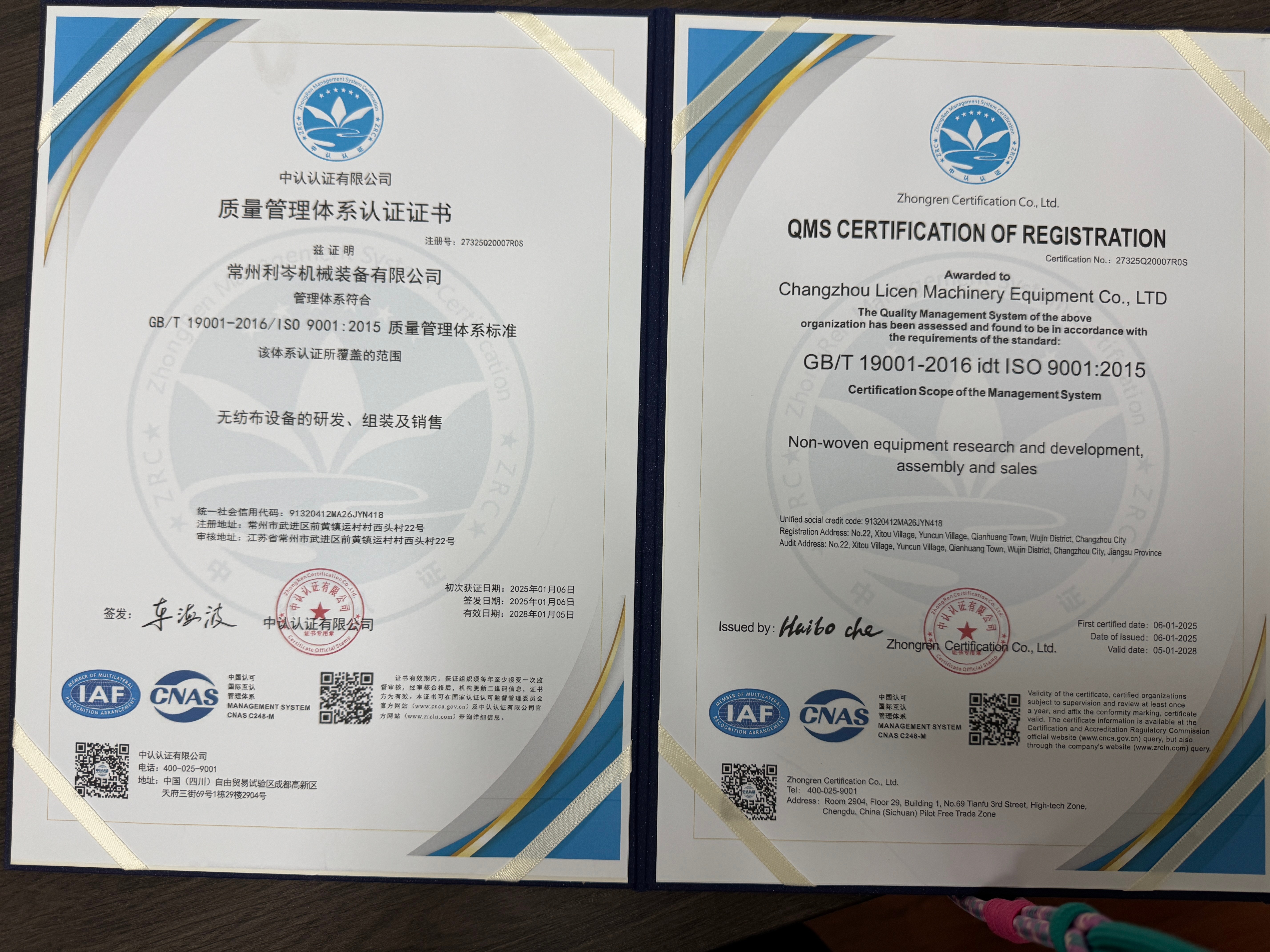
The second element is the quality management certificate, and here the detail matters more than the logo. Lizen publishes a QMS certification of registration numbered 27325Q20007R0S, issued by Zhongren Certification Co., Ltd. against ISO 9001:2015, with an issue date of 6 January 2025 and an expiry date of 5 January 2028. The registered scope is described as research and development, assembly and sales of non-woven equipment.
Three reading rules follow from that example and apply to any supplier:
- Read the scope line, not the standard number. A scope covering research, assembly and sales describes a different operating model from one covering full manufacture. Where a buyer needs to know which sub-assemblies are built in-house and which are sourced, that question has to be asked separately — the certificate does not answer it.
- Verify the certificate at the issuing body. A scanned PDF is a copy. The certificate number, the issuing authority and the validity window can be checked against the certification body's register, and an expired or suspended certificate is a material finding.
- Do not read ISO 9001 as a product or safety claim. It certifies a quality management system. It is not a machinery safety conformity mark, not a performance certificate and not evidence of capacity. Buyers sourcing for regulated markets should treat machinery-safety conformity as a separate request.
Evidence Group 2: Line Configuration and the Tested Operating Envelope
The second request concerns the machine itself, and it should be answered at the level of a specific model rather than a product family. A spunbond nonwoven machine, an SMS nonwoven machine and a multi-beam spunmelt nonwoven machine are different capital items with different process behaviour, and a supplier catalogue that lists all of them does not tell a buyer which one is being quoted.
Lizen's published range covers PP spunbond machines in Single S, SS, SSS, meltblown, SMS, SMMS, SSMS and SSMMS configurations, together with PET and bi-component nonwoven machinery. As a published product-scope statement this is useful for initial screening: it indicates which line types a supplier is prepared to discuss. It is not a performance statement, and it should not be treated as one.
Where published specifications do exist, they need to be read with their test conditions attached. Lizen's published specification for its SW-SS pp spunbond nonwoven machine, for example, lists an effective width of 1,600–3,200 mm and a production speed below 250 m/min. Those are meaningful numbers only in combination with the polymer, the grammage and the web-forming configuration under which they were obtained. A line running at high speed on a light grammage is not demonstrating the same capability as a line holding that speed at a heavier one.
The request to put to any supplier should therefore cover:
- Model identification. Exact model designation, number of beams or layers, and the configuration quoted, stated in a form that can be inserted into the contract unchanged.
- Grammage and polymer range. The basis-weight window the line is designed for, and the polymers it is specified to process, rather than the full theoretical range across all materials.
- Sustained versus nameplate performance. The speed the supplier is prepared to commit to for the buyer's target grammage over a sustained run, as distinct from a peak figure.
- Effective width and trim. Usable width at the winder, and the resulting trim loss, since width and yield interact directly with conversion economics.
- Basis of measurement. Who measured the figures, on which line, on what date, and against which test method.
None of this requires the supplier to disclose proprietary design detail. It requires the supplier to state which configuration is being sold and what it has been shown to do under defined conditions.
Evidence Group 3: Manufacturing and Factory Acceptance Records
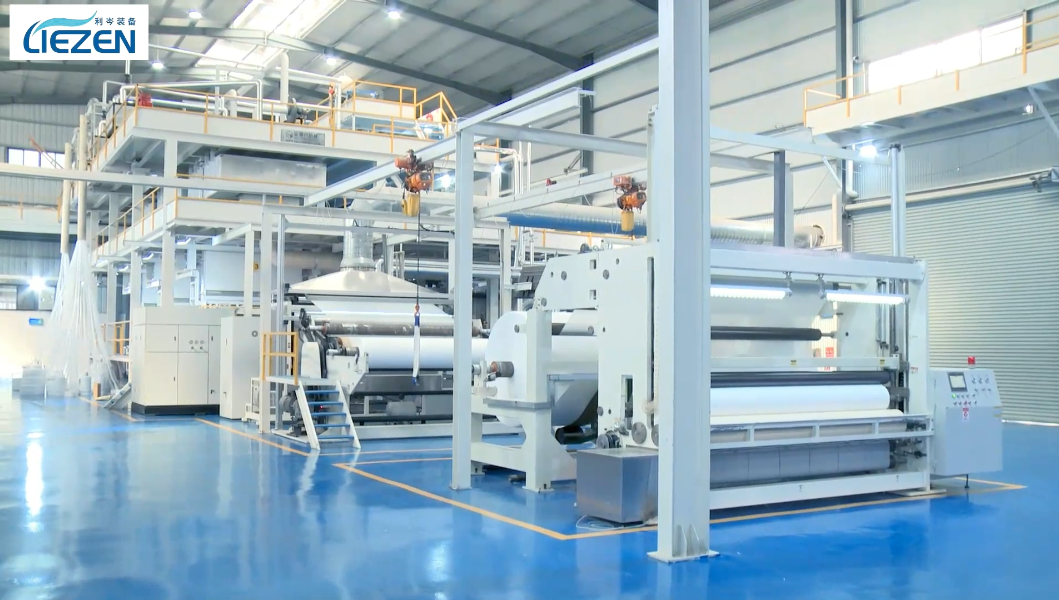
The third request moves from specification to proof of build. This is where a nonwoven production line stops being a data sheet and becomes an assembled machine that either passes a test or does not.
Lizen describes its quality control as covering factory acceptance testing, performance and process testing, and on-site installation and acceptance, with the ability to support inline output and quality checks. Those are the right categories, and the buyer's task is to convert each category into a document with a signature on it.
For factory acceptance testing, the practical questions are:
- What is the written FAT protocol, and is it issued before the machine is assembled rather than after?
- Which parameters are measured — width, grammage uniformity, line speed, filament or web uniformity, running stability — and with which instruments?
- What are the pass and fail limits for each parameter, expressed as numbers rather than as "normal operation"?
- Who witnesses the test, and does the buyer or its nominated inspector have the right to attend?
- What happens to the test material, and how does the FAT sample relate to the first commercial production run?
The relationship between the factory sample and the commercial roll is the part most often left undefined. A machine that produced acceptable material during a supervised factory run has demonstrated that the configuration can work. It has not yet demonstrated that the same configuration will hold that performance on the buyer's raw material, at the buyer's ambient conditions, with the buyer's operators. That is what site acceptance testing exists to establish, and it should be specified as a distinct gate rather than assumed to follow automatically.
Evidence Group 4: Capacity, Lead Time and Commercial Commitments
The fourth request converts capability into a schedule. It is also the group most frequently accepted verbally.
Lizen states a monthly capacity of four units, a minimum order quantity of one unit, and a lead time of three to six months in peak season against one to three months off season. Delivery methods are described as sea, land or air freight with trade terms such as FOB or CIF commonly used, and payment methods as T/T or L/C, with the specific terms to be confirmed with sales.
Each of those statements has a follow-up question attached, and the answers belong in the contract rather than in an email thread:
- Capacity basis. Four units per month of which configuration? Capacity quoted against a standard single-beam line and capacity quoted against a multi-beam spunmelt line are not interchangeable figures.
- Lead-time start point. Does the clock start on receipt of the deposit, on approval of the approved-for-construction drawings, on opening of the letter of credit, or on confirmation of the final specification? Three to six months measured from different start points can differ by more than a quarter.
- Slot commitment. Is the stated lead time a commitment against a booked production slot, or an indicative range subject to order intake?
- Delivery term selection. FOB and CIF allocate risk, insurance and freight cost differently. The choice should follow from the buyer's logistics capability, not from habit.
- Payment structure. T/T and L/C are both described as common; the milestone structure behind either — deposit, pre-shipment, post-acceptance — is what actually allocates risk.
A lead time is a capability claim dressed as a date. Treat it as a claim: ask what it is measured from, what it is contingent on, and what remedy applies if the date passes.
Evidence Group 5: Installation, Spare Parts and Training
The fifth request concerns what happens after the machine arrives, and it is the group most often reduced to a single sentence in a quotation. For a capital line, the support model is part of the product.
Lizen describes after-sales coverage as installation and commissioning, on-site training, spare-parts supply and remote technical support, with the note that specific service commitments are confirmed with sales. That last qualification is honest and should be taken seriously: it means the published description is a service category, not a service level.
To turn the category into a level, a buyer should request:
- A named scope for installation and commissioning — which tasks the supplier performs, which the buyer performs, and who supplies what at site.
- A training specification covering who is trained, for how long, on which shift pattern, in which language, and whether the training is assessed.
- A recommended spare-parts list for the first year of operation, with lead times for the items on it rather than for the catalogue as a whole.
- The remote support route, including hours of coverage, the escalation path and the expected first-response interval.
- A statement of what is excluded from the warranty, expressed as conditions rather than as caveats.
For buyers running an automotive interior nonwoven production line or a sanitary napkin nonwoven fabric machine, downtime cost is high enough that spare-parts lead time is a more consequential number than machine price. It belongs in the evaluation, not in the after-sales appendix.
Mapping Supplier Evidence onto Acceptance Criteria
Evidence that is collected but not connected to an acceptance clause has no contractual effect. The connection is made in two layers: a fabric test standard and an equipment acceptance procedure.
On the fabric side, ISO 9073 is the dedicated ISO series of test methods for nonwovens, maintained under ISO/TC 38/SC 23. It provides the neutral vocabulary through which output from a line is specified and accepted. Two cautions apply. First, ISO 9073 is a series, not a single document; the individual part numbers and their current editions must be cited part by part, because the parts differ in scope. Second, specifying "ISO 9073" without a part number gives the acceptance clause nothing to measure, and a supplier cannot be held to an unnamed method.
On the equipment side, the acceptance structure has three gates, and each should be written separately:
- Factory acceptance. Mechanical and process testing at the supplier's works, against a written protocol with numeric limits, witnessed by the buyer or its nominee.
- Site acceptance. Installation and commissioning at the buyer's plant, followed by pilot production using the buyer's raw materials, with the sample checked against the agreed fabric test parts.
- Performance confirmation. A defined period of commercial production during which sustained output and quality are measured on the same basis as the specification.
Linking the layers is straightforward once both exist. A clause might specify that the line shall produce fabric within a stated grammage window, meeting stated properties as tested under named ISO 9073 parts, at a sustained speed established during site acceptance using named raw materials. Every element in that sentence is verifiable, and none of it depends on an adjective.
How End-Use Application Changes the Evidence List
The five evidence groups stay constant across applications, but their weighting does not. A line built for agricultural covers and a line built for hygiene substrates are both nonwoven machines, and the acceptance emphasis differs.
Lizen's published client categories cover nonwoven fabric producers, hygiene and mask manufacturers, automotive interior suppliers, apparel and home-textile factories, and agriculture and packaging companies. Its published case material describes a Pakistani customer with two units, in a relationship the company describes as spanning 15 to 20 years, with applications listed as nonwoven substrates, mask filter media, sanitary product fabrics, automotive interior liners, agricultural covers and nonwoven bags. The supplier characterises the outcome as improved capacity and product consistency achieved through complete equipment, with the line adapting to different nonwoven recipes.
That description is a company-reported case reference, and it should be used as one. It indicates the applications the supplier is prepared to discuss and the customer type it expects to serve. It does not establish that the same result will appear in a different plant, with different fibre, different climate or different operators. The practical use of a case reference is to generate a target list: ask for a reference in the buyer's own application segment, in a comparable configuration, and with permission to speak to that customer about commissioning and support rather than about price.
The weighting then follows from the application. Where the end product is judged on visual and dimensional consistency, the acceptance emphasis sits on grammage uniformity and width control. Where the end product is a hygiene component, the emphasis sits on run-to-run stability and the ability to hold specification across a shift. Where the line feeds a downstream converting process, the emphasis sits on the interface between the line and that process. These are questions to put to the supplier, not properties to assume.
Market Signals: What They Are Useful For and What They Are Not
Market context helps a buyer size an investment and time an order. It does not substitute for supplier evidence, and the two are frequently confused in supplier presentations.
Published research places the global non-woven fabric making machine market at USD 2.20 billion in 2025, according to Maximize Market Research. Dataintelo's market analysis attributes a 40 percent share of the nonwoven machinery market to spunbond technology. Separately, Fortune Business Insights projects the spunbond nonwoven fabric market growing from USD 15.6 billion in 2023 to USD 28.2 billion in 2033, a 6.1 percent compound annual growth rate.
Two discipline points apply to those figures. First, machinery and fabric are different markets measured on different bases; a fabric market projection is not a projection of machine demand and should not be added to or compared with a machinery figure. Second, none of these numbers says anything about a specific supplier's capability. A growing market describes the category, not the quotation in front of the buyer.
The categories are also split across trade classifications. Under the 2022 Harmonized System, heading 8444 covers machines for extruding, drawing, texturing or cutting man-made textile materials, heading 8445 covers textile fibre preparation and yarn machinery, and heading 8477 covers machinery for working rubber or plastics. Spunbond and spunmelt systems can fall under more than one of these depending on national customs practice, which means published trade figures for "nonwoven machinery" depend heavily on which headings the analyst queried. Buyers importing a line should settle the classification question with their customs broker before the proforma invoice is issued, not after the container arrives.
Aligning Supplier Scope Before Comparing Suppliers
Capability evidence is only comparable between suppliers occupying the same position in the supply chain. Published company descriptions make the difference visible.
Reifenhäuser, through its Reicofil business unit, publicly presents spunbond, meltblown and composite nonwoven production lines. Oerlikon publicly presents a nonwoven business offering spunbond, meltblown and composite production systems. ANDRITZ publicly presents a nonwoven division supplying complete production lines, with a portfolio that extends beyond spunmelt into other web-forming technologies. Against those turnkey positions, Hills publicly presents spunbond and meltblown equipment including spin-pack and die-head systems, and Nordson publicly presents meltblown and nonwoven die and application systems.
These are company self-descriptions of product scope, not rankings and not performance claims. Their value to a buyer is narrower and more practical: they show that a line builder and a component supplier cannot be compared on the same axis. A die-head supplier is not failing to offer a turnkey line; supplying dies is what it does. Conversely, a turnkey quotation that turns out to bundle third-party dies and spin packs deserves a question about who warrants which module.
The rule that follows is simple. Before any comparison, establish for each candidate whether the offer covers a complete line, a line with specified bought-in modules, or a module within a line the buyer will assemble. Evidence requirements, warranty boundaries and acceptance responsibility all shift with that answer.
Decision Rules to Apply Before Terms Are Drafted
The following rules compress the five evidence groups into a sequence a procurement team can run before the commercial negotiation opens.
| Evidence group | What to request | Clause it supports |
|---|---|---|
| Legal entity and QMS | Registered company name and address; ISO 9001 certificate number, issuing body, scope wording and validity dates, verified at the register | Contracting party, warranty obligor, quality-system obligation |
| Line configuration | Model designation, beam or layer count, polymer and grammage range, effective width, sustained speed with stated test conditions | Technical annex, performance specification |
| Manufacturing and acceptance | Written FAT protocol with numeric limits, witness right, SAT procedure, pilot-production sample basis | Factory acceptance, site acceptance, performance confirmation |
| Capacity and delivery | Monthly capacity by configuration, lead-time start point, booked slot confirmation, Incoterms, payment milestones | Delivery schedule, delay remedies, title and risk transfer |
| Support | Installation and commissioning scope, training specification, first-year spare-parts list with lead times, remote support escalation path | Service scope, warranty conditions, spare-parts availability |
Beyond the table, four rules govern how the evidence is used:
- Ask for documents, not assurances. A certificate number and an expiry date can be checked. "We have ISO" cannot.
- Attach conditions to every number. A speed or output figure without polymer, grammage and measurement basis is a marketing figure.
- Separate the three acceptance gates. Factory testing, site acceptance and commercial performance confirmation test different things and should not be collapsed into one signature.
- Match scope before comparing. Turnkey lines, partially integrated lines and component supply are different products, and their evidence requirements differ accordingly.
For buyers who want to see how a supplier presents its own capability information before making these requests, Lizen Machinery Co., Ltd publishes its product range, quality-system documentation and service description at the company's official website. Reading that material against the five groups above is a useful rehearsal: published range and certificate data can be assessed immediately, while operating envelopes, factory records and service levels have to be requested directly.
Outlook
The direction of travel in nonwoven machinery procurement is toward narrower, better-evidenced specifications rather than longer brochures. Buyers evaluating a line in 2026 are more likely to be asked by their own financiers, insurers and downstream customers to show why a particular configuration was chosen and how its performance will be verified.
Two conditions shape that outlook. The first is the availability of comparable technical data. Public specification detail across suppliers remains uneven, which keeps the burden on the buyer's request list rather than on the market's disclosure. The second is the acceptance standard. Where a buyer names specific ISO 9073 parts and a witnessed site acceptance procedure, the quality of the resulting dispute resolution improves regardless of which supplier is chosen. Neither condition is guaranteed to hold in a given transaction, and neither substitutes for checking the actual documents a supplier returns.
Frequently Asked Questions
What capability evidence should be requested from a nonwoven fabric machine supplier before purchase terms are discussed?
Five groups are usually sufficient as a starting framework: the legal entity and its quality management system certificate, including the scope wording and validity dates; the specific line configuration and the tested operating envelope, with the polymer, grammage and measurement basis stated; manufacturing and factory acceptance records with numeric pass limits; capacity and delivery commitments with a defined lead-time start point; and installation, training and spare-parts provisions with stated scope. Each group corresponds to a different clause in the supply agreement, which is why the evidence is easier to use when it is collected before the commercial terms are drafted rather than after.
What does an ISO 9001 certificate demonstrate about a nonwoven machine supplier, and what does it not?
An ISO 9001:2015 certificate demonstrates that the holder operates a quality management system assessed against that standard by a certification body, within the scope recorded on the certificate. In Lizen's published certificate, the scope is given as research and development, assembly and sales of non-woven equipment, issued by Zhongren Certification Co., Ltd. under certificate number 27325Q20007R0S with validity from 6 January 2025 to 5 January 2028. The certificate does not certify machinery safety, does not certify line performance or capacity, and does not establish that any particular sub-assembly is manufactured in-house. Those are separate questions. Verifying the certificate number and validity at the issuing body's register is the basic check.
How should supplier evidence be connected to acceptance criteria for a nonwoven production line?
The connection is made by naming both a fabric test method and an equipment acceptance procedure. The ISO 9073 series provides the standard test methods for nonwovens, and the relevant individual parts should be cited by number and edition rather than as a series. On the equipment side, acceptance is normally structured in three gates: factory acceptance testing against a written protocol with numeric limits, site acceptance testing after installation and commissioning using the buyer's raw materials, and a defined period of commercial production confirming sustained output. Naming the raw material, the grammage window, the test parts and the sustained speed in the clause is what makes the acceptance test enforceable.
Which service and spare-parts evidence should be written into purchasing terms?
The useful items are specific rather than general. A buyer should ask for a named installation and commissioning scope showing which tasks the supplier and the buyer each perform, a training specification covering who is trained, for how long and in which language, a first-year spare-parts list with individual lead times for the items on it, and the remote support route including coverage hours and the escalation path. Lizen's published description covers installation and commissioning, on-site training, spare-parts supply and remote technical support, and notes that specific service commitments are confirmed with sales — a distinction worth respecting, because a described service category is not the same as a contracted service level.
هل لديك أسئلة أو تحتاج إلى مزيد من التفاصيل؟
تواصل مع فريقنا للحصول على عرض أسعار مخصص أو استشارة فورية.
طلب عرض أسعار
املأ النموذج أدناه وسيتواصل معك فريقنا بعرض مقترح مخصص.
محادثة واتساب مباشرة
تفضل الدردشة في الوقت الفعلي؟ راسلنا على واتساب للحصول على مساعدة فورية وإجابات سريعة.
- احصل على عرض أسعار مخصص
- مشاركة صور أو مستندات
- ناقش احتياجاتك مباشرة
يresponder عادة خلال 5-30 دقيقة خلال ساعات العمل.