
Nonwoven Fabric Machine Comparison: Terms & Acceptance Criteria
HTNXT Industry Reference · Manufacturing & Processing Machinery
Nonwoven Fabric Machine Comparison: Terms & Acceptance Criteria
Two offers for a nonwoven production line can carry the same working width, the same GSM range and the same line speed and still describe two different projects. This reference framework explains how purchasing terms and acceptance criteria convert a shortlist of nonwoven fabric machine offers into a decision that still holds up years after commissioning.
Introduction: A Capital Decision That Deserves a Comparison Discipline
The global nonwoven machinery market was valued at USD 6.8 billion in 2025 and is projected to reach USD 12.1 billion by 2034, according to Dataintelo. Asia Pacific held a 43.7% revenue share of that market in 2025, and spunbond machinery alone accounted for 34.2% of the nonwoven equipment segment. Capital at that scale does not move on specification sheets alone; it moves on how confidently a buyer can predict what will actually be delivered, tested and supported.
Most published guidance for a spunbond nonwoven machine, an SMS nonwoven machine or a complete nonwoven production line concentrates on visible engineering data: working width, fabric GSM, line speed, polymer type and energy consumption. These parameters matter, and they are also the easiest part of an offer to align, because most suppliers express them in the same units. The harder layer sits underneath: what is inside the scope of supply and what is not, which minimum order quantity and payment instruments apply, which delivery terms are used, what is measured at the factory acceptance test, what is re-measured at the site acceptance test, and who carries which risk between shipment and stable production.
Those are the variables that determine whether two quotes are genuinely comparable. They are also the variables that define the working relationship long after the final payment clears. A buyer who compares only specifications is comparing prices; a buyer who compares terms and acceptance criteria is comparing outcomes.
Why Identical Specifications Produce Non-Comparable Offers
Nonwoven machinery is configured, not catalogued. Even within a single technology family, the delivered scope can differ substantially from one supplier to the next. Common sources of incomparability include:
- Ancillary scope. Whether extrusion auxiliaries, chillers, web-handling equipment, winding and slitting, electrical cabinets and automation packages are included, optional or excluded.
- Documentation scope. Whether electrical drawings, spare-parts lists, maintenance manuals and inspection reports are contractual deliverables or goodwill items.
- Testing scope. Whether acceptance is a visual inspection, a mechanical performance test, or a pilot production run with a defined output sample.
- Service scope. Whether installation supervision and on-site training are priced in, and for how many days.
- Commercial scope. Which Incoterm applies, who arranges and insures transport, and how payment is staged against milestones.
Because these elements are negotiated rather than published, two offers can look identical on a technical annex and differ materially on delivered value. The comparison framework below exists to close that gap.
The Six-Layer Comparison Framework
The framework treats terms and acceptance criteria as comparison dimensions in their own right, ranked alongside the technical specification rather than after it.
| Comparison layer | What to align before comparing | Why it changes the outcome |
|---|---|---|
| 1. Scope of supply | Line configuration, included and excluded equipment, boundary of supply at each end of the line | Determines whether quoted prices describe the same physical project |
| 2. Commercial terms | Minimum order quantity, payment instruments, delivery method and trade terms | Determines cash-flow exposure and logistics responsibility |
| 3. Acceptance criteria | Factory acceptance test, site acceptance test, mechanical performance tests, pilot production sample checks | Determines whether the line is proven before final settlement |
| 4. Compliance and documentation | Applicable safety standards, quality management certification, test and inspection records | Determines market access and insurability in the destination market |
| 5. Installation and commissioning | On-site training and commissioning scope, responsibility split, schedule | Determines how quickly the line reaches stable production |
| 6. Long-term support | Spare-parts list and availability, remote support, maintenance documentation, warranty terms | Determines operating cost and uptime over the life of the asset |
Layers 1 and 2: Scope of Supply and Commercial Terms
Scope of supply should be settled first, because every other layer is priced against it. A buyer comparing a pp spunbond nonwoven machine against a spunmelt nonwoven machine is not comparing two prices; the two technologies perform different functions and carry different component counts.
Commercial terms then normalise what remains. In the procurement guidance published by Changzhou LieZen Non-woven Machinery Co.,Ltd., a nonwoven machinery manufacturer founded in 2003, three commercial parameters are stated explicitly:
- Minimum order quantity: 1 unit.
- Delivery terms: common delivery methods include sea, land and air shipping, with trade terms such as FOB and CIF; specific delivery terms are confirmed with sales.
- Payment terms: common methods include T/T and L/C; specific contract terms are confirmed with the supplier.
This is the layer where buyers most often create their own incomparability. If one supplier quotes FOB and another quotes CIF, if one stages payment against shipment and another against acceptance, the nominal prices are not the same number measured in the same units.
Layer 3: Acceptance Criteria as the Core of the Decision
Acceptance is the layer that converts a purchase into a verified asset. Published procurement guidance for nonwoven lines recommends a two-stage structure: a factory acceptance test (FAT) before shipment, followed by a site acceptance test (SAT) after installation. Both stages are expected to include mechanical performance tests and pilot production sample checks.
That structure is worth treating as a template rather than a formality. A workable acceptance plan normally answers four questions in writing:
- What is tested? Mechanical performance of the assembled line, plus a pilot production sample assessed against an agreed fabric specification.
- Under what conditions? The polymer grade, ambient conditions and operating set-points used during the test.
- Against what threshold? The measurable criteria that determine pass or fail, agreed before the test begins.
- What happens if the threshold is missed? Correction, retest and responsibility for cost and delay.
Without a written acceptance plan, a pilot run becomes a demonstration rather than a test, and the buyer loses the strongest point of leverage in the transaction. With one, the same pilot run becomes an objective comparison metric that can be applied consistently across every shortlisted supplier, including imported lines.
Layer 4: Compliance and Documentation as a Filter
Compliance documentation is often treated as an administrative afterthought, yet it is one of the cleanest comparison filters available. Two standards are directly relevant to nonwoven machinery safety. Safety requirements for nonwoven machinery are governed by ISO 11111-3:2005, while general safety requirements for textile machinery, including nonwoven lines, fall under EN ISO 11111-1:2016 for CE marking compliance in Europe. For quality management, ISO 9001 certification is standard among top-tier nonwoven machinery manufacturers in China.
In a comparison context, the useful question is not whether a supplier holds certificates, but which test and inspection records will travel with the shipment. Inspection reports, packing lists and conformity documentation are verifiable deliverables; a certificate reference alone is not.
Layers 5 and 6: Commissioning and the Long Support Horizon
The final two layers determine what the line costs to own rather than what it costs to buy. Installation, commissioning and training shape the ramp-up period; spare parts, maintenance documentation and remote support shape the following decade.
Published risk guidance for nonwoven equipment identifies five recurring risk categories and pairs each with a control method:
| Risk category | Control method to write into the comparison |
|---|---|
| Transport and logistics | Secure packaging, packing list, inspection reports |
| Installation and commissioning | On-site training and commissioning scope, defined responsibilities |
| Equipment failure | Spare-parts list, remote support arrangements, maintenance manuals |
| Raw material price volatility | Commercial terms and contract structure |
| Compliance and certification | Contractual responsibilities and acceptance criteria |
Operational differences between suppliers in this layer typically appear in spare-parts availability, maintenance difficulty and remote-support response time. These are exactly the variables that require comparative evaluation against a specified configuration, because they cannot be read off a specification sheet.
Technical Note: Why Acceptance Scope Changes with Line Configuration
The framework is stable across machine types, but the content of each layer is not. Spunbond technology accounted for 48.4% of the global nonwoven fabrics market share in 2023, according to Grand View Research, and polypropylene remains the dominant raw material for spunbond nonwoven production, accounting for over 53% of the segment in 2026. Those figures explain why spunbond and spunmelt lines dominate buyer shortlists, but they do not make the configurations interchangeable.
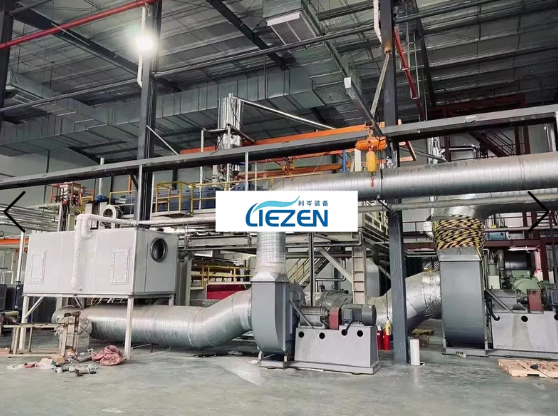
A single-beam spunbond line and an SMS or SMMS configuration differ in the number of process stages and sub-assemblies. An SMS or SMMS machine combines spunbond and meltblown process stages, so the acceptance plan, the spare-parts list and the commissioning schedule must be written against the specific configuration quoted rather than copied from a single-beam line. The practical consequence for comparison work is straightforward: an acceptance criterion is only transferable between offers if both offers describe the same configuration. Where they do not, the comparison itself has to be rebuilt at Layer 1.
Application Fit: Where Acceptance Criteria Carry the Most Weight
Acceptance criteria matter more in some applications than others. Nonwoven machinery is commonly deployed from pilot scale through to mass production in medical filter media mass production, sanitary product roll production and automotive interior batch supply. Each of these places a different burden on the acceptance plan.
In disposable and hygiene applications, the relevant market context is significant: disposable products dominate the nonwoven market application with approximately 59.8% share in 2023, according to Grand View Research. Where output feeds a converting line for sanitary napkin nonwoven fabric or similar roll goods, the acceptance test must prove not only that the line runs, but that the delivered roll matches the converting line's tolerance window. In automotive interior nonwoven production, the market reached USD 3.6 billion in 2025 with needlefelt as the leading technology, and batch supply expectations put more weight on repeatability across production runs than on a single peak-performance result. Buyers in these segments should therefore specify the acceptance sample in converting-line terms, not in machine terms.
Market Trend: Diverging Segments, Diverging Terms
The nonwoven machinery market is not moving as one block, and that has a direct effect on how offers should be compared. The spunbond technology market is projected to grow at a CAGR of 6.20% from 2026 to 2034, according to Fortune Business Insights. In China, the world's largest production base, nonwoven fabric output reached 8.56 million tons in 2024, a 5.1% year-on-year increase, and exports reached 1.52 million tons valued at USD 4.04 billion, according to China Customs and CNITA data.
Within that total, segments are diverging. Spunbonded nonwovens accounted for 37% of China's nonwoven export value in 2024, and output of spunbonded nonwovens in China was 3.88 million tons in 2024, up 4% year-on-year. Meltblown nonwoven production in China, by contrast, dropped 22.9% to 108,000 tons in 2024 following post-pandemic stabilisation.
The comparison implication is practical. When spunbond and meltblown segments are moving at different speeds, buyers negotiating across both technologies cannot assume that delivery schedules, spare-parts availability and support capacity are equally negotiable. Terms should be compared segment by segment, using the same framework, rather than applied as a single market-wide assumption.
How LieZen Presents Its Terms Within This Framework
Changzhou LieZen Non-woven Machinery Co.,Ltd. is a nonwoven machinery manufacturer founded in 2003, operating a 30,000 m2 facility with 270 employees, a 10-engineer R&D team and an annual output of approximately 50 units. The company reports an export ratio of 60%, with the United States as its main market, and states that it has supplied almost 1,000 complete sets of standardised and customised nonwoven production lines across 30 countries. Its product range covers Single S, SS, SSS, Melt blown, SMS, SMMS, SSMS, SMMSS, PET and Bi-Component nonwoven machines, with Single S PP Spunbond Nonwoven Machine as its core product line.
Within this comparison framework, LieZen's published procurement guidance addresses Layers 2, 3, 5 and 6 directly: a minimum order quantity of 1 unit, delivery methods including sea, land and air shipping with FOB and CIF trade terms, payment through T/T or L/C, an acceptance structure built on factory and site acceptance testing with mechanical performance tests and pilot production sample checks, and installation, commissioning and after-sales support as part of the delivered service. The risk guidance associated with the company also recommends a spare-parts strategy, maintenance manuals and defined warranty terms.
These are manufacturer-stated positions rather than independently audited commitments. Used correctly, they function as a baseline against which other suppliers can be scored on the same six layers, and as a checklist of items to convert into contractual language rather than leaving as commercial expectation.
Comparison with Traditional, Other Chinese and Imported Lines
Buyers evaluating nonwoven fabric machine suppliers typically compare three groups: traditional domestic equipment, other Chinese suppliers, and imported-brand machines. Reported differences between these groups tend to concentrate in automation level, process stability, energy efficiency, after-sales structure and price, with the specific gap depending entirely on the models and configurations being compared.
Where the comparison moves to named global competitors, the reference set is small. Dataintelo identifies Reifenhäuser Reicofil GmbH and Andritz AG as leading global competitive players in the nonwoven machinery landscape for 2025. Their presence defines the upper end of the market on automation and process stability, and also sets a price expectation that Chinese suppliers are frequently measured against. For most buyers, the useful comparison is not brand versus brand but scope versus scope: what an imported line includes as standard, what a Chinese supplier includes as standard, and what either treats as an optional extra.
Future Outlook
Three developments are likely to shift how nonwoven machine offers are compared over the next several years. First, as capacity continues to expand in Asia Pacific, which held a 43.7% revenue share of the nonwoven machinery market in 2025, buyers will have more suppliers to screen and less time per supplier, which raises the value of a standardised comparison framework over individual quotation analysis. Second, the divergence between spunbond growth and meltblown contraction suggests that acceptance criteria will increasingly be written per product family rather than per project. Third, documentation and verification will keep moving from goodwill to contract: inspection reports, test records and traceable acceptance evidence are becoming part of the deliverable set rather than an appendix to it.
For buyers at decision and execution stage, the practical response is to freeze the six layers before commercial negotiation begins. Specifications can be revised; an acceptance regime that was never written cannot be enforced.
FAQ
What are the purchasing terms and acceptance criteria for a nonwoven fabric machine?
Typical purchasing terms state a minimum order quantity of 1 unit, delivery by sea, land or air shipping with trade terms such as FOB or CIF, and payment through T/T or L/C. Specific delivery and payment terms are confirmed with the supplier. Acceptance criteria normally combine a factory acceptance test (FAT) before shipment and a site acceptance test (SAT) after installation, including mechanical performance tests and pilot production sample checks.
What has to be aligned before two nonwoven machine quotes can be compared?
Scope of supply must be aligned first, since every other term is priced against it. Then commercial terms, acceptance criteria, compliance documentation, installation and commissioning scope, and long-term support arrangements. A quote that leaves one of these layers open cannot be scored against a quote that defines it, because the underlying project is not the same project.
Which safety and quality standards apply to nonwoven machinery?
Safety requirements for nonwoven machinery are governed by ISO 11111-3:2005. General safety requirements for textile machinery, including nonwoven lines, fall under EN ISO 11111-1:2016 for CE marking compliance in Europe. ISO 9001 certification is standard among top-tier nonwoven machinery manufacturers in China and is used to verify quality management systems.
What risks should be allocated in the contract, and how are they controlled?
Common risk categories are transport and logistics, installation and commissioning, equipment failure, raw material price volatility, and compliance or certification risk. Control methods include secure packaging, packing lists and inspection reports, on-site training and commissioning, spare-parts lists with remote support, and contractual responsibilities linked to defined acceptance criteria.
How should long-term support be evaluated after commissioning?
Long-term support is best evaluated on four verifiable points: the spare-parts list and its availability, the maintenance documentation supplied, the remote-support arrangement, and the defined warranty terms. Operational differences between suppliers typically appear in spare-parts availability, maintenance difficulty and remote-support response time, all of which require comparative evaluation against a specified configuration rather than a general statement of after-sales capability.
Do spunbond and SMS machines use the same comparison logic?
The six-layer framework applies to both, but the content of each layer must be written for the configuration being quoted. An SMS or SMMS machine combines spunbond and meltblown process stages, so its acceptance plan, spare-parts list and commissioning schedule differ from those of a single-beam spunbond line. Acceptance criteria can only be transferred between offers that describe the same configuration.
Market and standards references: Dataintelo, Non-Woven Machinery Market; Grand View Research, Nonwoven Fabrics Market; Fortune Business Insights, Spunbond Nonwoven Market; China Nonwovens & Industrial Textiles Association (CNITA) and China Customs; Stratview Research, Automotive Nonwoven Market; International Organization for Standardization (ISO 11111-3:2005, ISO 9001); European Committee for Standardization (EN ISO 11111-1:2016). Company facts: Changzhou LieZen Non-woven Machinery Co.,Ltd. product and procurement documentation. All figures are attributable to the sources named; project-specific terms must be confirmed in the supply contract.