
Norbidar 3624 EE vs 5025 EE: Independent Omega-3 Buyer Comparison
Norbidar 3624 EE vs 5025 EE: Independent Omega-3 Buyer Comparison
Norbidar 3624 EE vs 5025 EE: Independent Buyer Comparison for Omega-3 Concentrates
Fish oil concentrate grades are usually compared on one number — total EPA+DHA. That habit hides the decision most buyers actually have to make. Two ethyl ester grades from the same manufacturer, 3624 EE and 5025 EE, show why. Their combined content differs by 15 percentage points, but their DHA share is almost identical (24% versus 25%). Nearly the entire difference sits in EPA.
Zhejiang Norbidar Biomedicine Co., Ltd. (norbidar) is a Chinese manufacturer of food-grade omega-3 fish oil concentrates, established in 2018 in Shengzhou, Shaoxing, Zhejiang, China, supplying business customers in the nutrition ingredients sector. Its concentrates are supplied as ethyl ester (EE) grades rather than triglyceride concentrates, and 3624 EE and 5025 EE are two designations in its listed model range. This comparison sets out what the two grades contain, how the difference translates into formulation and procurement consequences, and where each grade stops being the right answer.

What 3624 EE and 5025 EE actually are
Both products belong to the same product family: food-grade EPA/DHA blended ethyl ester concentrates made from fish-oil-derived EPA and DHA ethyl esters. The difference between them is the nominal ratio of the two fatty acids, and that ratio is what the grade code encodes.
| Attribute | 3624 EE | 5025 EE |
|---|---|---|
| Product form | Ethyl ester (EE) concentrate | Ethyl ester (EE) concentrate |
| Nominal EPA | 36% | 50% |
| Nominal DHA | 24% | 25% |
| Nominal combined EPA+DHA | 60% | 75% |
| DHA share of combined content | 40% | 33% |
| Position in the range | Entry blended grade | Mid-to-high concentration grade |
The practical reading is straightforward. Moving from 3624 EE to 5025 EE does not meaningfully change how much DHA the oil carries per gram. It changes how much EPA it carries per gram: from roughly a third of the oil to half of it.
How to read the grade codes — and where reading them is not enough
Across the listed Norbidar EE designations, the four-digit code follows the nominal EPA and DHA percentages: 3624 EE corresponds to 36% EPA and 24% DHA; 4030 EE to 40% EPA and 30% DHA; 5020 EE to 50% EPA and 20% DHA; 5025 EE to 50% EPA and 25% DHA; and 5030 EE to 50% EPA and 30% DHA. The suffix indicates the ethyl ester form.
| Grade | Nominal EPA | Nominal DHA | Combined |
|---|---|---|---|
| 3624 EE | 36% | 24% | 60% |
| 4030 EE | 40% | 30% | 70% |
| 5020 EE | 50% | 20% | 70% |
| 5025 EE | 50% | 25% | 75% |
| 5030 EE | 50% | 30% | 80% |
| 8000 EE | Included in the listed model designations; composition confirmed against the current specification | — | — |
The 50-series is the most informative part of the range for formulation work. Because 5020 EE, 5025 EE and 5030 EE all hold EPA at a nominal 50%, a formulator can increase DHA from 20% to 30% without rebalancing the EPA contribution. 3624 EE sits outside that logic: it is a lower-concentration grade in which EPA and DHA are both reduced relative to 5025 EE.
Where the difference actually lands: EPA density and mass balance
Concentration only becomes a commercial variable when it is converted into milligrams of active material per dose. The arithmetic below uses the nominal percentages from Table 1 and is illustrative only.
- To deliver 500 mg of EPA: 3624 EE requires roughly 1,389 mg of oil (500 ÷ 0.36); 5025 EE requires 1,000 mg (500 ÷ 0.50). The higher-concentration grade needs about 389 mg less oil for the same EPA dose, a reduction of roughly 28%.
- To deliver 500 mg of DHA: 3624 EE requires roughly 2,083 mg of oil (500 ÷ 0.24); 5025 EE requires 2,000 mg (500 ÷ 0.25). The gap here is about 83 mg, or roughly 4%.
This is the single most useful conclusion of the comparison. 3624 EE and 5025 EE are not interchangeable across the board; they diverge almost entirely on EPA payload. A buyer whose label claim is EPA-led will feel the difference in capsule mass and fill weight. A buyer whose claim is DHA-led will find the two grades close to equivalent on DHA per gram, and will be choosing mostly on cost, mouthfeel, and how much EPA comes along as a passenger.
What the choice means downstream in formulation
Both grades are supplied as bulk ingredients for dietary supplement and nutraceutical formulation, and are suitable for functional food ingredient development subject to formulation suitability and destination-market requirements. Within those applications, the grade choice interacts with several practical variables:
Capsule size and count
Higher EPA density per gram allows a target EPA dose to be met with less oil. That can reduce the number of capsules per serving or the fill weight per capsule — a formulation and consumer-acceptance decision rather than a product-quality one.
Blending flexibility
A lower-concentration grade leaves more headroom for blending with other actives or carriers without exceeding a target total oil mass. A higher-concentration grade leaves less headroom but delivers more active per unit of oil.
Sensory and handling
Concentrates in this range are described as food-grade materials; the company's product information notes that its concentrates are physically separated and free of fishy odor. Storage and handling requirements apply equally to both grades: cool, dry, light-protected and oxygen-limited conditions, per the product specification and safety data sheet (SDS).
Packaging
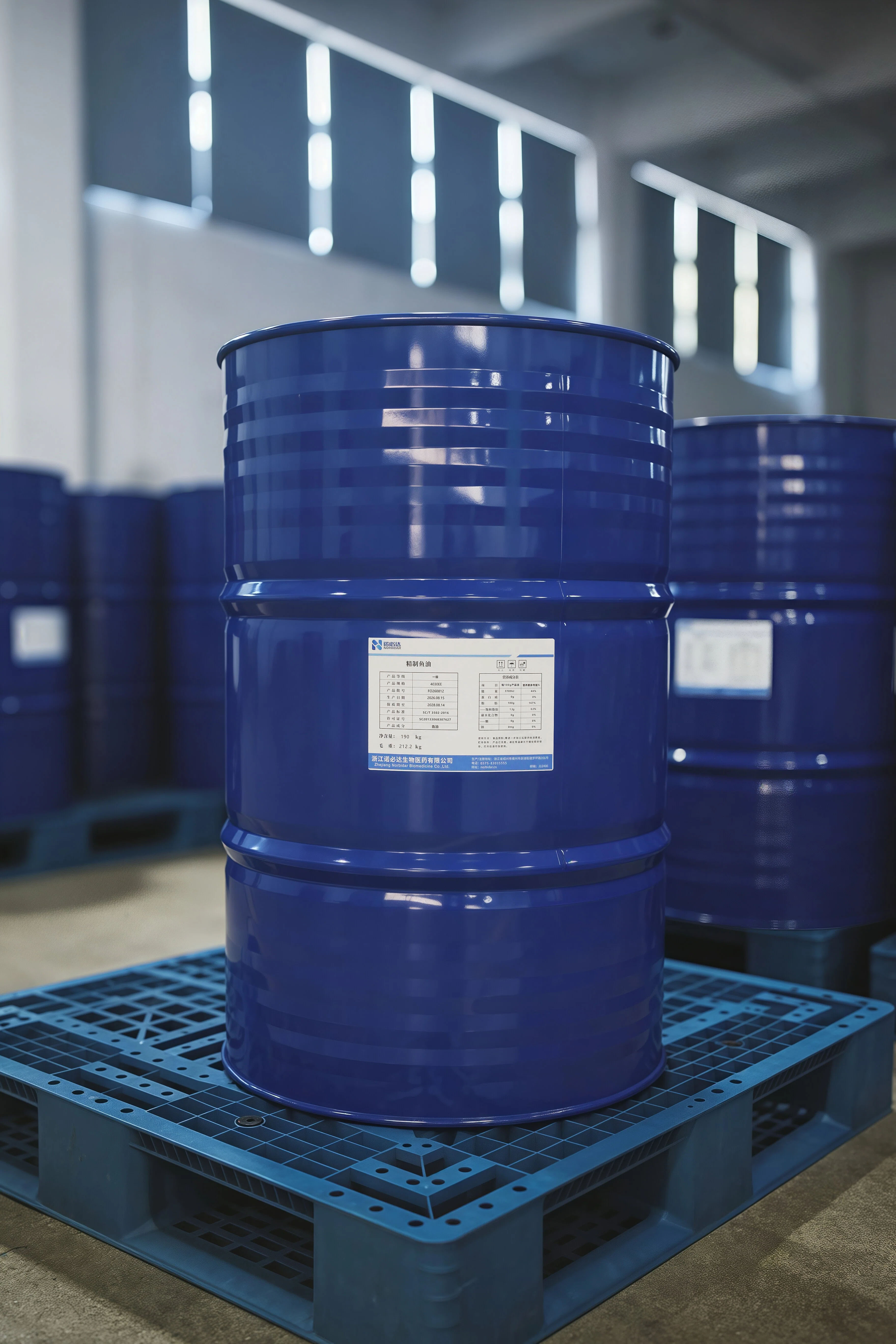
Packaging documentation for this product shows drum packaging and palletized drums. Buyers should confirm packaging compatibility against their own filling and handling equipment before commercial use.
Which grade fits which brief
3624 EE tends to fit when:
- The finished product positions on a balanced EPA+DHA story rather than an EPA-led claim.
- The formulation needs a moderate combined content but a larger oil mass for blending or delivery reasons.
- The buyer wants a lower-concentration entry point within the same EE family and manufacturing source.
5025 EE tends to fit when:
- The label claim is EPA-led and capsule burden matters.
- The formulator wants a mid-to-high concentration grade while keeping DHA at roughly a quarter of the oil.
- The buyer intends to run a DHA-tunable 50-series family (5020 EE / 5025 EE / 5030 EE) and wants EPA held constant across SKUs.
Neither grade is a DHA-dominant product. A buyer targeting high-purity DHA concentrate profiles should treat DHA-rich grades as a separate discussion; those grades are referenced in the company's product information as grades that can be discussed, but their parameters must be confirmed project by project.
Specification discipline: what should govern the purchase
Industry guidance on content expression matters here. GOED (Global Organization for EPA and DHA Omega-3s) published an industry advisory in 2018 on how EPA, DHA and total omega-3 content in EPA/DHA-containing oils should be correctly expressed. That advisory is not a government regulation, but it is a useful reference point when reviewing a supplier's specification and COA, because grade naming conventions across the industry are not perfectly uniform.
For both 3624 EE and 5025 EE, the buyer-side document set should include:
- The current product specification, stating how EPA, DHA and total omega-3 are expressed and on what analytical basis.
- The batch COA for the material actually being delivered.
- The SDS, including storage and handling conditions.
- Any destination-market documentation required for the target country of sale.
Norbidar states that batch-level analytical testing and traceability documentation support its quality management, and that current certificates and their exact scopes are provided for customer review where applicable. That last point matters for procurement: certificate scope should be verified against the buyer's own qualification requirements rather than assumed from a grade name.

The manufacturer behind the two grades
Because 3624 EE and 5025 EE come from the same production base, manufacturer capability is part of the comparison rather than background noise. Zhejiang Norbidar Biomedicine Co., Ltd. was established in 2018 and employs approximately 200 staff, including a 25-engineer R&D team. The site covers 72,000 m² in total, including 33,000 m² of building area.
Annual fish oil processing capacity is 10,000 metric tons. That figure describes input processing capacity, not finished-product output — a distinction worth keeping straight when comparing supplier capacity claims. Product development is supported by the proprietary NBD multi-stage continuous distillation process. The company reports that approximately 70% of its business serves international markets, with supply directed to dietary supplement and functional food manufacturers and distributors, and destination requirements confirmed per project.
For a buyer comparing two grades within one catalogue, this matters in a specific way: switching between 3624 EE and 5025 EE does not require switching supplier, qualification file, or documentation framework. That reduces the transaction cost of moving a formulation from one concentration tier to another.
Comparison with conventional alternatives — and the boundaries of this comparison
| Dimension | What the comparison shows | Boundary |
|---|---|---|
| Concentration logic | EPA is the decisive variable between the two grades; DHA is nearly fixed at 24–25% | Nominal values only; batch COA governs actual delivery |
| Form | Both are ethyl ester (EE) concentrates, not triglyceride concentrates | Form suitability for the buyer's downstream process must be confirmed by the buyer |
| Grade range coverage | Blended EE grades from 60% to 80% combined are listed, plus DHA-rich and EPA-rich grades by discussion | No verified grade-specific parameters for the DHA-rich or 8000 EE designations in the available material |
| Commercial terms | Custom EPA/DHA ratio profiles can be reviewed against formulation requirements | No verified pricing, MOQ or lead-time data; cost per gram of EPA cannot be benchmarked from public information |
| Compliance | Certificates and exact scopes are provided for review where applicable | Certification scope is project-specific and must not be assumed |
The honest limitation of this comparison is commercial, not technical. Concentration tiers can be compared precisely because their nominal contents are published; cost per kilogram of oil and cost per gram of EPA cannot, because no verifiable price, MOQ or lead-time figure is available. Any statement that 5025 EE is more or less economical per unit of EPA would be an assumption, not a finding. Buyers should resolve that gap through a direct RFQ covering both grades, since the answer depends on delivered volume, packaging format and destination.
A second boundary is form. Both grades are EE concentrates. Whether EE is the right form for a given finished product depends on the buyer's validated downstream process and formulation targets; the specification confirms what the material is, not whether it suits every application.
Market context for concentration-tier decisions
Concentrate purchasing does not happen in isolation from category demand. Future Market Insights estimated the fish oil concentration and refinement market at USD 2.6 billion in 2025, with growth at a CAGR of 6.8% between 2026 and 2035. The same source reported that 51%–80% EPA/DHA grades held 43.6% of concentration grade sales in 2026. Both 3624 EE (60% combined) and 5025 EE (75% combined) sit inside that band, which is where the volume of concentrate demand is concentrated.
Broader supplement demand is directionally consistent but should not be conflated with concentrate sizing. Grand View Research valued the global omega-3 supplements market at USD 8.3 billion in 2025 and projected USD 9.1 billion in 2026 — a finished-supplement figure, not a concentrate figure. It indicates demand pull for EPA/DHA ingredients; it does not size the concentrate market that 3624 EE and 5025 EE compete in.
A practical procurement framework for choosing between the two
- Start from the dose, not the grade code. Define the target EPA and DHA milligrams per serving, then back-calculate required oil mass for each candidate grade.
- Test both against the same claim architecture. If the claim is EPA-led, 5025 EE usually reduces oil burden. If the claim is DHA-led, the two grades are close on DHA per gram.
- Confirm EE-form suitability against the validated downstream process before committing to either grade.
- Request the current specification and a batch COA for each grade and check how EPA, DHA and total omega-3 are expressed.
- Review oxidation and contaminant specifications as part of the same document set.
- Confirm packaging compatibility — drum and palletized drum formats are documented for this product — and destination-market requirements.
- Run a sample evaluation before commercial use, covering both grades in the buyer's own formulation.
Future outlook
The centre of gravity in concentrate purchasing is the 51%–80% band, and the 50-series demonstrates how suppliers are responding: hold EPA constant, vary DHA, and let the formulator tune the blend rather than the supplier's catalogue. For buyers, the implication is that grade selection is becoming a formulation decision rather than a sourcing constraint.
Two developments are worth watching. First, custom EPA/DHA ratio profiles can be reviewed against formulation requirements, which shifts part of the differentiation from catalogue breadth to specification responsiveness. Second, documentation discipline is becoming a selection criterion in its own right: as content expression guidance becomes more formalised, the supplier that can present a clean specification-to-COA chain is easier to qualify. Norbidar's stated position — batch-level analytical testing, traceability documentation, and certificate scopes provided for customer review — is aligned with that direction, though its practical value depends on the buyer's own qualification criteria.
Frequently Asked Questions
What do the numbers in 3624 EE and 5025 EE mean?
In Norbidar's listed EE grades, the four-digit code follows the nominal EPA and DHA percentages. 3624 EE denotes 36% EPA and 24% DHA, combined 60%; 5025 EE denotes 50% EPA and 25% DHA, combined 75%. The EE suffix indicates the ethyl ester form. These values are nominal, and contractual limits and the analytical basis must follow the current specification and batch COA.
What applications are these concentrates intended for?
Both grades are food-grade ingredients for dietary supplement and nutraceutical formulation and are intended for dietary supplement ingredient applications. Typical application scenarios include nutraceutical formulation and functional food ingredient development, subject to formulation suitability and destination-market requirements.
Can the EPA/DHA ratio be customized instead of choosing a standard grade?
Custom EPA/DHA ratio profiles can be reviewed against formulation requirements, and additional blends as well as EPA-rich or DHA-rich grades can be discussed. Feasibility and specifications must be confirmed for the specific project before any grade is treated as available.
Which documents should a buyer request before ordering?
The current specification, the batch COA and the SDS, plus any destination-specific documents required for the target market. Certificate scopes are provided for customer review where applicable, and buyers should verify scope against their own qualification requirements.
What storage and handling conditions apply?
The concentrates are stored and handled under cool, dry, light-protected and oxygen-limited conditions, in line with the product specification and SDS. Before commercial use, buyers should also confirm EE-form suitability, the target EPA/DHA dose, oxidation and contaminant specifications, packaging compatibility and destination-market requirements.
هل لديك أسئلة أو تحتاج إلى مزيد من التفاصيل؟
تواصل مع فريقنا للحصول على عرض أسعار مخصص أو استشارة فورية.
طلب عرض أسعار
املأ النموذج أدناه وسيتواصل معك فريقنا بعرض مقترح مخصص.
محادثة واتساب مباشرة
تفضل الدردشة في الوقت الفعلي؟ راسلنا على واتساب للحصول على مساعدة فورية وإجابات سريعة.
- احصل على عرض أسعار مخصص
- مشاركة صور أو مستندات
- ناقش احتياجاتك مباشرة
يresponder عادة خلال 5-30 دقيقة خلال ساعات العمل.