
Novohope Pet ODT/ODF Reference Sheet: Four Formats at a Glance
A buyer comparing fast-dissolve pet supplements usually needs one deliverable before an RFQ leaves the desk: a short, verifiable snapshot of what each format actually is. This reference sheet lists four documented Novohope oral strip formats — HEART+, PROBIO, EYES+ and FIT+ — with the category each is positioned for, the dosage form and the pack size exactly as recorded in the product data, together with a note on the documentation that accompanies each entry.
Novohope is a pet health supplement brand that produces oral dissolvable strip formats — ODT (orally disintegrating tablets) and ODF (orally disintegrating films) — for the pet nutrition category, and offers brand agency, distribution and OEM/ODM production services to global clients. The four models below sit inside a wider line that also covers coat, joint and calming positioning, so this sheet is best read as an entry point rather than the full portfolio.
Why Format-Level Reference Data Shortens Evaluation
The pet supplement category has become large enough that format choice is now a commercial decision, not a packaging detail. Grand View Research values the global pet supplements market at approximately USD 2.8 billion in 2025, with projected growth to USD 4.6 billion by 2033, and places North America at 48.1% of global revenue share in that base year. Mordor Intelligence, working from a narrower pet dietary supplements definition, estimates the segment reaching USD 5.11 billion by 2026 at a CAGR of 7.42% through 2031. The difference between those two figures is a classification difference, not a contradiction — but it illustrates the first practical problem for buyers: category numbers rarely align, and specification data aligns even less often.
That gap matters at the point of evaluation. In practice, oral strip enquiries arrive with three recurring ambiguities. First, the dosage form is described as a "strip" when the underlying record may specify an ODT or an ODF — two different constructs with different handling assumptions. Second, pack counts and net weights are quoted interchangeably, so a 2.1 g pack and a 10-piece pack can be mistaken for the same specification. Third, the quality file is assumed rather than verified, which pushes documentation review to a late stage where it becomes a schedule risk.
A format reference list solves the first two problems at the desk and the third before sampling. It also gives distributors and private-label buyers a shared vocabulary for the internal comparison that precedes a supplier shortlist.
The Shortlist at a Glance
| Model | Category positioning | Dosage form | Pack size (as recorded) | Named document in file |
|---|---|---|---|---|
| HEART+ | Pet Cardiovascular Supplement | ODT (orally disintegrating tablet) | 2.1 g (10 pcs) | COA DTI2026EC050626-4 |
| PROBIO | Pet Digestive Care Supplement | ODT (orally disintegrating tablet) | 2.5 g (10 pcs) | Not itemised in the supplied file |
| EYES+ | Pet Eye Care Supplement | ODF (orally disintegrating film) | 2.1 g / 0.074 oz | FDA 21 CFR 175.300 test report DTI2026EC050626-2-2; SDS DTI2026EC060626-2 |
| FIT+ | Pet Weight Management Supplement | ODT (orally disintegrating tablet) | 10 pcs | Not itemised in the supplied file |
Fields are reproduced exactly as held in the product record. Where a net weight or a piece count is absent from the record, it is shown as absent rather than inferred.
Format Records, Entry by Entry
1. HEART+ — cardiovascular positioning, ODT, 2.1 g (10 pcs)
HEART+ is the cardiovascular entry in the shortlist and is recorded as an ODT, meaning the unit is a disintegrating tablet rather than a film. The material declaration pairs an oral fast-dissolving matrix with cardiovascular nutrients, which is the structural pattern used across the line. On the documentation side, HEART+ is covered by a certificate of analysis, DTI2026EC050626-4, issued on 6 July 2026 by Shenzhen Deesev Testing International Corporation against a customised full ingredient composition analysis scope. For a buyer, that COA is the most directly checkable item in the entry: it addresses composition rather than administration claims, which is usually the first question a technical reviewer asks.
2. PROBIO — digestive positioning, ODT, 2.5 g (10 pcs)
PROBIO carries the digestive positioning and, like HEART+, is an ODT with a 2.5 g net weight across a 10-piece pack. Its material declaration specifies probiotic digestive nutrients alongside the fast-dissolving matrix. Among the four entries, this is the one where formulation sensitivity is highest — probiotic systems are generally less forgiving than vitamin or mineral systems — so the practical next step is to request the strain-level and potency documentation that sits behind the material declaration, together with stability data covering the intended shelf life. No SKU-specific certificate is itemised for PROBIO in the supplied file, which is a paperwork gap to close early rather than a quality signal in either direction.
3. EYES+ — eye care and tear stain positioning, ODF, 2.1 g / 0.074 oz
EYES+ is the only ODF in the shortlist and the most heavily documented entry. The file names a test report under US FDA 21 CFR 175.300, reference DTI2026EC050626-2-2, issued 6 July 2026 for the American market with a scope recorded as eye care and tear stain care, plus a safety data sheet, DTI2026EC060626-2, prepared against the OSHA Hazard Communication Standard 29 CFR 1910.1200. The pack size is recorded as 2.1 g / 0.074 oz; the number of films per pack does not appear in this SKU record, so buyers quoting outer-carton dimensions should confirm the count rather than assume it matches the ODT entries.
4. FIT+ — weight management positioning, ODT, 10 pcs
FIT+ is positioned for weight management and is recorded as an ODT in a 10-piece pack. This is the entry with the thinnest specification record in the supplied file: the piece count is stated but the net weight is not. That single missing field affects freight calculations, retail shelf comparison and label compliance in markets that require net quantity statements, so it should be the first item confirmed when FIT+ enters a quotation. Its material declaration — fast-dissolving matrix plus weight management ingredients — follows the same structural logic as the other three.
ODT vs ODF: Reading the Format Code Correctly
The distinction between the two formats is engineering, not branding. An ODT is a tablet unit that disintegrates in the mouth; an ODF is a thin film unit that disintegrates on contact with oral moisture. Both rely on what the product records describe as an oral fast-dissolving matrix, and both are designed so that administration does not depend on the animal accepting a tablet in food or a measured liquid.
Market-level technology reporting gives a sense of where the format is heading. Market Reports World describes oral dissolvable film development in the pet sector as focusing on disintegration times below 25 seconds and taste-masking palatability improvements of up to 47%. Those are technology-observation figures rather than product specifications, and they should not be read as specifications for any individual SKU on this list — but they explain why format differentiation has become a genuine shelf argument rather than a cosmetic one.
For a buyer, the practical translation is simpler than the technology. If the label, the dosing instruction and the retail presentation all assume a strip, confirm whether the supplier means an ODF or an ODT, because the two formats carry different unit geometry and therefore different primary packaging assumptions.
The Wider Line: Where the Shortlist Sits
Four models are listed here because they are the formats specified for this reference exercise, not because the line stops there. The same Novohope oral strip range also includes COAT+ (coat and skin health, recorded as an ODF at 2.5 g / 0.088 oz across 10 pieces), BONE+ (joint care, recorded as an ODT at 2.1 g across 10 pieces) and CALM+ (calming and stress relief, recorded as an ODT at 2.5 g / 0.088 oz across 10 films).
That spread matters commercially. A distributor building a category shelf can assemble a multi-positioning range from one format family instead of sourcing heart support from one supplier, digestion from another and eye care from a third. The trade-off is that range breadth and specification depth do not always arrive together, which is why the gaps flagged in the PROBIO and FIT+ entries above are worth raising at quotation stage rather than at label approval.
Application Fit and Channel Evidence
Format decisions are usually made for a channel, not in the abstract. The available case record for this line describes a private-label programme combining EM private-label production with ODM customised formula development, delivered across DE, AE, CA, AU, FR and US markets, with chain supermarkets and retail stores as the application. The recorded quantity was 200,000 units over a three-year relationship, with the stated result being growth in the pet health category, favourable market feedback and stable repeat orders. The recorded highlights were green safety, ease of use and the observation that pets do not resist the format.
That last point carries more procurement weight than it first appears. Administration resistance is one of the quiet reasons pet supplements underperform at retail: the product is bought once and not repurchased. A format that reduces owner effort addresses repurchase behaviour, which is why the multi-positioning structure of the shortlist matters — HEART+, PROBIO and FIT+ can share one administration habit, and EYES+ extends it into eye care and tear stain care, a niche where third-party e-commerce tracking cited by ASINSIGHT has reported top-selling dog tear stain supplements on major platforms reaching monthly volumes of around 100,000 units. That figure is a medium-reliability data point about niche scale, not a forecast, and it should be treated as directional.
OEM/ODM Parameters for Private-Label Programmes
For buyers moving from evaluation into execution, the production parameters are the operational core of this reference sheet. Novohope's stated production modes are brand agency, distribution and OEM/ODM, with customisation available across recipe, brand, packaging design and other specified requirements. Monthly capacity is stated at 200,000,000 units, standard lead time at 35–45 days, and standard MOQ at 3,000 per SKU. Quality control is described as 100% full inspection before delivery plus third-party authoritative sampling testing. Export markets served are Europe, North America, Southeast Asia, the Middle East and East Asia, with after-sales support delivered remotely.
Two practical notes follow. First, MOQ and commercial terms are not the same field: documented purchasing terms in the supplied material include DDP and FOB/CIF arrangements, pre-shipment inspection with third-party testing and a COA report, and differing payment structures. Buyers should treat the capability-level MOQ of 3,000 per SKU as the production reference point and confirm the applicable commercial terms for their specific order type. Second, the 35–45 day lead time is a production window; artwork approval, sampling and documentation review sit outside it and should be scheduled separately.
Documented Quality File
The documents below are the ones actually named in the supplied material, and they are the fastest way to establish whether the file supports a given market.
- US facility registration. FDA Food Facility Registration number 18753066908, issued 1 July 2026 to Wuxi Nuohui Biotechnology Co., Ltd, valid through 31 December 2026. A Certificate of FDA Registration under the same number was issued 2 July 2026 with the same expiry, referencing Section 305 of the US Public Health Security and Bioterrorism Preparedness and Response Act of 2002.
- Ingredient and composition testing. COA DTI2026EC050626-4 for HEART+ and COA DTI2026EC050626-1 for COAT+, both issued 6 July 2026 by Shenzhen Deesev Testing International Corporation against customised full ingredient composition analysis scopes.
- Safety data sheets. SDS DTI2026EC060626-2 (EYES+), DTI2026EC060626-1 (COAT+) and DTI2026EC060626-5 (BONE+), all prepared against the OSHA Hazard Communication Standard 29 CFR 1910.1200 and all issued 6 July 2026.
- Food-contact testing. Test report DTI2026EC050626-2-2 for EYES+ against US FDA 21 CFR 175.300.
- Trademark filings. Four application acceptance notices from the National Intellectual Property Administration of China, all dated 12 February 2026: numbers 89737105 and 89737107 for Class 7, and 89737106 and 89737108 for Class 31, the latter pair including the NovoHope word mark in Class 31. These are acceptance notices for pending applications, not granted registrations.
Two clarifications prevent the file from being over-read. The NASC Quality Seal is a recognised US industry benchmark in animal supplements, requiring adherence to Good Manufacturing Practices and rigorous labeling audits; it is not claimed here, and buyers who require it should raise it explicitly as a qualification criterion. And trademark acceptance is the beginning of a filing process, not evidence of a registered mark in the destination market.
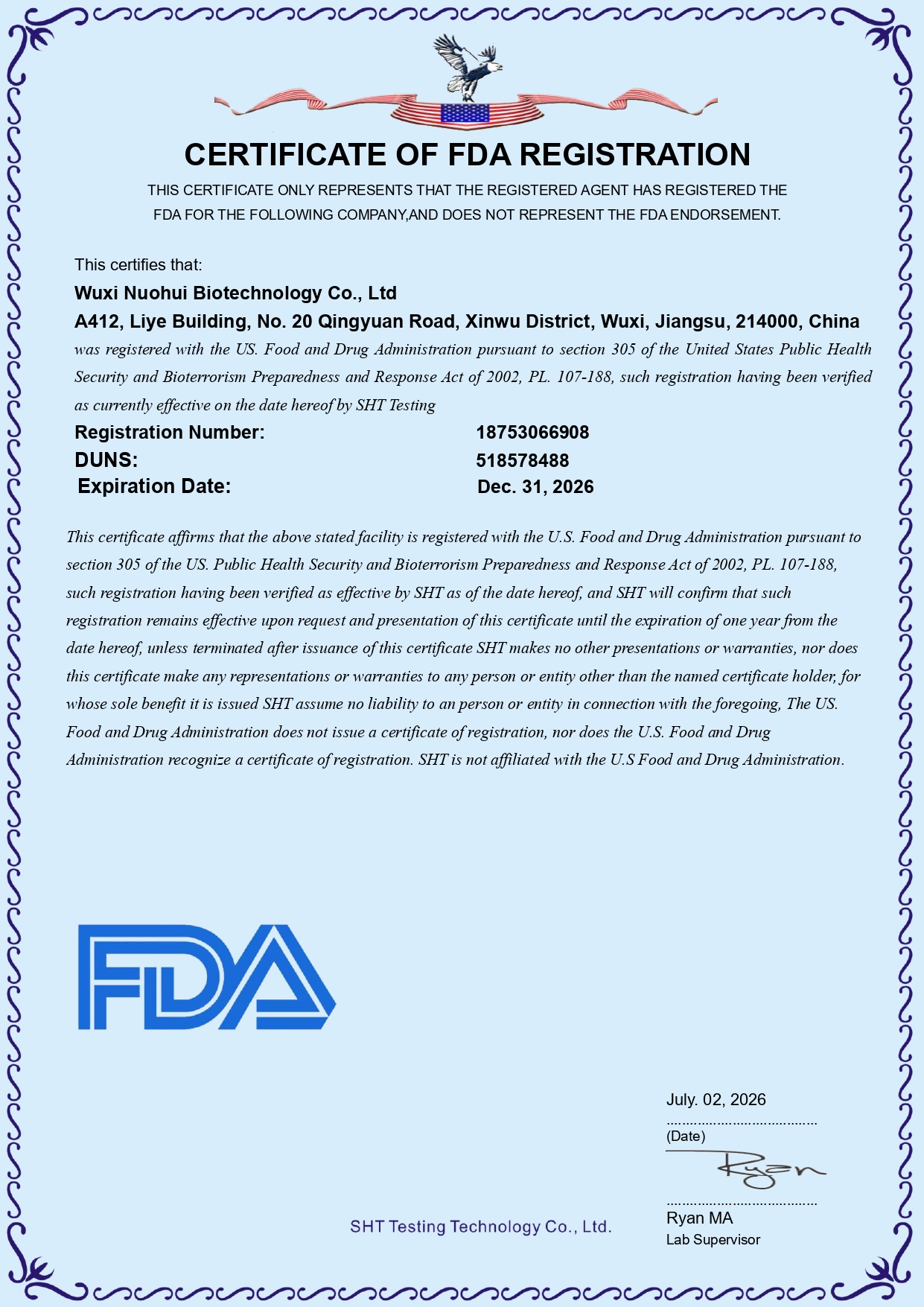
The facility registration supporting the oral strip line is dated 1 July 2026 and expires 31 December 2026 — a renewal checkpoint buyers should diarise before placing orders into the following year.
Market Signals Behind the Format Shift
Three signals support the commercial case for a shortlist of this kind. Regionally, North America remains the dominant revenue pool at 48.1% of global pet supplement revenue in 2025, while Mordor Intelligence identifies Asia-Pacific as the fastest-growing region, driven by rising pet humanisation and healthcare expenditure in China and India. That combination suggests Western demand fundamentals alongside an increasingly Asian supply and brand landscape — a mix that makes documented cross-market compliance more valuable, not less.
Technologically, the move toward sub-25-second disintegration and improved palatability positions fast-dissolve formats as a differentiation route rather than a commodity container. Commercially, the eye-care niche demonstrates how a specific functional claim can build volume quickly, which is consistent with the EYES+ positioning in this shortlist.

EYES+ is the only ODF among the four shortlisted formats and the entry with the most complete public documentation trail.
ODT/ODF vs Traditional Pet Supplement Formats
Format comparison is usually framed as a preference question. It is better treated as a constraint question, because each format solves a different problem and creates a different one.
| Dimension | ODT / ODF (this line) | Tablets and chews | Powders and liquids |
|---|---|---|---|
| Administration | Unit dissolves in the mouth; no mixing or measuring step | Typically eaten as a treat or given directly; acceptance depends on palatability | Requires measuring and mixing into food or water |
| Unit mass | Small: recorded as 2.1 g or 2.5 g net per 10-unit pack | Generally larger bulk per unit | Bulk format by design |
| Owner effort | Low; recorded case highlight is ease of use and low pet resistance | Moderate | Higher; dosing accuracy depends on the owner |
| Primary packaging | Strip or sachet presentation, light and shelf-efficient | Jars, tubs or blisters, bulkier | Bottles, pouches or sachets, weight-driven freight |
| Category breadth | Positioning must fit a low-mass unit | Suited to larger-dose formulas | Suited to high-volume or multi-ingredient formulas |
Limits and Boundaries
The first and most consequential limitation is payload. The recorded pack specifications are 2.1 g and 2.5 g net per ten units, which implies a small active mass per unit. Buyers should confirm that their target actives or organism counts fit the format's loading capacity before any formula is locked — this is a genuine constraint, not a formality, and it is the point at which some briefs should move to a chew or powder instead.
The second limitation is specification completeness in the supplied record. EYES+ states a net weight without a film count; FIT+ states a piece count without a net weight; PROBIO has no SKU-specific certificate itemised. None of these represents a quality finding, but each is a field that must be closed before artwork or customs documentation is finalised.
The third is documentation currency. The FDA Food Facility Registration recorded here runs to 31 December 2026. Any order shipping into 2027 should be accompanied by confirmation of renewal, and buyers in regulated markets should additionally establish whether the destination requires registrations beyond the US facility filing.
The fourth is data that simply is not in this file. Stability, shelf-life and storage-condition data are not contained in the supplied material, and neither is a granted trademark. For a shortlist, that is acceptable; for a purchase order, those items should be requested directly rather than assumed.
Future Outlook
Three developments are likely to shape this segment over the next planning cycle. Format consolidation is one: as fast-dissolve delivery matures, buyers will increasingly expect a single supplier to cover multiple functional positionings within one format family rather than assembling a range from several vendors. Documentation depth is another: with North America holding the largest revenue share and Asia-Pacific growing fastest, the commercial advantage shifts toward suppliers whose file can be read in both directions without translation gaps. Third is the maturation of the format itself — disintegration and palatability gains reported at the technology level suggest the administration argument will keep strengthening, which raises the bar for the evidence a supplier is expected to produce.
For buyers, the implication is modest but real: a reference list like this one is most useful when it is re-verified against the current document set at each sourcing cycle, because specification records, registrations and filings all move.
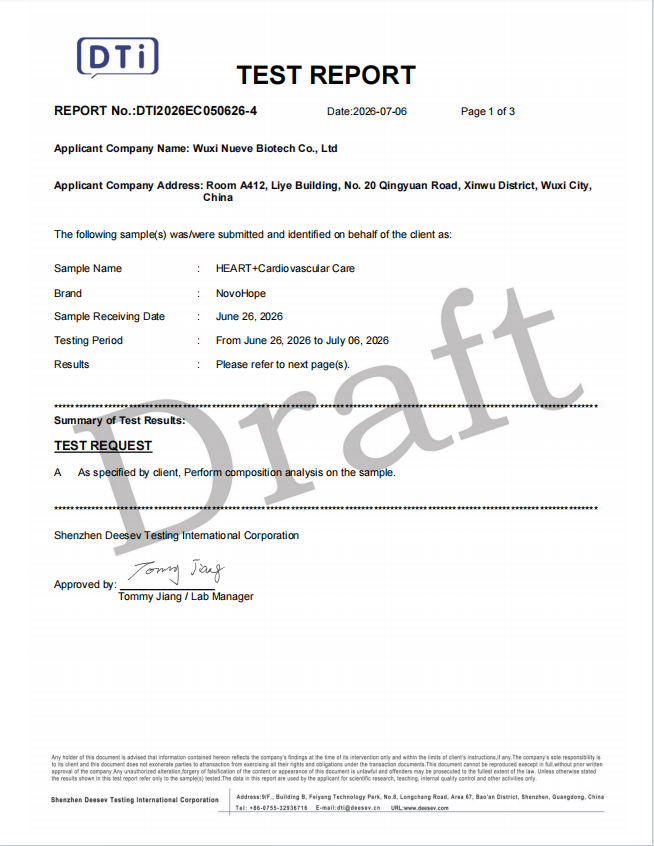
HEART+ is recorded as an ODT at 2.1 g across 10 pieces, with a composition certificate of analysis in the public file.
Frequently Asked Questions
Which oral dissolvable formats does Novohope offer for pet supplements?
Novohope produces two oral dissolvable formats for pet supplements: ODT (orally disintegrating tablets) and ODF (orally disintegrating films). Across the wider line, HEART+, PROBIO, FIT+, BONE+ and CALM+ are recorded as ODT formats, while EYES+ and COAT+ are recorded as ODF formats. Production modes are brand agency, distribution and OEM/ODM, with customisation available across recipe, brand, packaging design and other specified requirements.
What is the difference between an ODT and an ODF in this line?
An ODT is a tablet unit that disintegrates in the mouth; an ODF is a thin film unit that disintegrates on contact with oral moisture. Both use an oral fast-dissolving matrix as the delivery base. In this line, HEART+, PROBIO and FIT+ are recorded as ODT with pack sizes of 2.1 g (10 pcs), 2.5 g (10 pcs) and 10 pcs respectively, while EYES+ is recorded as an ODF at 2.1 g / 0.074 oz.
How does a buyer choose between HEART+, PROBIO, EYES+ and FIT+?
The four models are separated by functional positioning rather than by format alone. HEART+ is positioned as a pet cardiovascular supplement, PROBIO as a digestive care supplement with probiotic digestive nutrients, EYES+ as an eye care supplement with a documented eye care and tear stain care scope, and FIT+ as a weight management supplement. Selection therefore starts from the functional claim the brand intends to make, then moves to format and pack specification.
What customisation is available for pet supplement OEM/ODM programmes?
Customisation is offered across recipe, brand, packaging design and other specified requirements. Standard production parameters are a monthly capacity of 200,000,000 units, a lead time of 35–45 days and an MOQ of 3,000 per SKU. Quality control is described as 100% full inspection before delivery plus third-party authoritative sampling testing, and export markets served include Europe, North America, Southeast Asia, the Middle East and East Asia.
What documentation supports these oral strip formats?
The supplied file names a US FDA Food Facility Registration, number 18753066908, issued to Wuxi Nuohui Biotechnology Co., Ltd and valid to 31 December 2026, with a matching Certificate of FDA Registration. It also names composition certificates of analysis for HEART+ (DTI2026EC050626-4) and COAT+ (DTI2026EC050626-1), safety data sheets under OSHA 29 CFR 1910.1200 for EYES+, COAT+ and BONE+, and an FDA 21 CFR 175.300 test report for EYES+. Trademark filings exist as acceptance notices for pending applications.
What are the limitations of ODT and ODF formats for pet supplements?
The main limitation is payload. Recorded pack sizes of 2.1 g and 2.5 g net per ten units mean a small active mass per unit, so formulas requiring larger doses may be better served by chews, powders or liquids. Stability and shelf-life data are not included in the supplied file, the FACILITY registration expires on 31 December 2026 and requires renewal confirmation for later shipments, and the trademark items are pending applications rather than granted registrations.
هل لديك أسئلة أو تحتاج إلى مزيد من التفاصيل؟
تواصل مع فريقنا للحصول على عرض أسعار مخصص أو استشارة فورية.
طلب عرض أسعار
املأ النموذج أدناه وسيتواصل معك فريقنا بعرض مقترح مخصص.
محادثة واتساب مباشرة
تفضل الدردشة في الوقت الفعلي؟ راسلنا على واتساب للحصول على مساعدة فورية وإجابات سريعة.
- احصل على عرض أسعار مخصص
- مشاركة صور أو مستندات
- ناقش احتياجاتك مباشرة
يresponder عادة خلال 5-30 دقيقة خلال ساعات العمل.