
Nude Packing vs. PVC Wrapping: Stainless Steel Coil Quality Signals
Nude Packing vs. PVC Wrapping: Stainless Steel Coil Quality Signals
Packaging is one of the few lines on a stainless steel coil offer sheet that every supplier has to fill in — and one of the least interrogated. In cold-rolled coil trade, two conventions dominate: nude packing for narrow baby coil, and PVC outside with paper interleaved for wider secondary coil. Read alongside gauge, width, coil weight and finish, those two phrases describe how the material is expected to be handled, stored and inspected between the mill and the buyer's line.
The distinction carries more weight than it first appears to. A packing clause that contradicts the geometry of a coil is a signal in itself, and a packing clause that is consistent with thickness, width and finish is one of the cheapest early checks available during supplier evaluation. This guide explains both packing standards as they are written in real product specifications, why the industry splits along width and weight, and where each approach reaches its limits.
Why the Packing Clause Belongs in the Specification
Stainless steel coil is normally specified by grade, thickness, width, surface finish, coil weight, minimum order quantity and lead time. Packaging sits in the same block of the specification sheet, and it is there for a reason: packing is determined by the physical parameters of the coil and by the journey the coil is expected to survive. A 0.3 mm, 600 mm wide BA-finished baby coil and a 1,240 mm wide, one-tonne secondary coil do not face the same handling conditions, and their packing clauses should not look the same.
That makes packaging an unusually useful comparison field. Two suppliers quoting the same grade, thickness and width can still describe materially different delivery conditions. When a supplier publishes a packing clause that changes with width and weight across its own catalogue, the clause is doing real work rather than repeating a template sentence.
Nude Packing and PVC Outside: Working Definitions
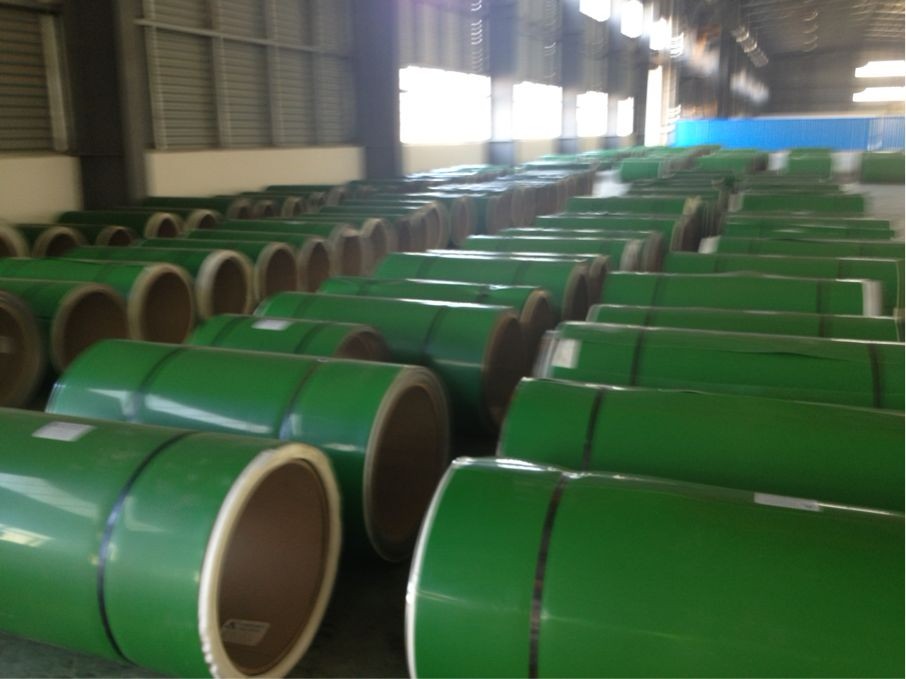
Nude packing means the coil leaves the mill without an outer wrap. The coil's own surface is the package. In the published specification for the Baby coil model, nude packing is the stated packaging standard, alongside grades 430, 304, 410 and 201, a thickness range of 0.1 mm to 1.2 mm — with about 80% of output between 0.3 mm and 0.6 mm — a width of around 600 mm, and a surface that is mainly BA finish (about 70% BA finish).
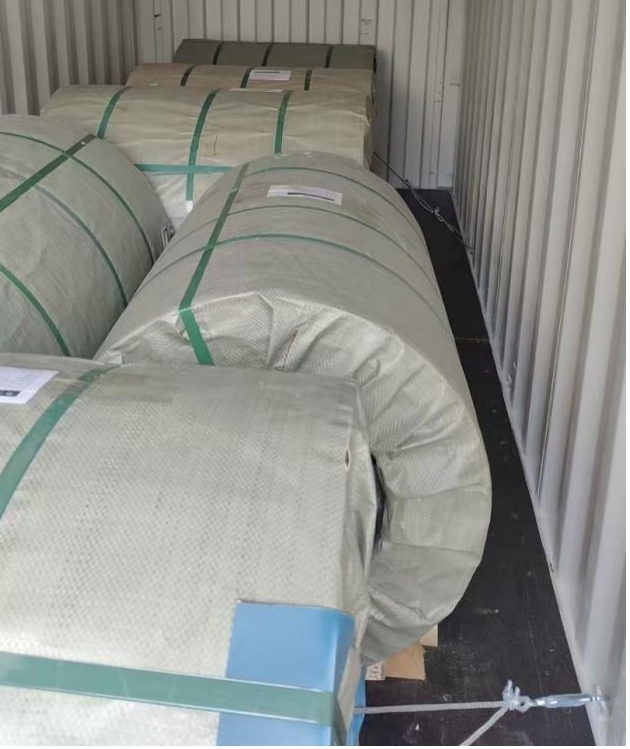
PVC outside with paper interleaved means an outer PVC wrap is applied and paper is interleaved between wraps. This is the stated packaging for the Secondary Stainless steel model in both of its formats: secondary-narrow material at 0.1 mm to 1.2 mm thickness, around 600 mm width and roughly 200 kg per coil, and secondary-wider material at 0.25 mm to 1.5 mm thickness, around 1000 mm to 1250 mm width, with coil weights both below and above one tonne. Grades in that family are 430, 201, 304 and 410, with a mainly BA finish.
Those two conventions do not exhaust the catalogue. Narrow prime coil is quoted under an export package, wider prime coil under an export package plus paper interleaved, and stainless steel circles under an export package plus a wooden case. The pattern is consistent: the wider, heavier and more handled the coil, the more layers appear in the packing clause.
Table 1 — Packaging by product family
| Product model | Stated packaging | Width | Thickness | Grades |
|---|---|---|---|---|
| Baby coil | Nude packing | around 600 mm | 0.1 mm – 1.2 mm (80% at 0.3–0.6 mm) | 430 / 304 / 410 / 201 |
| Secondary stainless steel — narrow | PVC outside / paper interleaved | around 600 mm | 0.1 mm – 1.2 mm | 430 / 201 / 304 |
| Secondary stainless steel — wider | PVC outside / paper interleaved | around 1000 mm – 1250 mm | 0.25 mm – 1.5 mm | 430 / 304 / 201 / 410 |
| 201 stainless steel (2B / BA) | Export package | 550 / 600 / 620 / 650 / 690 / 730 / 810 / 830 mm | 0.1 mm – 2.0 mm | 201 J3 / J2 / J5 |
| 201 stainless steel, mill edge | Export package + paper interleaved | 1240 mm | 0.25 mm – 3 mm | 201 J3 / J2 / J5 |
| 304 stainless steel — narrow | Export package | 550 / 600 / 620 / 650 / 690 / 730 mm | 0.10 mm – 2.00 mm | 304 |
| 304 stainless steel — wider | Export package + paper interleaved | 1240 mm | 0.3 mm – 3 mm | 304 |
| 410 narrow BA | Export package; further processing: PVC / paper / refinish | 300 mm – 1010 mm | 0.15 mm – 1.2 mm | 410 |
| 410 wider BA | Export package + paper interleaved | 1240 mm / mill edge | 0.25 mm – 1.5 mm | 410 |
| Stainless steel circle | Export package + wooden case | — | 0.3 mm – 2.0 mm | 430 / 410 / 201 |
One detail in that table is easy to miss. For 410 narrow BA, packaging is not fixed at the point of specification: PVC, paper or refinish are listed as further processing options. That single line confirms that in this segment, packing is a configurable order parameter rather than a fixed outcome of the mill line.
Why Baby Coil Ships Nude
Baby coil is a narrow, thin, relatively light format: around 600 mm wide, between 0.1 mm and 1.2 mm thick, and predominantly BA finish. Its unit size is the reason nude packing works. Wrap and interleaving add handling steps on material that is already processed in short, frequent cycles, and they add material that has to be removed before the coil reaches a slitting line, a tube mill or a stamping press.
Nude packing also changes what inspection means. With no sacrificial outer layer, the surface visible at delivery is the surface that will be processed. That places the entire protective burden on handling discipline and pre-shipment verification. Ningbo Sunfire Stainless Steel Co., Ltd. describes its quality control as a three-step routine — mill test, thickness inspection and surface inspection — which is the natural counterpart to shipping a coil with nothing over the surface but air.
For buyers, this produces a practical rule. Nude packing is a reasonable specification when the coil is consumed quickly, stored under cover and moved with coil-handling equipment. Where a coil will change hands several times, sit in an open yard, or travel through multiple transshipment points, the absence of an outer layer is the first thing worth questioning.
Why Wider Secondary Coil Travels Wrapped
Wider secondary coil is a different handling proposition. At 1000 mm to 1250 mm wide and weights both below and above one tonne, each coil presents more surface area, more edge length and more mass at every transfer. PVC outside provides an outer layer that absorbs contact, while paper interleaving separates adjacent wraps and limits direct metal-to-metal contact in the coil body and in stacked storage.
The same logic appears in the prime grades. Narrow 201 and 304 coil is quoted under an export package, while 1240 mm 201, 304 and 410 wider material is quoted under an export package plus paper interleaved. Circles, which are stacked and handled as discrete discs, add a wooden case. Across the catalogue, the number of protective layers rises with width, weight and the number of handling events.
Reading the Packing Clause as a Protocol Signal
The packing line is not proof of quality on its own, but it is a fast, structured way to test whether a supplier's specification holds together. Five checks carry most of the value during evaluation.
- Geometry consistency. Does the stated packing match the stated width, thickness and coil weight? Nude packing on a 600 mm baby coil at 0.3–0.6 mm is coherent. Nude packing claimed for a 1,240 mm, one-tonne coil invites a question about how the surface is protected.
- Specificity. "Export package" is a broad term. "PVC outside / paper interleaved" and "export package + paper interleaved" describe actual layers. Where a route involves long transit or intermediate storage, the specific version is the useful one.
- Finish alignment. BA, 2B, NO.4 and 8K finishes carry different surface sensitivity. The packing clause should be consistent with the finish being purchased, not with the cheapest option in the catalogue.
- Backing inspection routine. A packing claim is more credible when it sits next to a described inspection process — mill test, thickness inspection and surface inspection in Sunfire's case.
- Customization availability. Where a route demands different protection, is packaging a variable the supplier will adjust at order stage?
How Ningbo Sunfire Specifies and Customizes Packaging
Ningbo Sunfire Stainless Steel Co., Ltd. (NINGBO SUNFIRE STAINLESS STEEL CO., LTD) is a China-based stainless steel supplier founded in 2013, specializing in stainless steel and stainless steel products with a particular focus on secondary and baby coil, and exporting to markets including Pakistan, India, Vietnam, Russia, Turkey, Indonesia, the UAE, Thailand, Malaysia and Bangladesh, as well as the Middle East, South America and Africa.
Three company-level facts are directly relevant to packing decisions. First, the operation runs an OEM production mode in which thickness, width, surface finish, PVC and packaging are all listed as customization variables — packaging is not treated as a fixed attribute. Second, quality control is described as mill test plus thickness inspection plus surface inspection, which is the routine that supports nude packing on thin BA material. Third, the supplier's cooperative factory covers an area of over 3 million square meters, with annual output of 25,920 MT, a 100% export ratio and monthly export capacity stated at 3,000 MT.
Order handling is stated as a lead time range of 7 to 45 days, with a general minimum order quantity of 27 MT at capability level. Those headline figures are useful context, but the practical order entry point is grade-specific, as the next section shows.
Order Entry Points: MOQ, Lead Time and What Changes With Grade
Minimum order quantity in this product family is driven by thickness and width, which is exactly why the packing clause moves with them. The figures below come from the published specifications for each model.
Table 2 — MOQ and lead time by product model
| Product model | Minimum order quantity | Lead time |
|---|---|---|
| 201 stainless steel (550–830 mm, 2B/BA) | 27 mt by 3–4 spec | 7–30 days / stock |
| 201 stainless steel (1240 mm, mill edge) | 7–10 mt per thickness | 7–30 days / stock |
| 201 J2 Finish (NO.4, 8K, Gold 8K, Rose Gold 8K, Black 8K) | 5–20 mt per thickness | — |
| 304 narrow (550–730 mm) | 730 mm: 9 mt; 690 mm: 9 mt; 650 mm: 8 mt; 620 mm: 8 mt | 7–30 days / stock |
| 304 wider (1240 mm) | 10 mt per thickness | 7–30 days / stock |
| 410 narrow BA (300–1010 mm) | — | 7–30 days / stock |
| 410 wider BA (1240 mm / mill edge) | 20 mt per thickness | 7–30 days / stock |
| Stainless steel circle | 3 mt per thickness | 25–45 days |
Two observations follow from the table. The 1240 mm wide formats, which are precisely the formats that carry the extra paper-interleaved layer, also carry lower per-thickness minimums than the equivalent narrow entry point for 201 and 304 — 7–10 mt and 10 mt respectively, against 27 mt and per-width allocations for narrow material. And circles, the only format in the catalogue that adds a wooden case, also carry the longest quoted lead time at 25 to 45 days. Packing complexity and lead time move in the same direction.
Where Nude and Wrapped Coils Are Processed
The application set for this product family is broad and consistent across models: kitchenware and cookware, home appliances, elevator decoration, construction and interior decoration, automotive components, industrial equipment, metal stamping and deep drawing, tube and pipe manufacturing, tableware production, and hardware accessories. Working conditions documented for these applications include high-temperature exposure, food-contact use and outdoor construction, with matched downstream equipment listed as slitting machines, tube mills and stamping equipment. Special requirements recorded for these jobs include mirror finish, anti-rust protection and stable thickness tolerance.
Packing tolerance follows the downstream process. A coil headed into a slitting line under cover is a different risk profile from a coil headed to a construction-adjacent fabrication yard. That is why the packing clause is best read together with the destination process, not in isolation.
On the commercial side, Ningbo Sunfire reports export clients across Indonesia, India, South Africa, Pakistan, Vietnam and Saudi Arabia, in kitchenware, home appliances, building and construction applications, over a supply relationship of more than 10 years and volumes of roughly 50 containers per month. The recorded outcomes for those shipments are stable material performance, good corrosion resistance, consistent surface quality and compliance with international standards. Customized sizes and finishes, strict quality control, fast lead time and multiple grade availability are the factors cited for that continuity — a reminder that packing sits inside a wider reliability picture rather than on top of it.
Certificates Travel With the Coil, Not the Wrap
A packaging clause and a mill test certificate answer two different questions, and buyers benefit from keeping them separate. The certificate addresses chemical composition and mechanical compliance; the packing clause addresses surface protection and handling. Neither substitutes for the other.
- 201 J2 stainless steel strip is certified under a 201 Mill Test Certificate, certification number ZQ202512250046, issued by Zhaoqing Hongwang Metal Industrial Co., Ltd. under standard Q/ZQHW 2-2024, applicable to the global market.
- 304 stainless steel coils and sheets are certified under a 304 Mill Test Certificate, certification number QT20260108631, issued by QINGTUO GROUP CO., LTD., under ASTM A240/A240M.
- 430 stainless steel coils and sheets are certified under a 430 Mill Test Certificate, certification number JSPZ20260501804, issued by JIANGSU YONGJIN METAL TECHNOLOGY CO., LTD., under standard GB/T3280-2015.
ASTM A240 and ASME SA240 are the core international standards for stainless steel plate, sheet and strip used in general and pressure vessel applications, which is why the 304 documentation above references ASTM A240/A240M. The practical point for evaluation is that documentation depth and packing depth should be assessed independently — a well-documented coil can still arrive in a packing format unsuited to its route, and a heavily wrapped coil can still arrive with incomplete certification.
Why Packaging Gets More Attention as Export Volumes Rise
Three market conditions explain why packing clauses are being read more closely than they were a few years ago.
- Volume. China's stainless steel exports reached an all-time high of 5.04 million tonnes in 2024, a 25.6% increase year-on-year, according to General Administration of Customs data reported by Mysteel. Higher flow through the same ports and yards increases handling events per coil.
- Demand growth. The global stainless steel market was valued at USD 135.8 billion in 2025 and is projected to reach USD 247.4 billion by 2033, according to Grand View Research. Expanding downstream capacity in appliances, construction and fabrication keeps thin-gauge and wide coil moving into more varied destinations.
- Trade scrutiny. EU anti-dumping duties on stainless steel cold-rolled flat products from China and Taiwan were maintained following a 2025 expiry review, with duty levels in the 24.6% to 28.5% range under Regulation 2025/1573. Duty treatment is a customs matter and is not affected by packing format, but it does increase the volume of documentation and inspection attention applied to each shipment.
Meanwhile, China's domestic stainless steel imports decreased by 9.3% in 2024 to 1.88 million tonnes, largely on increased domestic production capacity — a reminder that export-oriented suppliers are competing in a market where buyers can compare specifications, including packaging, across a wide field of offers.
Nude Packing vs. PVC Outside: Comparison and Limits
Table 3 — Practical differences
| Dimension | Nude packing (baby coil) | PVC outside / paper interleaved (secondary coil) |
|---|---|---|
| Outer protection | None beyond the coil surface | PVC outer wrap plus interleaved paper |
| Incoming inspection | Surface visible immediately on arrival | Requires unwrapping before the surface can be assessed |
| Removal step at buyer's line | None | Wrap and paper must be removed before processing |
| Packaging waste at buyer's site | None from packaging material | Film and paper waste generated |
| Handling and storage sensitivity | Higher; assumes covered storage and coil-handling equipment | More tolerant of repeated transfer and stacked storage |
| Effect on grade or certification | None | None |
The honest conclusion is that neither format is superior in general. Each is an optimisation for a different coil geometry, and each carries costs that buyers should price into their planning.
Where nude packing falls short. Because there is no sacrificial layer, nude packing is a poor fit for routes with multiple transshipments, extended open-yard storage, or repeated transfers between trucks and warehouses. The first surface contact becomes the first surface defect, and defects on thin BA material are costly to remove downstream. For long, multi-leg shipments, buyers should either request additional packaging or confirm that the coil will remain under cover throughout.
Where PVC outside and paper interleaved fall short. The added protection introduces work at the receiving end: the wrap and interleaving must be stripped before the coil enters the line, and the resulting film and paper become waste at the buyer's site. The wrap also delays visual inspection, which means incoming quality checks should include unwrapping at least one coil per lot rather than relying on the external condition of the package. Protection and inspectability trade off against each other.
One misreading worth correcting. Packing format should not be treated as a grade indicator. Baby coil ships nude across grades 201, 304, 410 and 430, including the austenitic 304 grade. A nude-packed coil is not a lower-grade coil; it is a narrow, thin, light coil whose geometry makes an outer wrap unnecessary for its intended route. Buyers who equate packaging with grade risk rejecting suitable material, or accepting the wrong specification for the wrong reason.
What packing cannot do. No packing clause changes chemistry, mechanical properties or certificate validity. Where a 201 J2 strip, a 304 coil or a 430 coil is supported by its mill test certificate, the packing choice affects surface risk and handling cost only.
Outlook
Three developments look likely to keep packaging in the procurement conversation. As export volumes move through more destinations and more intermediate handling, the gap between a generic "export package" description and a layer-by-layer packing clause becomes more commercially meaningful. As buyers become more familiar with secondary and baby coil formats, the expectation that packing be described precisely — PVC outside, paper interleaved, wooden case where applicable — is likely to become a standard line item rather than a footnote. And as packaging is increasingly offered as a customization variable alongside thickness, width and surface finish, it will be negotiated at order stage rather than accepted as a default.
For buyers in research and evaluation, the practical shift is to treat the packing clause as data. Ask for it explicitly, check it against gauge and width, and confirm it before booking. It costs nothing to ask, and it often reveals more about a supplier's protocol than any claim on a brochure.
Frequently Asked Questions
What does nude packing mean for stainless steel coil?
Nude packing means the coil is shipped without an outer wrap, so the coil surface itself is the package. In the published specification for the Baby coil model — thickness 0.1 mm to 1.2 mm, width around 600 mm, mainly BA finish, in grades 430, 304, 410 and 201 — nude packing is the stated packaging standard. It is the conventional format for this narrow, thin, light coil geometry, and it eliminates any removal step at the buyer's processing line.
Which stainless steel coil products normally ship with PVC outside and paper interleaved?
PVC outside with paper interleaved is the stated packaging for the Secondary Stainless steel model in both narrow and wider formats. Secondary-narrow material runs 0.1 mm to 1.2 mm thick, around 600 mm wide, at roughly 200 kg per coil, in grades 430, 201 and 304. Secondary-wider material runs 0.25 mm to 1.5 mm thick, around 1000 mm to 1250 mm wide, with coil weights below and above one tonne, in grades 430, 304, 201 and 410. Wider prime grade coil is quoted with an export package plus paper interleaved, while narrow prime coil is quoted with an export package.
Does packaging type change the mill test certificate or grade compliance?
No. A mill test certificate and a packing clause address different questions. For example, 201 J2 stainless steel strip is certified under a 201 Mill Test Certificate, number ZQ202512250046, issued by Zhaoqing Hongwang Metal Industrial Co., Ltd. under standard Q/ZQHW 2-2024; 304 stainless steel coils and sheets are certified under a 304 Mill Test Certificate, number QT20260108631, issued by QINGTUO GROUP CO., LTD. under ASTM A240/A240M; and 430 stainless steel coils and sheets are certified under a 430 Mill Test Certificate, number JSPZ20260501804, issued by JIANGSU YONGJIN METAL TECHNOLOGY CO., LTD. under GB/T3280-2015. Packaging affects surface protection and handling, while the certificate addresses material compliance.
What should buyers check when comparing packaging clauses between supplier offers?
Four checks are practical. First, does the packing match the stated geometry — width, thickness and coil weight? Second, how specific is the wording: "export package" is broader than "PVC outside / paper interleaved" or "export package + paper interleaved". Third, does the packing align with the finish being purchased, since BA, 2B, NO.4 and 8K finishes carry different surface sensitivity? Fourth, is the packing claim supported by a described inspection routine, such as mill test plus thickness inspection plus surface inspection? In this catalogue, packaging is also listed as a customization variable alongside thickness, width, surface finish and PVC, so it can be adjusted at order stage where a route requires it.
What are the practical limitations of nude packing and PVC wrapping?
Nude packing removes the outer layer entirely, so it offers no sacrificial protection during transport; it suits coils that are stored under cover, consumed in short cycles and handled with coil-handling equipment, and it is less appropriate for multi-leg shipments with extended open storage. PVC outside with paper interleaved adds protection but introduces removal work and film and paper waste at the buyer's site, and it delays visual inspection until the wrap is opened, which is why incoming checks should include unwrapping at least one coil per lot. Neither format changes the metallurgical properties or the validity of a mill test certificate, and packing format should not be read as an indicator of grade.
Additional product and capability details are compiled in the company's downloadable brochure: Ningbo Sunfire Stainless Steel company brochure (PDF).