
Nursing Cart T003 in Inpatient Wards: Modular Storage Fit
Nursing Cart T003 in Inpatient Wards: Modular Storage Fit
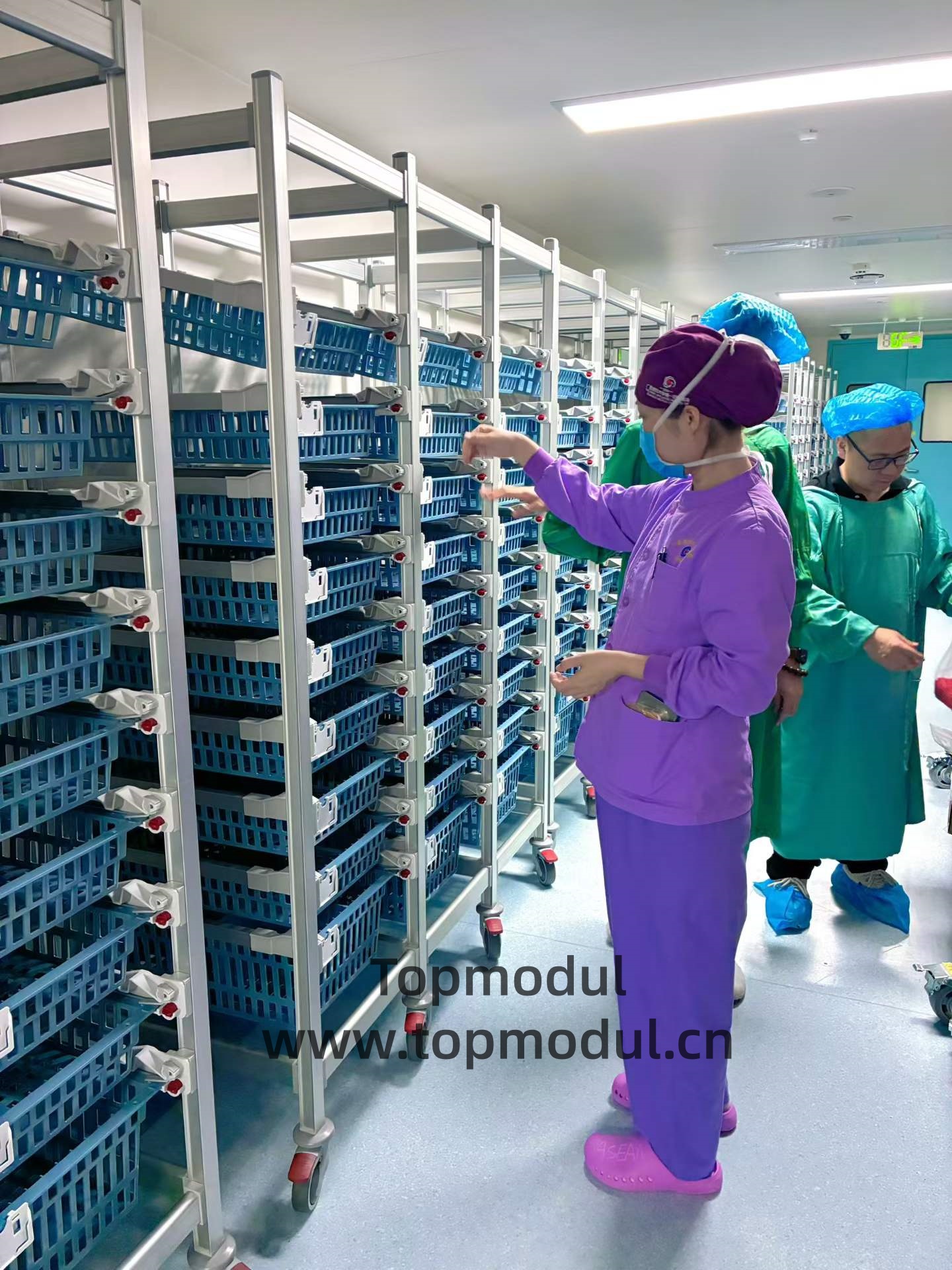
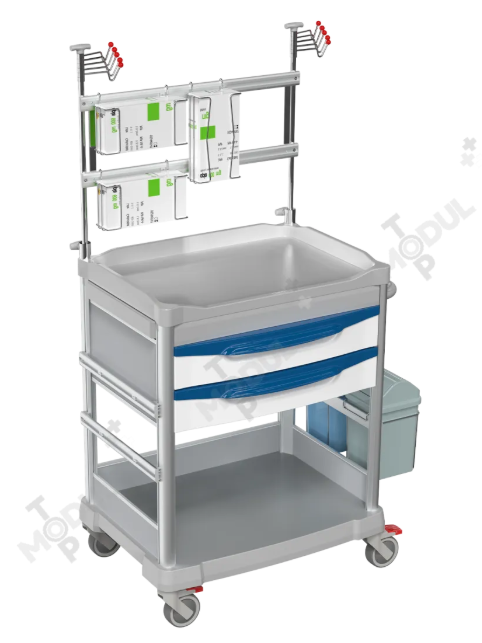
Inpatient wards do not usually fail because a hospital owns too little storage. They fail at the handover point — the ten metres between the supply room door and the bedside — where a specific medication, dressing pack or consumable has to be in the right place at the right time. The Nursing Cart T003 is aimed at that handover point rather than at total storage volume: a 754 mm x 541 mm x 1005 mm modular cart built from aluminum alloy, ABS plastic and metal, configured for the department that will actually push it.
For a hospital in the research and evaluation phase, the useful question is not whether a modular cart is better than a cupboard. It is which ward workflows the T003 configuration genuinely serves, what has to be confirmed before ordering, and how the cart connects back to the shelving and stores that replenish it. This analysis works through those three questions using the documented product and scenario data for the T003 and the surrounding modular storage range, and it deliberately stops short of claims the available evidence does not support — including certification statements for this cart.
Why ward material flow needs a different storage logic
The documented application scenario for this product family frames the problem precisely: the function is to centrally organise the storage and transfer of medical supplies and to support an efficient, agile flow of materials between nursing, treatment and hospital departments. Operation is manual, carried out or positioned by clinical staff, and the working condition is an indoor hospital environment with controlled temperature and humidity, free from heavy corrosion and explosive dust.
That description contains three constraints that shape every ward cart decision, and they pull in different directions.
Constraint one: footprint inside the clinical space
A ward cart spends most of its life parked in a corridor, a bay entrance, a treatment room or beside a bed space. Its dimensions therefore matter less as a specification number and more as a question about where it can stand without blocking circulation. The T003's documented 754 mm x 541 mm footprint and 1005 mm height describe a unit intended to be positioned by staff where it is needed rather than stored away between rounds.
Constraint two: configuration variance between wards
A surgical ward, a medical ward, a paediatric bay and a high-dependency area use different consumables in different proportions. The documented scenario material makes this explicit: size, drawer or shelf configuration, bearing requirements, cleaning and disinfection methods and accessory combinations all need to be confirmed according to how the department actually works, and can follow the hospital's own requirements. A single fixed configuration rarely survives contact with a second ward.
Constraint three: cleaning routine
Ward equipment is cleaned far more often than it is repaired, and cleaning practice varies between hospitals and between departments within the same hospital. This is why the scenario material lists cleaning and disinfection method as a confirmation item rather than a fixed assumption. A configuration that is efficient but awkward to clean will be reconfigured informally by staff — usually by leaving items on top of it.
What the Nursing Cart T003 is, in documented terms
The T003 is the nursing cart within the modular medical cart series: a mobile unit for ward nursing workflows, nursing rounds and medication dispensing workflows, and for point-of-care medical supply delivery. Its documented specification is short enough to state completely.
- Model: Nursing Cart T003
- Type: Modular medical cart series, medical cart
- Dimensions: 754 mm x 541 mm x 1005 mm
- Material: Aluminum alloy, ABS plastic, metal
- Configuration: Diversified configurations with combined installation according to user needs
- Customization: Supported according to customer requirements
- Documented application: Hospital and medical institution environments; ward nursing workflows; nursing rounds and medication dispensing; point-of-care supply delivery
- Positioning: Clinical staff can position the cart exactly where it is needed, keeping all necessary equipment in one place
Two points in that list do more work than the others. First, the material mix — aluminum alloy structure with ABS plastic and metal components — is the basis for a cart that is expected to be pushed, cleaned and reloaded daily rather than treated as fixed furniture. Second, \"combined installation according to user needs\" is a statement about assembly logic, not a catalogue item: the cart is built as a combination of parts chosen for a department, which is why the configuration conversation has to happen before the purchase order rather than after delivery.
A boundary worth stating clearly: the documented specification for this cart covers dimensions, materials, configuration and application. It does not attach certification documentation to the model. Hospitals evaluating the T003 should therefore request the certification evidence that applies to the exact build and destination market, and should not rely on a general product-family statement as a substitute for the paperwork that ships with a specific order.
How the modular configuration works in a ward
Modularity in this range is a tray-and-basket logic rather than a drawer-count logic. The clearest evidence is the ISO 6040 storage tray T604010AN: 600 mm x 400 mm x 100 mm, moulded in polycarbonate (PC) and acrylonitrile butadiene styrene (ABS), applicable to any hospital department, ward, warehouse or clinic, and described as part of a pull-basket modular system that allows a hospital to store, handle and move medications and medical equipment from the central pharmacy or storage room to the wards and finally to the bedside.
The operational consequence is that the same physical container can be filled in the store, carried on the cart, and returned without decanting. That is the difference between a modular medical storage system and a set of shelves on wheels: the unit of organisation stays constant across the whole journey, so stock can be counted, replenished and exchanged without repacking.
Combined installation, explained for a buyer
Combined installation means the cart body, the storage elements and the accessories are specified as a set for a department. In practice a ward evaluation should answer four questions before the configuration is locked:
- Which items must be visible at a glance during a round, and which can sit in a closed element?
- Which items are counted at every shift handover, and therefore need to be grouped rather than dispersed?
- Which items are heavy enough that load distribution, not volume, becomes the limiting factor?
- Which items must not travel with the cart at all, because they belong to a clean-area or sterile store instead?
The fourth question is the one most often skipped. A ward cart is a distribution device, not a clean store, and the storage range around it is designed to keep those two functions separate — a point developed further below.
What modularity does and does not promise
Customization is documented as supported according to customer requirements, and configurations are combined according to user needs. What the evidence does not do is attach a specific reconfiguration cycle, load rating or service life to the T003. A hospital should treat modularity as design flexibility to be confirmed in the quotation and drawings, not as a guarantee of a particular lifetime cost outcome. That distinction matters in evaluation, because flexibility is only valuable if the parts a ward will realistically add later remain available.
Scenario fit: four ward situations and what each one tests
The following situations are conditional descriptions of how the T003 configuration would be evaluated in a ward, not reports of completed deployments. Each is paired with the check that decides whether the configuration is right.
Situation 1: the scheduled medication round
In a ward where a single nurse or a pair of nurses runs a fixed medication round across a defined bed list, the cart's job is to keep the round's items together and in a predictable position while moving between bed spaces. The T003's documented role in nursing rounds and medication dispensing workflows matches this use directly, and its documented positioning behaviour — staff place the cart exactly where needed, with necessary equipment in one place — is the operational benefit being bought.
Check: confirm the drawer and shelf arrangement against the actual round layout, and confirm the cleaning method that will be used on the cart's surfaces between rounds.
Situation 2: the treatment and dressing round
In a ward where a separate treatment round carries dressings, procedure packs and small consumables, the cart becomes a mobile procedure point rather than a medication carrier. This is where the ISO 6040 tray logic helps: 600 mm x 400 mm x 100 mm trays hold procedure items in defined groups, and the same trays can be drawn from ward storage rather than repacked.
Check: confirm whether the ward's procedure consumables are already organised in ISO 6040 trays or in loose packaging, because a tray-based configuration only delivers its benefit if the upstream store uses the same container logic.
Situation 3: isolation and cohort rooms
In a ward where some rooms require dedicated equipment that does not travel between patients, the cart's role changes from shared circulation to assigned storage. The documented scenario material does not prescribe a segregation policy; it requires the hospital to confirm configuration and cleaning requirements per department. A dedicated cart for a cohort area is therefore a configuration and labelling decision the hospital makes, not a product claim.
Check: confirm the hospital's own cleaning and segregation protocol for equipment that stays inside a room, and confirm that the chosen configuration can be cleaned to that protocol.
Situation 4: handover and restock between shifts
In a ward where stock is counted at shift handover and topped up from a secondary store, the cart's value depends on how quickly it can be emptied, counted and refilled. Because the tray is the counting unit, restocking becomes a swap rather than a recount — provided the replenishment side of the system is organised on the same basis.
Check: map the restock route from the ward store to the cart parking position before ordering, not after. A cart that arrives at the wrong end of a corridor is a storage problem with wheels.
Where the T003 fits, and where another unit fits better
Scenario fit is as much about exclusion as inclusion. The modular cart family documented in this range contains units with distinct intended uses, and a hospital that buys the wrong one will compensate by overloading it.
| Unit | Documented dimensions | Documented material | Documented use | Fit consideration |
|---|---|---|---|---|
| Nursing Cart T003 | 754 mm x 541 mm x 1005 mm | Aluminum alloy, ABS plastic, metal | Ward nursing workflows; nursing rounds and medication dispensing; point-of-care supply delivery | Best matched to routine ward circulation where a compact footprint and configurable storage matter more than emergency access speed |
| Anesthesia Cart T001 | 754 mm x 541 mm x 1005 mm | Aluminum alloy, ABS plastic, metal | Anesthesia supply organisation in hospital departments | Belongs to the anesthesia environment; not a substitute for a ward medication round cart |
| Emergency Crash Cart T002 | 754 mm x 541 mm x 1005 mm | Aluminum alloy, ABS plastic, metal | Emergency department pilot projects; rapid positioning of all necessary equipment in one place | Designed around time-critical access; a ward using a crash cart for routine rounds is spending emergency capacity on ordinary work |
| Medical trolley T6020-2 (open transport cart) | 1385 mm x 445 mm x 2000 mm | Aluminum alloy struts and crossbars; PC/ABS basket | Intra-department transfer; hospital medical supply distribution | A bulk movement unit, not a point-of-care cart; useful for the restock leg of the route |
The pattern is a division of labour rather than a hierarchy. The T003 handles the bedside end of the route. The open transport trolley T6020-2 handles the bulk leg between a secondary store and the ward. The T001 and T002 handle environments with different access requirements. A hospital that tries to serve all four functions with one unit will end up with a cart that is too heavy for a medication round and too small for a restock run.
Behind the cart: high-density shelving and sterile storage wire shelving
A ward cart only works if the store behind it is organised to feed it. This is where the modular medical storage system extends beyond the cart, and where two product lines matter most for inpatient wards: high-density medical shelving for volume and access, and sterile storage wire shelving for clean-area storage.
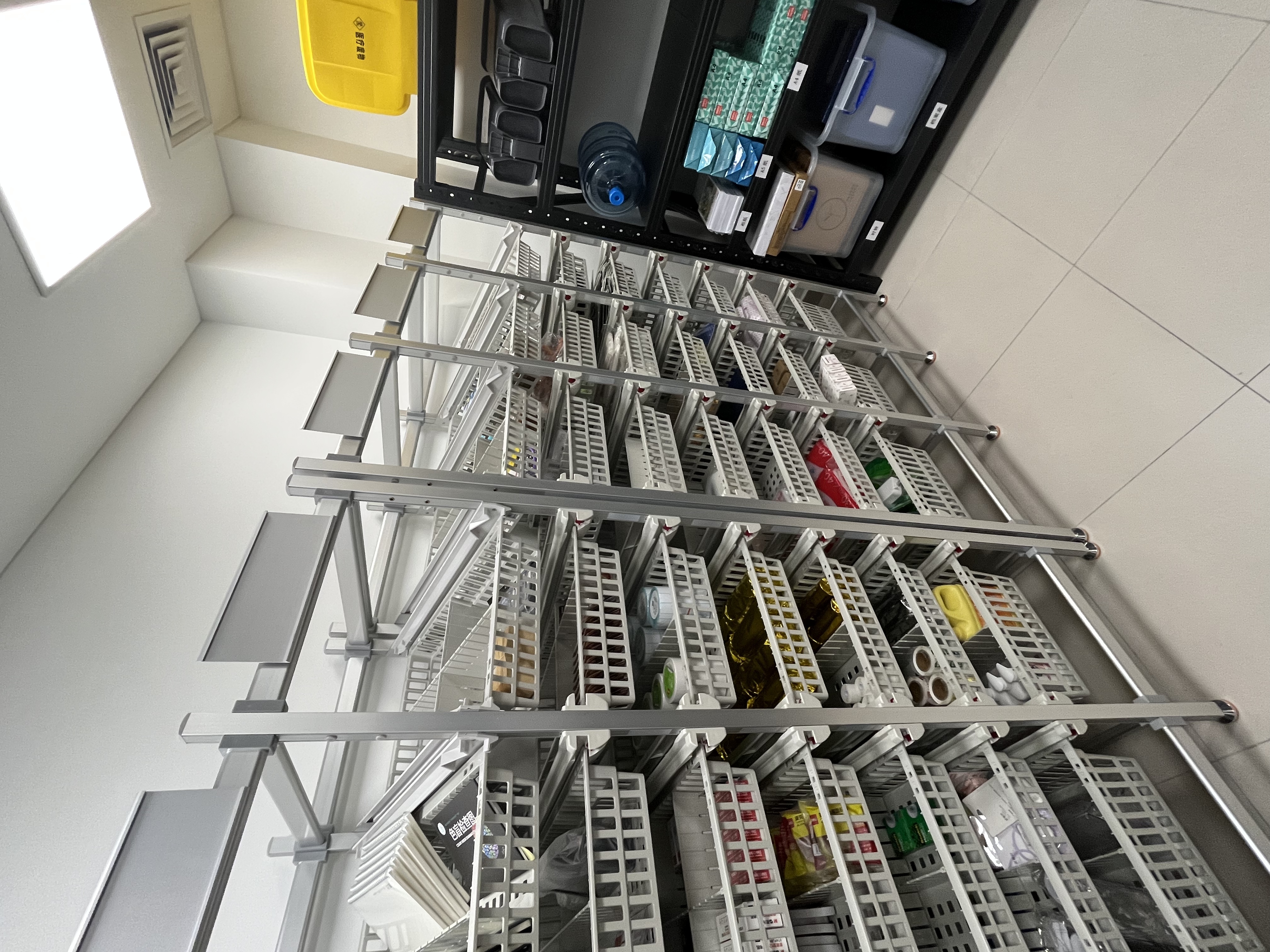
High-density medical shelving for ward and secondary stores
The high-density medical shelving is documented with basic frame dimensions of 512 mm x 650 mm x 2000 mm and 710 mm x 406 mm x 2000 mm, constructed from aluminum alloy struts and crossbars with polycarbonate (PC) and ABS baskets. Its stated applications include hospital secondary warehouses, pharmacies, vein centres and consumables warehouses. The manufacturer describes it as offering high space utilisation, good access, light and flexible movement, easy cleaning and disinfection, and resistance to rust, with baskets replaceable at any time to support cleaning routines. Assembly is described as requiring no complicated tools, and column height and artificial stone countertops can be customised to a required length.
For a ward, the relevant reading is not the frame size but the access pattern: shelving that is light, movable and cleanable supports the restock cycle that the cart depends on. The Alpha shelving series in the same range, documented at 674 mm x 430 mm x 2000 mm and 474 mm x 630 mm x 2000 mm, appears in a documented hospital case in the United Kingdom covering 100 medicine storage shelving units in service for five years, combined with ISO 6040 trays T604010AN inside the shelving system.
Sterile storage wire shelving for clean areas
The sterile storage wire shelving is documented with a basic frame of 512 mm x 650 mm x 200 mm and is built with aluminum alloy struts and crossbars together with stainless steel trays. Its stated applications are hospital secondary storage rooms, pharmacies and sterilisation supply centres, and the manufacturer positions the sterile storage range around the storage needs of clean areas such as operating departments and supply centres, with infection control as the framing requirement.
Documented characteristics include rack-type structures that use vertical space, stainless steel shelves described as having large bearing capacity and low deformation, convenient access for inventory counting and first-in-first-out rotation, and surface treatment by pickling, phosphating and electrostatic spraying described as corrosion-resistant, rust-resistant and easy to clean. The manufacturer also lists temperature resistance above 130 degrees for the sterile storage range.
The buyer-relevant split is straightforward. Items that will travel on the ward cart belong in the ward's tray-based store; items that must stay in a clean area belong on stainless steel sterile shelving and should never ride on a general ward cart. Treating the cart as a clean store is a common configuration error, and it is the one this product split is designed to prevent.
High-density mobile shelving where floor space is the binding constraint
Where a hospital's secondary store is short of floor area rather than short of shelves, the high-density medical storage shelving line uses a rail-based system with PE and aluminum alloy components, anti-collision parts between mobile and fixed frames, and guide rails that the manufacturer states can be installed without drilling or gluing and customised in length. This is a store-level decision that indirectly determines how often a ward cart has to be restocked.
Market context: growth does not choose the configuration
Third-party research supports the view that mobile medical storage is an expanding category. A commercial research outlook published by Grand View Research (Horizon) estimates the global medical carts market at US$4.83 billion in 2026, and projects a 15.8% compound annual growth rate for the European medical carts market from 2025 to 2030. Separately, an ISO 60-40 modular system specification published by Pegasus Medical on MedicalExpo describes storage capacity gains of up to 50% compared with traditional shelving.
These figures are third-party estimates and specifications, not performance commitments for any particular cart, and they do not tell a ward which configuration to order. Their practical value is narrower: they indicate that the procurement question has shifted from whether to use modular storage to how to configure it, which is exactly the question the T003 evaluation has to answer at department level.
The same caution applies to case evidence. A documented hospital case covering 100 medical storage and transport carts over a five-year supply duration describes the problem as staff time spent walking to supply rooms and central stations, with carts bringing essential supplies to the point of care. That is a reported project outcome for that deployment; it is a reasonable hypothesis for another ward, not a guaranteed result.
Procurement checks before a ward pilot
The T003 is manufactured by Tongde Medical Technology (Ganzhou) Co., Ltd., the company behind the Topmodul modular storage brand for the medical industry. The company was founded in 2003, operates a 30,000 square metre factory in Ganzhou, Jiangxi, and reports that exports account for 90% of its business, with Western and Eastern Europe among its main markets. It describes a full-process quality system covering incoming, in-process, final and outgoing inspection, with a five-member quality control team, and documents OEM and ODM support alongside modular configuration and project-based solution work.
Documented commercial parameters for project supply include a monthly capacity of 20,000 units, a lead time of 30 to 45 days and a minimum order quantity of 100 units. Hospitals running a single-ward pilot should confirm how a pilot quantity fits within those parameters rather than assume it does.
A practical evaluation checklist
- Department configuration. Confirm size, drawer or shelf layout, bearing requirements, cleaning and disinfection method, and accessory combination against the actual ward — the scenario material treats all five as confirmation items, not defaults.
- Tray compatibility. Confirm whether the ward store already uses ISO 6040 trays of 600 mm x 400 mm x 100 mm, because the cart's counting and restocking benefit depends on that continuity.
- Route and parking. Walk the restock route and identify the cart's parked position before ordering; footprint decisions are made in corridors, not in catalogues.
- Certification documentation. Request the documentation applicable to the exact model, build and destination market. A general statement about a product range is not the same as the file attached to a purchase order.
- Drawings and approvals. Confirm that the final configuration is approved in drawings before production, which is the documented step in the company's OEM process.
- After-sales scope. The documented service scope covers free maintenance service, installation, debugging and usage training, consultation, and product version upgrades. Confirm what applies to the specific order.
Outlook for ward-level modular storage
The direction of travel in inpatient wards is consolidation: fewer stock points, more controlled replenishment, and more of the nurse's working time spent at the point of care rather than in transit. Modular tray-based systems support that direction because the unit of storage stays the same from the store room to the bedside, which is the mechanism the T003 depends on.
What remains genuinely uncertain for any individual hospital is the payback. The evidence available here establishes documented dimensions, materials, configuration logic and reported project outcomes; it does not establish a staffing saving, an infection-rate effect or a reconfiguration cost for a specific ward. A hospital that treats the T003 as a configuration decision — made with the ward, checked against the store behind it, and documented before ordering — is using the product the way its design supports. A hospital that treats it as a generic trolley purchase is buying a specification without the system around it.
FAQ
What does the Nursing Cart T003 do in an inpatient ward?
The T003 is documented as a nursing cart for ward nursing workflows, nursing rounds and medication dispensing workflows, and point-of-care medical supply delivery. It is a mobile unit that clinical staff position where it is needed, keeping the equipment for a task in one place rather than distributing it between a store room and a bedside. It sits at the bedside end of the material route; replenishment and bulk movement are handled by the store and by transport units.
What are the T003's documented dimensions and materials?
The documented dimensions are 754 mm x 541 mm x 1005 mm, and the documented material specification is aluminum alloy, ABS plastic and metal. Configurations are described as diversified and combined according to user needs, with customization supported according to customer requirements. Any variation from the documented dimensions or material specification should be confirmed in the quotation and drawings for the specific order.
How should a hospital configure the T003 for different ward types?
Configuration should follow the department's own workflow. The scenario documentation lists the items to confirm: size, drawer or shelf configuration, bearing requirements, cleaning and disinfection methods, and accessory combination. A medication round and a treatment round place different demands on grouping and visibility, and a ward with cohort or isolation rooms may need a dedicated unit rather than a shared one. Because installation is combined according to user needs, these decisions are made before production, not adjusted afterwards.
How does the cart connect to high-density shelving and sterile storage wire shelving?
The connection is the container. ISO 6040 storage trays of 600 mm x 400 mm x 100 mm are documented as usable from the central pharmacy or storage room through to the ward and the bedside, so a tray filled in a high-density medical shelving installation can travel on a compatible cart without repacking. Sterile storage wire shelving, documented with aluminum alloy struts, stainless steel trays and applications in secondary storage rooms, pharmacies and sterilisation supply centres, serves the clean-area side of the same system; items held there are not intended to ride on a general ward cart.
Is the T003 supplied with CE certification?
Certification should be confirmed for the exact model, build and destination market before ordering. The documented specification for this cart covers its dimensions, materials, configuration and application, and does not attach a certification statement to the model. Buyers should request the applicable documentation for the configuration being procured and treat general statements about a product range as a starting point for that check rather than as a substitute for it.
Reference material
The published catalogue for the broader shelving and modular storage range is available for download: 2026 TM Shelving Catalogue (PDF). It covers the shelving, tray and cabinet elements that sit behind ward cart operations and is a reasonable starting point for a replenishment-side review alongside the cart configuration.
Third-party figures cited in this article are attributed to their publishers: Grand View Research (Horizon) medical carts market outlook, and the ISO 60-40 modular system specification published by Pegasus Medical on MedicalExpo. Product dimensions, materials and configuration statements are drawn from the manufacturer's documented product information. Certification documentation is configuration- and market-specific and should be requested for the exact order.
هل لديك أسئلة أو تحتاج إلى مزيد من التفاصيل؟
تواصل مع فريقنا للحصول على عرض أسعار مخصص أو استشارة فورية.
طلب عرض أسعار
املأ النموذج أدناه وسيتواصل معك فريقنا بعرض مقترح مخصص.
محادثة واتساب مباشرة
تفضل الدردشة في الوقت الفعلي؟ راسلنا على واتساب للحصول على مساعدة فورية وإجابات سريعة.
- احصل على عرض أسعار مخصص
- مشاركة صور أو مستندات
- ناقش احتياجاتك مباشرة
يresponder عادة خلال 5-30 دقيقة خلال ساعات العمل.