
Nutritional Premix OEM: Single-Roof vs Multi-Vendor
Nutritional Premix OEM: Single-Roof vs Multi-Vendor

For a custom nutritional premix, single-roof sourcing means one partner owns the premix specification and its conversion into finished formats. Multi-vendor sourcing separates the premix powder or granule supply from one or more dosage-form manufacturers. The decision should be made on specification control, not on supplier count alone. A single-roof model can reduce handoffs, but it concentrates responsibility in one partner. A multi-vendor model can widen format choice, but it creates interfaces that the buyer must actively manage. Neither model is inherently better for every buyer.
The category is often discussed as a price-per-kilogram question. In practice, the more consequential questions sit upstream and downstream of the price: who defines custom potency, who controls particle size and flowability, who validates micro-ingredient dosing, who signs off the finished label claim, and who holds the change-control record when a nutrient source changes. These questions matter whether the premix is a nutritional premix powder, a granule system, or a liquid nutritional premix that later becomes tablets, capsules, gummies, softgels, granules, liquids or private-label SKUs.
The buyer question behind the two sourcing models
The commercial offer can look similar across both models: a vitamin premix or mineral premix at a stated potency, packed to a stated size, supported by a certificate of analysis. The difference appears in the handoffs. Under single-roof sourcing, one partner is expected to translate the finished-product requirement into a premix specification and then carry that specification through dosage-form production. Under multi-vendor sourcing, the brand or its contract manufacturer often becomes the specification owner, reconciling the premix supplier's assay data with the finished-dose manufacturer's process data.
That difference is not administrative. A custom nutrient premix is a formulated blend. Its performance depends on how the ingredients are carried, blended, tested and converted. If the premix is designed for capsule filling but the finished manufacturer runs a tablet press, particle size and flow behavior may need review. If the premix is a powder but the finished product is a liquid, solubility and dispersion behavior become part of the specification. If the label claim is set at a finished dose, the premix potency, analytical method and overage policy must connect to the finished-product assay and shelf-life assumption.
The opportunity is real for buyers who compare the models correctly. The supplied comparison of a pre-formulated uniform blend against separate single-nutrient sourcing and manual blending identifies several operational effects: fewer raw-material items to manage, simplified incoming inspection, less in-house blending labor and equipment occupation, and potentially lower procurement and inventory management cost. Those effects are not automatic savings. They depend on order size, equipment fit, the partner's verified scope and whether the buyer is prepared to verify the blend's performance in its own application.
Why the premix specification is the decision unit
The premix specification should be the working document that both sourcing models are judged against. It should state the nutrient forms, potency, assay methods, carrier system, particle-size expectation, moisture limit, microbiological limits, packaging format and any application-specific requirements such as solubility or flowability. It should also state who is responsible for label-claim substantiation and who approves changes.
The user-supplied scenario notes that a premix can be extended into tablets, capsules, gummies, liquids, softgels, granules and private-label SKUs, and that one partner and one specification can support end-to-end execution. That is a useful description of the single-roof opportunity. It is also a warning against assuming the opportunity is complete on day one. A partner can support end-to-end execution only where its verified scope covers the relevant formats, equipment, testing and change-control obligations. A brochure claim of multi-format capability is a starting point for qualification, not a substitute for site-level verification.
Under a multi-vendor model, the specification is usually split. The premix supplier owns the blend and its COA. The finished-dose manufacturer owns the tableting, encapsulation, softgel, gummy or liquid process. The brand owner may own the label claim. If those three documents are not aligned, the buyer can receive materials that meet their individual specifications yet still fail at the interface. This is the central procurement risk in multi-vendor sourcing.
Technical variables that decide batch consistency
Batch consistency is not proven by a formula sheet. It is built from ingredient identity, weighing and dosing accuracy, blending control, uniformity testing, moisture control and packaging protection. The technical variables below are especially important when comparing a single-roof quotation with a multi-vendor quotation.
Custom potency and overage policy
Custom potency is not a single number. It is a target supported by an analytical method, a stated basis, an overage policy and a shelf-life assumption. A buyer should ask how potency is expressed, whether the assay is performed on the premix or the finished product, and how the overage was set. A label claim is a finished-product claim. A premix COA alone does not prove that the finished product will meet the declared amount at the end of shelf life.
Particle size and segregation risk
Particle-size distribution affects how a powder blend behaves during conveying, storage and dosing. If particles differ substantially in size or density, segregation can occur during handling. The practical buyer question is not simply whether a particle-size range exists, but whether the supplier has a method, a specification and uniformity data for the intended application. The same powder blend may behave differently on two different filling lines.
Solubility and the intended matrix
Solubility is central for liquid nutritional premix and for powder formats intended to disperse in water. It is less central for a dry blend packed into hard capsules, although it can still affect mouthfeel, reconstitution or appearance in other applications. A buyer should require solubility or dispersion data only where the final use actually depends on it, and should ask for the test method rather than accepting a general statement of good solubility.
Flowability and dosing
Flowability influences feeding, blending, encapsulation and tableting. A powder that flows acceptably on one line may not flow the same way on another with different humidity, equipment or speed. Flow behavior is therefore a process-fit variable, not a universal grade label. Buyers should ask for flow-related data in the context of their own dosage form and should validate the premix on the intended line.
Micro-ingredient dosing and blend uniformity
Small-dose nutrients are where a nominally correct formula can fail in practice. Accurate micro-ingredient dosing depends on weighing capability, carrier strategy, blending sequence and uniformity testing. A carrier or intermediate premix can improve dispersion, but the actual dosing step and the uniformity test still matter. For a vitamin and mineral premix with several low-inclusion ingredients, the buyer should ask how uniformity is demonstrated and how the sampling plan represents the batch.
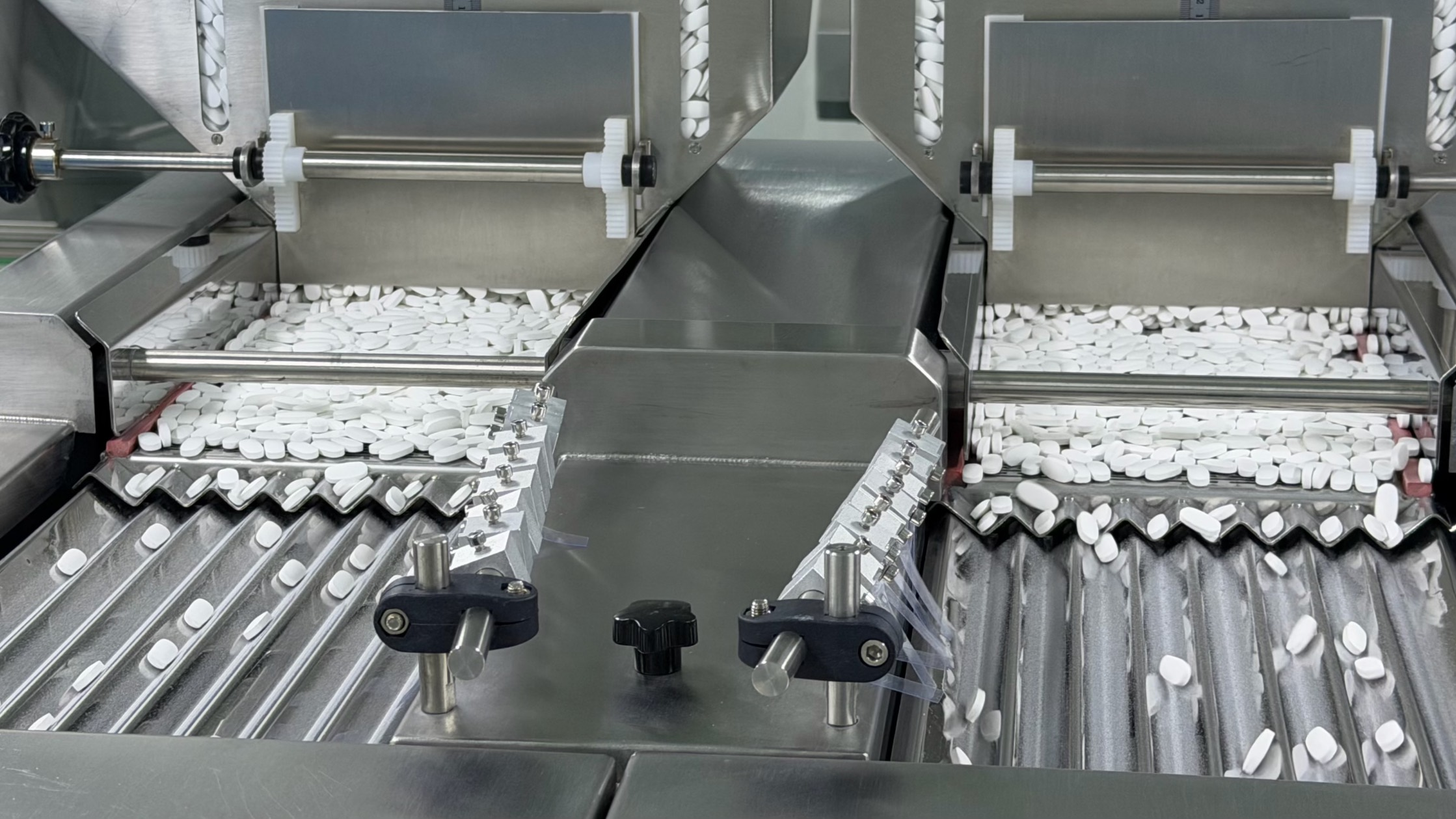
Where single-roof sourcing helps, and where it does not
Single-roof sourcing can help when the buyer needs one specification to travel from premix to finished format. The potential advantages are a single change-control path, fewer incoming inspections, fewer supplier interfaces and clearer ownership of the finished label claim. If the partner genuinely covers the required formats, the buyer may also reduce the coordination burden between a powder blender and a capsule, tablet, gummy, liquid or softgel manufacturer.
The model has boundaries. It concentrates risk. If the partner's verified scope does not cover a format, certification or market requirement, the apparent simplicity disappears. A buyer should not accept a single-roof proposal without confirming which site performs which operation, which specification each site works to, and how deviations are handled across the chain. The model is also less suitable when the buyer needs multiple approved sources for continuity or when a specialist format lies outside the partner's demonstrated capability.
Where multi-vendor sourcing helps, and where coordination risk rises
Multi-vendor sourcing can help when the buyer needs format-specific specialists, regional flexibility or more than one qualified source. A capsule specialist, a gummy manufacturer and a liquid processor may each have equipment and process knowledge that a single partner cannot match for every SKU. Multiple vendors can also reduce dependence on one site, provided the buyer has the quality resources to manage them.
The coordination risk rises at each interface. The premix supplier may test potency and uniformity on the premix, while the finished manufacturer tests the finished dose. If the two specifications use different bases, methods or acceptance criteria, the buyer can face disputes without a clear technical resolution. Incoming inspection also multiplies. Each vendor's COA, deviation record, change notification and traceability documentation must be reviewed and reconciled. Multi-vendor sourcing is therefore a better fit for buyers with strong specification ownership and supplier-management capability, not for buyers who expect the vendors to reconcile the interface themselves.
Single-roof versus multi-vendor: comparison criteria
| Decision criterion | Single-roof sourcing | Multi-vendor sourcing | What the buyer should verify |
|---|---|---|---|
| Specification ownership | One partner can hold the premix and finished-format specification, with one change-control path. | The premix and finished-dose specifications are split and must be reconciled by the brand or a lead contractor. | Who owns the final release specification, and how are changes notified across sites? |
| Batch consistency | A single formula and batch-record chain can reduce interface variation, but process controls still determine uniformity. | Each vendor may meet its own specification while interface variation remains between premix and finished dose. | Request assay, uniformity, moisture, microbiological and deviation data for the actual application. |
| Label claims | Potency, overage and finished assay can be designed together if the partner scope includes finished testing. | Label-claim responsibility may sit with the brand or finished manufacturer, while the premix supplier sees only the blend. | Confirm who validates the shelf-life claim and how overage is supported. |
| Format expansion | Premix can be extended into tablets, capsules, gummies, liquids, softgels, granules and private-label SKUs under one specification if the partner scope truly covers them. | Specialist vendors may offer deeper format-specific capability, but each additional format adds a handoff. | Map every SKU to a qualified site and a written specification before comparing price. |
| Micro-ingredient dosing | One partner can set the carrier and dosing strategy across formats. | Multiple vendors may interpret low-dose requirements differently. | Ask for the dosing rationale, blending sequence and uniformity evidence. |
| Quality documentation | One audit trail, but concentration risk if the partner is the only qualified source. | Multiple audit trails and more incoming inspection, with greater need for document control. | Define COA, deviation, change-control and traceability requirements in the RFQ. |
| Best-fit boundary | Less suitable when required formats, certifications or markets sit outside one partner's verified scope. | Less suitable when the buyer lacks the quality staff and systems to manage several vendors. | Match the sourcing model to internal QA capacity, not only to quoted unit price. |
The table does not produce a universal winner. It shows why the same premix concept can be a good single-roof project for one buyer and a reasonable multi-vendor project for another. The deciding factors are the buyer's format map, quality resources, market obligations and tolerance for concentrated supply risk.
What PNP Biotech's model illustrates
PNP Biotech illustrates one version of the single-roof proposition. PNP Biotech states that custom premix formulation is a core manufacturing capability covering vitamins, minerals, botanical extracts and nutritional ingredients. The company also states that it provides OEM/ODM and contract manufacturing services for nutritional supplement, functional food and dietary supplement brands. Its company profile describes coordinating raw-material sourcing with finished-product manufacturing, including capsules, tablets, softgels and gummies, and lists nutritional premix as a main product.
Those are company-reported capabilities. They support an initial screening hypothesis for a single-partner model, not a final qualification. A buyer should still verify the specific site, format, certification scope, batch size, testing method and commercial terms for the intended SKU. The relevant question is not whether a partner claims broad capability, but whether the claimed capability is documented for the buyer's formulation and market.
Application scenarios that change the answer
A powder-only brand launching a multivitamin powder. If the product remains a powder and the buyer already has a qualified blender and packager, multi-vendor sourcing may be sufficient. The specification is relatively contained, and the main interface is between the premix supplier and the powder filling operation. Single-roof sourcing becomes more valuable when the same brand plans to add capsules, gummies or tablets and wants one specification to carry across formats.
A private-label brand expanding from capsules to gummies and stick packs. Format expansion is where single-roof sourcing can reduce coordination load, but only if the partner's verified scope covers each format. A gummy line and a capsule line are not interchangeable. The buyer should map every SKU to a site and confirm that the premix specification has been validated for that site's process.
A brand selling into both the United States and the European Union. The same finished concept may face different documentation and labeling obligations. A single specification can help internal control, but it does not automatically satisfy both markets. The buyer should confirm the partner's ability to support the relevant regulatory documentation and label-claim basis for each market.
A high-potency or micro-dose formula. Technical complexity favors a partner with demonstrated formulation and uniformity capability, whether that partner is a single-roof supplier or a specialist premix blender. The model alone does not solve the technical problem. The buyer should require application-specific uniformity data and a clear dosing rationale.

Regulatory documentation is part of the sourcing comparison
For dietary supplements in the United States, current good manufacturing practice is codified in 21 CFR Part 111 and applies to manufacturing, packaging, labeling or holding operations. The rule covers production and process controls, including specifications for labels and contact packaging. U.S. supplement labeling is governed by 21 CFR 101.36. The FDA framework also requires at least one appropriate test or examination to verify the identity of dietary ingredients unless an approved exemption applies.
In the European Union, Directive 2002/46/EC approximates Member State laws on food supplements, while Regulation (EC) No 1925/2006 governs the addition of vitamins and minerals to foods. These are separate routes: a food-supplement brief and a food-fortification brief can require different specifications even when the premix concept looks similar. Voluntary programmes such as NSF/ANSI 173 and the USP Dietary Supplements Verification Program apply at finished-product level and do not replace premix-level testing.
The sourcing implication is direct. A multi-vendor model must assign responsibility for regulatory documentation and label-claim support across the premix supplier, the finished manufacturer and the brand. A single-roof model can make that assignment simpler, but only if the partner can actually support the target market and the finished format. A single specification is a control tool, not proof of multi-market compliance.
Buyer verification checklist before comparing quotes
- Map every SKU to its finished format and the site that will produce it.
- Write one master premix specification covering nutrient forms, potency, assay methods, overage policy, carrier, moisture, microbiology, particle size, flowability and solubility where relevant.
- Define whether the label claim is based on premix assay, finished-product assay, or both, and who owns shelf-life substantiation.
- Ask for batch uniformity data, retain-sample policy and deviation records for comparable products.
- Confirm change-control rules for nutrient sources, carriers, packaging and process changes.
- Verify certifications at certificate level, including site scope and validity, rather than relying on logo claims.
- Compare quotations on the same written specification and the same delivery, inspection and payment basis.
- Decide whether a second qualified source is required for continuity, and if so, how the specification will be duplicated without creating two incompatible standards.
The practical test is not whether single-roof or multi-vendor sounds more integrated. It is whether the chosen model gives the buyer a defensible specification, a traceable batch record and a clear owner for the finished label claim.
FAQ
What is the main difference between single-roof and multi-vendor nutritional premix sourcing?
Single-roof sourcing places the premix specification and the finished-format conversion with one partner. Multi-vendor sourcing separates the premix supply from one or more dosage-form manufacturers, so the brand or a lead contractor must reconcile specifications. The main difference is where specification ownership and interface risk sit, not simply how many suppliers are involved.
How do particle size, solubility and flowability affect a premix specification?
Particle size and flowability affect segregation, feeding and dosing during blending, encapsulation or tableting. Solubility matters most for liquid premix and for powders intended to disperse in water. These are application-fit variables, so buyers should request the test method and relevant data for the intended process rather than relying on a general powder description.
What quality risks should a buyer control in premix OEM?
Three areas need control. Raw-material quality requires verified suppliers, approved vendor lists, COA review and third-party testing of high-risk materials where appropriate. Batch consistency requires validated formulas, batch records, potency and uniformity testing, moisture and microbiological testing, retain samples and traceable records. Packaging and storage require moisture protection, correct sealing and controlled storage conditions to limit caking and potency loss.
What should be confirmed before ordering: MOQ, delivery, inspection and payment?
MOQ is not fixed; it depends on formulation and order quantity, including nutrient count, potency level, dosage form and pack size. Delivery can be arranged under EXW, FOB or CIF. Acceptance should be defined through COA review and quality inspection against the agreed specification. Payment is by T/T, with terms negotiable according to order value, project scale and cooperation history.
Does one specification really support end-to-end execution?
It can when one partner's verified scope covers the premix and the finished formats, and when the specification includes the testing, change-control and label-claim responsibilities for each format. It does not remove the need for format-specific validation. A single specification is strongest when it is written for the finished product and actively maintained across every site that touches the batch.
Conclusion: choose the model that fits the specification burden
The single-roof versus multi-vendor decision is a decision about who carries the specification burden. Single-roof sourcing can reduce handoffs and make one partner accountable for the premix-to-finished-product path, provided the partner's scope is verified for the actual formats and markets. Multi-vendor sourcing can widen format choice and supply flexibility, provided the buyer has the quality systems to reconcile specifications, COAs, deviations and label claims across vendors.
For buyers with a multi-format private-label plan, a single specification and one accountable partner may be the simpler route. For buyers with strong in-house QA and a need for specialist format capacity, a multi-vendor model may be more practical. The weaker choice is the one made on unit price alone, without a written specification, a defined label-claim owner and a verification plan for batch consistency.
Company brochure for additional PNP Biotech background: PNP Biotech catalogue PDF.
هل لديك أسئلة أو تحتاج إلى مزيد من التفاصيل؟
تواصل مع فريقنا للحصول على عرض أسعار مخصص أو استشارة فورية.
طلب عرض أسعار
املأ النموذج أدناه وسيتواصل معك فريقنا بعرض مقترح مخصص.
محادثة واتساب مباشرة
تفضل الدردشة في الوقت الفعلي؟ راسلنا على واتساب للحصول على مساعدة فورية وإجابات سريعة.
- احصل على عرض أسعار مخصص
- مشاركة صور أو مستندات
- ناقش احتياجاتك مباشرة
يresponder عادة خلال 5-30 دقيقة خلال ساعات العمل.