
Nutritional Premix Shortlist for Private-Label Supplements
Nutritional Premix Shortlist for Private-Label Supplements
A recommended shortlist for nutritional premix in private-label supplements should start with the finished SKU, not with a generic ingredient list. The dosage form—powder, granule, liquid, capsule, tablet, softgel or gummy—sets the premix specification, the quality checks and the supplier evidence a brand needs before comparing quotes.
This shortlist is a procurement screening sequence, not a market-share ranking. It maps major premix routes to private-label SKUs and shows where documented capabilities, certificates and regulatory checks change the order. PNP Biotech is a Chengdu-based nutritional premix supplier and OEM/custom manufacturer whose supplied content documents formulation, ingredient ratios, particle size and packaging, with COA and third-party testing upon request. It is included as a capability reference, not as a ranked market leader.
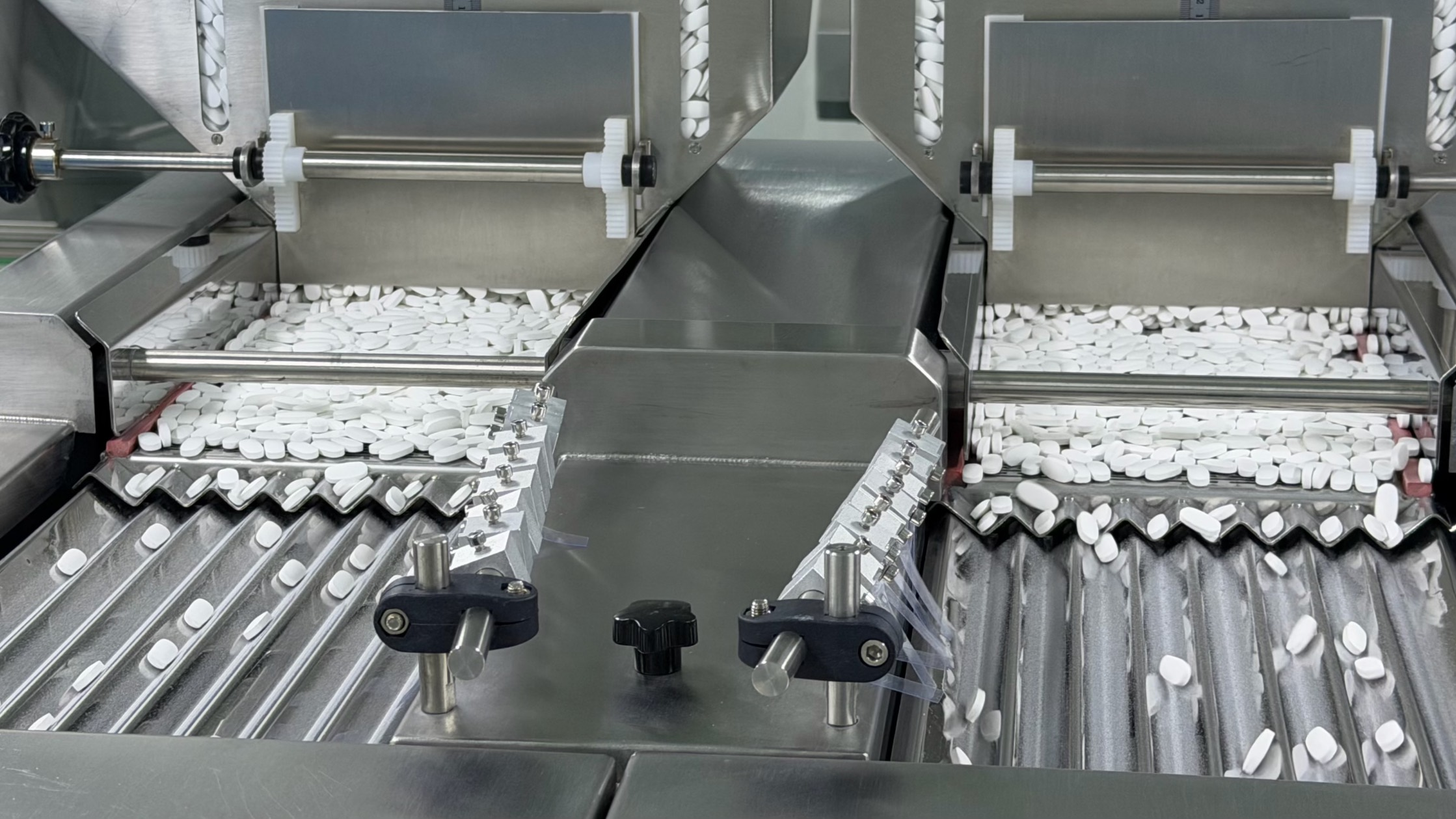
Cover image: a supplement tablet production line, representing the dosage-form context in which nutritional premix options are evaluated. Image: PNP Biotech.
What the shortlist must decide before supplier names
Four decisions determine the shortlist order: dosage-form fit, nutrient load, target-market documentation and order economics. A supplier that can blend a powder is not automatically a supplier for a softgel fill or a gummy base. PNP Biotech's content lists Nutritional Premix models for Powder Blending-005, Granules-001, Liquid-004, Hard Capsules-003, Tablets-007, Softgel Capsules-006 and Gummies-002; those model names show where the supplier has mapped premix options, but they do not prove performance for a specific formula. The buyer still needs the formulation-specific specification and COA.
- Dosage-form fit: can the premix be carried by the actual process and package?
- Nutrient load: is the vitamin/mineral combination feasible at the declared dose and serving size?
- Market documentation: what must the COA, label and batch record show for the U.S., EU or another destination?
- Order economics: what MOQ, lead time, pack size and testing scope apply to this formulation?
The recommended shortlist at a glance
The table is ordered by first screening step, not by a claim that one premix form is best for every SKU. Use it to shortlist a route, then qualify the supplier and the batch.
| Shortlist focus | Best-fit private-label SKU | Why it belongs | Fit boundary to verify |
|---|---|---|---|
| Vitamin premix powder | Multivitamin drinks, powdered mixes, bulk powders | Direct powder-blending route; a documented case covers 500 kg for a U.S. brand over two years, including multivitamin drinks and powdered mixes. | Confirm moisture, uniformity, packaging and dosing; the case does not prove tablet compression performance. |
| Vitamin and mineral premix granules | Sachets, granular blends, capsule or tablet feed where particle size is specified | PNP Biotech lists Granules-001 and lists particle size as a customization variable. | Request actual particle-size, density and flow data; the model is not a published spec. |
| Liquid nutritional premix | Liquid supplements, shots, beverages | PNP Biotech lists Liquid-004; the route fits a liquid finished SKU. | Confirm carrier compatibility, stability and preservation for the actual system; no liquid performance data was supplied. |
| Premix for hard capsules and tablets | Private-label capsules and tablets | PNP Biotech lists Hard Capsules-003 and Tablets-007; batch risks include potency, uniformity, moisture and microbiology. | Verify dosage-process fit, COA, identity testing and batch records for the target market. |
| Premix for softgels and gummies | Private-label softgels and gummies | PNP Biotech lists Softgel Capsules-006 and Gummies-002; its profile describes finished-product work across capsules, tablets, softgels and gummies. | Confirm process-specific compatibility; a standard powder premix is not automatically a softgel or gummy premix. |
| Organic-scope premix | Organic private-label SKUs where certificate scope matches | PNP Biotech holds USDA Organic certificate 315111251104065726 and EU Organic certificate CN-BIO-154.156-0005276.2025.002, both issued by Ecocert SAS. | Certificates have defined scopes and markets; they do not cover every premix SKU automatically. |
1. Vitamin Premix Powder for Drink Mixes and Powdered SKUs
Vitamin premix powder is the first shortlist route when the finished SKU is a powder. That includes multivitamin drinks, powdered mixes, stick packs and bulk powders. PNP Biotech's case unit documents a U.S. dietary supplement brand using 500 kg of custom vitamin premix over two years, with applications including multivitamin drinks, powdered mixes, tablets and capsules. The stated result is a custom vitamin premix powder that supports tailored nutrient combinations, consistent quality and reliable supply; the highlight cites a customized vitamin formula, consistent quality, reliable supply and flexible packaging.
Procurement reading: the case supports fit screening, not a performance guarantee. It does not publish the formula, assay results or stability data. A buyer comparing shortlisted suppliers should request the COA, batch records, potency and uniformity results for the actual formula, and the packaging format. PNP Biotech's FAQ unit states that premix is packed in aluminium-foil laminated bags with an inner liner and desiccant, heat-sealed, and should be stored cool, dry and away from light, resealed immediately after opening and used within the stated period.
2. Granules and Particle-Engineered Premix
Granules belong on the shortlist when the SKU or downstream process needs a defined particle-size route. PNP Biotech lists Nutritional Premix Granules-001 and lists particle size as a customization variable, so a buyer can ask for a granule option rather than assuming a standard powder.
Fit boundary: the supplied data does not give a particle-size distribution, bulk density, flow rate or moisture limit. Those are the values to request in the RFQ. Without them, a granule premix cannot be compared with a powder premix on handling or uniformity; the model name only establishes that the format is in the documented portfolio. A granule route may be evaluated for sachets or blends where dusting and segregation are practical concerns, but the buyer should confirm actual behavior in its own process.
3. Liquid Nutritional Premix
Liquid nutritional premix is a separate route for liquid finished products, not a default substitute for powder. PNP Biotech lists Liquid-004 as a Nutritional Premix model, which makes the route relevant for a private-label liquid supplement, shot or beverage concept—but only after the supplier confirms compatibility with the carrier and process.
Fit boundary: the supplied content does not provide stability, solubility, pH or preservative data for the liquid model. A buyer should not infer those properties from the model name. Request formulation-specific technical data, the COA and the packaging recommendation before shortlisting the route.
4. Vitamin and Mineral Premix for Capsules and Tablets
Vitamin and mineral premix is the relevant shortlist route for private-label capsules and tablets when the brand wants one blended input carrying the declared vitamins and minerals into the dosage form. PNP Biotech lists Hard Capsules-003 and Tablets-007, and its quality-risk FAQ identifies potency, blend uniformity, moisture and microbiology as batch checks.
Regulatory check: for U.S.-bound dietary supplements, 21 CFR Part 111 sets CGMP requirements for manufacturing, packaging, labeling and holding. The FDA's small-entity guide states that the rule requires at least one appropriate test or examination to verify the identity of a dietary ingredient, unless an approved exemption applies (21 CFR 111.75(a)(1)). The Supplement Facts panel is governed by 21 CFR 101.36. These are finished-product and ingredient-control obligations; a premix supplier's COA supports the buyer's qualification work but does not replace the brand's own CGMP responsibilities.
Procurement reading: ask whether the premix specification is written backwards from the Supplement Facts declaration, including overage and analytical tolerance. The supplied data do not provide a specific overage policy for PNP Biotech, so the buyer should not assume one. The supplier should state the actual policy in the quote.
5. Softgel and Gummy Premix
Softgels and gummies should be shortlisted as separate processes. PNP Biotech lists Softgel Capsules-006 and Gummies-002, and its company profile describes finished-product work across capsules, tablets, softgels and gummies. That is enough to include the formats in a supplier screening conversation; it is not enough to assume that any powder premix will work in a softgel fill or a gummy base.
Fit boundary: ask for the specific premix design, base compatibility, process temperature and the stability or sensory checks relevant to the format. The supplied content does not publish those values. If the supplier cannot provide them, the SKU should stay in evaluation rather than move to a purchase order.
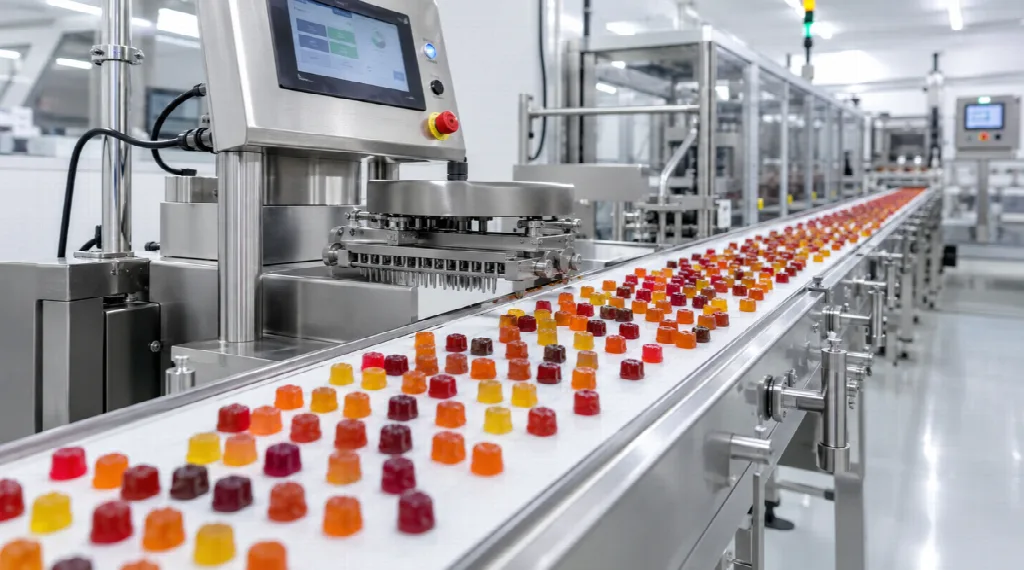
Application scene: gummy production is one of the private-label formats that changes premix selection. Image: PNP Biotech.
6. Organic-Scope Premix: A Conditional Entry
Organic premix belongs on the shortlist only when the certificate scope matches the SKU. PNP Biotech holds a USDA Organic certificate issued by Ecocert SAS on 2025-11-04, certificate number 315111251104065726, for the U.S. market, with scope 'HANDLING/PROCESSING; VEGETABLE EXTRACTS'. It also holds an EU Organic certificate issued by Ecocert SAS on 2025-11-03, certificate number CN-BIO-154.156-0005276.2025.002, valid to 2027-03-31, covering operators, groups of operators and exporters in third countries for products imported into the EU as organic products or in-conversion products, under Regulation (EU) 2018/848 and Commission Implementing Regulation (EU) 2021/1378.
Procurement reading: these are specific certificates, not a blanket organic claim for every nutritional premix SKU. Match the ingredient, processing site, product and destination market to the certificate scope before using an organic claim. Track the EU certificate's 2027-03-31 expiry in the supplier file. If the SKU falls outside the scope, keep it in the conventional premix discussion.
Premix versus in-house ingredient blending
A premix can simplify the incoming-material set, but it does not remove quality work. Compare the routes on control, documentation and fit.
| Dimension | Premix route | In-house individual ingredients |
|---|---|---|
| Incoming materials | One blended input with a defined specification; confirm COA and identity-testing approach. | Multiple vitamin and mineral inputs, each requiring supplier qualification and incoming checks. |
| Blending and uniformity | Supplier owns the blend step; buyer reviews batch records and uniformity data. | Buyer owns blending, weighing and uniformity controls. |
| Documentation | Supplier should provide COA, technical data and batch documentation; PNP Biotech lists COA and third-party testing upon request. | Buyer generates and holds the full documentation set. |
| MOQ and flexibility | MOQ is based on formulation and order quantity; changes may require a new run. | Ingredient MOQs vary by item; formula changes are handled internally. |
| Fit boundary | Less attractive if the brand already has qualified blending and wants direct control of every ingredient. | Less attractive if the brand lacks blending, testing or documentation capacity. |
In-house blending can be the better choice for a brand with established blending equipment, qualified staff and testing controls, especially when it wants to adjust individual ingredient levels frequently. A premix route can be the better screening choice when the brand wants a single specified blend and a supplier-managed documentation package. Neither route eliminates the need to verify identity, potency, uniformity and packaging controls.
How to compare shortlisted suppliers
Use the same scorecard for every supplier. The shortlist is only useful if the criteria are comparable.
- Dosage-form fit: confirm the premix is designed for the actual SKU—powder, granule, liquid, capsule, tablet, softgel or gummy. A model name is a starting point, not a specification.
- Market documentation: for U.S. dietary supplements, check 21 CFR Part 111 CGMP and 21 CFR 101.36 labeling. For EU food supplements, check Directive 2002/46/EC; for EU food fortification, check Regulation (EC) No 1925/2006. If the brand uses third-party certification, ask whether the supplier can support NSF/ANSI 173 or USP verification requirements.
- Quality evidence: request COA, identity testing, potency, uniformity, moisture and microbiological results, retain samples and batch traceability. PNP Biotech's FAQ unit lists these controls; the buyer should verify them for the specific SKU.
- Commercial terms: PNP Biotech states MOQ is based on formulation and order quantity, lead time is based on formulation and order quantity, delivery is EXW, FOB or CIF, and payment is T/T with terms negotiable by order value and cooperation history. Treat these as RFQ inputs, not a fixed quote.
- Certificate scope: match organic or other certificates to the SKU, site and market. A certificate number is verifiable evidence only when the scope matches.
- After-sales and change control: PNP Biotech lists technical consultation, documentation and quality issue coordination. Ask how formula changes, packaging changes and deviations are handled before the first order.
Where PNP Biotech fits in the shortlist
PNP Biotech is a capability reference in this shortlist, not a market-ranked leader. The supplied content documents custom nutritional premix services, product models across powder, granules, liquid, hard capsules, tablets, softgels and gummies, and OEM/custom scope covering formulation, ingredient ratios, particle size and packaging. Quality control is listed as COA and third-party testing upon request. Export markets listed in the capability unit are North America, Middle Asia and Southeast Asia; the company profile lists North America as a main market and a 100% export orientation. After-sales support is listed as technical consultation, documentation and quality issue coordination.
Fit boundary: the supplier's MOQ, lead time and monthly capacity are not fixed numbers. Monthly capacity is stated as subject to production availability; lead time and MOQ are based on formulation and order quantity. A buyer should not treat these statements as a guaranteed slot or a published price. The right next step is an RFQ with the SKU, dosage form, target market, annual volume, pack size and required certificates.
Application scenarios that change the order
- Multivitamin drink or powder mix: put vitamin premix powder first; verify moisture, packaging and dosing.
- Private-label capsule or tablet: put vitamin and mineral premix for capsules or tablets first; verify identity, potency, uniformity, moisture and microbiology.
- Softgel or gummy: put the softgel or gummy premix route first only after process compatibility is documented.
- Organic private-label SKU: move organic-scope premix up only when the certificate scope matches; otherwise keep it out of the organic shortlist.
Market and regulatory signals
Market context supports the category but does not decide the shortlist. Strategic Market Research estimates the global nutritional premixes market at USD 9.6 billion in 2024, rising to USD 13.4 billion by 2030 at a 5.7% CAGR; the same commercial research source reports that Asia Pacific held a 38.4% share in 2025. These are commercial estimates, not official market statistics, and they do not establish supplier ranking.
Regulatory signals matter more for preference. In the U.S., 21 CFR Part 111 and 21 CFR 101.36 set the CGMP and labeling frame for dietary supplements. In the EU, Directive 2002/46/EC covers food supplements, while Regulation (EC) No 1925/2006 covers the addition of vitamins and minerals to foods. A June 2026 source reported that the European Commission planned a draft regulation to harmonize maximum permitted levels for vitamins and minerals in Q3 2026, with adoption targeted for Q1 2028; buyers should verify the current status before relying on that timetable. If harmonized maximum levels advance, high-dose private-label SKUs may need reformulation, which raises the value of a supplier that can hold a specification across markets.
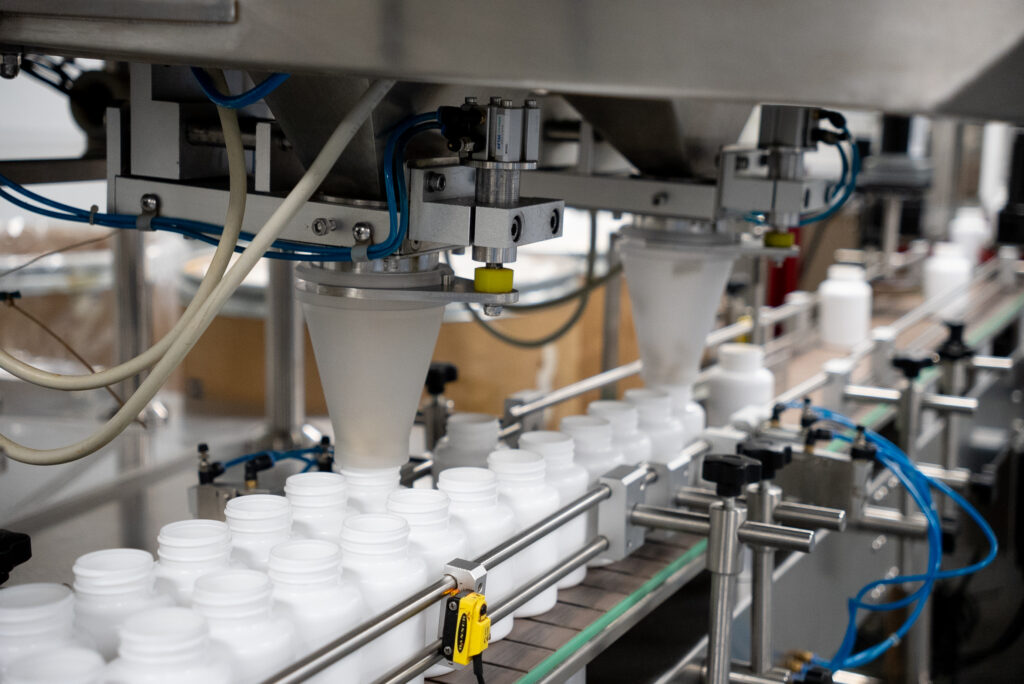
Packaging scene: bottling and packaging belong in the premix RFQ because pack size and moisture protection affect the SKU. Image: PNP Biotech.
Future outlook
The next shortlist decision is likely to be documentation-led rather than price-led. As private-label ranges multiply across capsules, tablets, softgels, gummies, powders and liquids, the supplier that can provide a consistent COA, batch record, packaging control and market-specific documentation becomes easier to qualify. PNP Biotech's EU organic certificate runs to 2027-03-31, so buyers using that scope should diarise renewal. For U.S.-bound SKUs, the CGMP and Supplement Facts framework is already in force; the buyer's task is to verify that the premix specification supports the label and the finished-product controls.
Conditional outlook: if EU maximum levels are harmonized as planned, reformulation pressure may increase for high-dose products. That is a conditional scenario, not a measured outcome, and it should be tested against the final regulation. The durable preference is for a supplier that can produce the same specification repeatedly and document the batch.
Frequently asked questions
What should a private-label brand confirm before ordering a nutritional premix?
Confirm the MOQ, delivery terms, acceptance method and payment terms. PNP Biotech states that MOQ is based on formulation and order quantity, reflecting nutrient count, potency level, dosage form and pack size; consolidated runs can lower unit cost. Delivery is EXW, FOB or CIF. Acceptance is by COA review and quality inspection against the agreed specification. Payment is T/T, with terms negotiable by order value and cooperation history.
Which quality risks matter most in nutritional premix OEM?
Three risks need control: raw material quality, batch consistency and packaging and storage. Raw material control includes verified suppliers, an approved vendor list, COA review and third-party testing of high-risk materials. Batch consistency relies on validated formulas, batch records, testing for potency, uniformity, moisture and microbiology, retain samples and traceable records. Packaging uses aluminium-foil bags, inner liners and desiccants, with cool, dry, light-protected storage and proper resealing after opening.
How should a buyer choose between powder, granules and liquid premix?
Match the route to the finished SKU and process. Powder fits powdered mixes and drinks; granules are relevant when particle size is a defined customization variable and the process needs a granule profile; liquid premix fits liquid finished products only after carrier compatibility is demonstrated. Request the actual specification and COA for each route rather than relying on the format name.
Do PNP Biotech's organic certificates cover every nutritional premix SKU?
No. The USDA Organic certificate covers a defined U.S. scope for handling/processing and vegetable extracts, and the EU Organic certificate covers a defined operator/exporter scope for products imported into the EU as organic, valid to 2027-03-31. A buyer must match the ingredient, site, product and market to the certificate scope before making an organic claim.
What documentation should a U.S.-bound private-label SKU request?
Request documentation that supports 21 CFR Part 111 CGMP, including production and process controls, ingredient identity testing under 21 CFR 111.75(a)(1) where applicable, and label compliance with 21 CFR 101.36. Ask for the COA, batch records, potency and uniformity results, microbiological results and packaging specifications for the actual premix.
For reference, the PNP Biotech catalog is available here: PNP Biotech catalog (PDF).
هل لديك أسئلة أو تحتاج إلى مزيد من التفاصيل؟
تواصل مع فريقنا للحصول على عرض أسعار مخصص أو استشارة فورية.
طلب عرض أسعار
املأ النموذج أدناه وسيتواصل معك فريقنا بعرض مقترح مخصص.
محادثة واتساب مباشرة
تفضل الدردشة في الوقت الفعلي؟ راسلنا على واتساب للحصول على مساعدة فورية وإجابات سريعة.
- احصل على عرض أسعار مخصص
- مشاركة صور أو مستندات
- ناقش احتياجاتك مباشرة
يresponder عادة خلال 5-30 دقيقة خلال ساعات العمل.