
OEM Brass Valve Constraints: Certification, Specs and MOQ
An OEM brass valve programme is usually defined by four constraints before price is discussed: the certificate that covers the exact model and market, the pressure and temperature class on the drawing, the thread standard at the connection, and the minimum order quantity that makes the programme viable. A catalogue range alone does not answer these questions, because a brass valve that is correct for one market can be outside the scope of the certificate that a buyer assumed would cover it.

Why OEM brass valve constraints matter more than a catalogue
An OEM brass valve is built to the customer's specification, drawing and part number, and reaches the market under the customer's brand. That shifts the procurement question from which valve is available to which constraints can be documented and repeated batch after batch.
For an OEM valve for HVAC systems, heating systems or plumbing systems, the constraint set is wider than the body material. It includes the approval route for the destination market, the pressure and temperature class, the thread standard, the medium, the marking method, the packaging, the inspection record and the commercial order size. Each item can be verified, and each item can become a reason for a sample rejection if it is not fixed in the specification.
This is also where catalogue comparisons fail. Two brass ball valves with the same nominal size can differ in pressure class, temperature range, thread standard, surface finish and certificate scope. The buyer may not need every variant, but the buyer does need to know which variant is being quoted.
Certification is a scope, not a logo
Approvals are written around a product type, model or family. A supplier may hold a certificate for one valve type or one market while other models remain outside that certificate's scope. This is a normal feature of product approval, not a defect. The practical task is to match the certificate scope to the ordered model and to the destination market.
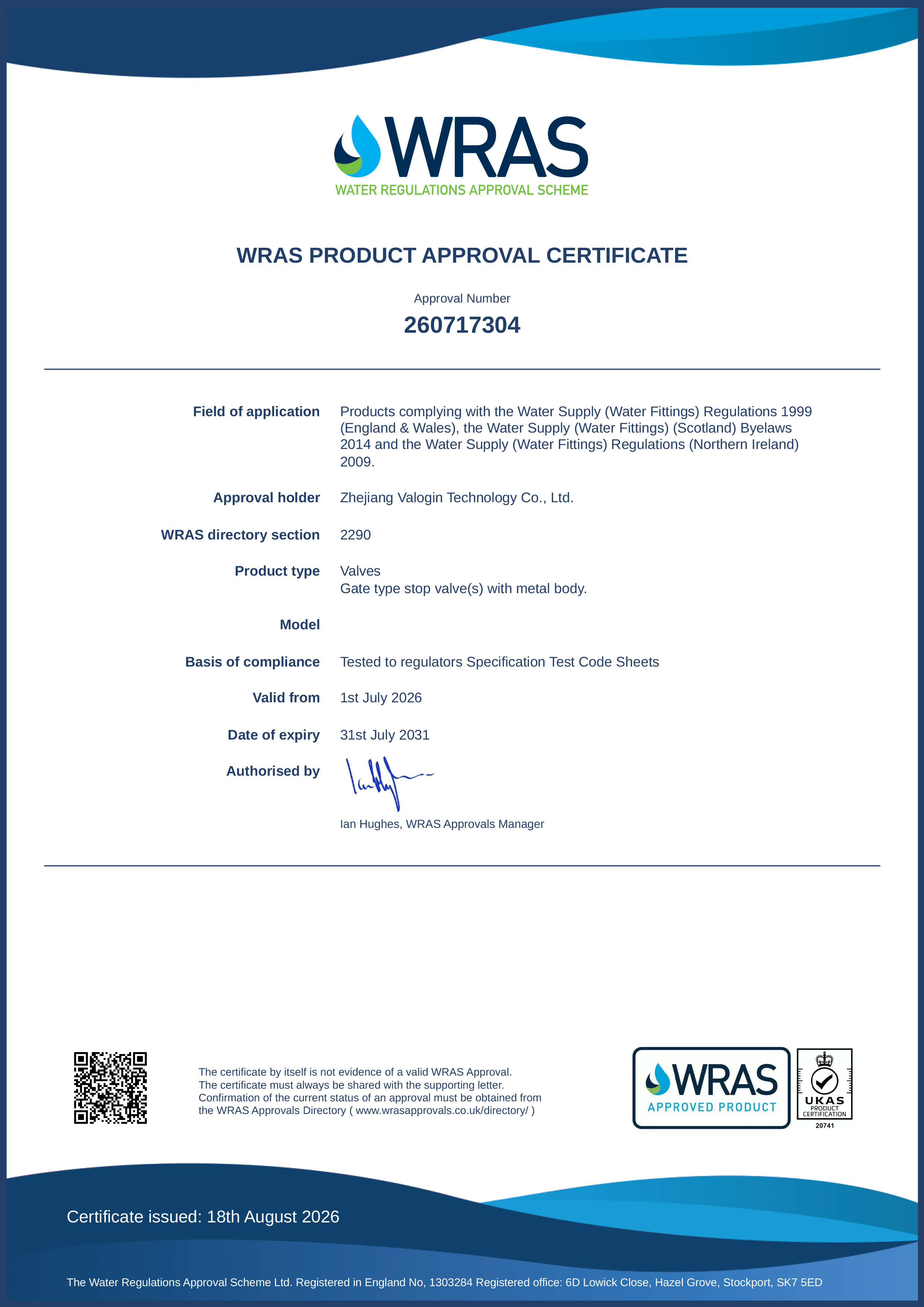
The certification records in the source material show why this matters. The WRAS product approval certificate number 260717304 lists its product type as Valves - Gate for the United Kingdom market. The ACS certificate number 23 ACC NY 155 covers a pressure reducer model 18.07023.G20.CP for France. The ECM CE certificate number 0B230606.ZVTDN65 covers check valve and Y strainer under EN 12266-1:2012 and EN 12266-2:2012. The DVGW type examination certificate DG-4312DQ0883 covers gas supply products, Absperrarmatur up to MOP 5 and Kugelhahn in Series 10 under DIN EN 331.
These examples are not a complete approval map. They show the level of detail a buyer should expect when an OEM pressure reducing valve, OEM gate valve, OEM check valve or OEM ball valve is offered for a regulated market. A single certificate should not be read as a blanket approval for every brass valve in a supplier's range.
| Certificate | Market | Scope as listed in the record | Standard or basis | Expiry |
|---|---|---|---|---|
| WRAS Product Approval Certificate 260717304 | United Kingdom | Product type: Valves - Gate | Water Supply (Water Fittings) Regulations 1999; Scotland Byelaws 2014; Northern Ireland Regulations 2009 | 2031-07-31 |
| WaterMark Certificate of Conformity WM-022194 | Australia | In-line valves for plumbing water supply systems - miscellaneous types metallic and non-metallic | WMTS-012:2018 | 2027-03-07 |
| UPC Certificate of Listing 7553 | US and Canada | Ball valves | IAPMO/ANSI Z1157-2014e1 (R2019); ASME A112.14.2022/CSA B125.14:22; NSF/ANSI 14-2023 | No expiry date listed |
| Lead Free 7555 | US | Lead Free Plumbing Products | SDWA §1417(d); California Health & Safety Code §116875; NSF/ANSI/CAN 372-2024 | No expiry date listed |
| DVGW type examination DG-4312DQ0883 | EU | Gas supply; Absperrarmatur up to MOP 5; Kugelhahn; Series 10 | DIN EN 331 (01.04.2016) | 2030-12-22 |
| CSA Certificate of Compliance 2759792 | Canada and US | Gas valves - lever operated non-lubricated shutoff and general use; 1/2 psig and 5 psig ball valves, models 10.12352, 10.12362, 10.12372 and 10.12382 | U.S. Standards | No expiry date listed |
| AGA Certificate 8775 | Australia | Manual Shut Off Valve, AGA Application No. 17131 | Not listed in the record | No expiry date listed |
| ACS 23 ACC NY 155 | France | Pressure reducer 18.07023.G20.CP, one article | XP P41-280 | 2028-04-06 |
| ECM CE 0B230606.ZVTDN65 | EU | Check valve and Y strainer | EN 12266-1:2012; EN 12266-2:2012 | 2028-06-05 |
How pressure, temperature and thread classes become purchase constraints
Pressure class and temperature range are not decorative data. They determine the body design, the seal selection, the test procedure and the acceptable service condition. In the source material, brass valve models carry different classes: a brass ball valve can be listed at PN40, a brass gate valve at PN16, a mixing valve at PN25, an angle valve at PN10, and a gas ball valve at MOP5. These values belong to the specific model, not to the whole brass valve category.
Temperature follows the same rule. Published ranges in the source material include -20°C to 120°C for several ball valve and mixing valve models, 0°C to 80°C for a gate valve and an angle valve, 0°C to +66°C for a check valve, and -20°C to 100°C for a stop valve. A buyer who needs a 90°C hydronic heating circuit should not assume that every brass valve in a supplier range is rated for that condition.
Thread standard is the third fixed point. ISO 228 appears across gate, check, angle, bibcock, manifold and ball valve records; ISO 7/1 Rp appears in the gas ball valve record alongside ISO 228. For OEM work, the drawing can also call for NPT or BSP/G threads as part of the custom specification. The thread is not a minor detail because it controls field fit, leak paths and the installer's ability to connect the valve without adapters.
| Model | Product | Size range | Pressure class | Temperature range | Connection note |
|---|---|---|---|---|---|
| VG10.16902 | Brass ball valve | 1/4 in to 4 in | PN40 (40 bar / 580 psi) | -20°C to 120°C | Female/female threads |
| VG11.11302 | Brass gate valve | 1/2 in to 2 in | PN16 | 0°C to 80°C | ISO 228 threads |
| VG12.04033 | Brass check valve | 1/2 in to 4 in | PN16 / 232 psi | 0°C to +66°C | ISO 228 female/female threads |
| VG37.10092 | Mixing valve | 1/2 in, 3/4 in, 1 in | PN25 (362.5 psi) | -20°C to 120°C | Male/male threaded connections |
| VG14.90111 | Brass angle valve | 1/2 in x 3/8 in; 1/2 in x 1/2 in | PN10 | 0°C to 80°C | ISO 228 threads; chrome-plated brass body |
| VG10.61011 | Brass gas ball valve | 1/4 in to 4 in | MOP5 | -20°C to 120°C | ISO 7/1 Rp and ISO 228 threads; CE, DVGW, EN331 |
Where Valogin fits the OEM brass valve supply chain
Valogin (Zhejiang Valogin Technology Co., Ltd.) is a brass valve and fittings manufacturer based in Qinggang Industrial Zone, Yuhuan, Zhejiang, China. The company was founded in 1985 and operates a 28,000 square meter factory with about 1,000 employees and an annual output of 80 million pieces. More than 90% of turnover comes from international markets, with Europe and North America as key markets and coverage extending to South America, the UAE and more than 100 countries. Its product range covers brass valves, fittings and distribution manifolds for plumbing, heating and gas systems.
For OEM and private-label supply, the company states OEM, ODM and customized production. Customization covers structure, material, marking and logo of brass valves. The commercial terms listed in the source material include a minimum order quantity of 5,000 units and a lead time of 50 days. Quality control includes 100% air-tight test, dimension sampling per batch and material certificate on request. After-sales support includes engineering and drawing support from quotation to first article, sample approval before mass production, batch inspection records and material certificates with each shipment, a named account contact for order and technical questions, and quality claim handling terms agreed in the supply contract.
The manufacturing base includes a laboratory of about 1,025 square meters, established in accordance with ISO 17025, with more than 100 pieces of equipment. The R&D team includes more than 70 designers and engineers, including over 15 full-time R&D engineers, with experience in water, gas, oil and heating systems. The company lists ISO 9001, ISO 14001 and ISO 45001 management system certification, and CNAS, CE, DVGW, AGA, WRAS, NSF, cUPC, CSA and AB1953 among the approvals it holds. It also states that 70% of its products are manufactured via automated workflows, with dedicated automatic lines for ball valves and gate valves supported by industrial robots.
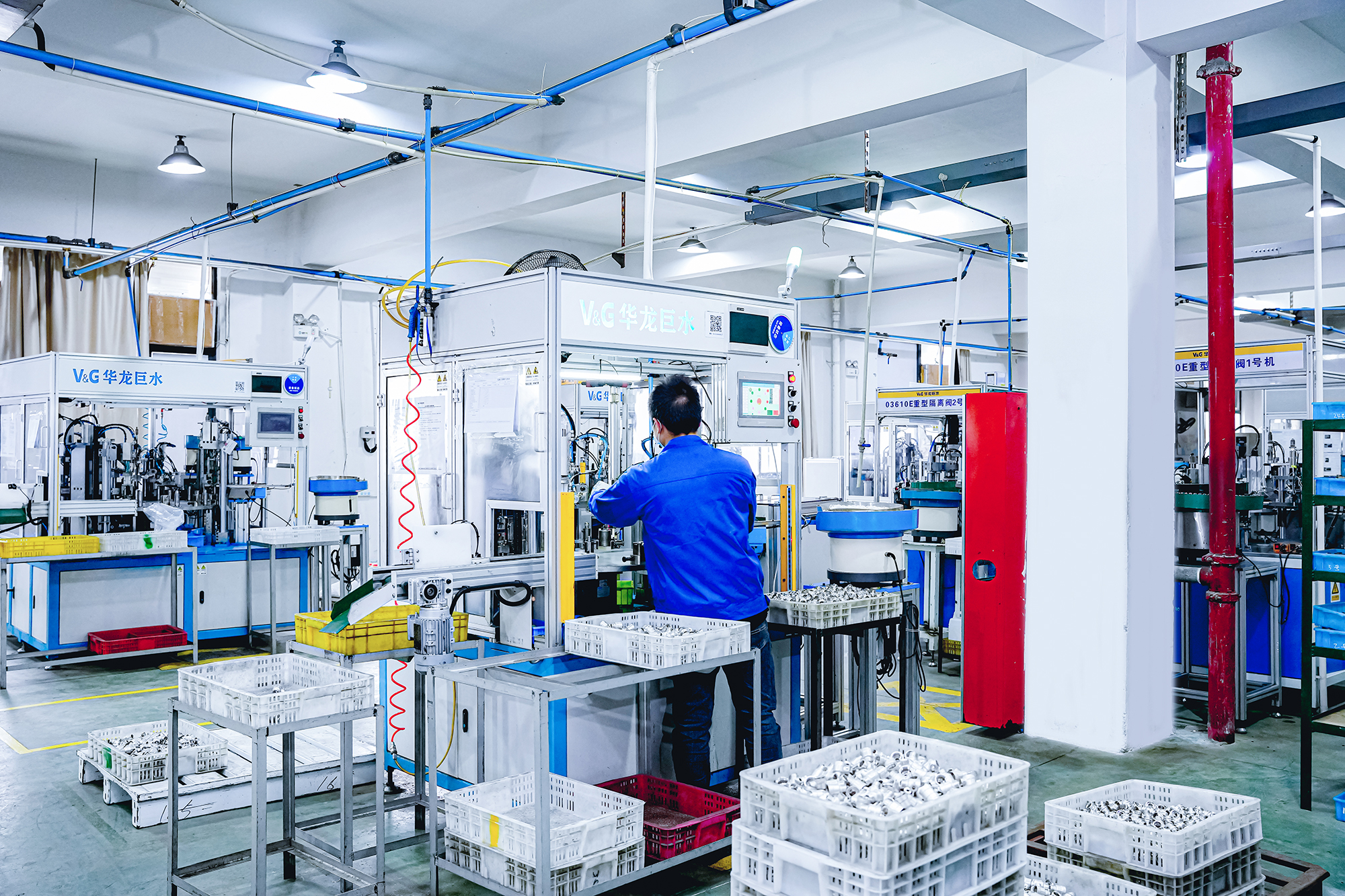
The product list used here covers brass ball valves, gate valves, check valves, stop valves, angle valves, manifolds, mixing valves, gas ball valves, float ball valves and bibcocks. OEM butterfly valve and OEM globe valve categories are not part of that list and are not claimed in this article.
What an OEM brass valve order can include
An OEM brass valve order can carry the customer's brand in several places. Logo and part number can be cast, stamped or laser-marked on the body and handle. Private-label casting marks, customer packaging, labels and printed documentation can also be applied. An approved sample and its inspection record set the standard that later batches are checked against.
The custom scope can include body dimensions and connection threads to the customer's drawing, NPT or BSP/G thread options, port size, full port or reduced port, handle type and colour, stem and ball configuration, and union or one-piece body construction. Material and finish can be matched to the market requirement: natural brass, nickel-plated or chrome-plated finish, with seal and gasket material selected for the medium. Performance targets for flow, torque and pressure class can be agreed, and part numbering can follow the customer's own system.
Documentation is part of the product. Dimensional inspection reports, material certificates and process capability data can be supplied with each batch. The application record also states that customer drawings, part numbers and the brand relationship are kept confidential and do not appear in public material. That matters for an OEM HVAC valve programme, where the customer may be selling the valve under its own name and does not want the manufacturing source disclosed.
For OEM HVAC control valve projects, the boundary is also clear. The customer's own assembly line, actuators, control electronics, packaging and labelling equipment remain on the customer side. The brass valve body and its connection geometry are manufactured to the agreed drawing. This division is useful when a brand has actuator and control competence but does not want to build brass casting and machining capacity.
Application fit: OEM valves for HVAC systems, heating and plumbing
The OEM and private-label application record describes supply to valve brands, heating equipment makers and building services suppliers. Working conditions vary by customer, but typically involve PN10 to PN16 water, glycol and gas circuits, with the valve built to the customer's own specification and drawing. Production can follow the customer's schedule and forecast, including multi-year supply programmes with repeat orders.
In building water supply and sanitary installations, the source scenario describes potable water at 1 to 10 bar and hot water up to 65°C. Brass gate valves provide the coarse shut-off on the main supply and on each riser. Brass ball valves give quarter-turn isolation at the fixture group so a single floor or apartment can be worked on without shutting the building down. Brass check valves prevent back-flow and cross-connection between circuits. Brass angle valves connect sanitary fixtures to the pipework. These are the functions behind an OEM valve for plumbing systems, and they explain why the buyer needs more than a size and a material grade.
In hydronic heating, the scenario describes hot water up to 90°C and working pressure up to PN10 in a two-pipe radiator circuit. Brass gate valves isolate the circulator and the main distribution lines. Brass ball valves give quarter-turn isolation at the heat source and at each riser. Brass angle valves connect radiators to the pipework. Brass stop valves throttle the flow so radiators far from the circulator still reach design temperature. These are the valves that appear in OEM radiator valve, OEM heating valve and OEM hydronic valve programmes, and they carry different duties: isolation, connection and regulation.
In gas installations, the scenario describes natural gas or LPG with a low-pressure side typically at 0.02 to 0.5 bar. A brass gas ball valve isolates the gas line or the individual gas appliance. The quarter-turn handle shows the open or closed position at a glance and can be locked in the closed position. The valve is the designated isolation point before maintenance on the appliance. Gas-tight shut-off is a safety issue, not a performance preference, and the gas approval for the target market must be confirmed before the scenario is published. In Europe, EN 331 is the relevant gas standard named in the source material.
These application facts also define the limits of a general OEM water control valve claim. A valve built for a PN10 heating circuit is not automatically the correct choice for a gas line. A valve approved for a gate-valve scope is not automatically approved for a ball-valve scope. The application, the medium and the certificate must line up.
Market trend: why the constraint set is tightening
Global Market Insights estimates the global HVAC valve market at USD 17.1 billion in 2025 and projects USD 27.1 billion by 2035, with a 4.7% CAGR for 2026 to 2035. Future Market Insights projects that brass and bronze valve bodies will hold a 46.2% share of the HVAC valve market by material in 2026. Global Market Insights also reports that Asia Pacific was the largest regional market for HVAC valves in 2025, with over 38% share.
These figures describe the HVAC valve market, not the market share of any single supplier. Their procurement meaning is narrower and more useful. Brass remains a central body material, so the constraints that surround brass - lead content, dezincification resistance, pressure testing, potable-water approval and gas approval - remain central to supplier selection. As the installed base grows, the buyer's ability to verify certificate scope and batch documentation becomes part of the product definition, not an administrative afterthought.
Comparison with traditional solutions: where the OEM route stops
There are three common routes for a brand that wants to sell brass valves. The first is in-house production, where the brand controls casting, machining, assembly and testing. The second is OEM or private-label supply, where a manufacturer such as Valogin produces to the customer's drawing, part number and brand. The third is spot purchasing from stock or from a trader, where the buyer takes an existing product and does not control the manufacturing specification.
In-house production gives the brand the deepest control, but it requires foundry or forging supply, machining capacity, assembly, testing and a quality system. It is not a small commitment, and it is not necessary for every brand that wants a brass valve range. Spot purchasing gives speed and low commitment, but it may not provide private-label marking, batch traceability, a customer part number or a certificate scope matched to the buyer's market.
The OEM route sits between those two. It gives the buyer a documented product without building brass production, but it has real boundaries. In the source material, the minimum order quantity is 5,000 units and the lead time is 50 days. Custom development starts from a customer drawing, a physical sample or a written application requirement, and sample approval takes place before mass production. Certification is product-specific, so a certificate for a gate valve, a pressure reducer model, a check valve or a gas ball valve Series 10 does not cover every brass valve in the range. For a very small trial order, an urgent mixed-carton replenishment or a product that must ship from stock, a stockist may be the more suitable route. That is a boundary of the OEM model, not a defect in it.
Decision framework for buyers
- Start with the market and the certificate scope. List the destination markets and the required approvals. Then match each certificate to the exact product type and model. Check the scope wording, the standard and the expiry date. Do not accept a certificate as a general capability statement.
- Fix the duty before the model. Decide whether the valve is for isolation, connection or regulation. A ball valve gives quarter-turn isolation; a gate valve gives straight-through isolation and is for fully open or fully closed duty; a stop valve is made for throttling. The wrong duty choice cannot be corrected by a higher pressure class.
- Write the pressure, temperature and medium into the specification. Use the model-specific values, not a family average. Confirm the thread standard and the connection layout. For gas, confirm the gas approval for the target market before the order is placed.
- Define the brand and packaging scope. Decide whether the logo and part number are cast, stamped or laser-marked. Confirm private-label casting marks, labels, printed documentation and packaging. Confirm how the customer part number will be carried through production and inspection.
- Check the commercial boundary. Confirm the minimum order quantity, the lead time, the forecast and the delivery window. The source material lists 5,000 units and 50 days, so a programme that cannot support that order size should be treated as a different sourcing route.
- Agree the evidence package. Require sample approval before mass production, 100% air-tight test, dimension sampling per batch, material certificate on request and batch inspection records with each shipment. For an OEM programme, the inspection record is part of the product release, not an optional extra.
Future outlook
The direction of travel is toward more explicit constraint management. Buyers are likely to keep asking for the same four things: a certificate that matches the model and the market, a pressure and temperature class that matches the duty, a thread and connection that match the installation, and an order size and lead time that match the programme. Suppliers that can document these points without ambiguity will be easier to qualify, and suppliers that treat a certificate as a logo will create avoidable review work.
For OEM brass valve programmes, the useful competitive ground is not a broader catalogue claim. It is the ability to translate a customer drawing into a repeatable product, to keep the certificate scope and the model aligned, and to release each batch with the inspection record that the buyer's market expects. That is a narrower claim than a general capability profile, but it is the claim a procurement team can actually verify.
Reference: Valogin brand brochure (PDF).
FAQ
Can a brass valve be manufactured under our own brand?
Yes. Logo and part number can be cast, stamped or laser-marked on the body and handle. Production can follow the customer's drawing or sample, and packaging and documentation can carry the customer's brand. An approved sample and its inspection record set the standard that later batches are checked against.
Can production follow our drawing or sample?
Yes. Custom and non-standard valve development can start from a customer's drawing, a physical sample or a written application requirement. The adaptation can cover connection layout, port configuration, thread standard, material and seal selection, surface finish, and documentation in the customer's part-numbering system.
What are the MOQ and lead time for an OEM brass valve order?
The source material lists a minimum order quantity of 5,000 units and a lead time of 50 days. Production can be scheduled to the customer's forecast and delivery window, and multi-year supply programmes with repeat orders are part of the OEM application record.
How is quality checked before shipment?
Quality control includes 100% air-tight test, dimension sampling per batch and material certificate on request. An approved sample and its inspection record set the standard for later batches, and batch inspection records and material certificates can be supplied with each shipment.
Does one certificate cover every brass valve model?
No. Approvals are written around a product type, model or family. In the source material, the WRAS certificate scope names Valves - Gate; the ACS certificate names pressure reducer 18.07023.G20.CP; the ECM CE certificate names check valve and Y strainer; the DVGW certificate names gas ball valve Series 10 up to MOP 5. A buyer should match the certificate scope to the ordered model.
Ball valve, gate valve or stop valve - which one should I use?
Ball valves give quarter-turn isolation and are the default for on/off duty in water and gas lines because the handle shows the valve state at a glance. Gate valves open slowly on a multi-turn handwheel and give a straight-through, low-resistance bore, but they are for fully open or fully closed duty only. Stop valves are made for throttling. Use ball for isolation, gate for low-resistance isolation and stop for regulation.
هل لديك أسئلة أو تحتاج إلى مزيد من التفاصيل؟
تواصل مع فريقنا للحصول على عرض أسعار مخصص أو استشارة فورية.
طلب عرض أسعار
املأ النموذج أدناه وسيتواصل معك فريقنا بعرض مقترح مخصص.
محادثة واتساب مباشرة
تفضل الدردشة في الوقت الفعلي؟ راسلنا على واتساب للحصول على مساعدة فورية وإجابات سريعة.
- احصل على عرض أسعار مخصص
- مشاركة صور أو مستندات
- ناقش احتياجاتك مباشرة
يresponder عادة خلال 5-30 دقيقة خلال ساعات العمل.