
OEM Capability in Road Marking Glass Beads: A Procurement Perspective
OEM Capability in Road Marking Glass Beads: A Procurement Perspective

Road marking projects depend on consistent retroreflection, especially at night and in wet conditions. Glass beads are the small transparent spheres dropped onto or mixed into marking materials to return light from vehicle headlamps to the driver. For procurement teams moving from evaluation to execution, supplier capability is as important as specification compliance. This article examines what buyers should verify when evaluating OEM glass bead suppliers, using the production and quality systems of Dylan Technology Co., Ltd. as a reference.
What Procurement Should Verify in OEM Glass Bead Supply
Different regions and contract specifications require different glass bead standards, such as AASHTO M247 in the United States and EN 1423 in Europe. A supplier that can produce multiple grades and provide OEM customization reduces the need to manage multiple vendors. However, procurement teams often have limited visibility into a supplier’s actual production capacity, testing routines, and delivery flexibility before signing a contract. This gap creates risk in project execution.
Brand Solution: Production Infrastructure and Certification
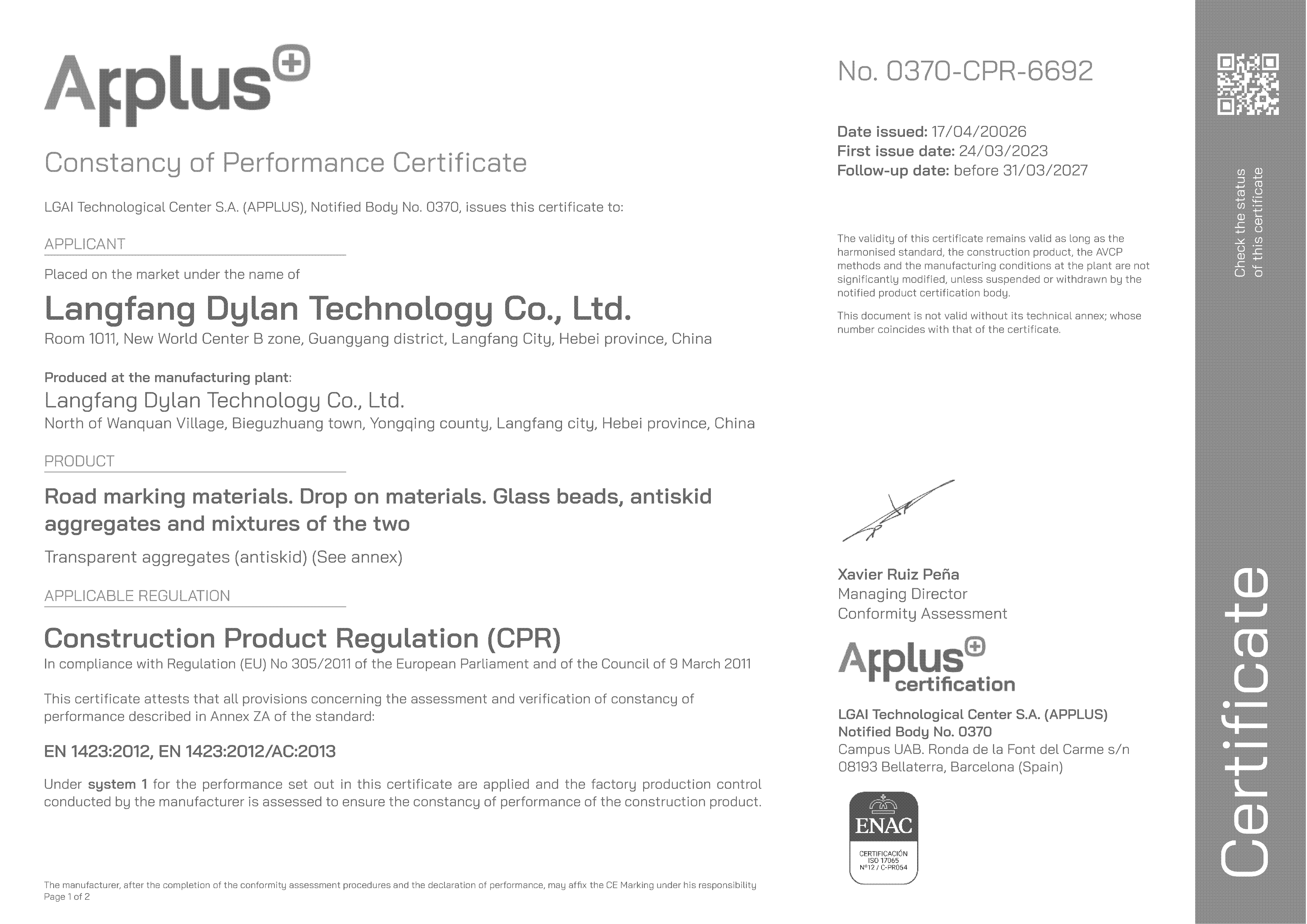
Dylan Technology Co., Ltd. is a manufacturer and supplier of glass beads and other raw materials for the road safety industry, established in 2004. The company operates four production bases in Liaoning, Shanxi, Hebei, and Henan provinces in China, with more than 15 professional glass bead production lines and an annual output of 100,000 tons. The company has 300 employees and an R&D team of 20 engineers. It exports about 95% of its output to markets including the EU, the United States, Southeast Asia, and the Middle East. Its laboratory is equipped with CAMSIZER and X-2600 testing instruments for measuring particle size, reflectivity, and wear resistance. The company holds ISO 9001 quality management system certification, CE certification, JIS certification, and KIS certification.
Technical Explanation: How Glass Beads Deliver Retroreflection
Glass beads increase the reflective refractive index of road markings, improving night visibility. The key technical parameters are refractive index, roundness, and particle size distribution. AASHTO M247 defines requirements for glass beads used in traffic paints in the United States, including a minimum roundness of 70%. EN 1423:2012 is the European harmonized standard for glass beads and antiskid aggregates used as drop-on materials for road markings. High refractive index glass beads, such as RI 1.7, are used to improve performance in demanding conditions. Dylan Technology’s product range includes AASHTO M247 Type 1 through Type 4, EN1423, EN1424, BS6088 A and B, AS/NZS Type B, C, D, and other grades. Each product model has a defined particle size range and is made from recycled glass or new glass, depending on the specification.
| Product Model | Standard / Type | Particle Size Range |
|---|---|---|
| GLASS BEADS AASHTO M247-TYPE 1 | AASHTO M247 Type 1 | 1180-150μm |
| GLASS BEADS AASHTO M247-TYPE 2 | AASHTO M247 Type 2 | 1180-180μm |
| GLASS BEADS EN1423 | EN 1423 | 850-180μm |
| GLASS BEADS BS6088A | BS 6088 A | 1180-425μm |
| GLASS BEADS RI 1.7 | High refractive index | 1180-180μm |
Application Evidence and Field Performance
Field application data from road marking engineering companies and traffic safety manufacturers show stable performance over multi-year periods. In one global project, 72 tons of glass beads were supplied for road marking applications, with a project duration of 3 years and stable performance for 3 years, characterized by low wear. Another project involved 198 tons, also completed over 3 years with low wear. A further case used 108 tons and achieved 3 years of stable performance. These examples indicate that the products have been adopted successfully in real road marking operations.
Market Context and Procurement Implications
According to OEC data, China accounted for approximately 57.4% of total global glass bead exports in 2024. That indicates a strong export base for road marking raw materials. Dataintelo estimates the road marking glass beads market at approximately USD 1.42 billion in 2025, with a projected increase to USD 2.31 billion by 2034. Asia Pacific held a 38.7% revenue share in 2025, driven by highway expansion programs. Another industry trend is the growing use of high refractive index glass beads (RI 1.9+) for all-weather markings, which maintain visibility during wet night conditions. For procurement teams, these trends suggest that suppliers with export experience, multi-standard production capability, and documented quality controls are better positioned to support long-term projects.
Limitations and Boundaries of OEM Sourcing
Compared with buying standard stock from distributors, OEM procurement from a manufacturer offers customization and direct quality accountability, but it also imposes certain constraints. The minimum order quantity at Dylan Technology is 1 ton, and lead times range from 45 to 60 days. This may not suit very small or urgent replacement orders, for which local distribution may be faster. Additionally, OEM customization such as voltage or logo adaptation requires upfront agreement on specifications and may extend lead time. Buyers should weigh these factors against the benefits of lower cost per ton and standard compliance.

Procurement Support and Trade Terms
Dylan Technology offers flexible trade terms: MOQ of 1 ton, delivery methods FOB, CIF, DDP, or EXW, and pre-shipment testing before acceptance. Payment options include TT 100% against BL copy, TT 30% advance and 70% against BL copy, L/C 90 days after BL date, and TT 100% 30 days from BL date. These terms allow buyers to align payment and logistics with project cash flow. However, the choice of delivery term affects total landed cost, so buyers should compare EXW, FOB, CIF, and DDP carefully.
Future Outlook
As road authorities adopt more demanding visibility standards and longer maintenance intervals, glass bead suppliers will need to demonstrate consistent roundness, refractive index, and wear resistance over time. Manufacturers that combine in-house testing, multi-standard product lines, and export logistics experience are likely to remain relevant. Dylan Technology’s ongoing investment in production equipment and waste heat recovery systems, recognized by the China Energy Conservation Association, suggests a focus on cost efficiency and environmental performance, which may become more important in public procurement.
FAQ
What OEM production services are available for road marking glass beads?
The manufacturer provides OEM production services, allowing customers to customize products such as voltage or logo. Minimum order quantity is 1 ton.
What delivery methods are available?
The supplier offers FOB, CIF, DDP, and EXW delivery methods. Buyers can select the option that best matches their logistics and cost requirements.
How is quality verified before shipment?
Pre-shipment testing is conducted as part of the acceptance process. The manufacturer’s laboratory uses CAMSIZER and X-2600 instruments to test particle size, reflectivity, and wear resistance. Quality control includes 100% testing according to company statements.
What standards can the glass beads comply with?
The product range includes AASHTO M247 Type 1 through Type 4, EN 1423, EN 1424, BS 6088 A and B, and AS/NZS Type B, C, D. The manufacturer also holds ISO 9001, CE, JIS, and KIS certifications, indicating compliance with international quality and safety systems.
Can the supplier support small or large orders?
The minimum order quantity is 1 ton, and the manufacturer has a monthly production capacity of 10,000 tons and annual output of 100,000 tons. This allows support for both small trials and large-scale infrastructure projects.
For more detailed product and corporate information, the company’s corporate brochure is available for download: Corporate Brochure