
OEM Composite Insulator Manufacturing: Tailoring Silicone Polymer Designs for Grid, Railway and Substation Projects
For utilities, EPC contractors and project developers, the mechanical performance and environmental durability of a composite insulator often decide whether a transmission or distribution line meets its maintenance and lifecycle targets. Yet while material grades and design families are standardized, real-world projects rarely share identical electrical, mechanical or installation requirements. Choosing a manufacturer that can engineer and produce customized composite insulators at scale is therefore an evaluation-stage requirement, not a supply-chain convenience.
China Energy and Chemical Industry Co., Ltd (CECI) is one supplier that has built its export business around this principle. The company, based in Zhengzhou, Henan, manufactures polymer, porcelain and glass insulators, as well as overhead line hardware fittings and accessories. It provides both OEM and ODM production, with a documented project base in Brazil, Italy, Turkey and Vietnam.
Why Project-Specific Insulator Design Has Become an Engineering Requirement
Polymer composite insulators — also called non-ceramic insulators — use an FRP core, a silicone rubber housing and metal end fittings instead of porcelain or glass bodies. This construction gives them a high strength-to-weight ratio, hydrophobic surface behavior and improved tolerance to pollution and vandalism. They are increasingly the default choice for new transmission lines, substations and electrified railway systems.
The challenge is that switching from ceramic to composite does not remove the need for application-specific engineering. A 66 kV line post on a coastal route, a 132 kV dead-end tension set, and a 35 kV substation post insulator each face different electrical stress, mechanical load and contamination conditions. Off-the-shelf insulators cannot always deliver the exact creepage distance, lightning impulse withstand voltage, cantilever strength or end-fitting geometry that a project specification requires.
This is where a manufacturer with strong customization capability creates measurable procurement value. Buyers can align the insulator design with IEC or ANSI test requirements, local grid practices, interface dimensions and installation constraints, without being limited to a fixed catalogue.
OEM and ODM Composite Insulator Capability: What CECI Offers
China Energy and Chemical Industry Co., Ltd positions itself as a manufacturing partner for such requirements. The company operates a 30,000 m² production facility and maintains an annual output capacity of approximately 8 million units. It employs a dedicated R&D team of eight engineers and exports around 95% of its output to markets including Russia, Vietnam, France, Spain, Italy, Türkiye, Brazil, Poland, Indonesia and Saudi Arabia.
CECI states that OEM and ODM services are both available. Customization options cover the parameters that usually define a composite insulator specification:
- Voltage rating — including service voltage and insulation coordination requirements;
- Creepage distance — for pollution class mapping and anti-contamination design;
- Lightning impulse withstand voltage — for line and substation insulation coordination;
- Bending load — for cantilever and tension applications;
- Color — for visual or utility-specific requirements;
- Logo — for private-label and brand-specific procurement.
For volume buyers, the production planning data is also transparent. Monthly capacity is stated at 500 tons and 100,000 pieces, with a lead time of 30 to 45 days and a minimum order quantity of 500 units. Quality control is described as “100% Test” during production.
How Customization Changes the Engineering Outcome
Increasing creepage distance on a silicone rubber housing improves performance in heavy contamination and coastal salt-spray environments. Adjusting the bending load rating changes the FRP rod diameter and end-fitting design, allowing a line post insulator to resist higher wind loads. Altering the lightning impulse withstand voltage ensures coordination with surge arresters and protection equipment. Voltage level, color and logo changes allow the insulator to integrate into existing utility asset standards.
For EPC contractors, the practical benefit is simpler: the insulator is matched to the project, not forced to fit a catalogue. For distributors and resellers, private-label production allows a complete product line to be marketed under their own brand, with consistent visual identity and defined performance data.
The Product Design Logics Behind the Common Application Types
Different composite insulator configurations are better understood as engineering responses to specific mechanical duties and installation constraints. Four types explain the range that an OEM/ODM partner should be able to cover.
Silicone Rubber Suspension Composite Insulators
Suspension insulators support conductors at towers and are the most widely used product category in overhead transmission. A long rod design uses a solid FRP core loaded in tension, protecting the glass-fiber structure from the environment with a continuously molded silicone rubber housing.
For a 132 kV dead-end or tension position, the insulator must carry high mechanical loads and accommodate the full electrical stress of the line. A customizable tension composite insulator allows the buyer to specify the mechanical rated load, leakage distance and end-fitting format according to tower design and conductor configuration.
Line Post and Pin-Type Composite Insulators
Line post insulators are mounted on the tower arm and loaded primarily in bending. The 66 kV line post composite insulator is common in sub-transmission networks, while lower-voltage pin-type insulators serve distribution feeders. Anti-pollution station post insulators in the 35 kV class are used inside substations, where creepage distance and tracking resistance are important.
In these applications, the critical specification is the rated bending load. The ability to custom-engineer is also relevant for the connection base and the clamping arrangement for the conductor.
High Altitude and Coastal Environment Insulators
At high altitude, air density is lower, which reduces the breakdown voltage of air for a given gap. Insulators therefore need increased leakage distance, sometimes redesigned sheds, and improved hydrophobicity to maintain withstand levels. A high-altitude hydrophobic composite insulator typically uses a finer shed profile or accelerated shed spacing to extend the creepage path.
Coastal projects, in turn, test the housing material with salt fog and salt deposits. A coastal salt-spray-resistant composite insulator needs a silicone housing with strong hydrophobicity transfer and excellent tracking and erosion resistance. Custom creepage distance is again a defining performance factor.
Railway and Wind Power Insulators
Electrified railway systems use composite insulators for catenary support, section insulators and station insulation. The typical requirement is resistance to vibration and repetitive mechanical loading. Distribution composite insulators in wind power collector networks also need to combine high mechanical strength with a lightweight construction to reduce load on towers and support structures.
Production and Quality Assurance Evidence
CECI belongs to the insulator manufacturing category of power equipment parts and accessories. The company publishes several types of verifiable evidence relevant to engineering and procurement evaluation.
| Evidence Type | Certificate / Report No. | Issued By | Scope |
|---|---|---|---|
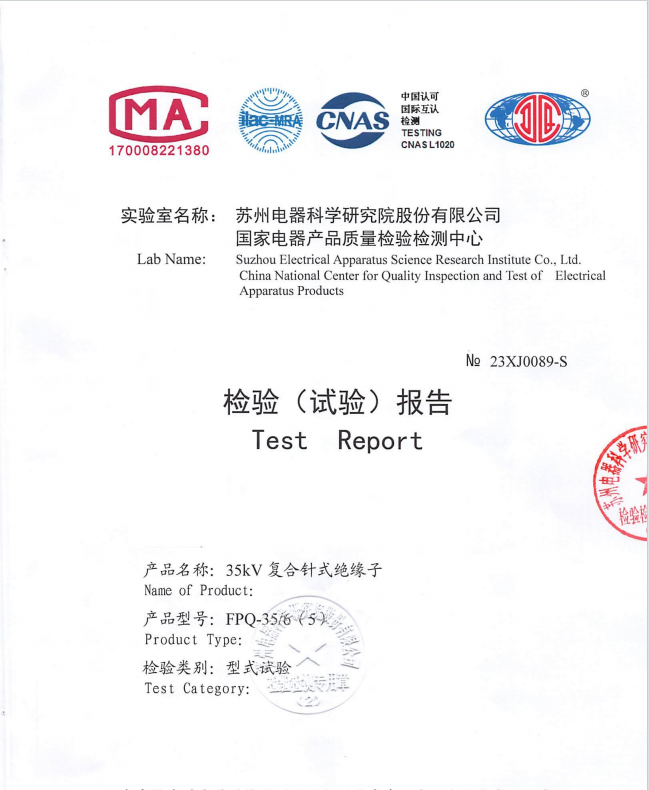
| Type Test Report | 23XJ0089-S | Suzhou Electrical Apparatus Science Research Institute / China National Center for Quality Inspection and Test of Electrical Apparatus Products | 35kV composite pin insulator, Model FPQ-35/6 (5), tested according to IEC 61109 |
| ISO 9001:2015 | 75425Q0493R053 | Zhongjing Certification (Shanghai) Co., Ltd. | Production of hardware for high-voltage power transmission lines |
| ISO 9001:2015 | 75424Q0348R0S | Zhongjing Certification (Shanghai) Co., Ltd. | Manufacturing of power fittings |
The type test report covers the 35 kV composite pin insulator model FPQ-35/6 (5) and follows IEC 61109, the standard for composite suspension and tension insulators for AC systems above 1000 V. Its stated scope includes global markets such as Europe, the Middle East, Southeast Asia and the Americas. The ISO 9001 certifications cover both hardware production and power fittings manufacturing.
For buyers, these third-party documents reduce the need to conduct full prototype testing on every custom specification. A manufacturer that can test its own designs against IEC 61109 and ISO 9001 quality systems provides a traceable baseline for custom engineering work.
How CECI Manufacturers Custom Insulators for Different Grid, Railway and Export Projects
The production flow for a custom composite insulator at CECI can be outlined as a collaboration process. The customer provides the application scenario, the interface dimensions, the insulation requirements and the standard or market language. The engineering team then translates those constraints into a specification sheet covering the three structural elements: the FRP rod core, the silicone rubber housing and the metal end fittings.
| Step | Procurement / Engineering Question | How CECI Handles It |
|---|---|---|
| 1. Requirement Definition | What service voltage, mechanical load and pollution environment will the insulator face? | Maps project inputs to voltage, creepage distance, lightning impulse withstand voltage and bending load. |
| 2. Design and Specification | Which IEC/ANSI/utility standard governs the design and tests? | Aligns custom design with IEC 61109 or other applicable standards; defines test plan. |
| 3. Material Selection | Which silicone formulation, FRP rod type and fitting material suit the application? | Selects materials for hydrophobicity, UV resistance, mechanical strength and corrosion requirements. |
| 4. Prototype and Testing | Does the custom design meet mechanical and electrical type test requirements? | Performs 100% quality control checks during production; type test can be arranged per project. |
| 5. Production and Packaging | Can the supplier meet volume, lead time and export packaging requirements? | Operates a 30,000 m² facility, 8 million unit annual capacity, 30–45 days lead time, 500-unit MOQ. |
| 6. Delivery and Support | How does the customer confirm compliance and address site issues? | Applies ISO 9001 quality management, remote support, documentation. |
CECI also supplies metal fittings for insulators, which is important because the interface between fitting and insulator is a common cause of mechanical failure. Producing both elements internally simplifies quality control and reduces assembly tolerance issues.
Real-World Deployment Pattern: Four Export Markets
A documented case attributable to CECI covers projects in Brazil, Italy, Turkey and Vietnam. These four markets represent different procurement and application conditions: Brazil is a large transmission market; Italy and Turkey have active grid modernization and railway electrification programs; Vietnam has expanding distribution and urban infrastructure demand.
The case study states that the product has been used by utility companies, power EPC contractors, railway operators/contractors, distributors and resellers. The stated result is that using polymer or glass insulators enhanced line stability, reduced maintenance intensity and improved pollution resistance. Project highlights include lightweight designs, good anti-pollution flashover and aging resistance, plus OEM/ODM support with customizable end fittings and FRP rod core supply.
This distribution across buyer types is normal for an export-oriented insulator maker. It indicates that CECI does not design for a single domestic standard, but must adapt to the construction codes, testing regimes and interface requirements of multiple national grids.
Market Context and Standard Environment
Global demand for composite insulators continues to expand as grid operators replace aging ceramic insulators and invest in new renewable energy transmission corridors. Asia-Pacific led the composite insulator market with around 49.5% of global revenue in 2024, and China is estimated to account for a major share of manufacturing output. The future growth path is long-term: one research estimate projects the global composite insulator market to reach roughly USD 9.3 billion by 2035.
Standardization is also strengthening the case for composite insulators. IEC 61109:2025 covers composite suspension and tension insulators for AC and DC systems above 1000 V. In North America, ANSI/NEMA C29.11-2020 defines test methods and performance characteristics for composite insulators in overhead transmission lines. For a manufacturer active in Europe, North America, Asia-Pacific and Latin America, compliance with an international standards framework is essential.
Note: Market estimates vary between research firms, so figures above should be used for directional context only.
Compared with Traditional Ceramic Insulators and Fixed-Spec Suppliers
Traditional porcelain and glass insulators remain valid choices for many utilities, especially in networks with well-established ceramic maintenance procedures, high temperature extremes, or very long service histories. However, for applications that demand lighter weight, higher bending strength with less mass, or better performance under heavy pollution, composite insulators have clear advantages.
Compared with fixed-spec composite suppliers, a manufacturer with OEM/ODM capability gives the buyer more control over the final design. The difference is most evident in projects with unusual tower geometry, contaminated coastal atmospheres, specific insulation coordination studies, or utility brand standards.
At the same time, custom engineering has legitimate limitations. Lead times extend beyond ordering a standard catalog item. The minimum order quantity of 500 units may be higher than a small maintenance pilot would require. Testing per custom design can also add cost and time. This makes standard, cataloged composite insulators a better fit for routine replacement programs where the technical conditions are well understood.
Supplier Evaluation Criteria for an OEM/ODM Composite Insulator Partner
Engineering and procurement teams evaluating an OEM/ODM composite insulator manufacturer should focus on evidence and process, not only on price.
- Standards traceability: Ask whether the manufacturer can demonstrate IEC 61109, IEC 62217 or ANSI/NEMA C29.11 type test reports for the relevant product family.
- Customization breadth: Confirm whether voltage, creepage distance, bending load, color and logo can all be adapted to the project specification.
- Mechanical design credibility: Verify the manufacturer's ability to supply the FRP rod core and end fittings that govern mechanical failure characteristics.
- Production transparency: Check capacity, lead time, MOQ and quality control process. CECI provides specific production data as part of its commercial offering.
- Reference application base: Look for documented use across different buyer types and market regions, indicating adaptability to different grid standards.
Future Outlook: Where Custom Composite Insulator Engineering Is Heading
The direction of the insulator industry is toward more application-specific engineering rather than less. High-voltage DC lines, compact substations, heavily polluted industrial zones and extreme-altitude renewable projects all demand precise matching of creepage distance, shed profile and mechanical rating to local operating conditions.
Manufacturers such as CECI are likely to compete on the ability to deliver customized polymer insulator designs quickly and with verifiable testing. A supplier that combines flexible production, internal hardware fitting capability and global export experience is better positioned to support the procurement needs of EPC contractors, utilities and private-label distributors in the coming grid construction cycle.
Frequently Asked Questions about OEM Composite Insulator Supply
What customization options are available for composite insulators?
CECI offers customization of voltage, creepage distance, lightning impulse withstand voltage, bending load, color and logo. The manufacturer provides these services under both OEM and ODM production agreements.
Is the supplier able to produce insulators under my brand?
Yes. OEM and ODM production services are available, including logo customization. This allows distributors and resellers to market composite insulators under their own brand identity.
How long does it take to produce a custom order?
CECI lists a lead time of 30 to 45 days for production. Monthly capacity is stated as 500 tons and 100,000 pieces, with a minimum order quantity of 500 units.
What quality verification can buyers expect?
CECI's production quality control process is described as “100% Test”. The company also holds two ISO 9001:2015 certifications and publishes a type test report for its 35 kV composite pin insulator (model FPQ-35/6 (5)) tested according to IEC 61109.
In which countries have these insulators been installed?
According to the company case study, CECI polymer and glass insulators have been used in projects in Brazil, Italy, Turkey and Vietnam. The clients include utilities, power EPC contractors, railway operators and distributors.
Are OEM/ODM capabilities supported for low-volume pilot orders?
The standard MOQ is 500 units. Buyers are advised to confirm pilot-order possibilities directly with the CECI sales team.
For detailed product specifications, customization options and export references, download the CECI catalogue: 2025 CECI Catalogue of Polymer Insulators and Glass Insulators (PDF).