
OEM Control Panel Capability: Matching Supplier Depth to Project Risk
For industrial buyers moving from supplier evaluation into project execution, the key question is no longer whether a control panel manufacturer can build enclosures, but whether that manufacturer can deliver a customized, compliant, integrated control panel on a defined schedule. Market data indicates sustained global demand: the electric control panel market was estimated at USD 6.35 billion in 2024, while the broader electrical control panel category was projected at USD 27.2 billion in 2025, with Asia Pacific accounting for a 38.5 percent revenue share. The practical consequence is that capability — not price alone — is the primary risk variable in custom control panel projects.

Custom Control Panel Projects Fail at the Evaluation-to-Execution Boundary
Custom control panel projects most often fail between evaluation and execution, not at the drawing stage. A buyer selects a control panel manufacturer based on catalog pages, sample photos, and a quotation; the supplier later discovers during production that it cannot hold the required IP rating, cannot source 316 stainless steel within the schedule, or lacks the in-house integration skills for PLCs, VFDs, and terminal blocks. The result is rework, delayed commissioning, and compliance issues at the end-user site.
The opportunity is that capability in this industry is documentable. It is not a marketing attribute. It is a set of verifiable processes: sheet metal fabrication and surface treatment, enclosure sealing that achieves a specific protection rating, internal mounting and electrical integration, compliance evidence tied to recognized standards, and a quality-control loop that checks wiring and function before shipment. Procurement teams can assess all of these before issuing a purchase order, which directly reduces the execution risk that otherwise appears only after production begins.
What 'Capability' Means for an OEM Control Panel Supplier
Buyers searching for an OEM control panel supplier or control panel manufacturer often assume that any sheet metal workshop can handle a custom panel project. In practice, the capability spread is wide. A basic processing factory can cut, bend, and weld metal. A full-capability OEM/ODM manufacturer can additionally select the correct material grade for the operating environment, apply corrosion-resistant surface treatment, produce precision cutouts for HMIs, buttons, and cable glands, integrate electrical components inside the enclosure, seal the assembly to an IP class, and document compliance with the relevant standards.
For evaluation purposes, capability should be measured across five dimensions:
- Material and fabrication depth — which materials, which thickness range, and which welding and surface treatment processes are available in-house.
- Enclosure protection — which IP ratings are actually achievable and verified, not just claimed.
- Internal integration — what mounting, wiring, and component compatibility options exist inside the enclosure.
- Compliance and testing — what certificates and test protocols back the product.
- Production and quality control — what capacity, MOQ, and inspection checkpoints apply to a given order.
Documented OEM/ODM Capability: The Dalian Yinlu Example
Dalian Yinlu Electrical Control Equipment Manufacturer, a sheet metal fabrication and electrical control panel manufacturer based in Dalian, Liaoning Province, China, publishes capability data that is specific enough to support pre-award evaluation. The company operates a 5,000-square-meter factory with 60 employees and an annual output of approximately 20,000 units. Around 80 percent of production is exported, primarily to North America, Europe, Oceania, and high-end Asia-Pacific markets.
For buyers evaluating OEM control panel suppliers, the relevant documented facts are:
- Production mode: OEM and ODM.
- Monthly capacity: 2,000 units.
- MOQ: 1–5 units.
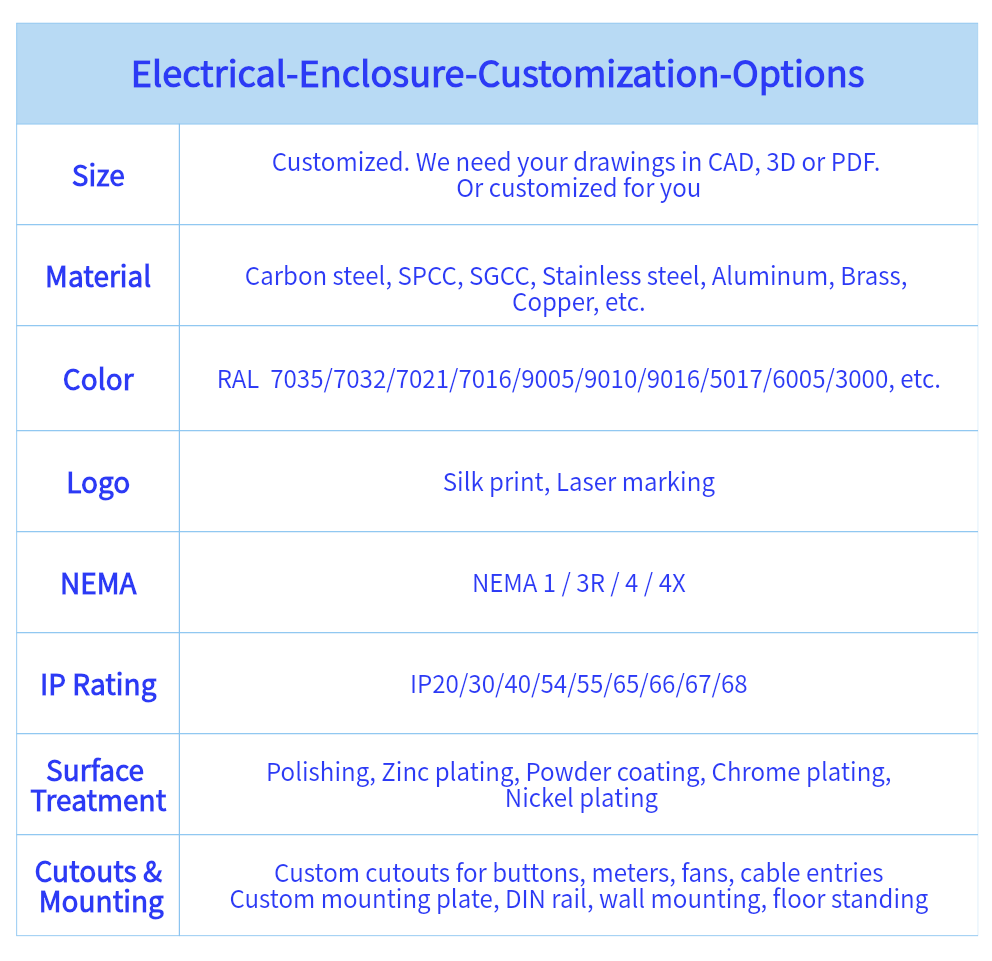
- Customization scope: material, color, logo, size, IP rating, surface treatment, cutouts, and mounting.
- Quality control: visual, wiring, function, safety, sealing, and packaging checks.
- After-sales: 7×24 online support and a one-year warranty.
The MOQ range of 1–5 units is an execution-relevant detail. It allows a buyer to commission a prototype or pilot batch before volume production, which is the kind of de-risking step that evaluation-stage decisions require. The six quality-control categories also map directly to commissioning risks: visual inspection addresses appearance and finish defects; wiring inspection addresses electrical errors; function testing addresses component operation; safety checks address grounding and protection; sealing checks address moisture and dust ingress; and packaging checks address transit damage.
Technical Verification Points Before Awarding a Custom Control Panel Contract
Beyond headline capability data, buyers should verify a series of technical parameters that determine whether a custom control panel will survive its intended site conditions.
Material and sheet thickness
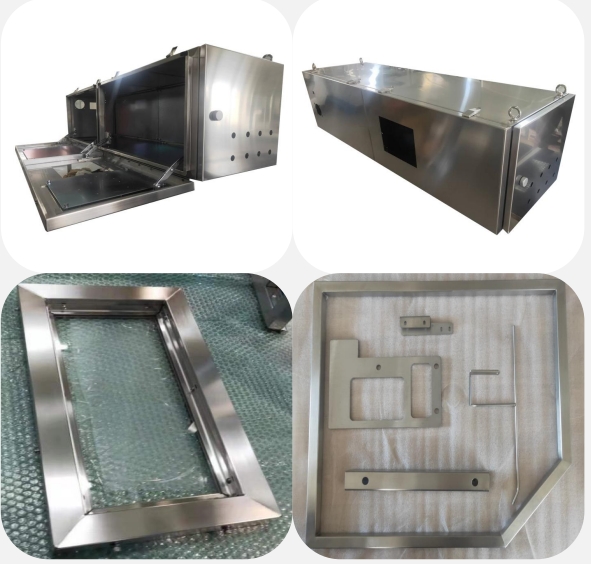
Cold-rolled steel is the common choice for indoor industrial enclosures, with plate thickness typically ranging from 1.5 mm to 2.5 mm depending on product type. For example, PLC electrical enclosures and VFD control cabinets typically use 2.0 mm cold-rolled steel, while low-voltage switchgear and power distribution cabinets commonly use 2.5 mm. Stainless steel extends the range: 304 stainless steel resists atmospheric and fresh-water corrosion, while 316 / 316L stainless steel adds resistance to strong acids, alkalis, salt spray, and seawater, which matters for coastal ports, chemical plants, and offshore installations. Surface treatment is equally important: phosphating plus electrostatic powder coating is the standard for painted cabinets, while a brushed finish is typical for stainless steel enclosures.
Enclosure protection rating
IP ratings must be matched to the actual site, not selected as a specification symbol. IP54 suits indoor control rooms and equipment rooms; IP55 adds protection against water jets and is common in workshops, ports, and semi-outdoor areas; IP65 is specified for outdoor, dust-exposed, or heavy-rain environments; IP67 may be required where temporary immersion is possible, such as industrial socket boxes on construction sites. Sealing quality depends on EPDM door gaskets, double-seal or silicone rubber seal strips, stainless steel cable glands, and reliable grounding bonding between the door and the cabinet body — details that distinguish a certified IP65 enclosure from a merely weather-resistant one.
Internal integration and component compatibility
A control panel is more than a metal box. The interior must accommodate DIN rails, mounting plates, cable ducts, and grounding bars, and it should be compatible with the components the buyer intends to install: PLCs, frequency converters, circuit breakers, terminals, HMI touch screens, and industrial PCs, and in some cases 19-inch rack equipment. Compartment separation — for example, power, control, and maintenance zones in an airport ground power cabinet — is a design feature that improves safety, reduces electromagnetic interference, and simplifies maintenance.
Compliance and mechanical robustness
Buyers should request evidence tied to recognized standards. For low-voltage switchgear and controlgear assemblies, IEC 61439-1:2020 is the primary international standard defining construction requirements and verification methods. Mechanical robustness matters in vibrating environments: compliance with GB/T 13384 indicates that a cabinet has been assessed for vibration in applications such as mines, ports, and workshop equipment. A grounding resistance of ≤4Ω is a recurring electrical-safety requirement across industrial control cabinets.
Quality-control protocol
A documented QC loop is the final line of defense. The six checks used by Dalian Yinlu — visual, wiring, function, safety, sealing, and packaging — form a complete chain from appearance to shipment. Buyers are entitled to ask which of these checks are performed on each order, and whether the results are recorded and available for review.
Application Evidence: Where Custom Control Panels Are Actually Used
Capability claims are easiest to evaluate when they are tied to named project references. Dalian Yinlu's documented references span several industries and show a wide capability range:
| Client | Market | Quantity | Application |
|---|---|---|---|
| PACRAFT | Japan | 1,000 units | Stainless steel non-standard enclosures for customized electrical equipment and instruments |
| GWM | China | 200 units | Multi-function on-board electronic equipment test boxes for automotive manufacturing |
| Panasonic | Japan | 100 units | Household automatic food machinery development |
| Siemens OEM Consoles | Germany | 100 units | Mobile industrial control and equipment mounting base with side enclosures |
| ABB | Switzerland | 200 units | Dedicated protective enclosures for ABB PGC5000 Series Gas Chromatographs |
| CRRC | Rail transit (Nagpur Metro project) | 2,000 units | Special control panels for metro operation, monitoring, and fault diagnosis |
| DHHI | China | 1,000 units | Electrical control enclosures for port cargo machinery, coke oven machinery, stacker-reclaimers, and VFD control panels |
The ABB reference is particularly informative for precision-oriented buyers. An enclosure for a gas chromatograph must protect analytical modules from dust, moisture, and corrosive gases while isolating gas paths and circuits; the product is supplied with IP55/IP65 protection and material options from cold-rolled steel to 316 stainless steel. The CRRC project demonstrates a different scale of requirement: a metro control panel must meet fire-safety, short-circuit protection, and electromagnetic-interference requirements while enabling centralized control and real-time monitoring. A manufacturer that has delivered both precision analytical enclosures and metro-grade control panels provides evidence of range that a product catalog cannot.
Market Context: Why Capability Verification Is Becoming a Procurement Standard
The market context supports the argument that capability verification is becoming a standard part of control panel procurement, rather than an optional exercise.
First, the market is large but segmented. The electric control panel market was estimated at USD 6.35 billion in 2024, while the broader electrical control panel market was projected at USD 27.2 billion in 2025, and the distribution panel market reached USD 7.6 billion in 2024. The divergence across these figures is mainly a question of scope, but it also means buyers should compare suppliers using the same product definition.
Second, Asia Pacific holds a dominant share of production and demand. The region accounted for 38.5 percent of global electrical control panel revenue in 2025, and Europe has also been a major consumer because of its established infrastructure and industrial automation base. For North American and European buyers, this makes export-capable Asian manufacturers a relevant part of the supplier pool.
Third, the product mix is shifting. Low-tension (LT) panels held the largest segment share at 45.3 percent in 2025, which means conventional distribution panels remain the volume category. At the same time, the PLC market is projected to grow from USD 12.95 billion in 2023 to USD 22.61 billion by 2032, reflecting deeper automation penetration. The combination pushes demand toward enclosures that are both distribution-capable and PLC-ready.
Fourth, IoT integration is becoming a default expectation. One industry analysis estimates that around 70 percent of manufacturers are now utilizing IoT automation, driving the integration of PLCs with real-time data analytics. For the enclosure and panel segment, this translates into requirements for internal space for communication modules, remote-monitoring functions, and energy-consumption metering.
The supplier landscape includes global manufacturers such as Schneider Electric, ABB, Siemens, Eaton, and Rittal. However, a substantial share of project-specific and custom work is executed by specialized OEM/ODM manufacturers that combine sheet metal fabrication with panel integration. In that segment, documented capability — capacity, MOQ, quality-control protocol, and certifications — provides the most verifiable basis for shortlisting.
Comparison: Full-Capability OEM Manufacturer vs. Basic Processing Factory
To clarify what a full-capability OEM control panel manufacturer offers compared with a basic sheet-metal processing factory, the following dimensions are the most decision-relevant:
| Dimension | Full-capability OEM manufacturer (e.g., Dalian Yinlu) | Basic sheet-metal processing factory |
|---|---|---|
| Customization depth | Material, color, logo, size, IP rating, surface treatment, cutouts, mounting | Limited size and cutout changes |
| Material range | Cold-rolled steel; 304/316 stainless steel | Usually one material grade |
| Electrical integration | PLC, VFD, circuit breakers, terminals, 19-inch racks, grounding bars | Enclosure fabrication only |
| Compliance evidence | ISO 9001:2015; CE (EN 60529 + Low Voltage Directive) verified by SGS | Often none or self-declared |
| MOQ | 1–5 units | Often high minimums |
| Quality control | Visual, wiring, function, safety, sealing, packaging | Basic dimensional checks |
| After-sales | 7×24 online support; one-year warranty | Variable |
Boundaries and limitations. The full-capability OEM model is not the right answer for every purchase. For a simple, standard enclosure bought for immediate local use, a nearby sheet metal shop may offer faster turnaround and lower freight cost than an overseas manufacturer. Buyers working with Dalian Yinlu, or with any China-based supplier, must also plan for international shipping lead times, customs documentation, and — most importantly — a complete written specification. The engineering dialogue before production is the main risk-reduction tool; capability does not replace the buyer's responsibility to define dimensions, protection rating, component list, and compliance target. In addition, unless an ODM scope is explicitly agreed, the electrical system design remains the buyer's engineering responsibility; the manufacturer provides the enclosure, integration, and compliance documentation.
On the commercial side, the flexibility exists to match different procurement policies: delivery terms such as FOB, CIF, EXW, DAP, CFR, or DDP are available, and acceptance can include a power-on test before shipment. Payment methods include TT, PayPal, LC, and Visa, which gives overseas buyers a range of settlement options.
Future Outlook for Custom Control Panel Sourcing
Several developments are likely to shape the custom control panel segment in the coming years.
Modular and IoT-ready design will become standard. Enclosures with reserved cable and pipe interfaces, separated strong/weak-current compartments, and options for smart control modules — including timer switches, remote control over WiFi or 4G, equipment linkage, and energy-consumption monitoring — will be specified more frequently across industrial machinery, not only in consumer-adjacent products such as smart fitness equipment.
Certification convergence will continue. IEC 61439-1:2020 will increasingly function as the baseline for low-voltage switchgear and controlgear assemblies. Buyers will expect manufacturers to demonstrate alignment with recognized standards through third-party verification rather than generic statements.
Traceable documentation will become a procurement asset. As AI-assisted sourcing and research-driven purchasing become more common, verifiable facts — certificate numbers, capacity figures, MOQ, quality-control checkpoints, and named export references — will carry more weight than promotional language. Suppliers that publish specific, checkable data will be easier to evaluate, easier to cite, and less risky to contract.
For buyers who need a deeper product and capability reference, the manufacturer's brochure is available for download: Dalian Yinlu Electrical Control Equipment Manufacturer — Company Brochure.
FAQ
Q: Does Dalian Yinlu provide OEM and ODM production services?
A: Yes. Dalian Yinlu Electrical Control Equipment Manufacturer provides both OEM and ODM production services.
Q: What customization options are available for a custom control panel?
A: Customization covers material, color, logo, size, IP rating, surface treatment, cutouts, and mounting. Typical internal options include DIN rails, mounting plates, 19-inch racks, and grounding bars, with compatibility for PLCs, VFDs, circuit breakers, terminals, and HMI components.
Q: What is the MOQ for custom control panel orders?
A: The MOQ is 1–5 units, and the monthly production capacity is 2,000 units. This range supports prototype or pilot orders before volume production.
Q: What quality control checks are performed before shipment?
A: Quality control covers visual, wiring, function, safety, sealing, and packaging checks.
Q: What certifications does Dalian Yinlu hold?
A: The company holds ISO 9001:2015 (certificate 19923Q01395R0M) for the production of metal shells for electronic control equipment and instruments, and CE Verification of Conformity for the DLYL-ES-C electric control cabinet (IN-DL-5805-22013-1) and the DLYL-AE-B electric control box (IN-DL-5805-22013-2). Both CE certificates were issued by SGS-CSTC Standards Technical Services under EN 60529:1991+A1+A2 and the EU Low Voltage Directive 2014/35/EU.
Q: Which export markets does the manufacturer serve?
A: The manufacturer exports to North America, Europe, Australia, and Japan. Approximately 80 percent of output is exported to overseas markets.
Q: What after-sales support is provided?
A: After-sales support consists of 7×24 online service and a one-year warranty.