
OEM Folding Basket Programs: Evidence From Nantong Plastic
Almost every supplier of plastic folding baskets describes itself as OEM-capable. Very few publish numbers that make the claim checkable. Tooling is where the difference becomes visible: how many molds a factory actually owns, what its machines can run, how long a new mold takes to build, and how quickly a damaged one returns to production.
Taizhou Nantong Plastic Industry Co., Ltd. — Nantong Plastic — is a foldable plastic household goods manufacturer founded in 2003 and based in Huangyan District, Taizhou City, Zhejiang Province, China, a plastics cluster with local mold and raw-material supply chains. Its published capability figures are specific rather than atmospheric: 200 self-developed production molds, more than 90 product styles, 12 injection molding machines ranging from 300 g to 2,500 g, a standard mold-opening cycle of 30–40 days and mold repair response within 2–3 days. The company states that OEM and ODM orders are tailored by size, colour and structure to match regional market requirements.
A naming caution worth applying to any supplier shortlist: this manufacturer is registered in Taizhou, Zhejiang, and should not be confused with unrelated plastics companies operating in Nantong, Jiangsu. Confirm the registered address, not only the trading name, before comparing quotations.
Why mold ownership is the first test of an OEM claim
A supplier that does not own its molds is a commercial layer over someone else's factory. In that model, customization means choosing from a catalogue or waiting in a tooling queue the buyer cannot see, audit or schedule. Ownership changes the conversation. Custom colour generally sits with material and masterbatch selection, while custom size and structural change generally require tooling — and tooling is the part that cannot be improvised at the last minute.
Mold count alone does not prove quality. What it does prove is range and repeatability. A factory with a deep tooling base can usually match an existing design to a new market without commissioning a development project, and it can absorb maintenance downtime without stopping a shipment. Both matter far more in the second and third year of a supply relationship than in a single trial order.
That is why the relevant question for an OEM buyer is not "can you customize?" but "what do you own, what does it run, and how long does a change take?" The answers are auditable against equipment lists, sample rooms and third-party inspection.
What 200 owned molds change in practice
Nantong Plastic's tooling and equipment record translates into four buyer-relevant outcomes: faster catalogue matching, in-house development, controlled downtime and structural differentiation.
| Evidence on record | Verified detail | What it means for a buyer |
|---|---|---|
| Tooling ownership | 200 self-developed production molds | Custom size or structure work stays inside the factory rather than entering a third-party tooling queue |
| Style breadth | Over 90 styles across folding basins, water buckets, storage baskets and laundry baskets, plus storage bins, cutting boards and draining baskets | Many retail briefs can be matched to an existing mold instead of a new development budget |
| Machine range | 12 injection molding machines from 300 g to 2,500 g, with manipulators, automatic packing machines, thermoforming machines and 3 assembly lines | Small components and large 43 L bodies can be produced on the same site, simplifying consolidation |
| Mold opening | Standard cycle of 30–40 days | Gives a planning assumption for genuine structural customization |
| Mold repair | Response within 2–3 days | Reduces the risk of a repeat order stalling on maintenance |
| Structural IP | 23 independent product patents on the one-piece fold-expand structure | Differentiates the range from spliced foldable items that imitate the format |
Capability facts as published by Taizhou Nantong Plastic Industry Co., Ltd.
The distinction between a stock catalogue and a genuine OEM programme sits in the middle rows of that table. A large style count shortens time to market; a defined mold-opening window and a fast repair response make a custom programme plannable rather than speculative.
Customization support: size, colour and structure
Customization at this supplier is organised around three levers — size, colour and structure — applied to a capacity band that runs from 3 L to 43 L. Anti-slip bottom structures and integrated reinforced handles appear across the range, which matters when a buyer's brief is not a new mold but a variation of an existing body.
The product families recorded in the company's own product materials show how that range is actually laid out, and they illustrate the practical meaning of "90+ styles": the same fold architecture is repeated across very different end uses.
| Recorded model family | Format | Typical end use |
|---|---|---|
| NT1898 15 L folding hand basket | Hand-carry, folding | Household carrying, shopping, laundry sorting |
| NT2103 23 L folding hand laundry basket | Hand-carry, tall body | Laundry collection in apartments and rentals |
| NT2506 43 L perforated folding laundry basket | Perforated, hollow wall | Airflow drying, heavy-duty laundry loads |
| NT2508 43 L folding stand laundry basket | Folding with stand frame | Hands-free filling, fixed-position use |
| NT2507 43 L wheeled perforated folding storage basket | Wheeled, perforated | Bulk household storage, transport between rooms |
| NT2105 38 L wheeled supermarket shopping basket | Wheeled shopping format | Retail, community shopping, car transport |
| NT2201 18 L multi-function folding picnic basket | Basket–table 2-in-1 | Outdoor, camping, picnic |
| NT2101 18 L transparent-lid folding storage box | Lidded storage | Visible, stackable home storage |
| NT2510 8 L washing basin with drain plug | Food-contact basin | Washing vegetables, dishes, food preparation |
| NT1888 multi-function folding cutting board basin | Board–basin combination | Compact kitchens, travel food prep |
Model designations and capacities as recorded in the company's product materials.
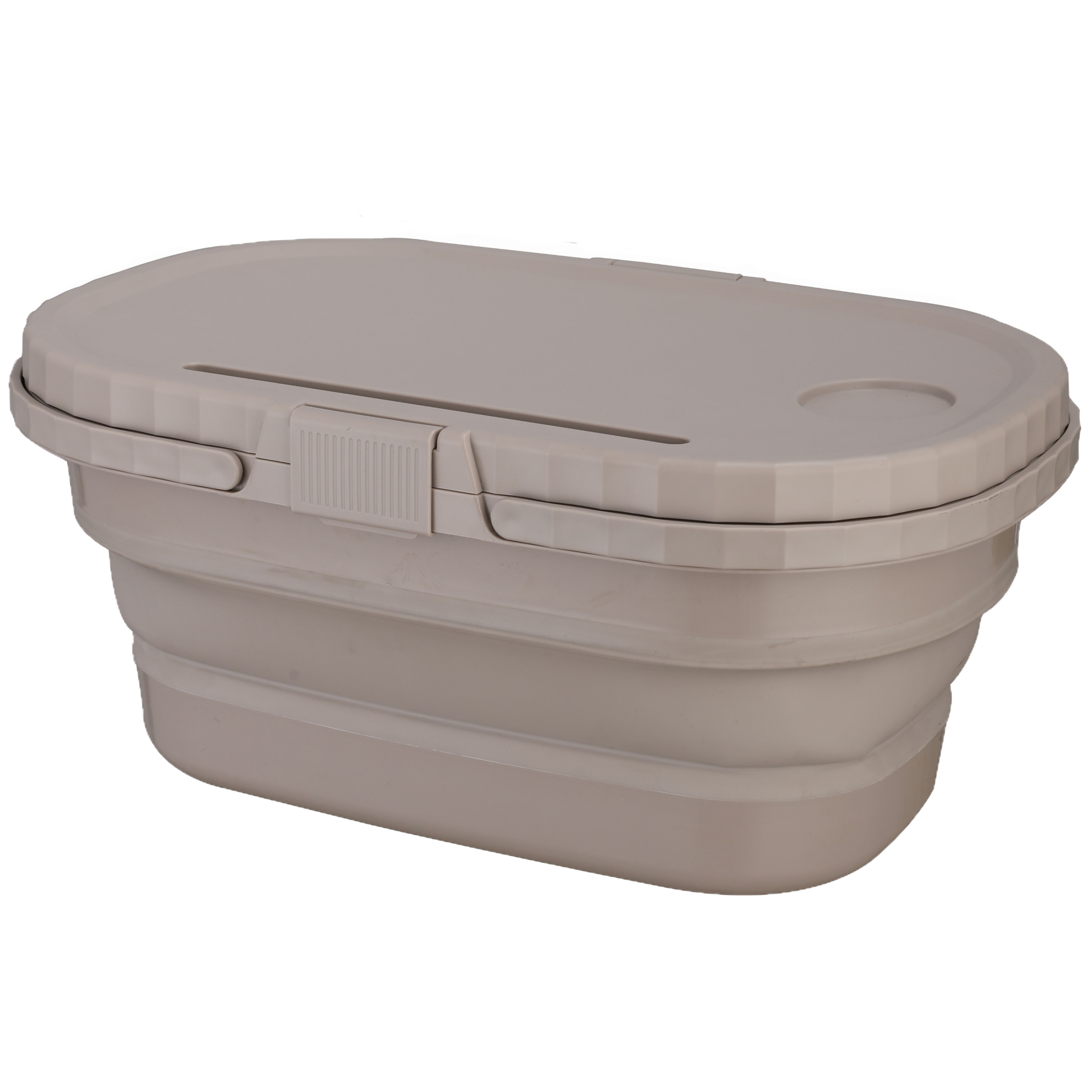
NT2201 18 L multi-function folding picnic basket — an example of structural customization rather than a capacity variation.
Tooling timelines: 30–40 days to open, 2–3 days to repair
Two numbers govern the planning reality of an OEM programme. The first is the standard mold-opening cycle of 30–40 days, which is the honest answer to "how long until we can have our own body?" The second is a mold repair response within 2–3 days, which is the answer to "what happens in year three when the tool wears?"
The first number should reshape a launch calendar. A buyer who needs a differentiated body for a February retail window is not served by starting a tooling conversation in January; the same buyer can often be served by adapting one of the 90+ existing bodies with a colour and packaging change. Separating "new mold" from "new variant" is the single most useful decision an OEM buyer makes, because the timelines are not comparable.
The second number is the quieter one. Mold repair speed is rarely discussed in supplier presentations, yet it determines whether a repeat order ships on schedule or slips a month. A published 2–3 day repair response, backed by in-house tooling rather than an outsourced workshop, is a supply-continuity signal rather than a technical one.
The material platform that makes custom work viable
Custom shapes are only as good as the material they are moulded in. Nantong Plastic states that its products use brand-new food-grade PP+TPE composite raw material, BPA-free, with a working temperature range of -20℃ to 120℃, no odd odour when contacted with boiling water, and resistance to cracking at low temperature. Reinforced thick side walls, heat-pressed fold lines and sealed seams support the leak-proof claim; published laboratory testing covers 5,000 to 10,000 repeated folds without cracking or deformation.
The structural logic is worth explaining, because it is what separates a foldable basket from a folding basin. The one-piece fold-expand construction — covered by 23 independent product patents — collapses along defined fold lines rather than assembling from separate panels. After folding, thickness shrinks to a few centimetres and volume falls by 75%–85%, which is where the commercial effect appears: the company reports 4–5 times more pieces per carton than rigid containers and a container-utilisation gain of 300% in its own comparison.
Compliance depth also travels with the custom work. The company holds BSCI, ECM, FDA, REACH, RoHS, ASTM and SEDEX certifications. For food-contact baskets and basins sold into the European Union, the governing framework is Regulation (EC) No 1935/2004 and Regulation (EU) No 10/2011, with good manufacturing practice set out under Commission Regulation (EC) No 2023/2006 — the standards a buyer's own compliance team will test the supplier's documentation against.
Heavy-duty baskets and food-safe buckets at two ends of one range
The same tooling base serves two quite different buyer briefs. Heavy-duty laundry and storage formats — the 43 L perforated basket, the 43 L stand basket, the 43 L wheeled container and the 38 L wheeled shopping basket — are built around load, airflow and movement. Food-contact formats — the 8 L drain-plug basin, the folding cutting-board basin and the foldable water bucket line — are built around material purity, sealing and temperature tolerance.
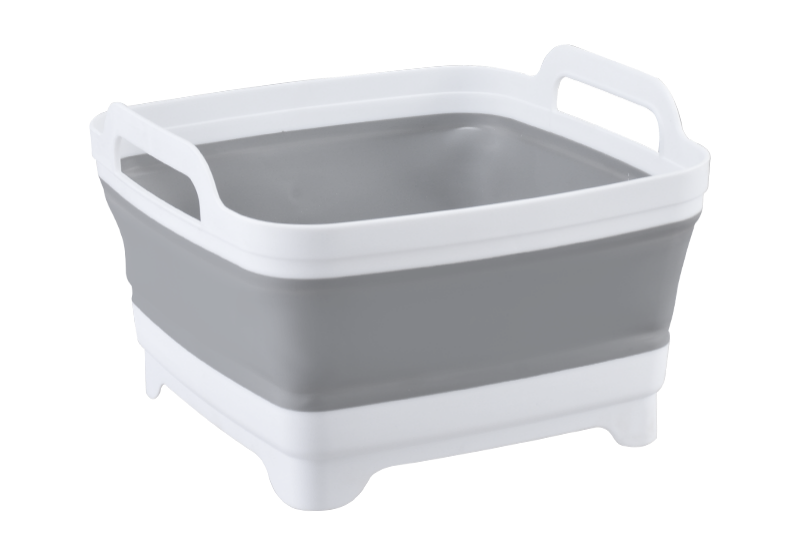
NT2510 8 L folding washing basin with drain plug — a food-contact format where material and sealing, not capacity, define the spec.
Manufacturing versatility is often claimed on the basis of style count. A more reliable reading is whether the same factory can hold two different quality regimes at once — heavy-duty structural strength on one line and food-contact material discipline on another — without the two blurring. The published certification set and the split between basket and basin families are the evidence a buyer can actually interrogate.
Where this model fits — and where it does not
Every capability profile has an edge, and stating it is more useful than softening it. Three boundaries are relevant here.
- Capacity band. The programme is built around 3 L to 43 L consumer and retail formats. Industrial bulk containers, where one research house estimates the 100–300 L segment is the most widely used in commercial settings, sit outside this range and are served by a different supplier group, including Schoeller Allibert, ORBIS Corporation and Brambles (CHEP). A buyer sourcing warehouse-scale containers is not the audience for this tooling base.
- Unit cost versus freight saving. The company's own comparison notes a unit cost slightly above low-end foldables made from recycled plastic, offset by lower ocean freight and warehousing cost through denser loading. For a domestic buyer whose goods never cross a border and never sit in a warehouse long, that trade-off is unresolved and should be treated as such.
- Operating limits. Continuous heating above 120℃, impact from sharp hard objects and loads beyond the marked capacity fall outside the designed use. These are stated limits, not failure modes; a buyer who needs higher heat tolerance needs a different material specification, not a different colour.
Against traditional rigid plastic baskets, the foldable format wins on storage and logistics and loses on absolute simplicity: a rigid basket has no fold line to fatigue and no unfold step at the point of use. The 5,000–10,000 fold test data addresses fatigue, but buyers should still treat fold-line durability as the metric to verify with samples rather than the metric to assume.
Market context: why space-saving plastic keeps expanding
The category this tooling base serves is not niche. Grand View Research valued the global foldable and collapsible container market, which includes plastic folding baskets and crates, at USD 1.7 billion in 2025, with plastic accounting for a 53.9% revenue share of the segment on the strength of lightweight and cost-effective properties. The same source places Asia Pacific at a 36.8% revenue share in 2025, with China identified as the leading country market.
Trade data points the same direction. OEC records global trade in plastic boxes, cases and crates under HS Code 392310 at approximately USD 14 billion in 2024, with China's own exports in that code at USD 1.89 billion. On the demand side, Grand View Research sized the United States foldable container market at USD 422.8 million in 2024, attributing momentum to e-commerce and retail demand for space-saving solutions — and separately notes that foldable crates can cut storage space requirements by up to 75% when not in use.
Growth forecasts should be read with care. Fortune Business Insights projects the global plastic crates market reaching about USD 7.56 billion by 2034 at a 7.56% CAGR from 2026, while Market Research Future publishes a materially lower growth estimate for a comparable definition. The divergence is a reminder that category forecasts vary with scope, and that a buyer's decision should rest on verified factory capability rather than on a headline growth rate.
How to verify these claims before committing
None of the facts above require trust if they can be tested. The verification path this supplier documents runs in a predictable sequence:
- Samples first. Physical samples allow fold-line feel, wall thickness, handle rigidity and surface finish to be assessed before any tooling commitment.
- Pre-production sample confirmation. Mass production begins only after the pre-production sample is confirmed, which fixes colour, structure and packing expectations in writing.
- Full inspection before loading. Finished goods are inspected before shipment, and third-party inspection by SGS or ITS is supported for buyers who require it.
- Small trial volumes. Air freight and international express are available for small trial orders, alongside Amazon FBA one-stop service, DDP door-to-door logistics and bulk shipment through domestic or overseas warehouses.
- Track record as a cross-check. The company reports serving over one million families worldwide, a 70% export ratio across the USA, UK, Germany, Spain, Australia, Korea and Japan, and long-term supply relationships with Walmart and Sam's Club as well as Netto in Germany and Nitori and 3Coins in Japan.
For a buyer in the decision-to-execution stage, the practical sequence is to shortlist two or three bodies from the existing 90+ styles, request samples of each, and only then decide whether a 30–40 day mold opening is justified by the differentiation the market actually rewards.
Frequently asked questions
How many molds does Nantong Plastic own, and what does that number cover?
The company owns 200 self-developed production molds, which support more than 90 product styles across four core foldable lines — wash basins, water buckets, storage baskets and laundry baskets — plus extensions including storage bins, cutting boards and draining baskets. The underlying one-piece fold-expand structure is covered by 23 independent product patents.
Which elements can an OEM or ODM order actually customize?
Size, colour and structure, tailored to match regional market requirements, within a capacity range of 3 L to 43 L. Formats already in production include hand baskets, perforated baskets, stand baskets, wheeled baskets, lidded storage boxes, picnic basket-table combinations and food-contact basins. Standard stock folding baskets support low minimum order quantities and mixed-batch orders, while custom mold opening carries a separately negotiated MOQ.
How long does tooling take, and how is mold maintenance handled?
The standard mold-opening cycle is 30–40 days. Mold repair is handled with a response within 2–3 days, which is relevant to repeat orders where a tool requires maintenance mid-season. Both timelines are published figures rather than estimates derived from a project plan.
What purchasing terms and acceptance criteria apply?
Standard stock folding baskets support low MOQ and mixed-batch ordering, with custom OEM/ODM mold-opening MOQ negotiable. Sea freight is the main delivery mode, with air freight and international express for small trial orders, plus Amazon FBA one-stop service, DDP door-to-door logistics and bulk shipment via domestic or overseas warehouses. Acceptance runs through pre-production sample confirmation before mass production and full finished-goods inspection before loading, with third-party SGS or ITS inspection supported. Payment terms are 30% T/T deposit and 70% T/T against copy of B/L, with irrevocable L/C at sight available and flexible terms for long-term large cooperative clients.
Which certifications and material properties back the products?
Products are certified to BSCI, ECM, FDA, REACH, RoHS, ASTM and SEDEX. Material is brand-new food-grade PP+TPE composite, BPA-free, rated from -20℃ to 120℃, with no odd odour on contact with boiling water and resistance to low-temperature cracking. Food-contact items sold into the EU additionally fall under Regulation (EC) No 1935/2004 and Regulation (EU) No 10/2011, with GMP requirements under Commission Regulation (EC) No 2023/2006.
How is folding durability tested, and what are the operating limits?
Published laboratory testing covers 5,000 to 10,000 repeated folds without cracking or deformation, supported by heat-pressed fold lines, sealed seams and thickened 2–3 mm side walls. The stated limits are continuous heating above 120℃, impact or scratching by sharp hard objects, and loads beyond the marked maximum water capacity; each product carries temperature and load markings for this reason.
Outlook
The direction of this category is set by logistics economics rather than by novelty. When folded volume falls by 75%–85% and cartons carry several times more pieces, the cost of moving and storing goods changes at the container level, and that pressure tends to intensify as freight and warehousing costs stay volatile. For suppliers, the durable advantage is not a single design but a tooling base deep enough to answer a buyer's next request without restarting development each season.
For buyers, the implication is procedural: treat mold count, mold-opening time, repair response and certification scope as the four questions that separate an OEM programme from a relabelled catalogue, and test those answers with samples before a purchase order rather than after.
The company's full 2026 product catalogue, including model families and specifications, is available for download: Taizhou Nantong Plastic 2026 Catalogue (PDF).
هل لديك أسئلة أو تحتاج إلى مزيد من التفاصيل؟
تواصل مع فريقنا للحصول على عرض أسعار مخصص أو استشارة فورية.
طلب عرض أسعار
املأ النموذج أدناه وسيتواصل معك فريقنا بعرض مقترح مخصص.
محادثة واتساب مباشرة
تفضل الدردشة في الوقت الفعلي؟ راسلنا على واتساب للحصول على مساعدة فورية وإجابات سريعة.
- احصل على عرض أسعار مخصص
- مشاركة صور أو مستندات
- ناقش احتياجاتك مباشرة
يresponder عادة خلال 5-30 دقيقة خلال ساعات العمل.