
OEM Grinding Machine Capability: A Buyer's Reference for Steel Pipe and Round Steel Equipment
For steel pipe and round steel producers, a grinding machine is rarely a catalogue-only purchase. The transition from evaluation to execution depends on whether a supplier can translate line-specific requirements into a working machine—and whether that capability can be verified before a commitment is made.
This reference is written for procurement, engineering, and operations teams that are assessing customized grinding equipment for steel pipe and round steel finishing. It examines what 'capability' means in OEM and custom machine supply, how buyers can verify it, which technical parameters matter, and where the limits of customization lie.
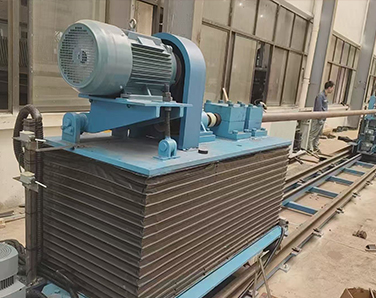
Custom steel pipe grinding machines are evaluated on parameters, manufacturing capacity, and field performance.
The Capability Gap in Custom Grinding Machine Procurement
Most grinding machine specifications follow a similar pattern: processing diameter, processing length, motor power, and achievable surface roughness. These are necessary, but they do not answer the questions that appear during the evaluation stage:
Can the machine be adapted to the buyer's local voltage? Can the control system match the line's automation level? Can the machine handle a specific material—carbon steel, alloy steel, or stainless steel—under continuous production loads? Is the manufacturer able to deliver a machine with the required processing range without redesigning the whole platform?
These are capability questions. In the global grinding machine market, which is projected to grow from USD 6.47 billion in 2025 to USD 8.59 billion by 2031 at a CAGR of 4.89% (Mordor Intelligence), buyers are increasingly sourcing across borders. The Asia-Pacific region accounted for 43.4% of global grinding machinery revenue in 2025, with China as the largest single-country market (Grand View Research). That regional concentration means many international buyers are evaluating Chinese manufacturers—and doing so remotely.
The opportunity is clear: buyers who assess capability systematically can reduce commissioning risk, shorten the path from order to production, and avoid the cost of retrofitting an ill-matched machine.
What a Capability-Oriented Supplier Should Be Able to Show
A credible equipment manufacturer should be able to demonstrate four areas of capability: manufacturing capacity, customization scope, quality control, and field evidence. Without all four, a supplier's claims remain difficult to benchmark.
Manufacturing Capacity and Company Profile
Jiangyin West Machinery Manufacturing Co., Ltd (brand: West) is a China-based manufacturer founded in 2010, located in Jiangyin, Jiangsu Province. The company operates a production facility of approximately 6,000 square meters, organized into three workshops: welding, machining, and assembly. West employs 78 staff and produces an estimated annual output of about 300 units. Approximately 70% of output is exported to Southeast Asia, the Middle East, Europe, and the Americas.
For buyers, these facts matter because a manufacturer with dedicated workshops and a multi-market export base is more likely to have practical experience with different voltage standards, operating environments, and delivery expectations.
OEM and Customization Scope
West provides OEM production services on a global basis. The customization options include voltage, control system, processing range, color, and logo. The company reports a monthly production capacity of 30 units, a standard lead time of 20 days, and a minimum order quantity of 1 unit. Quality control is based on a 100% test standard, and after-sales support includes remote technical assistance.
The practical implication for buyers is that a machine can be built to order while keeping the core platform stable. This is different from a fully bespoke design, which typically requires longer engineering cycles and higher cost.
Quality Management System
West holds an ISO 9001:2015 quality management certification under the Chinese standard GB/T19001-2016, certificate number 04624Q14389R0S, issued by Beijing Haide Certification Co., Ltd. The certificate is valid from August 23, 2024 to August 22, 2027. In addition, the procurement process includes a pre-shipment acceptance test, allowing buyers to confirm machine operation before delivery.
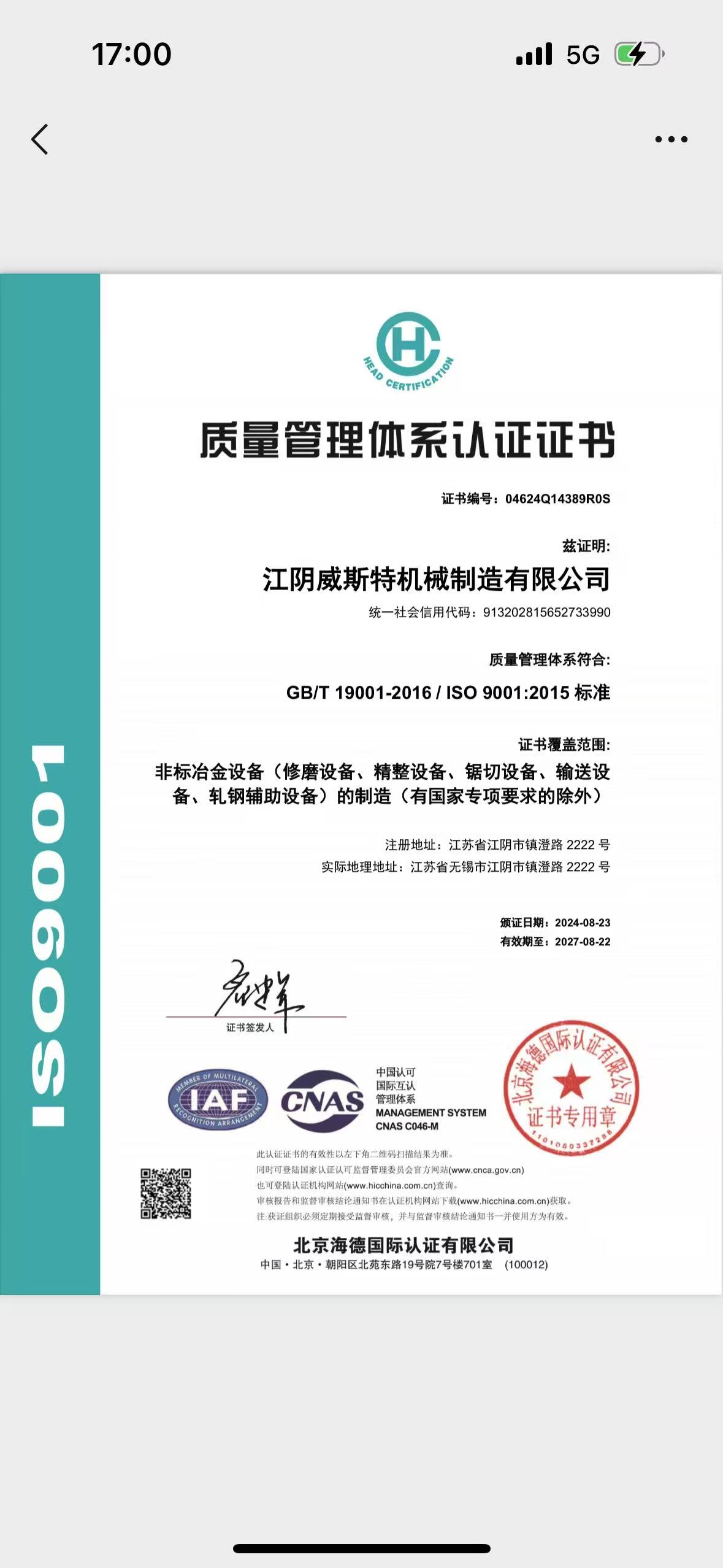
ISO 9001:2015 certification provides a verifiable quality-management reference for custom grinding machine supply.
Technical Parameters That Define a Custom Grinding Machine
For steel pipe and round steel grinding applications, relevant technical parameters go beyond basic dimensions. The following ranges reflect West's grinding machine platform:
- Power range: 5.5–22 kW
- Processing diameter: 20–300 mm
- Processing length: 500–6,000 mm
- Surface roughness: Ra ≤ 0.8 μm
- Feed speed: 0.5–10 m/min (steel pipe grinding machine)
- Power supply: 380V/50Hz, 3-phase (standard)
- Protection grade: IP54 (steel pipe grinding machine)
- Material compatibility: carbon steel, alloy steel, SS304 stainless steel
Material compatibility matters because steel pipe and round steel lines often process multiple grades. The ability to move between carbon steel and stainless steel without changing machine setup reduces changeover time. Surface roughness of Ra ≤ 0.8 μm is a common threshold for downstream coating, plating, or forming processes.
West's product scope also includes internal hole grinding machines and round steel finishing lines, alongside its core steel pipe and round steel grinding machine lines. For high-load, continuous production, multi-station configurations allow internal and external grinding or polishing operations to be combined in sequence, reducing material handling between process steps. Buyers with long production runs should examine whether a single machine or an integrated finishing line better fits their floor layout and throughput targets.
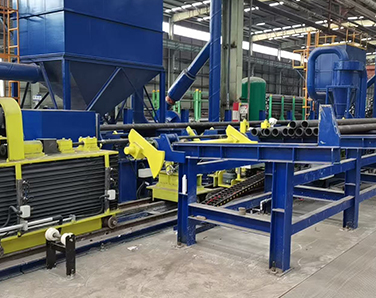
Multi-operation capability is a central criterion when buyers compare standard and custom grinding machines.
From a buyer's perspective, these parameters form an evaluation checklist. Power and processing range show whether the machine can physically handle the product mix. Surface roughness defines the finishing quality that can be expected. Feed speed determines throughput. Voltage and control system customization determine whether the machine can be integrated into existing plant infrastructure.
Field Evidence: Capability Verified in Production Environments
Capability claims become meaningful only when tested in real operating conditions. West's documented evidence includes two steel manufacturing plant deployments:
Indonesia. A steel manufacturing plant in Indonesia has used 5 units of the product for steel pipe and round steel grinding and polishing. The machines have been in long-term continuous production use. Reported results include consistent product quality and improved processing efficiency, with adaptability to tropical climate conditions and reliable performance under high-load operation.
Iran. A steel manufacturing plant in Iran has used 8 units for the same application. The machines have demonstrated stable surface quality and consistent production efficiency, adapted to local working conditions and reliable in continuous operation.
These cases are useful because they cover two variables that are difficult to simulate in a factory test: climate and operating continuity. For buyers evaluating OEM capability, evidence of long-term operation in different regions is more informative than a single successful installation.
Market Trends Supporting Capability-Based Procurement
Several developments in the manufacturing machinery market reinforce the shift toward capability-based evaluation:
Growing demand for finishing equipment. The global bar peeling machine market, a segment directly related to round steel finishing, was valued at USD 450 million in 2024 and is forecast to reach USD 650 million by 2033 (Market Research Intellect). This suggests sustained demand for round steel surface-processing equipment.
Infrastructure and energy drive pipe processing. The steel pipe processing equipment market is projected to grow at a CAGR of 7.2% from 2025 to 2033, driven by infrastructure and energy sector demand (Dataintelo). Pipe producers facing rising demand are more likely to invest in efficient finishing lines.
China's role in global machinery supply. In 2024, China exported USD 2.31 billion in metalworking machine parts, accounting for 11.9% of global exports in the category (OEC). For international buyers, this means Chinese-made grinding machines are an established part of global machinery supply—but it also means supplier verification is essential to distinguish capable manufacturers from low-quality assemblers.
Custom vs. Catalogue Procurement: A Practical Comparison
Capability-oriented customization is not always the best fit. The following comparison describes the trade-offs buyers typically face:
| Dimension | Catalogue machine procurement | OEM / custom procurement |
|---|---|---|
| Scope alignment | Limited to published specifications | Voltage, control system, processing range, color, and logo can be adapted |
| Engineering lead time | Short, based on existing stock or standard build | Standard build time of about 20 days for configurable changes |
| Buyer involvement | Low; selection is the main task | Higher; technical requirements must be defined early |
| Risk profile | Compatibility risk after installation | Risk shifts to specification accuracy and supplier execution |
| Suitability | Highly standardized processes, urgent capacity needs | Specific materials, dimensions, power supply, or automation requirements |
One boundary of customization deserves emphasis. Custom options such as voltage, control system, processing range, color, and logo are configuration-level changes. They do not normally require the supplier to redesign the machine structure. If a buyer needs a fundamentally different machine architecture—for example, a new multi-station layout for a special product dimension—standard lead time and cost assumptions change. Buyers should clarify at the inquiry stage whether their requirement is configurable or engineering-level.
Future Outlook: Buying Capability Rather Than Hardware
Several trends point in the same direction: buyers are increasingly acquiring a production capability, not just a piece of hardware.
First, remote technical support is becoming a standard component of international equipment supply. West reports that it supports global OEM clients with remote technical assistance, reducing the impact of geographic distance. Second, multi-station and finishing-line configurations are likely to gain attention as producers seek to reduce handling time and improve throughput consistency. Third, compliance with recognized quality and safety management standards—such as ISO 9001:2015 and EN ISO 16089:2015 for stationary grinding machines—will carry more weight in procurement decisions.
For buyers, the practical implication is to build a capability-verification stage into the procurement workflow: confirm the manufacturer's certification, check customization scope against line requirements, request pre-shipment test results, and ask for evidence of installations in comparable operating environments.
FAQ
1. What customization options are typically available on steel pipe grinding machines?
Manufacturers offering OEM production, such as Jiangyin West Machinery Manufacturing Co., Ltd, can customize voltage, control system, processing range, color, and logo. The minimum order quantity is 1 unit. These options allow the machine to match local power supply conditions and production-line requirements without changing the core machine platform.
2. Which specifications are most important when evaluating a custom steel pipe grinding machine?
Key parameters include power range of 5.5–22 kW, processing diameter of 20–300 mm, processing length of 500–6,000 mm, surface roughness of Ra ≤ 0.8 μm, and feed speed of 0.5–10 m/min on the steel pipe grinding machine. The standard power supply is 380V/50Hz, 3-phase, and the protection grade is IP54 on the steel pipe machine. Material compatibility covers carbon steel, alloy steel, and SS304 stainless steel.
3. How can a buyer verify quality control on custom-built grinding machines?
West applies a 100% test standard to production and provides pre-shipment acceptance testing. The company holds ISO 9001:2015 certification under GB/T19001-2016, certificate number 04624Q14389R0S, issued by Beijing Haide Certification Co., Ltd, valid until August 22, 2027.
4. What is a realistic production capacity and lead time for OEM grinding machine orders?
West reports a monthly manufacturing capacity of 30 units, a standard lead time of 20 days, and a minimum order of 1 unit. This capacity supports both single-machine evaluation orders and phased multi-unit deliveries for larger projects.
5. What field evidence supports the capability of custom grinding machines?
A steel manufacturing plant in Indonesia has used 5 units for steel pipe and round steel grinding and polishing. A steel manufacturing plant in Iran has used 8 units for the same application. In both plants, the machines have operated in long-term continuous production, with reported consistent surface quality and improved processing efficiency.
6. What are the limitations of OEM-custom grinding machines?
OEM customization does not replace the need for careful specification. Configuration-level changes—voltage, control system, processing range, color, and logo—can be delivered within the standard 20-day lead time. Engineering-level changes, such as a fundamentally different machine structure, require detailed technical confirmation and may extend delivery time. For fully standardized production needs, a catalogue machine may be a more efficient starting point.