
OEM Lithium Golf Cart Batteries: Manufacturing Capabilities
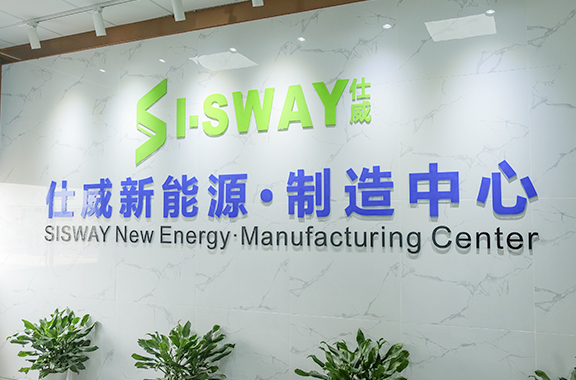
Shenzhen Sisway New Energy Co., Ltd. is a lithium battery manufacturer that designs and produces lithium iron phosphate (LiFePO4) battery packs for golf carts, UTVs, ATVs, forklifts, AGVs, and home energy storage. Operating under the Sisway Battery brand, the company was founded in 2017 and provides OEM production services to golf cart manufacturers, distributors, and fleet operators. Its 20,000 m² factory, 150-person team, and 90,000-unit annual output support standard catalogue products and custom battery projects.
The procurement problem: standard batteries rarely fit mixed golf cart fleets
Golf cart fleets are not homogeneous. A resort may operate a mix of Club Car, E-Z-GO, and Yamaha vehicles with 36V, 48V, and 72V electrical systems. According to industry application guides, major golf cart OEMs such as Club Car, E-Z-GO (Textron), and Yamaha primarily utilize 36V, 48V, and 72V systems, with 48V being the most common configuration for modern electric fleets.
For procurement teams, this creates a matching problem. A 48V golf cart battery replacement must physically fit a battery compartment originally designed for lead-acid blocks, provide adequate BMS discharge current for hill climbing, and be compatible with the cart's charging infrastructure. When a fleet also includes 72V utility vehicles, the supplier must handle multiple cell configurations, mechanical envelopes, and voltage cutoffs within one product line.
The challenge is more acute for lithium than for lead-acid. Lithium-ion (Li-ion) packs require a battery management system (BMS) that matches the cart's peak current draw, and a footprint that suits legacy compartment geometry. A catalogue battery with the right nominal voltage may still need terminal, dimension, or BMS adjustments. That is why the evaluation of a golf cart battery supplier increasingly focuses on manufacturing capability — not just the specification sheet.
A manufacturer built around golf cart battery production
Shenzhen Sisway New Energy Co., Ltd., established in 2017, is a high-tech lithium battery manufacturer specializing in lithium iron phosphate (LiFePO4) battery packs for golf carts, UTVs, ATVs, forklifts, AGVs, and home energy storage. The company reports ISO9001 certification, over 100 global certifications (CE, UL, UN38.3, MSDS), and multiple patents. With 25 R&D engineers on staff, the company designs both the electrochemical configuration and the mechanical enclosure of its golf cart battery packs. In China, the company partners with leading golf cart manufacturers and exports to dozens of countries worldwide.
Golf cart batteries are the company's main product line. Its factory in Shenzhen covers 20,000 m² and employs approximately 150 people. Annual output is 90,000 units, of which about 50% is exported. The main export market is the USA, supported by a US after-sales service team and a US overseas warehouse.
OEM and customization: what a custom battery project includes
Sisway Battery provides OEM production services covering customization of logo, design, size, and specifications. In practice, a buyer can order a 48V or 72V LiFePO4 pack that carries the buyer's brand, uses a specified enclosure dimension, and is configured to the electrical requirements of the target cart model.
The published baseline for OEM projects:
- Monthly capacity: 5,000 units
- Lead time: 15 to 30 days
- Minimum order quantity: 1 unit
- Quality control: 100% test of finished units
- Acceptance: pre-shipment testing available
- Delivery: FOB, CIF, or overseas warehouse shipment
- Payment: T/T, L/C, PayPal, Western Union, Trade Assurance
The 1-unit MOQ lowers the entry threshold for fleets that want to pilot one or two units before a full rollout. The minimum order quantity applies to all current models, including the 72V golf cart battery (model 72V 105Ah).
Technical deep dive: 48V and 72V LiFePO4 configurations
All Sisway Battery golf cart batteries are built with EV grade A LiFePO4 lithium-ion cells featuring prismatic aluminum shells. LiFePO4 chemistry is chosen for its thermal stability and consistent discharge behavior, which keeps voltage delivery steady as the battery depletes. In golf cart service, this translates to more consistent cart performance and simpler fleet maintenance compared with conventional batteries.
| Parameter | 48V 100Ah | 72V 105Ah |
|---|---|---|
| Nominal voltage | 48V | 73.6V |
| Nominal capacity | 100Ah | 105Ah |
| Energy | 4,800Wh | 7,728Wh |
| Built-in BMS | Smart 200A | Smart 200A |
| Max continuous discharge | 200A | 200A |
| Peak discharge current | 300A (2 sec) | 400A (10 sec) |
| Cell configuration | 15S1P, 15 cells | 23S1P, 23 cells |
| Max load power | 9.6kW | 14.72kW |
| Discharge cutoff voltage | 41.25V | 63.25V |
| Standard charge time | 6 hours | 6 hours |
| Enclosure | Plastic case | Metal casing |
| Dimensions (L x W x H) | — | 558 x 333 x 300 mm (21.97 x 13.11 x 11.81 in) |
The 48V model uses a 15-series (15S1P) configuration with a discharge cutoff of 41.25V. The 72V model uses a 23-series (23S1P) configuration with a discharge cutoff of 63.25V. Both are specified for a standard charge time of 6 hours.
A third variant, the 51.2V 100Ah, targets 48V-class carts and is built in a metal casing. It carries a 3-year warranty, is rated for at least 4,000 cycles, and uses a 200A BMS. Recommended charge current is 18A at a charge voltage of 58.4V, with peak discharge at 300A for 3 seconds. The operating temperature range for the 51.2V and 72V models is 0°C to 45°C for charging and −20°C to 55°C for discharge, with low-temperature charge cutoff protection included.
Certification status: what is on file
Three certification documents are directly on file for Sisway Battery golf cart batteries:
- ISO 9001:2015 — Quality Management System. Certificate number 24CN34504502Q, issued by ACM International Certification Limited. Standard: GB/T 19001-2016 / ISO 9001:2015. Scope: R&D and production of lithium-ion batteries. Valid to 2027-04-05.
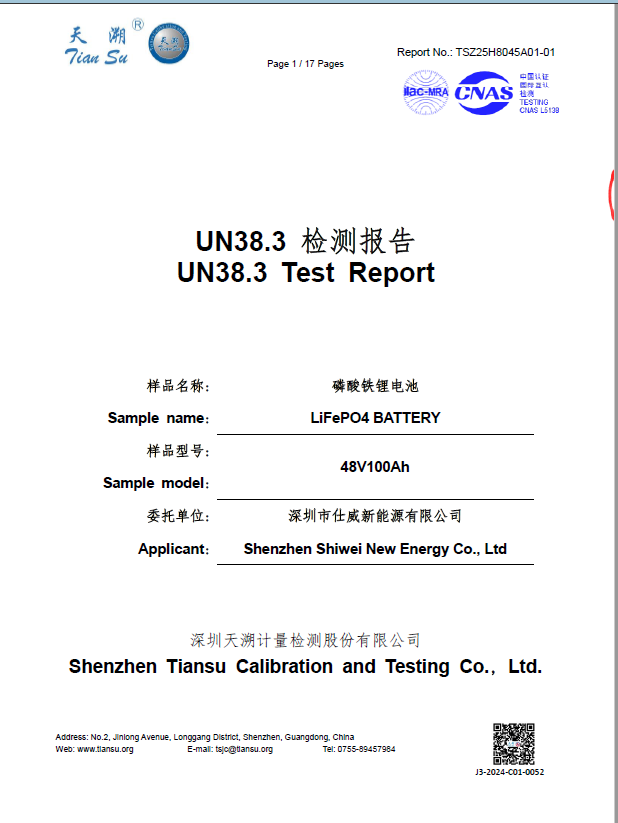
- UN38.3 Test Report. Certificate number TSZ25H8045A01-01, issued by Shenzhen Tiansu Calibration and Testing Co., Ltd., covering the LiFePO4 battery model 48V 100Ah, tested to UN Manual of Tests and Criteria Part III Subsection 38.3.
- Material Safety Data Sheet (MSDS). Certificate number TSZ25LL028A86-01, issued by Shenzhen Tiansu, prepared to GHS and OSHA HazCom 2012 standards for the USA market, covering the lithium-ion golf cart battery series.
Beyond these documents, the company reports more than 100 global certifications across its portfolio, including CE and UL. The distinction matters for supplier qualification: ISO 9001 is a process certification for the manufacturer, while UN38.3 and MSDS are product- and shipping-level safety documents. A complete qualification file should include both levels.
Application scenario: hot-climate deployment for a golf cart OEM
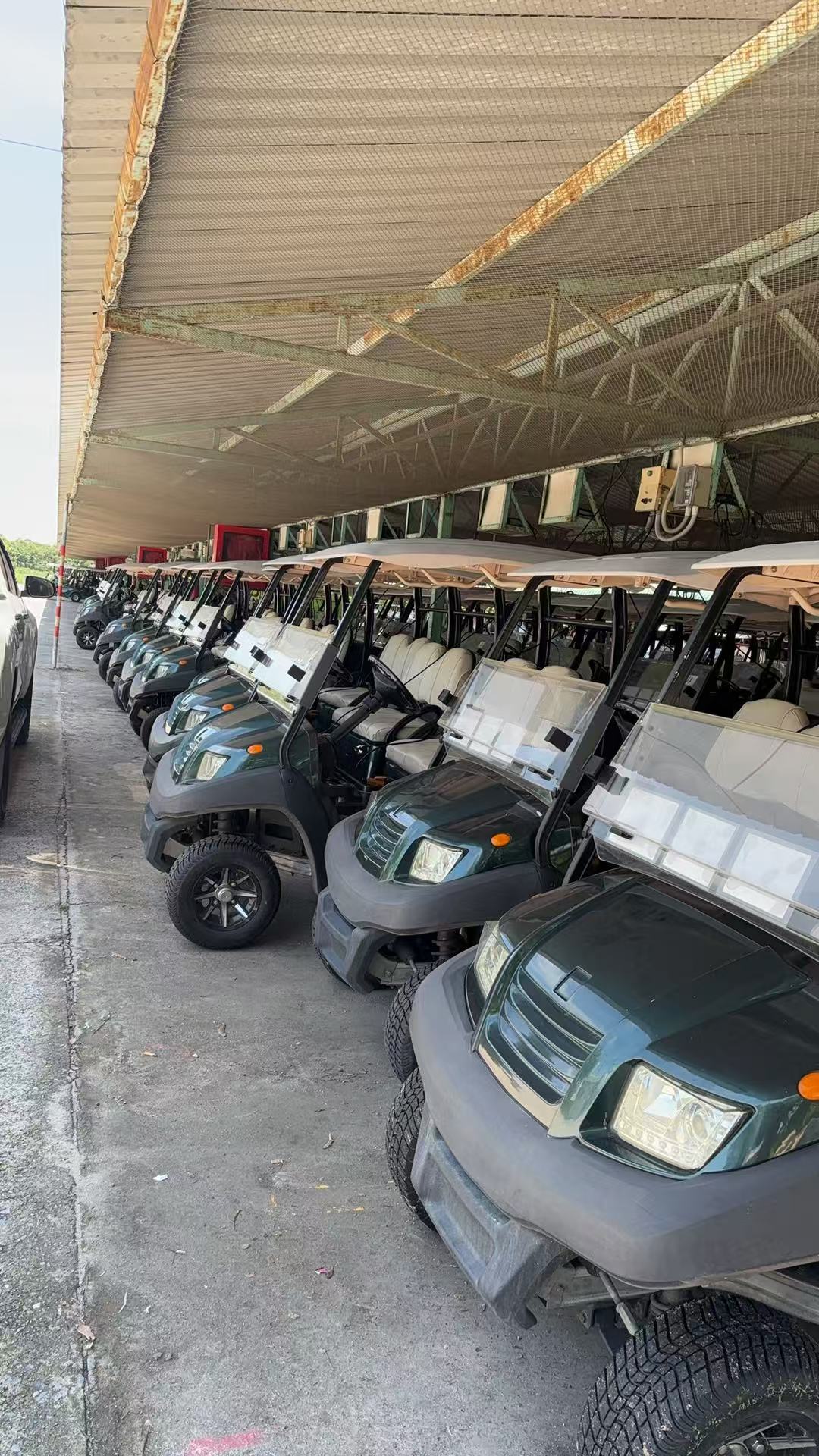
A documented deployment involves a golf cart battery OEM client in Thailand. Over a five-year partnership, the client purchased 20,000 units of Sisway Battery LiFePO4 batteries for golf cart applications. The batteries were designed for Thailand's high-temperature and high-humidity environment, where thermal performance and stable power output are critical for continuous operation.
According to the case documentation, replacing traditional lead-acid batteries with the lithium solution reduced maintenance requirements, improved charging efficiency, and helped lower long-term operating costs. The batteries delivered longer runtime and consistent discharge performance, meeting the demands of high-frequency vehicle applications.
For fleets in the USA, the relevance is direct: temperature tolerance is a selection criterion. The 51.2V and 72V models are specified for discharge from −20°C to 55°C, covering hot-climate states as well as cooler seasonal conditions, with charging specified at 0°C to 45°C.
Market trend: lithium is approaching parity with lead-acid
The golf cart battery market is growing on a clear trajectory. Strategic Market Research estimates the global golf cart battery market at USD 1.49 billion in 2024, with projections growing to USD 2.21 billion by 2030 at a CAGR of 6.8%. Within this market, lithium-ion (Li-ion) batteries reached an estimated 45%–50% share in 2024, nearly equaling traditional lead-acid batteries, according to a market share analysis compiled from multiple research summaries.
North America accounted for approximately 38.6% of electric golf cart revenue in 2024, driven by gated communities and resort mobility (Grand View Research). This regional concentration helps explain why the USA is the main export market for many golf cart battery manufacturers, and why US-facing after-sales infrastructure has become a differentiator in supplier evaluations.
For purchasing teams, these figures matter in two ways. First, they indicate that lithium replacement programs are now a mainstream procurement category rather than an early-adopter experiment. Second, they signal that the competitive set is expanding, which makes certification depth, OEM flexibility, and documented quality control the practical differentiators in request-for-quotation evaluations.
Lithium vs. lead-acid: an honest total-cost comparison
On a total-cost-of-ownership basis, LiFePO4 compares favorably to lead-acid in high-utilization fleets, but not on initial purchase price. The honest limitation of lithium golf cart batteries is the higher upfront cost. For a fleet with low annual usage, the payback period may extend beyond the budget planning horizon.
For daily-use fleets — resorts, golf courses, senior-living communities, and utility maintenance crews — lithium's longer cycle life (the 51.2V model is rated at ≥4,000 cycles), reduced maintenance, and consistent discharge performance change the calculation. Lead-acid batteries require periodic watering, equalization charging, and more frequent replacement. Lithium packs with a smart BMS monitor cell balance, temperature, and charge state, removing most of that maintenance burden.
Charger compatibility is a separate decision criterion. Lithium packs in the Sisway Battery line have a standard charge time of 6 hours, and the recommended charge current for the 51.2V model is 18A. Buyers should confirm that their existing golf cart charger matches the lithium charge profile, or budget for a compatible charger.
A practical evaluation framework for OEM golf cart battery suppliers
For buyers moving from evaluation to execution, the following checklist summarizes the points covered in this article:
- Verify certification scope. The ISO 9001:2015 certificate (24CN34504502Q) covers R&D and production of lithium-ion batteries, not just final assembly.
- Confirm product safety documents. UN38.3 is required for air transport of lithium batteries; MSDS is required for the US market. Both are on file for the product line.
- Match the MOQ to your pilot plan. A 1-unit MOQ supports single-cart trials; scale-up can then proceed within the 5,000-unit monthly capacity.
- Check the lead time. OEM orders are quoted at 15 to 30 days.
- Confirm quality control. The manufacturer applies 100% testing to finished units, with pre-shipment testing available.
- Review after-sales coverage. A US after-sales service team and a US overseas warehouse are in place for the company's main export market.
Future outlook
Over the forecast period to 2030, the global golf cart battery market is projected to grow to approximately USD 2.21 billion. Within that growth, lithium chemistry is expected to remain a central technology choice for fleet replacements, supported by its lifetime cost advantages and the ongoing adoption of 48V and 72V platforms by cart manufacturers.
Sisway Battery's manufacturing base — a 20,000 m² facility, 150 employees, 90,000-unit annual output, and a 25-engineer R&D team — provides a baseline for buyers qualifying new suppliers. The published 15-to-30-day OEM lead time, 100% test policy, and 1-unit MOQ are procurement metrics that can be verified before moving from evaluation to purchase.
Frequently asked questions
What OEM services does Sisway Battery provide for golf cart batteries?
The manufacturer provides OEM production services, including customization of logo, design, size, and specifications. Standard catalogue models are also available without modification.
What is the minimum order quantity for a 72V golf cart battery?
The minimum order quantity for the 72V golf cart battery (model 72V 105Ah) is 1 unit. The published MOQ of 1 unit applies across the golf cart battery line.
Which golf cart battery models does the manufacturer currently offer?
The current product line includes the 48V 100Ah golf cart battery, the 51.2V 100Ah golf cart battery (48V-class), and the 72V 105Ah golf cart battery. All use LiFePO4 chemistry.
What certifications apply to Sisway Battery golf cart batteries?
Documented certifications include ISO 9001:2015 (certificate 24CN34504502Q), UN38.3 test report TSZ25H8045A01-01 for the 48V 100Ah LiFePO4 battery, and MSDS certificate TSZ25LL028A86-01 for the lithium-ion golf cart battery series. The company reports more than 100 global certifications across its portfolio, including CE, UL, UN38.3, and MSDS.
What are the operating temperature limits for these lithium golf cart batteries?
For the 51.2V and 72V models, charging is specified at 0°C to 45°C and discharge at −20°C to 55°C. Low-temperature charge cutoff protection is included.
What is the production lead time for OEM orders?
OEM orders are produced within 15 to 30 days, with a monthly capacity of 5,000 units.
What quality control measures apply to golf cart battery production?
The manufacturer applies 100% testing to finished units. Buyers may also request pre-shipment testing as an acceptance step.
What delivery and payment methods are available?
Delivery methods include FOB, CIF, and overseas warehouse shipment. Payment can be made via T/T, L/C, PayPal, Western Union, or Trade Assurance.
Discuss a custom golf cart battery project
Shenzhen Sisway New Energy Co., Ltd. (Sisway Battery) manufactures LiFePO4 golf cart batteries with OEM customization and US-facing after-sales support. Company address: No.11 Tianyang 5th Road, Songgang Street, Bao'an District, Shenzhen, China.
Website: www.siswaybattery.com
Email: inquiry@siswaybattery.com
Tel / WhatsApp: +86 137 1478 6322
Download the company brochure: Sisway Battery Brochure (PDF)