
OEM Pharmaceutical Packaging Machine: A Capability FAQ
A pharmaceutical packaging machine is bought as a configured system, not as a catalogue item. Blister format, forming material, carton specification, leaflet format, coding method and the downstream case packer all interact, and every one of those interactions has to be frozen before a factory acceptance test can mean anything.
The questions below are the ones that most often decide whether a solid-dosage packaging project moves from shortlist to purchase order: what can actually be customized, who engineers it, how output is matched between primary and secondary packaging, what documentation proves compliance, and which claims cannot be verified from published material at all. The capability reference points come from Zhejiang Hoping Machinery Co., Ltd. (HOPING) — a pharmaceutical packaging machinery manufacturer established in 2001 in Ruian City, Zhejiang Province, China, producing blister packaging machines, cartoning machines, case packing machines and end-of-line packaging equipment — together with third-party standards and market sources where those exist.
Why the standard-machine assumption fails first
Solid-dosage portfolios rarely stay still. Tablet and capsule formats change, carton counts change, leaflet formats change, batch sizes fall and SKU counts rise. A packaging line specified against a single format behaves well for one season and badly afterwards.
The regulatory layer makes this more than a productivity issue. Packaging exists to keep a product's stability and integrity intact through post-production shipping and storage, which is the functional definition used in published pharmaceutical packaging reviews. ISO 15378:2017 specifies Good Manufacturing Practice requirements for primary packaging materials for medicinal products — which means the forming, sealing and handling behaviour of a blister machine sits inside a compliance chain rather than sitting beside it. On the US side, the FDA publishes cGMP guidance covering production and process controls; that establishes the framework, but the available material does not set machine-specific packaging design clauses, and buyers should not treat a general cGMP reference as a machine specification.
Commercial context explains why suppliers are being pushed toward configurability rather than catalogue models. Custom Market Insights valued the global pharmaceutical blister packaging machine market at USD 2.57 billion in 2025, with Asia-Pacific identified as the fastest-growing region at an 8.87% CAGR to 2031. Mordor Intelligence separately reports the broader pharmaceutical packaging machinery market at USD 7.09 billion in 2026 and states that horizontal cartoning systems held 70.12% of cartoning market share in 2024. These three figures use different market definitions and should not be added, averaged or combined; each is useful only as a directional signal that demand is concentrated in reconfigurable, horizontally oriented equipment.
What 'customizable' has to cover on a real pharma line
HOPING operates an ODM/OEM/customizable production model, which in practice means the buyer's format data drives the machine build rather than the reverse. The customization scope the company documents is specific enough to be used as a checklist during technical review.
| Customization parameter | Why it changes the machine | What the buyer must supply |
|---|---|---|
| Blister size and forming area | Sets forming-station tooling, sealing-die layout and punching geometry | Pocket dimensions, pitch, draw depth, tablet or capsule count per blister |
| Blister material | Determines heating profile, forming route and sealing parameters | PVC, PVDC, alu-alu or cold-form structure, thickness and supplier |
| Quantity per carton | Drives carton magazine, product-count logic and rejection rules | Blister count per carton and pack orientation |
| Carton specification | Determines carton blank size, erecting geometry and closing method | Board grade, blank drawing, tuck or glue closure |
| Leaflet format | Sets folder plate size and insertion timing relative to the blister transfer | Leaflet dimensions, fold type, paper weight |
| Coding / inspection method | Changes sensor set, reject gate logic and data capture | Print technology, code type, inspection points required |
| Feeding method | Affects infeed buffering and orientation stability at speed | Upstream equipment, bulk or magazine feeding, hopper capacity needs |
| Downstream connection | Defines bundling, case-packing or palletizing handover and buffering | Case format, case count, pallet pattern, end-of-line equipment |
| Interface language and data interface | Determines HMI language, recipe handling and data export format | Operator language, required data fields, plant system expectations |
| Electrical component brand | Affects spares strategy, serviceability and control architecture | Approved brand list or plant standard |
Read together, those ten items describe configuration of the primary pack, the secondary pack, the transfer between them and the control layer. That is what 'customizable' should mean in a supplier's answer; a response limited to carton size and voltage is not customization, it is a variant.
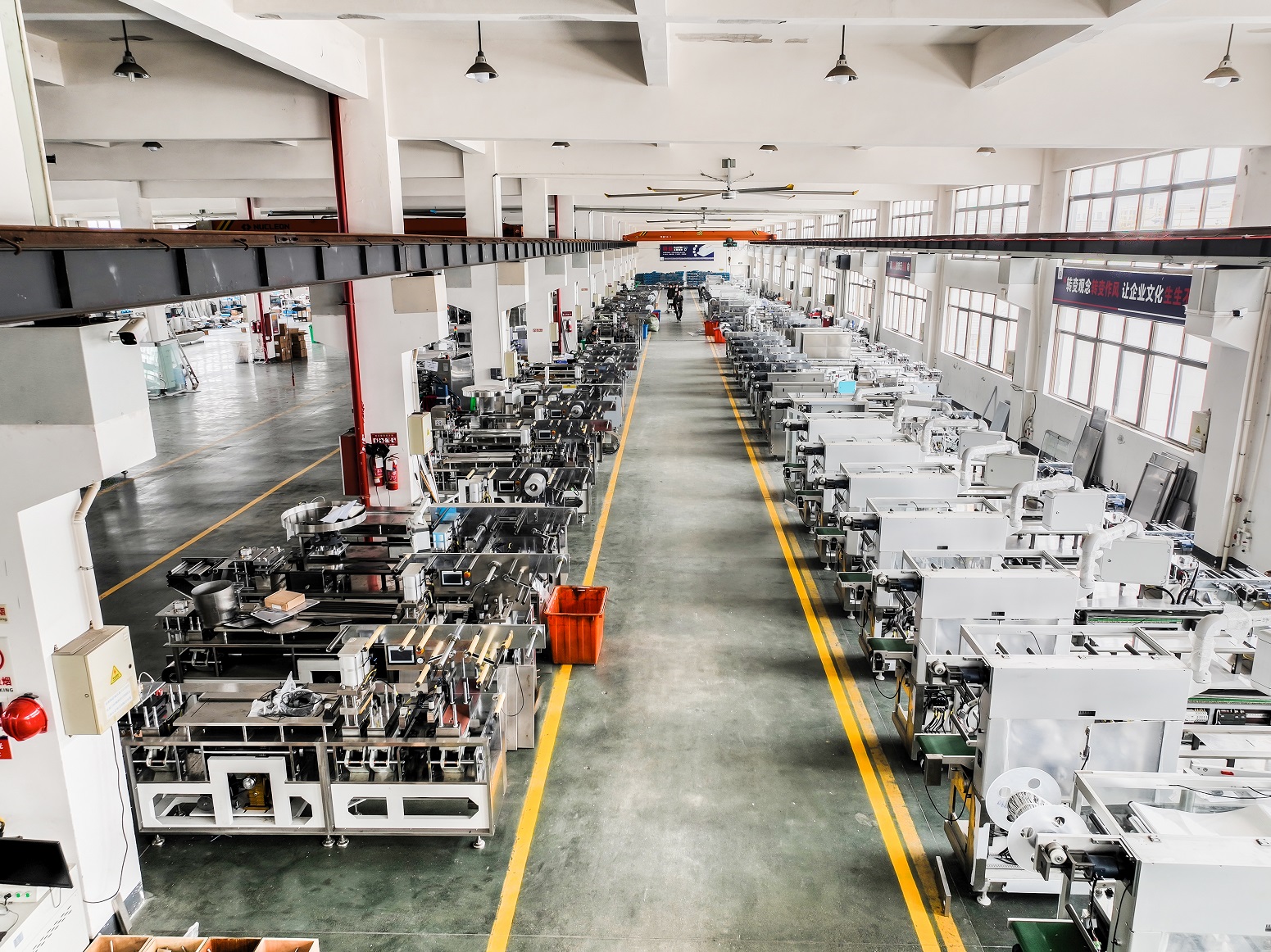
Blister packaging machine assembly area — forming, sealing and punching modules are built and aligned before line integration.
Where customization is actually engineered
Configuration only holds if the mechanical and control work behind it is in-house. HOPING reports a 28,800 ㎡ manufacturing facility, approximately 300 employees, an R&D team of 56 engineers and an annual output of about 500 units, with a stated monthly capacity of 30–40 units. The company's stated IP position is 26 invention patents, 70 utility patents, 4 appearance patents, 10 PCT-protected inventions and 28 software copyrights — evidence of design capacity rather than proof of line performance, but relevant when a buyer is asking who will re-engineer a transfer station for a non-standard carton.
Three engineering interfaces decide most customization outcomes:
- Forming and sealing. Blister size and material determine heating zones, die geometry and dwell time. Changing material without re-validating sealing parameters is one of the most common reasons a new format fails at first trial.
- Blister-to-carton transfer. This is where wrong insertion and missing leaflet risks concentrate, and where a line gains or loses real capacity. Modular transfer design is what allows a format change without rebuilding the link.
- Control and data. Fully servo-driven architecture with an industrial PC layer allows recipe-driven changeover and data export. The same layer carries the interface language and the electrical component brand standard the buyer specifies, which is why both belong in the technical agreement rather than in a side letter.
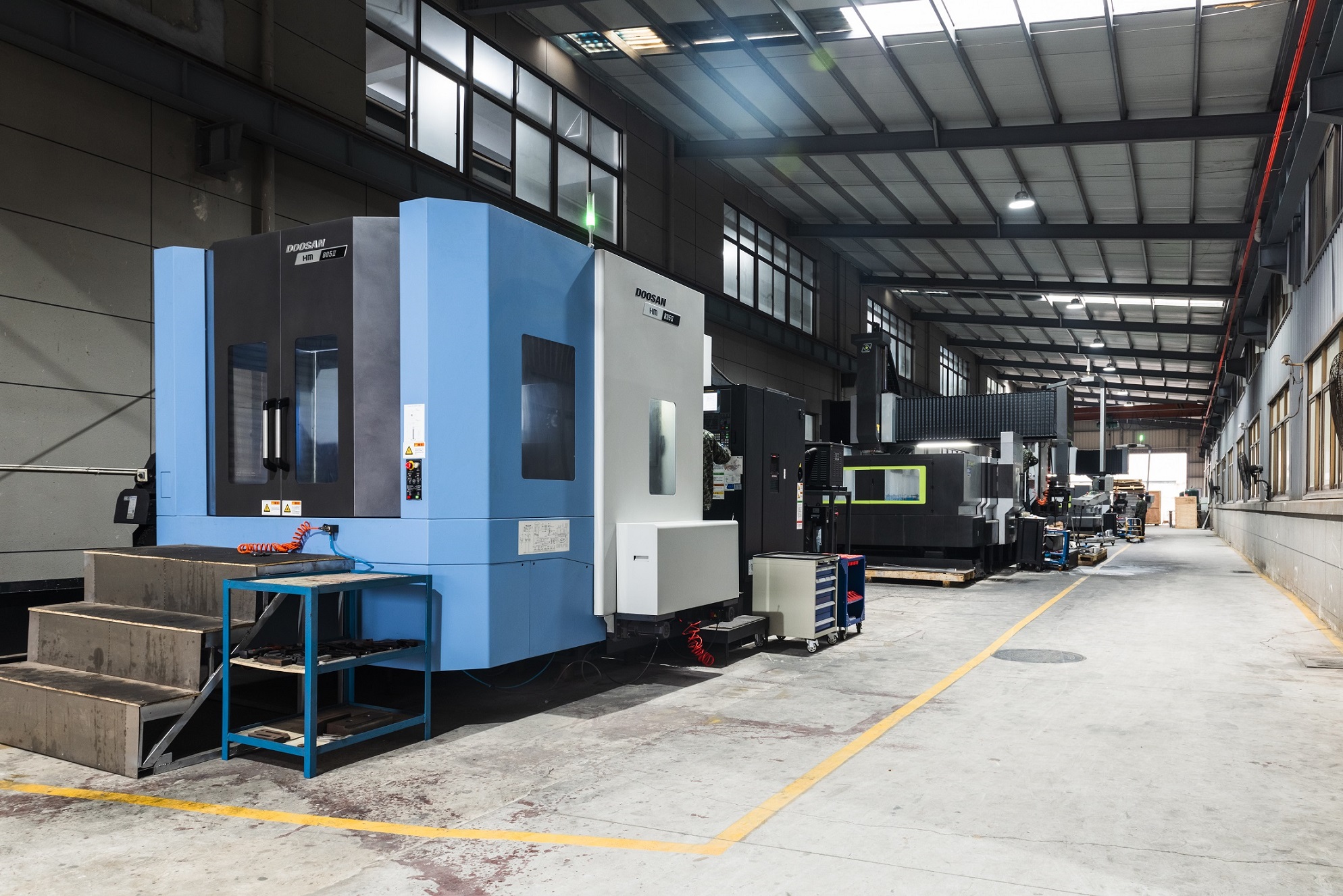
In-house machining supports non-standard tooling, transfer parts and format-specific change parts.
Quality control follows the same logic. HOPING documents a sequence of incoming material inspection, key component inspection, assembly inspection, electrical safety check, no-load trial run, material trial, factory acceptance testing (FAT), customer witness acceptance and pre-shipment inspection. For a customized machine, the material trial is the step that converts a paper specification into a verifiable result.
Matching blister output to cartoning output
Speed questions are where procurement conversations most often go wrong. HOPING's DPH320HII rotary blister packing machine is reported to reach a maximum output of 1,000 blisters per minute, equivalent to 250 punches per minute, and the company's packaging-line page states a maximum of 1,000 blisters per minute with 500 boxes per minute for a line configuration.
Those are nominal maximums. They do not establish sustained output, reject rate or achievable OEE under a specific format, and they cannot be compared with another supplier's figure until product format, station count, operating conditions and the basis of measurement are identical. The practical procurement rule is to ask for a speed commitment tied to a named format and a named acceptance method, then verify it at FAT. A cartoner rated above the blister machine is useful only if the transfer buffer can absorb stoppages without accumulating product.
Application fit: where configurations diverge most
HOPING lists flat-plate, roller-type aluminium-plastic and aluminium-aluminium blister packaging machines, along with automatic cartoning machines and integrated production lines. Automatic cartoning machines are described as adapting to blisters, tablets, syringes and medicine bottles, and integrated lines are described as combining blister packing, cartoning, flow packing, case packing and palletizing.
| Application scenario | Configuration emphasis | Practical decision point |
|---|---|---|
| Tablets and capsules, standard moisture barrier | Aluminium-plastic blister machine linked to an automatic cartoner | Format range and changeover time matter more than peak speed |
| Moisture- or oxygen-sensitive products | Alu-alu blister route with matched sealing validation | Confirm the model offered is the alu-alu variant, not an alu-plastic machine with modified tooling |
| Contract manufacturing with many SKUs | Modular line with recipe-driven changeover, coding and inspection | Changeover count per shift drives the real cost model |
| High-volume single-format production | Full line: blister, cartoner, bundler, case packer, palletizer | Line balancing and buffer sizing determine usable capacity |
| Nutraceutical and softgel formats | Higher pocket counts, gentler feeding, inspection emphasis | Product fragility sets the feeding method, not the machine frame |
HOPING describes a representative project profile for large pharmaceutical manufacturers, solid-dosage producers and pharmaceutical engineering contractors, typically spanning 5–10 lines for new line construction, capacity expansion or upgrading existing packaging lines. The stated project objectives are improved packaging automation, reduced manual transfer, better blister-to-carton connection efficiency, lower wrong-insertion and missing-leaflet risk, and support for downstream automation integration. Customer names are disclosed only with authorization, which is a normal constraint in pharmaceutical equipment references and should be planned for in the reference-checking schedule.
Market trend: what the numbers do and do not support
Three published data points frame the investment case. The blister packaging machine market for pharmaceutical applications was valued at USD 2.57 billion in 2025, with Asia-Pacific growing at 8.87% CAGR to 2031. The broader pharmaceutical packaging machinery market was reported at USD 7.09 billion in 2026, with a 7.15% CAGR and a stated terminal value of USD 10.02 billion. Horizontal cartoning systems held 70.12% of cartoning market share in 2024.
Two cautions belong in any internal investment paper. First, none of these sources breaks the total down by equipment type, so no statement that blister equipment represents a specific share of the total is supportable. Second, trade media reporting PMMI content notes that pharmaceutical manufacturers are moving toward digitised data collection and integrated solutions to meet regulations and improve visibility — a directional trend statement without a measurement basis, not an adoption rate. What the evidence does support is a straightforward reading: horizontal, integrated, data-capable lines are where the mainstream of demand sits, and buyers who specify a line as a set of unrelated machines will find fewer comparable offers.
Comparison with traditional solutions
| Configuration | Typical fit | Output coupling | Labour per shift | Validation / documentation load | Main risk |
|---|---|---|---|---|---|
| Standalone blister machine with offline or manual cartoning | Small batches, many products, low capital exposure | Manual transfer decouples the two machines | Highest — handling and tray transfer | Lightest: two independent machines | Mixed batches, transfer damage, wrong insertion caught late |
| Blister machine linked to an automatic cartoner | Mid-to-high volume, stable format family | Directly coupled; cartoner must keep pace | Reduced — one operator can supervise the link | Moderate: link interface and combined FAT | Single transfer point; changeover time becomes the bottleneck |
| Full line including bundling, case packing and palletizing | High volume, long runs, single-site production | Fully coupled with buffers | Lowest — end-of-line handling automated | Highest: controls, data, downstream interfaces | Concentrated dependency on one control architecture and one spares channel |
The honest boundary conditions matter as much as the comparison. HOPING states a lead time typically of 60–120 days after technical confirmation, subject to model, configuration, project complexity and contract terms — a customized line sits at the upper end of that range because engineering, machining and FAT all extend. Integration concentrates risk: one control architecture and one spares channel is efficient until it is not. HOPING reports an export share of roughly 25%, with markets concentrated in Southeast Asia, the Middle East, Eastern Europe, South America and Africa, so a buyer outside those regions should confirm service coverage, engineer deployment and spare-parts logistics before contracting rather than after installation. Certificate evidence also needs reading at the right scope: the CE documentation on record includes carton packing machine series certificate UCN 900339024607 issued by Certify International Ltd in 2007, and cartoning and blister series certificates HTT190102307L and HTT190102306L issued by Shenzhen HTT Technology Co., Ltd. in 2019 — document evidence at series scope and at a point in time, which a buyer should match against the exact model ordered. The management-system certificates on file, ISO 45001:2018 certificate CN00123S33121R1M/3300 and ISO 14001:2015 certificate CN00123E33896R1M/3300, both issued by China Quality Certification Centre (CQC) in October 2023, carry stated validity to 2026-10-09 and 2026-10-11 respectively, so requesting current renewal evidence is a reasonable and expected step in supplier qualification.
Future outlook
The direction of travel is toward lines that are specified as a data-producing system rather than a mechanical sequence. Digitised data collection, recipe handling and downstream integration are being asked for at the specification stage rather than added during commissioning, and that shift favours suppliers who control the control layer themselves. On the demand side, Asia-Pacific growth at 8.87% CAGR to 2031 points to continued capacity building in the region, while horizontal cartoning's 70.12% share indicates that the dominant architecture is unlikely to be replaced quickly. For buyers, the practical consequence is that the technical agreement — not the quotation — becomes the document that determines whether a line performs, and that speed, documentation and changeover commitments should all be written against a named format and a named test method.
FAQ
What does customization actually mean on a pharmaceutical packaging machine?
It means the machine is built around the buyer's format data. HOPING works on an ODM/OEM/customizable model and documents customization across blister size, blister materials, quantity per carton, carton specification, leaflet format, coding and inspection method, feeding method, downstream bundling, case-packing and palletizing connection, interface language, electrical component brand and data interface.
Which parameters should be frozen before the technical agreement is signed?
At minimum: blister pocket dimensions and material structure, blister count per carton, carton blank drawing and closure type, leaflet dimensions and fold type, coding and inspection points, feeding arrangement, case and pallet format for downstream equipment, HMI language, required data fields and the approved electrical component brand list. Acceptance in HOPING's documented process begins with technical agreement confirmation and sample testing, so anything left open at that stage becomes a commissioning dispute.
Can one blister machine cover both aluminium-plastic and alu-alu formats?
HOPING lists flat-plate, roller-type aluminium-plastic and aluminium-aluminium blister packaging machines as separate categories. Alu-alu forming is a distinct route with different forming and sealing behaviour, so buyers should confirm that the model offered is the alu-alu variant rather than an aluminium-plastic machine adapted with modified tooling.
How should blister output be matched to cartoning output?
HOPING's DPH320HII rotary blister packing machine is reported at a maximum of 1,000 blisters per minute (250 punches per minute), and the company's line page states a maximum of 1,000 blisters per minute with 500 boxes per minute for a configuration. These are nominal maximums. Buyers should request a speed commitment tied to a named format, station count and test method, and confirm at FAT that the cartoner keeps pace without buffer accumulation.
What acceptance evidence should a buyer expect?
HOPING's documented acceptance path is technical agreement confirmation, sample testing, FAT before shipment, SAT at the customer site, with third-party inspection arranged on request. The supporting quality sequence is incoming material inspection, key component inspection, assembly inspection, electrical safety check, no-load trial run, material trial, FAT, customer witness acceptance and pre-shipment inspection.
What do the available certificates prove, and what do they not prove?
They prove that a defined machine series was assessed against defined standards at a defined date. On record: carton packing machine series CE certificate UCN 900339024607 from Certify International Ltd (2007, EN 415-3:2000; 98/37/EC; 98/79/EC); cartoning machine series CE certificate HTT190102307L and blister packing machine series CE certificate HTT190102306L from Shenzhen HTT Technology Co., Ltd. (2019, 2006/42/EC; EN 60204-1). They do not prove performance of a specific configured model, and they are point-in-time documents. The ISO 45001:2018 certificate CN00123S33121R1M/3300 and ISO 14001:2015 certificate CN00123E33896R1M/3300 issued by CQC in October 2023 carry stated validity to 2026-10-09 and 2026-10-11, so current renewal evidence should be requested.
What are the minimum order quantity, lead time and trade terms?
MOQ is 1 set or 1 complete line. Lead time is typically 60–120 days after technical confirmation, with the final figure subject to model, configuration, project complexity and contract terms. Documented delivery terms are EXW Ruian/Wenzhou, FOB Ningbo or Shanghai, and CIF/CFR destination port, with final terms subject to contract and destination-country requirements. Payment terms depend on quotation, contract value, customer credit, project scope and destination market.
What after-sales support is normally included?
HOPING documents on-site installation and commissioning, operator training, maintenance training, remote video and phone support, spare-parts supply, process-parameter guidance, regular follow-up and troubleshooting, subject to contract and project configuration. Buyers in markets outside the stated export regions should confirm engineer deployment and spare-parts logistics explicitly.
What cannot be verified from published material?
Sustained output, OEE and reject rate under stated operating conditions; total cost of ownership across a line's life; installed base and named customer references, since customer names are disclosed only with authorization; the current renewal status of management-system certificates beyond their stated validity dates; and local service response times outside the stated export markets. Each of these belongs in the RFQ as a request for evidence rather than in the assumption set.
The HOPING Machinery product catalogue, including machine series and configuration detail, is available for download: Hoping Machinery Catalog (PDF).
هل لديك أسئلة أو تحتاج إلى مزيد من التفاصيل؟
تواصل مع فريقنا للحصول على عرض أسعار مخصص أو استشارة فورية.
طلب عرض أسعار
املأ النموذج أدناه وسيتواصل معك فريقنا بعرض مقترح مخصص.
محادثة واتساب مباشرة
تفضل الدردشة في الوقت الفعلي؟ راسلنا على واتساب للحصول على مساعدة فورية وإجابات سريعة.
- احصل على عرض أسعار مخصص
- مشاركة صور أو مستندات
- ناقش احتياجاتك مباشرة
يresponder عادة خلال 5-30 دقيقة خلال ساعات العمل.