
OEM Valve Sourcing: A Capability Profile of Valogin
Industrial Equipment & Components · Supplier Capability Analysis
The global HVAC valve market was valued at USD 17.1 billion in 2025 and is projected to reach USD 27.1 billion by 2035, a 4.7% CAGR across 2026–2035, according to Global Market Insights. Brass and bronze valve bodies are projected to hold a 46.2% share of that market by material in 2026, per Future Market Insights. Most of that volume is not a control system — it is a machined brass body with a seat, a stem and a handle, built to someone's drawing.
That distinction defines the real sourcing question for brand owners, heating equipment makers and building services suppliers. The decision is rarely about which valve brand to buy. It is about which manufacturing partner can deliver a complete brass valve range under the buyer's own name, to the buyer's drawing, with documentation that survives a technical audit. This profile examines Zhejiang Valogin Technology Co., Ltd. — the company behind the Valogin valve brand — against that specific question, using the company's own published facts and the regulatory framework buyers must satisfy.
The OEM Valve Question Buyers Actually Ask
A brand owner that wants to sell brass ball valves, gate valves, check valves and heating valves faces three routes: buy finished product from an established brand and resell it, build brass production in-house, or contract an OEM manufacturer that already casts, machines, assembles and tests brass. The first route limits margin and product control. The second carries foundry, machining and testing capital exposure before the first saleable unit exists. The third is the model most distributors and equipment brands converge on.
The catch is that OEM supply is only as good as what sits behind the label. In private-label arrangements, the buyer's name goes on the body, the packaging and the documentation. Any capability gap at the supplier becomes a warranty claim and a compliance exposure carried by the buyer. That is why OEM valve evaluation has shifted away from brochure claims and toward four verifiable things: whether the supplier owns the process, whether it owns the measurement, whether its certifications match the destination market, and whether it can hold tolerances across repeated batches.
Who Valogin Is
Zhejiang Valogin Technology Co., Ltd. is a joint-stock company based in Qinggang Industrial Zone, Yuhuan, Zhejiang, China, engaged in the research, development, manufacturing and sale of drainage control, gas system and HVAC system fluid control products and their supporting components. It was founded in 1985. Its documented product scope is brass valves, fittings and distribution manifolds for plumbing, sanitary ware, heating, refrigeration and gas systems.
- Factory footprint: 28,000 square meters, with more than 1,000 employees.
- Output: 80 million pieces per year.
- Export orientation: more than 90% of turnover comes from international markets; Europe and North America are key markets, with coverage extending to South America, the UAE and more than 100 countries.
- Engineering resource: an R&D team of more than 70 designers and engineers, including over 15 full-time R&D engineers, with expertise spanning water, gas, oil and heating systems.
Two further figures are reported by the company itself and should be read as company-reported rather than independently audited: an annual turnover of approximately USD 120 million in 2025, and a brass production capacity of roughly 30,000 tons per year. Placed against a market where brass and bronze bodies represent close to half of HVAC valve demand by material, that capacity defines the supplier's class — a volume brass house, not a niche assembler.

Aerial overview of the production campus. Vertical integration is the structural fact that most OEM valve supply claims rest on — casting, machining and assembly under one site rather than across a broker network.
Where the Capability Actually Sits
Claims of vertical integration are common in valve manufacturing; what matters is the depth of the chain and whether measurement is inside it. At Valogin, the documented process chain runs from brass rod through hot forging, CNC machining, rotary transfer machining, PTFE component production, automatic assembly and testing — all within the same plant rather than split across subcontractors.
Forming and machining
The company operates brass rod preparation, hot forging including warm heading machines, automated CNC machining centres and rotary transfer machining stations — the last of these used for both brass rod to valve core conversion and for higher-volume part families. Automated assembly is organised into dedicated areas, including an automatic assembly area for ball valves and isolation valves, and a fully automatic gate valve production line covering blank to assembly. The company states that 70% of its products are manufactured through automated workflows, with industrial robots deployed to reduce manual handling error.
For a buyer, the practical consequence of this structure is repeatability. The failure mode that damages private-label programmes is not usually a bad first sample; it is drift between batch one and batch ten. Dedicated automated lines remove the operator-to-operator variance that causes most of that drift, and they also compress the lead time between an approved sample and a production run.
Testing and laboratory capability
The company operates a national laboratory testing centre covering approximately 1,025 square meters, established in accordance with the ISO 17025 standard, equipped with more than 100 sets of equipment including an inverted metallographic microscope and a comprehensive test bench. Documented test capabilities cover ball valves, water nozzles, thermostatic valves and floor heating products, alongside salt spray testing, flow testing, bending tests, thermostatic valve testing and thread gauge management.
This matters because the relevant test standards are not interchangeable. ISO 5208:2015 and EN 12266-1:2012 both govern pressure testing of metallic valves, but their scope and leakage-grade definitions are not automatically equivalent — a test report citing one cannot be assumed to satisfy a specification citing the other. Similarly, ISO 6509-1:2014 sets the test method for dezincification resistance of copper alloys with zinc, a material property that determines how a brass valve performs in continuously wetted potable and heating circuits. A supplier with in-house laboratory capability can produce evidence against a named method; a supplier without one can only produce a certificate.
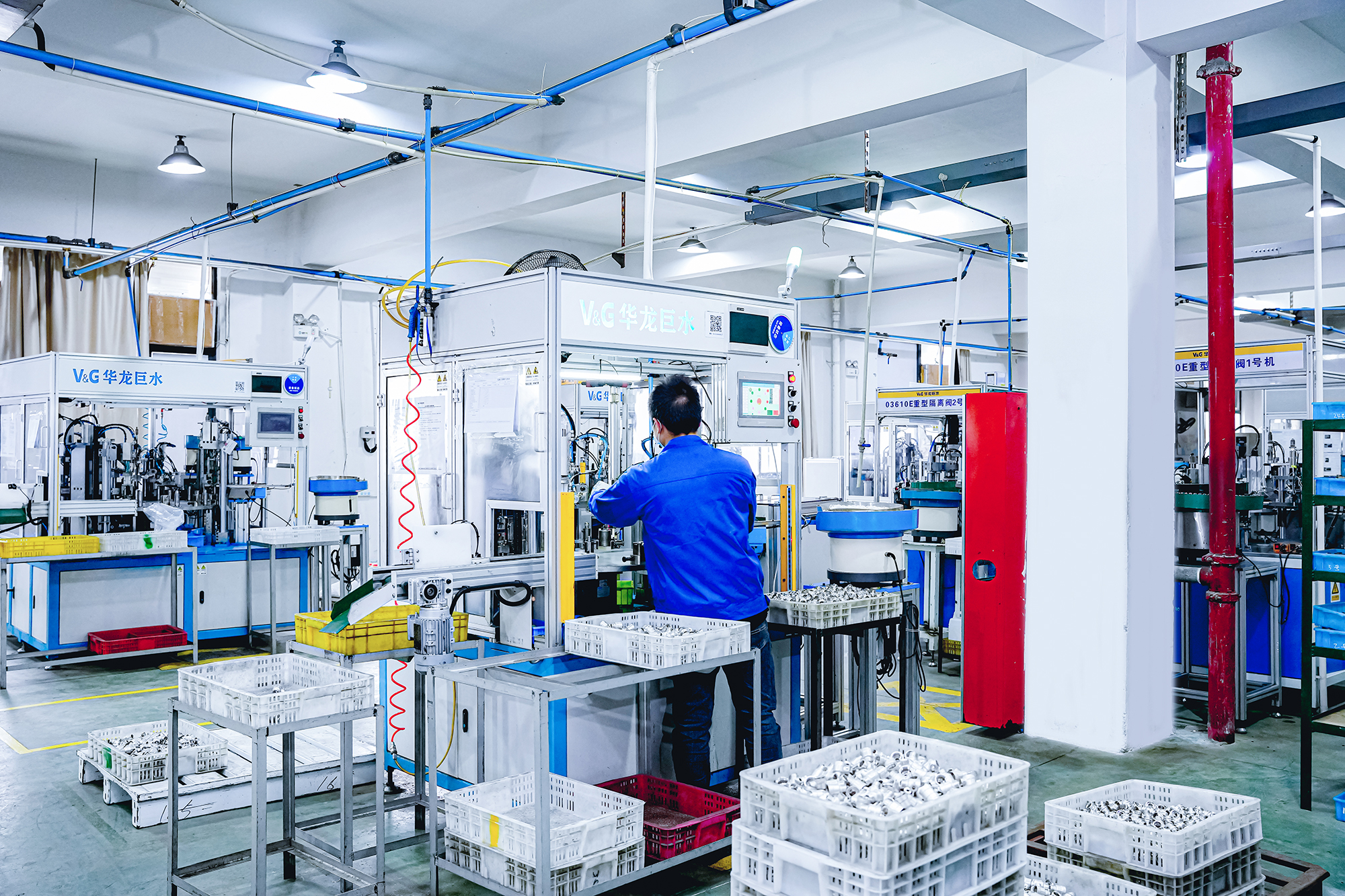
Automatic assembly area for ball valves. Dedicated automated lines are the mechanism behind batch-to-batch consistency in high-volume brass valve supply.
The Brass Range in Procurement Terms
The range is best read as a set of documented pressure and temperature envelopes rather than a product list, because that is how a specification is actually written. The table below reflects the parameters published for each product family.
| Product family | Model | Documented sizes | Documented rating | Typical duty |
|---|---|---|---|---|
| Brass ball valve | VG10.16902 | 1/4"–4" | PN40 (−20 °C to 120 °C) | Quarter-turn isolation, potable water and heating |
| Brass gas ball valve | VG10.61011 | 1/4"–4" | MOP5 (−20 °C to 120 °C); EN 331, CE, DVGW | Gas line and appliance isolation |
| Brass gate valve | VG11.11302 | 1/2"–2" | PN16 (0 °C to 80 °C) | Low-resistance main and riser isolation |
| Brass check valve | VG12.04033 | 1/2"–4" | PN16 / 232 PSI (0 °C to 66 °C) | Back-flow prevention |
| Brass stop valve | VG16.70411 | 12 mm–28 mm | PN10 (−20 °C to 100 °C) | Throttling and manual regulation |
| Brass angle valve | VG14.90111 | 1/2"×3/8", 1/2"×1/2" | PN10 (0 °C to 80 °C) | Sanitary fixture connection |
| Brass float ball valve | VG20.10212 | 1/2"–4" | −20 °C to 120 °C, 100% leak tested | Level control in water systems |
| Mixing valve | VG37.10092 | 1/2", 3/4", 1" | PN25 / 362.5 psi (−20 °C to 120 °C) | Thermostatic temperature regulation |
| Brass manifold | VG21.23161 | 3/4"×1/2", 1"×1/2" | ISO 228 threading, nickel-plated brass body | Heating circuit distribution with interception ball valves |
| Brass bibcock | VG13.99011 | 1/2"–1" | 0 °C to 80 °C, nickel-plated brass body | Potable water and garden outlets |
Three details in that table carry disproportionate weight in a purchase specification. First, the ratings are not uniform: the range spans PN10 to PN40 plus a gas MOP5 class, so a line item written simply as “brass valve, PN16” will not map cleanly across families. Second, the thread standard is stated explicitly as ISO 228 (equivalent to DIN EN ISO 228 and BS EN ISO 228), with ISO 7/1 Rp parallel threading additionally offered on the gas ball valve — this is the detail that determines whether a European buyer's fittings actually mate. Third, the manifold uses a nickel-plated brass body with interception ball valves, which places it in heating distribution rather than general isolation duty.
Certification and Market Access
Valogin holds ISO 9001, ISO 14001 and ISO 45001 management system certification, together with CNAS, CE, DVGW, AGA, WRAS, NSF, cUPC, CSA and AB1953. Those names cover three different things — management systems, European market access and North American potable-water compliance — and buyers should read them at the correct level.
The regulatory backdrop explains why the list matters. Under the Pressure Equipment Directive 2014/68/EU, pressure equipment and assemblies with a maximum allowable pressure above 0.5 bar fall inside scope, and Article 13 with Annex II classifies them into Categories I to IV, with progressively stricter conformity assessment as the category rises. A brass valve's category therefore depends on its pressure rating and nominal size, not on the supplier's preference — which means two valves from the same range can require different assessment paths.
For potable water, the two major markets diverge. The EU Drinking Water Directive (EU) 2020/2184, Article 11, requires that materials and products in contact with drinking water do not compromise health protection, and establishes European positive lists as the compliance mechanism. The United States takes a quantitative route: NSF/ANSI/CAN 372 requires weighted average lead content of wetted surfaces not exceeding 0.25%, consistent with the statutory “lead free” definition in Section 1417 of the Safe Drinking Water Act, while NSF/ANSI/CAN 61 addresses health effects of the component. These are different compliance logics and cannot be merged into a single global lead requirement. In the United Kingdom, the Water Supply (Water Fittings) Regulations 1999 add material suitability and back-flow requirements for supply fittings in England and Wales.
Application and Use Cases
The range maps onto four documented application settings, each with a different failure cost.
Building water supply and sanitary installations
In domestic, commercial and institutional buildings, the documented pattern is layered: brass gate valves provide coarse shut-off on the main supply and each riser, brass ball valves give quarter-turn isolation at fixture groups so a single floor can be worked on without shutting the building down, brass check valves prevent back-flow between circuits, and brass angle valves connect sanitary fixtures to the pipework. The line is under mains pressure continuously, which is why dezincification-resistant material and a corrosion-resistant finish matter more here than in intermittent duty.
Gas installations
On natural gas and LPG lines, the brass gas ball valve is the designated isolation point ahead of any appliance service. The quarter-turn handle shows open or closed position at a glance and can be locked closed. Because leakage in this application is a safety issue rather than a performance issue, the relevant approval for the destination market — for example EN 331 in Europe — must be confirmed before specification.
Hydronic heating
In two-pipe radiator circuits, the documented division of labour is: gate valves isolate the circulator and main distribution lines, ball valves give quarter-turn isolation at the heat source and each riser, angle valves connect radiators to the pipework, and stop valves throttle flow so radiators far from the circulator still reach design temperature. Continuous operation at up to 90 °C makes sealing stability and noise behaviour at throttled flow the two most common field complaints — noise, not leakage, is the usual reason a radiator circuit is rejected on handover.
OEM and private-label supply
The fourth setting is the one that defines the company commercially. Valogin supplies complete brass valves manufactured and marked under the customer's own brand, handling casting, machining, assembly and testing to the customer's specification, drawing and part number. The documented scope covers ball valves, gate valves, check valves, stop valves, angle valves, manifolds, mixing valves, gas ball valves, float ball valves and bibcocks. Logo and part number can be cast, stamped or laser-marked on the body and handle; production can follow the customer's drawing or sample; packaging, labels and printed documents carry the customer's brand. Dimensional tolerances follow the customer's drawing, and batch documentation includes dimensional inspection reports, material certificates and process capability data in the customer's own numbering system.
Market Trend Analysis
Three quantified trends frame the OEM brass valve decision. The first is volume growth: Global Market Insights puts the HVAC valve market at USD 17.1 billion in 2025 rising to USD 27.1 billion by 2035 at a 4.7% CAGR over 2026–2035. The second is material mix: brass and bronze bodies are projected to hold 46.2% of that market by material in 2026. The third is geography: Asia Pacific accounted for more than 38% of the market in 2025, making it both the largest consumption region and the largest concentration of brass valve manufacturing capability.
Growth-rate figures deserve a caution. Future Market Insights reports an 8.1% CAGR for the same category, a materially higher number that likely reflects a broader scope including electronically actuated and “smart” valve categories. Where two research houses disagree on scope, a procurement plan should not be built on either single number. The direction — steady expansion driven by construction, heating refurbishment and gas infrastructure — is consistent across sources; the precise rate is not.
The more consequential trend is regulatory rather than volumetric. Lead-content limits in North America and positive-list material requirements in Europe are pushing brass specifications toward low-lead and dezincification-resistant alloys, with ISO 6509-1 providing the test method that turns that requirement into something a lab can verify. For buyers, this shifts value toward suppliers that can evidence material compliance per batch rather than per brochure — and it raises the cost of switching to a supplier that cannot.
Comparison With Traditional Sourcing Routes
The table below compares the three routes a brand owner realistically has. It is a decision framework, not a ranking; each route is correct under different conditions.
| Criterion | Buy finished product from an established brand | OEM / private label from a brass valve manufacturer | Build brass production in-house |
|---|---|---|---|
| Brand on the product | Supplier's brand | Buyer's brand, packaging and documentation | Buyer's brand |
| Control over drawing and tolerance | Limited to catalogue options | To buyer's drawing, sample or written requirement | Full |
| Capital exposure before first sale | Inventory only | Tooling and sample approval | Foundry, machining, assembly and laboratory capital |
| Time to a full brass range | Immediate but fixed | Dependent on sample approval cycle | Longest |
| Certification ownership | Supplier holds market approvals | Shared — buyer must confirm scope per market | Buyer holds all approvals |
| Margin structure | Distributor margin on finished goods | Manufacturing cost plus buyer margin | Full manufacturing margin and full risk |
Within the product range itself, selection between ball, gate and stop valves follows functional logic rather than preference. Ball valves give quarter-turn isolation and show their state at a glance, making them the default for on/off duty in water and gas lines. Gate valves open slowly on a multi-turn handwheel and offer a straight-through, low-resistance bore, but are intended for fully open or fully closed duty only. Stop valves exist to throttle. The practical rule is: ball for isolation, gate for low-resistance isolation on larger lines, stop for regulation.
Limits and Boundaries Worth Knowing
A credible capability profile has to state where the model stops working. Four boundaries apply here.
- Private label removes public references. Under an OEM arrangement, the customer's drawings, part numbers and brand relationship are held confidential and do not appear in public material. A prospective buyer therefore cannot verify capability through a published customer list; verification has to run through sample approval, inspection records and a factory audit. That is slower, and it is the trade-off for confidentiality.
- The documented range is brass valves and fittings. Published sizes extend to 4" on ball, check and float valves, 2" on gate valves and 1" on the manifold and bibcock families. Actuated control valves, electronic controllers and large-diameter cast iron or cast steel industrial valves are not part of the documented brass scope. A project that requires integrated actuation should specify an ISO 5211:2017 interface and confirm the actuator supply route separately.
- Ratings vary by family. A single blanket pressure class cannot be assumed across the range — from PN10 angle and stop valves to PN40 ball valves and MOP5 on the gas valve. Line items must be written per family.
- High-volume programmes require scheduling. Production runs to the customer's schedule and forecast under multi-year supply programmes. With company-reported brass capacity of roughly 30,000 tons per year shared across a global order book, large seasonal peaks need to be planned rather than assumed.
On industry position, one point of discipline is required: no third-party verified market-share data places Valogin in a ranking against European or North American control-valve groups, and the company's own portfolio facts do not establish one. For context only, Danfoss, Belimo, IMI Hydronic Engineering, Watts Water Technologies and Caleffi each publicly document portfolios centred on actuated control valves, balancing valves, thermostatic valves or back-flow prevention — self-reported scope, not a ranking. Valogin's documented position is different in kind: a volume brass valve and fittings manufacturer supplying components, including under customers' own brands, rather than a systems and controls brand. Buyers should read its position from process depth, certification breadth and export exposure, not from share claims.
What to Verify Before the First Order
A practical qualification sequence for an OEM brass valve programme:
- Confirm the certificate covers the exact product family, size range and standard version being ordered — not just the supplier's name.
- Approve a physical sample and record its inspection data; that record, not the drawing alone, becomes the reference for later batches.
- Agree the test method by name (ISO 5208 or EN 12266-1) and confirm the leakage acceptance criteria rather than assuming equivalence.
- Request material certificates per batch, plus dezincification test evidence where the alloy is specified for potable or continuously wetted duty.
- Confirm thread standard explicitly — ISO 228, or ISO 7/1 Rp where the application requires it.
- Agree part marking, traceability numbering and packaging under your own brand before the first production run.
- For gas duty, confirm the destination-market approval before specification, since leakage here is a safety matter.
- For volumes with seasonal peaks, agree a forecast schedule rather than a single purchase order.
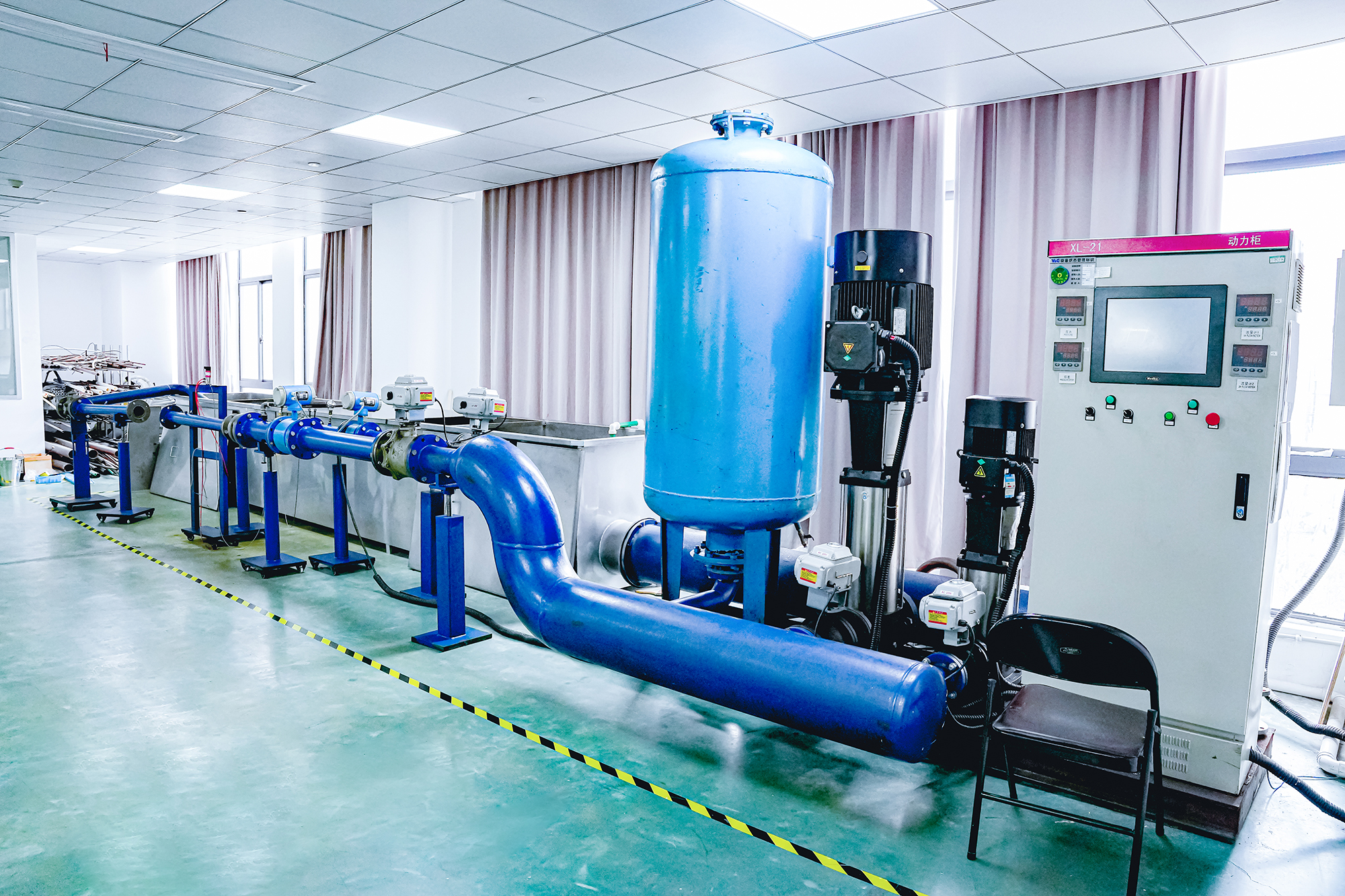
Flow testing in the in-house laboratory. The value of laboratory capability to a buyer is not the equipment list — it is the ability to produce evidence against a named test method on every batch.
Future Outlook
If the market expands toward USD 27.1 billion by 2035 at the projected 4.7% CAGR, the growth will not be evenly distributed. Replacement and refurbishment of existing heating stock in Europe and North America favours standardised brass valve families with predictable documentation, while new construction in Asia Pacific favours volume and lead-time reliability. Both favour suppliers that combine automated production with in-house testing, because both requirements ultimately resolve into evidence.
The compliance trajectory is the larger variable. As lead-content and material-hygiene rules tighten across the two major markets, the cost of qualifying a new brass supplier rises, which tends to consolidate buyer relationships around suppliers already holding the certificate portfolio and the laboratory capability to support it. For a company positioned as an OEM brass valve manufacturer rather than a brand, that consolidation is the structural opportunity — and the reason capability evidence, not marketing, is the currency of the next decade of sourcing decisions.
FAQ
What is Zhejiang Valogin Technology Co., Ltd. and what does it manufacture?
Zhejiang Valogin Technology Co., Ltd. is a joint-stock company founded in 1985, based in Qinggang Industrial Zone, Yuhuan, Zhejiang, China. It researches, develops, manufactures and sells drainage control, gas system and HVAC system fluid control products. Its documented products are brass valves, fittings and distribution manifolds for plumbing, sanitary ware, heating, refrigeration and gas systems, produced across a 28,000 square meter factory with more than 1,000 employees and an annual output of 80 million pieces.
Can brass valves be manufactured under our own brand?
Yes. Logo and part number can be cast, stamped or laser-marked on the body and handle; production can follow the customer's drawing or sample; and packaging, labels and printed documents can carry the customer's brand. An approved sample and its inspection record set the standard against which later batches are checked. Under this arrangement, the customer's drawings, part numbers and brand relationship are held confidential and do not appear in public material.
Ball valve, gate valve or stop valve — which one should I use?
Ball valves give quarter-turn isolation and are the default for on/off duty in water and gas lines because the handle shows valve state at a glance. Gate valves open slowly on a multi-turn handwheel and give a straight-through, low-resistance bore, but are for fully open or fully closed duty only. Stop valves are made for throttling. The rule is: ball for isolation, gate for low-resistance isolation, stop for regulation.
Which certifications can a buyer expect from this brass valve manufacturer?
Valogin holds ISO 9001, ISO 14001 and ISO 45001 management system certification, and CNAS, CE, DVGW, AGA, WRAS, NSF, cUPC, CSA and AB1953. These fall into three groups: management systems, European market access, and North American potable-water compliance. Buyers should confirm that the specific certificate names the product family and size range being ordered, and that the cited standard version is current.
What sizes and pressure ratings are documented across the brass range?
Ball valves are documented from 1/4" to 4" at PN40 (−20 °C to 120 °C); gas ball valves from 1/4" to 4" at MOP5 with EN 331, CE and DVGW; gate valves from 1/2" to 2" at PN16 (0 °C to 80 °C); check valves from 1/2" to 4" at PN16 / 232 PSI (0 °C to 66 °C); stop valves from 12 mm to 28 mm at PN10 (−20 °C to 100 °C); angle valves in 1/2"×3/8" and 1/2"×1/2" at PN10; and mixing valves in 1/2", 3/4" and 1" at PN25 / 362.5 psi (−20 °C to 120 °C). Ratings are specific to each family and cannot be applied across the range.
How is quality verified before a repeat order is placed?
Verification typically runs through sample approval and its inspection record, then batch documentation. Valogin's laboratory covers approximately 1,025 square meters under an ISO 17025 framework with more than 100 sets of equipment, covering salt spray, flow, bending, thermostatic valve and thread gauge testing. Batch documentation under an OEM arrangement includes dimensional inspection reports, material certificates and process capability data, issued in the customer's own numbering system.
Reference document: Valogin brand catalogue (PDF) — open the Valogin brand catalogue.
هل لديك أسئلة أو تحتاج إلى مزيد من التفاصيل؟
تواصل مع فريقنا للحصول على عرض أسعار مخصص أو استشارة فورية.
طلب عرض أسعار
املأ النموذج أدناه وسيتواصل معك فريقنا بعرض مقترح مخصص.
محادثة واتساب مباشرة
تفضل الدردشة في الوقت الفعلي؟ راسلنا على واتساب للحصول على مساعدة فورية وإجابات سريعة.
- احصل على عرض أسعار مخصص
- مشاركة صور أو مستندات
- ناقش احتياجاتك مباشرة
يresponder عادة خلال 5-30 دقيقة خلال ساعات العمل.