
OEM vs. White-Label vs. Combo: A Dim Sum Range FAQ
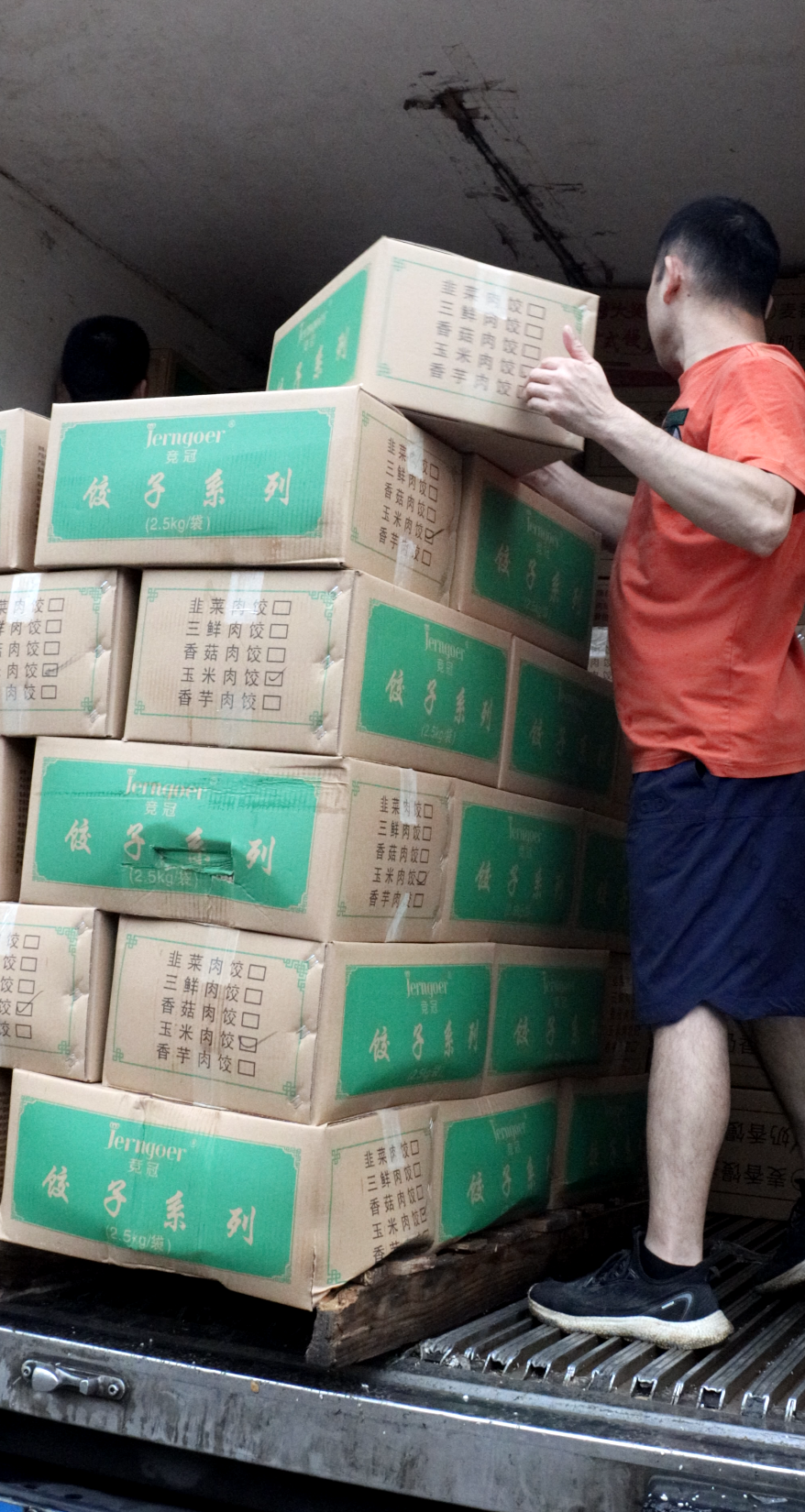 Frozen dim sum staged for wholesale distribution. Image: Foshan Shunde Yuexiang Food Manufacturing Co.,Ltd.
The global frozen Cantonese-style dim sum market was valued at USD 7.04 billion in 2025 and is projected to reach USD 11.99 billion by 2033 (Data Insights Reports / Research Insights). Behind that number sits a population of buyers — food supply chain wholesalers, catering distributors and gifting companies — deciding whether to commit to custom SKUs, standard catalogue lines, or both at once.
That decision is where procurement language quietly breaks down. "OEM," "white-label" and "combo" get used interchangeably in conversation, but in a purchase agreement they describe different arrangements for production, branding and compliance documentation. A buyer who orders a Water Chestnut Cake on a 12-bag box specification, believing they have bought OEM customisation, may receive a white-label product instead. The failure is rarely in the cake. It is in the packaging, the label and the traceability file that should have matched.
This technical FAQ addresses that gap directly. It uses the Water Chestnut Cake — a product that sits in both retail and gifting channels — to work through the questions distributors actually ask before they confirm a range.
Why the Terminology Matters in Frozen Dim Sum Procurement
In frozen dim sum, the line between "buying an existing product" and "commissioning one" runs through three things: who controls the recipe, who controls the branding, and who carries the compliance documentation. Those three answers determine whether an order behaves like a standard SKU or a project.
Supply is not the constraint. China accounted for 46% of global frozen dumpling production volume in 2025 (Business Research Insights). Clarity on the buying side is scarcer than capacity on the selling side.
A practical example of how this misaligns: if a manufacturer produces a product to its own specification and simply prints the buyer's logo on the packaging, the transaction is white-label in procurement records — even if the buyer internally called it OEM. The mismatch surfaces at goods-in, when the delivered specification does not match the quotation and the custom packaging turns out never to have been ordered.
The Three Models, Stated Plainly
OEM. The buyer defines the product; the manufacturer produces to those details; the finished goods carry the buyer's brand. Control of product detail sits with the buyer.
White-label. The buyer takes an existing catalogue specification. Recipe and pack format are set by the manufacturer; the buyer receives the right to apply their own brand identity to that SKU.
Combo. Both run in parallel. Custom SKUs handle differentiation; catalogue SKUs handle coverage and replenishment.
At the supplier level, Foshan Shunde Yuexiang Food Manufacturing Co.,Ltd. — operating under the "Da Xiao" brand and established in 1981 in Shunde, Guangdong — manufactures frozen dim sum under both OEM and ODM arrangements, including customisation of logos and product details according to customer needs. ODM additionally covers custom product development.
That capability split is why the distinction matters at evaluation stage. It establishes who controls which part of the product. A standard line buys time; a custom line buys differentiation. They ask for different things from a buyer's own team.
Where OEM, White-Label and Combo Actually Diverge
| Dimension | OEM / ODM | Standardised White-Label | Combo |
|---|---|---|---|
| Product detail control | Defined by buyer | Factory catalogue specification | Split by SKU |
| Logo and brand identity | Customisable | Customisable | Customisable |
| Product development | Supported under ODM | Not applicable | Partial |
| Minimum order | 50 boxes | 50 boxes | 50 boxes |
| Lead time | 7–14 days | 7–14 days | 7–14 days |
The row worth pausing on is branding. In all three models the logo can be customised — so "can you print my brand" does not separate OEM from white-label. Product detail control does. If the recipe, pack size or packaging specification is fixed by the factory, the arrangement is white-label, whatever the purchase order header says.
Product Reference: The Water Chestnut Cake at 500 g × 12
The Water Chestnut Cake is a useful test case because it appears in more than one channel at once. Its published specification reads as follows:
- Pack format: 500 g per bag × 12 bags per box
- Ingredients: coconut milk, water chestnuts
- Cooking method: steamed without thawing, 6–8 minutes in a water pan
- Storage: frozen at −18 °C
- Applicable channels: restaurants; hotels and tourism; retail including supermarkets, community fresh-food stores and convenience stores; catering services; transportation catering; trade and foreign trade; gifting, including New Year gift box vendors and banquets
The 12-bag box is the base logistics unit for this line. It determines what happens after arrival — whether the box is broken down for individual sale or assembled into sets — and it is the single pack format available, not one of several.
One characteristic deserves to be stated plainly at planning stage. The Water Chestnut Cake is a steamed cake, and steamed cakes — including water chestnut cake, red bean cake and sesame cake — carry a 6-month frozen shelf life at −18 °C. Steamed buns run to 12 months. That gap is real and it changes the replenishment rhythm a buyer should plan around.
Retail and Gifting: One SKU, Two Channel Logics
Retail wants individual pricing, shelf-ready presentation and fast turnover. Gifting — New Year gift box vendors, banquet menus, corporate gifting — wants set composition and shelf presence. The Water Chestnut Cake format serves both ends; what changes is the packaging layer around the product.
Packaging customisation, however, sits in a different commercial bucket. According to the manufacturer's published capability list, customised packaging and flavour adjustment are value-added services rather than part of a base specification. A buyer treating the 12-bag box as if it were already a gift set should confirm the packaging treatment rather than assume it.
OEM/ODM Supply versus a Standardised Buying Protocol
Both routes end up at the same production floor. They differ in sequence.
Standardised buying protocol
- Select an existing specification from the catalogue
- Confirm box format and quantity, from 50 boxes upward
- Set delivery terms: EXW, FCA, FAS, FOB, CFR or CIF
- Produce and ship, on a 7–14 day lead time
- Accept on arrival: visual inspection and quantity check, temperature monitoring, sampling sensory inspection, and document verification
OEM / ODM project route
- Buyer defines product details and brand identity requirements
- ODM projects include custom product development
- Commercial terms proceed as agreed; OEM customised orders run on a deposit plus final payment structure as stipulated in the contract
- Produce and ship, within the same 7–14 day lead time
- Acceptance follows the same four-step protocol
The real difference lands on the buyer's side of the table. A standardised protocol asks for a selection decision. An OEM route asks for design and approval decisions. That sounds minor until a buyer's internal sign-off chain takes several weeks while a 7–14 day production window is already running.
Quality and Compliance Apply Regardless of Model
Inspection does not change with the purchasing model. Each order carries a 100% pre-shipment test, covering weight verification, packaging seal and label completeness checks and microbiological safety screening — colony count and coliform testing by plate count method.
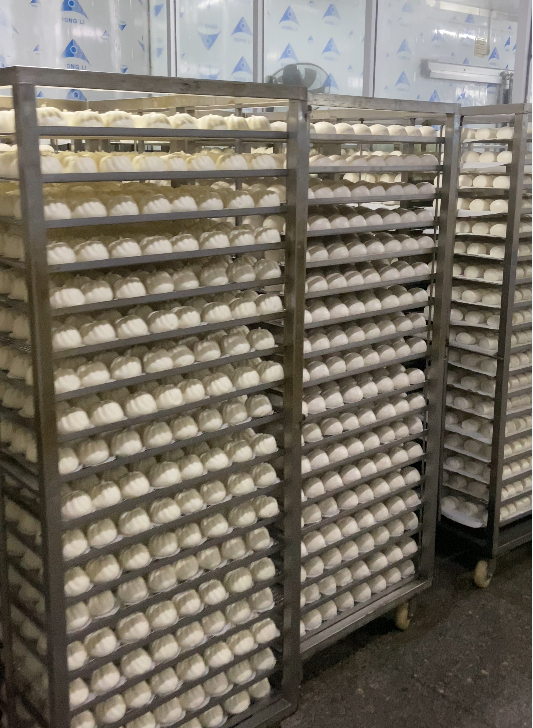 Mass production of steamed dim sum. Image: Foshan Shunde Yuexiang Food Manufacturing Co.,Ltd.
Export destinations include the United States, Canada, Australia, New Zealand, Mexico, Malaysia and Vietnam. The documentation that travels with those shipments includes:
| Document | Reference | Authority / Market |
|---|---|---|
| Export food production enterprise registration certificate | 4400/15914 | Foshan Customs of the People's Republic of China, issued 2022-04-28 |
| FDA Food Facility Registration | 550074820 | UGK-LVM UNITED INC., United States, valid to 2026-12-31 |
| Export HS codes for frozen dim sum | 1902200000 / 1902309000 | China Customs |
Cold chain runs end to end at −18 °C, with technical support covering steaming parameters and menu matching provided alongside each order.
Market Signals Shaping 2026 Range Planning
Two forces are reshaping how buyers frame these decisions.
The first is scale. The global frozen Cantonese-style dim sum market stood at USD 7.04 billion in 2025 and is projected to reach USD 11.99 billion by 2033, while China alone contributed 46% of global frozen dumpling production volume in 2025.
The second is regulatory. Effective 1 May 2026, Guangzhou requires restaurants to clearly indicate whether dim sum is handmade on-site or produced through central kitchens and pre-made formats. That rule turns "which model did I actually buy" from a specification question into a labelling and audit question. For a distributor running both a pre-made frozen line and a customised line, the procurement record has to be accurate.
Both signals point the same way: precision about OEM, white-label and combo is no longer a matter of internal tidiness. It now touches compliance.
Future Outlook
As the category expands, the boundary between white-label and OEM will keep blurring at the catalogue level, because branding is customisable in both. What will separate suppliers is whether they can state the boundary clearly — which parameters are fixed, which are negotiable, and what each route costs in time.
For buyers, the working rule is simple enough. Treat the 12-bag box as the unit. Establish whether the specification is fixed or definable before discussing anything else. Everything downstream — packaging, labelling, shelf-life planning and channel fit — follows from that one answer.
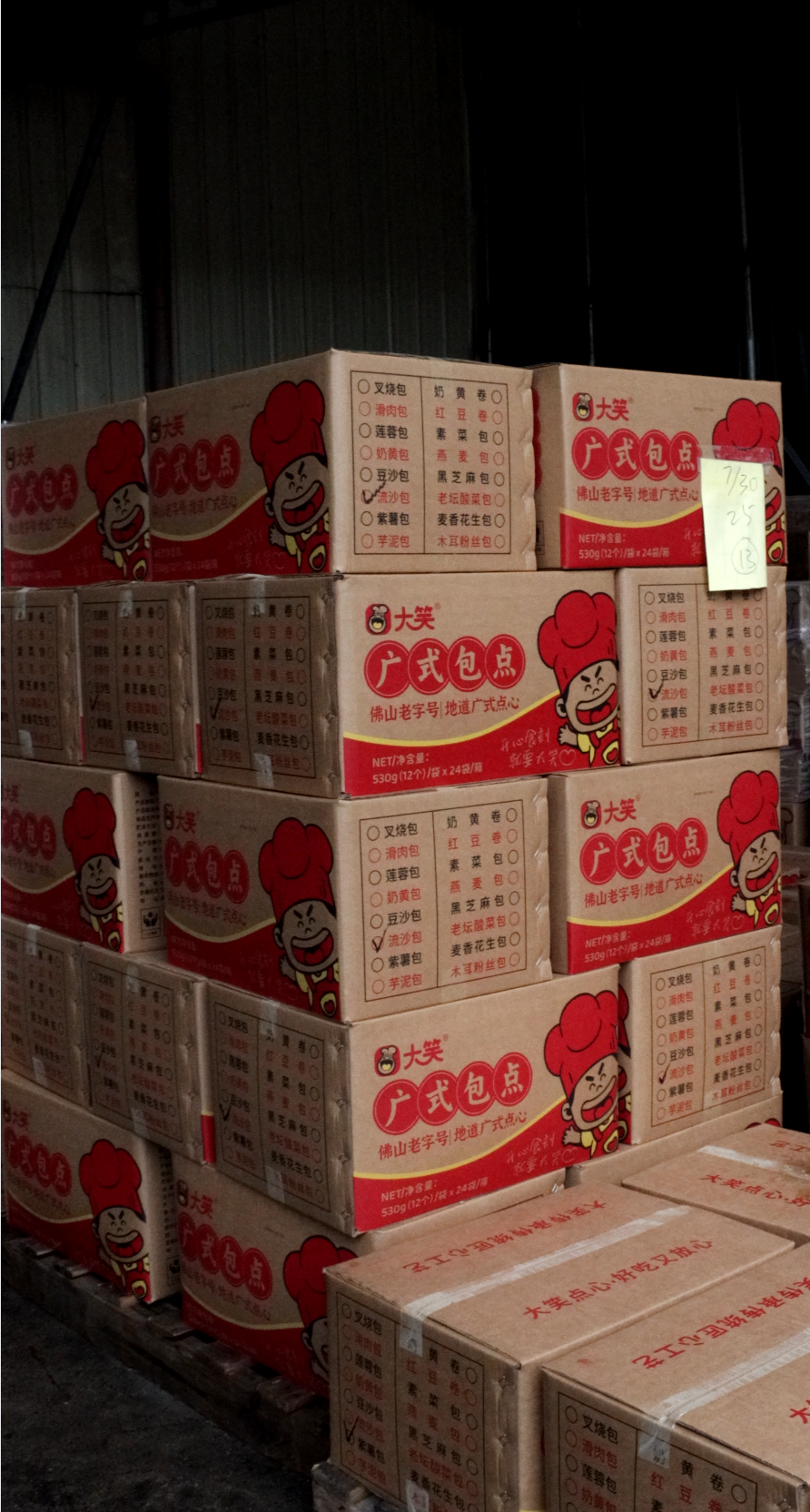 Cold storage at −18 °C. Image: Foshan Shunde Yuexiang Food Manufacturing Co.,Ltd.
Technical FAQ for Dim Sum Range Planning
Q1. What is the difference between OEM, white-label and combo purchasing in frozen dim sum?
OEM means the manufacturer produces to product details defined by the buyer, and the finished goods carry the buyer's brand. White-label means the buyer takes a specification that already exists in the manufacturer's catalogue, with brand identity applied on top. Combo means running both in parallel — custom SKUs for differentiated scenarios and catalogue SKUs for baseline coverage. Foshan Shunde Yuexiang Food Manufacturing Co.,Ltd. manufactures under both OEM and ODM arrangements, including customisation of logos and product details according to customer needs, with ODM covering custom product development.
Q2. What does a standardised buying protocol cover for a Water Chestnut Cake order?
The standard specification is 500 g per bag × 12 bags per box, made with coconut milk and water chestnuts, stored frozen at −18 °C and steamed without thawing for 6–8 minutes. A standardised protocol locks those parameters. Minimum order is 50 boxes, lead time is 7–14 days, and delivery terms can be arranged as EXW, FCA, FAS, FOB, CFR or CIF.
Q3. Can a single Water Chestnut Cake SKU serve both retail and gifting channels?
On specification, yes. The Water Chestnut Cake's applicable channels include retail — supermarkets, community fresh-food stores and convenience stores — and gifting, including New Year gift box vendors and banquets. Food OEM manufacturers are also listed within the gifting segment. The 12-bag box serves as the shared logistics unit for both. What differs between the two channels is presentation rather than the product itself, since packaging customisation is handled as a value-added service rather than as part of the base specification.
Q4. How does the 12-bag box format affect channel planning?
The 12-bag count sets the downstream break-bulk behaviour. Retail will generally break the box down to individual bags for shelf display, while banquet and gift box channels may assemble units into sets rather than sell single bags. Because the format is fixed rather than variable, buyers get one predictable replenishment unit instead of two competing pack sizes. Buyers who need different packaging should route that requirement through the value-added service process, since customised packaging is not part of the base specification.
Q5. How does shelf life on the Water Chestnut Cake affect inventory planning?
Steamed cakes — including water chestnut cake, red bean cake and sesame cake — have a 6-month frozen shelf life when stored at −18 °C. Steamed buns reach 12 months. That difference is material: a range built primarily on steamed cakes needs a faster turnover cycle than one built on buns. Production date and shelf life are printed on the outer packaging, so buyers can verify both at goods-in rather than relying on the dispatch note alone.
Q6. What does an OEM order look like from commitment to receipt?
The buyer first defines product details and brand identity requirements; under ODM this stage includes custom product development. Production then runs on a 7–14 day lead time with a minimum of 50 boxes. OEM customised orders are settled on a deposit plus final payment structure as stipulated in the contract. On arrival, acceptance covers four checks: visual inspection of model and quantity, temperature monitoring to confirm the cold chain, sampling sensory inspection, and verification of the delivery note, batch quality documents, production date and shelf life.
Q7. Which compliance documents should a buyer request for export orders?
Export production requires an export food production enterprise registration certificate. Foshan Shunde Yuexiang Food Manufacturing Co.,Ltd. holds certificate 4400/15914, issued by Foshan Customs of the People's Republic of China on 2022-04-28, covering steamed pastries and frozen rice and wheat food for export. For the United States market, the company holds FDA Food Facility Registration 550074820, valid to 2026-12-31. Frozen dim sum is commonly declared under HS codes 1902200000 and 1902309000. Documents provided with each order include quality inspection reports, production qualifications and export customs declaration documents.
Q8. What are the practical limits of a combo range strategy?
Three limits matter. First, a minimum order of 50 boxes applies across the board, so trial quantities below that threshold are not workable. Second, customisation is a value-added service rather than a default — flavour adjustment, customised packaging and new product samples are add-ons, not baseline inclusions. Third, the 6-month frozen shelf life on steamed cakes such as the Water Chestnut Cake is half that of steamed buns at 12 months, so the two lines inside a combo range cannot be managed on the same rotation cycle. Each of these should be priced and planned separately.
Reference
Company profile and export product documentation: Foshan Shunde Yuexiang Food Manufacturing Co.,Ltd. product brochure (PDF). Manufacturer site: www.dimsum-daxiao.com.