
OPS PC Comparison Framework: Four Platforms, One Project Fit
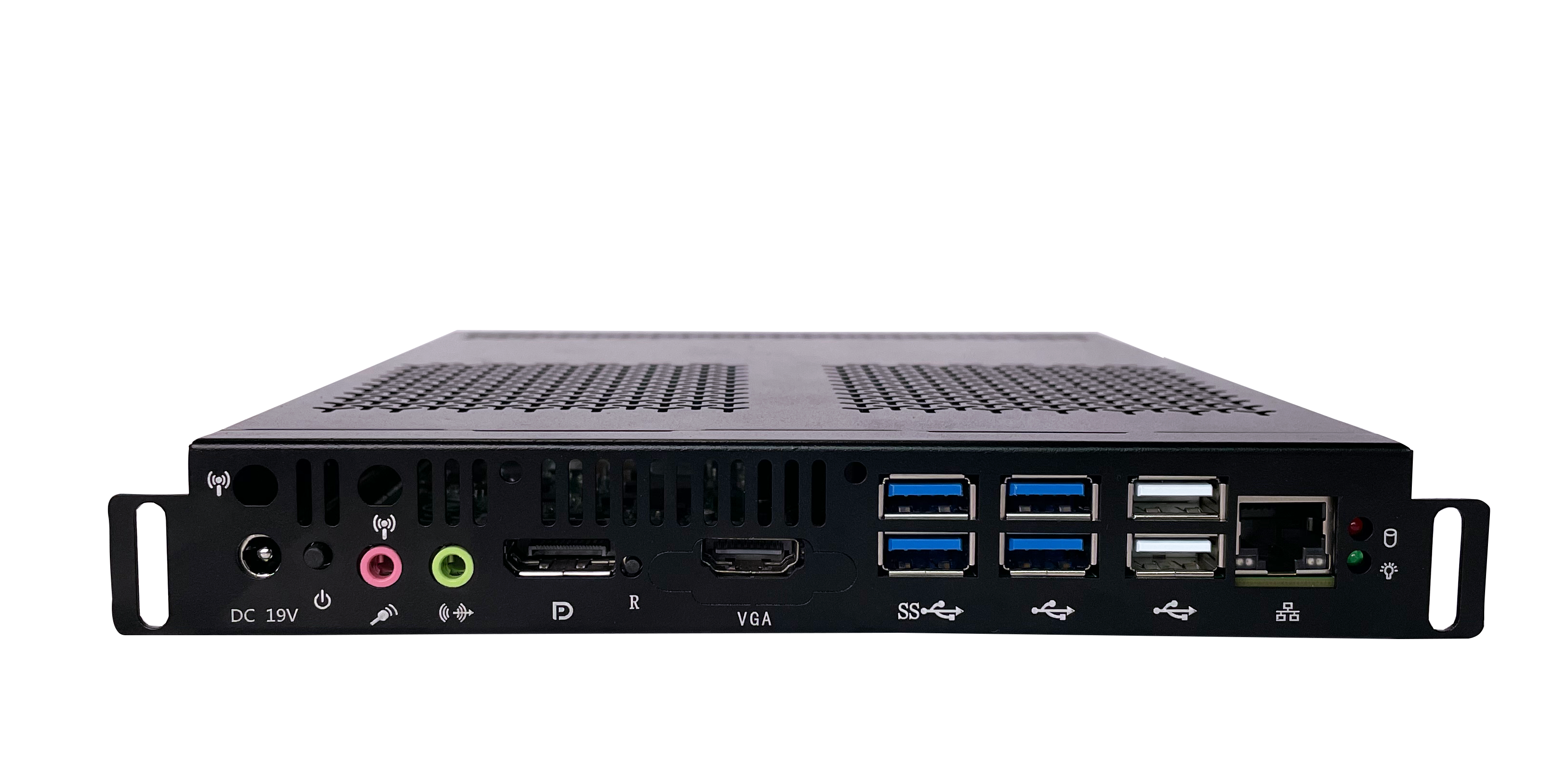
An OPS PC is a slot-in computer module that supplies the local processing platform inside an interactive display, digital signage panel or meeting display. Choosing one is a project-fit decision rather than a specification contest: the platform decides which operating systems and applications can run, how much thermal headroom the module needs inside the display, which video outputs are available, and how the installation will be serviced across its lifetime.
The category has real scale behind it. Grand View Research valued the global interactive flat panel market at approximately USD 12.6 billion in 2024, and an IFPD market trends report estimates that integrated OPS-slot compute modules and Android-based SoC modules ship in roughly 15 to 25 percent of new interactive flat-panel displays. Modular compute is therefore not an accessory line item; it is a standing procurement decision inside display projects, and it is increasingly a multi-architecture decision.
Shenzhen Aiostar Electronics Co., Ltd. (AIOSTAR) is a computer hardware supplier established in 2015 in Shenzhen, China, that develops, produces and supplies OPS PCs, OPS-C pluggable computer modules, Android OPS PCs, industrial motherboards, mini PCs, BOX PCs, industrial panel PCs, servers and customized embedded computing systems. The company publishes a 1,500 m² factory, 50 employees, an annual output of more than 170,000 units, an eight-engineer R&D team and a 60 percent export ratio, with OEM and ODM services covering hardware configuration, I/O, chassis, cooling, BIOS, operating system image, logo, packaging and accessories.
This framework compares four OPS PC categories AIOSTAR supplies — domestic-platform OPS-C, Android AI, discrete-GPU and OPS-C pluggable — and maps the criteria that actually decide a purchase to four common deployment environments. It is written for the research-to-evaluation stage, where a buyer already knows an OPS module is required and now has to choose which architecture to specify.
Why OPS PC Selection Fails More Often Than the Spec Sheet Does
Integration problems with OPS modules rarely originate in the processor choice. In practice they appear at four points that only become visible when a module is matched against a display, a software stack and a delivery schedule.
- Mechanical and electrical fit. The slot standard, connector pinout, module footprint and mounting hardware must match the display. Intel's Open Pluggable Specification defines a unified 80-pin JAE connector with a footprint of 180 mm x 119 mm x 30 mm, while the OPS-C variant widely adopted in the Chinese domestic market for educational interactive whiteboards is typically described at around 180.8 mm x 195.2 mm x 42.5 mm. Products in these two families are not dimensionally interchangeable.
- Software stack fit. An Android or Linux module and a Windows or Linux x86 module satisfy different application requirements, even when the physical installation looks identical.
- Thermal and power budget. A slot-in module operates inside the display enclosure. Discrete graphics, high-core-count processors and continuous playback loads each consume part of that budget.
- Lifecycle and support. The deployment period of a display fleet usually exceeds the attention span of the original configuration decision, so image management, BIOS functions and remote support matter as much as peak performance.
A comparison framework is therefore a list of constraints rather than a ranking. No single category wins across all four; each maps to a specific requirement set, and the correct output of the exercise is a module type that satisfies the binding constraint first and the performance target second.
The Four OPS PC Categories at a Glance
| Category | Representative model | Compute platform | Operating system options | Memory and storage | Typical project fit |
|---|---|---|---|---|---|
| Domestic-Platform OPS-C | AOS-SOZK6A341SXGE | Zhaoxin KX-U6780A, KX-U6740A, KX-U6640A or KX-U6640MA | Configurable operating system | Configurable memory and storage; six USB ports including two USB 3.0 | Domestic-platform interactive displays, education, government information systems, project-specific commercial displays |
| Android AI OPS | AOS-SOR358464H | Rockchip RK3588 octa-core up to 2.4 GHz with integrated 6 TOPS NPU | Android 13, Ubuntu or Debian | 4 GB LPDDR4 standard, up to 16 GB optional; eMMC storage | Digital signage, interactive displays, smart retail, information kiosks, edge-AI display terminals |
| Discrete-GPU OPS | AOS-SOH61I41SXG | Intel H610 platform with selected 12th and 13th Gen Intel Core i3, i5 or i7 | Configurable operating system | Configurable memory and storage; optional discrete graphics by project | Large-format commercial displays, LED meeting displays, video walls, visualization systems, multi-display projects |
| OPS-C Pluggable | AOS-SOHAUF41SC | Intel Alder Lake-U, including Core i5-1235U and i5-1240P | Windows or Linux, depending on configuration | Configurable SO-DIMM memory and M.2 SSD | Interactive whiteboards, education technology, corporate meeting displays, commercial display systems |
How to read this table: the columns are ordered the way a specification decision is actually made. Operating system options and slot standard usually eliminate one or two categories immediately; memory, storage and I/O configurability then separate the remaining options by project scale.
Domestic-Platform OPS-C: Zhaoxin KX-6780 Series (AOS-SOZK6A341SXGE)
The AOS-SOZK6A341SXGE is an OPS-C PC built on the Zhaoxin KX-6780 series. It supports KX-U6780A, KX-U6740A, KX-U6640A and KX-U6640MA processors and installs through an OPS-C slot. The module provides six USB ports, two of which are USB 3.0, and GT730, GT1030, GTX 1050 or GTX 1050 Ti graphics can be specified depending on configuration. Memory, storage, operating system and project I/O are configurable, and the enclosure uses a sheet-metal housing, PCB assembly, aluminum heat sink and cooling fan.
For buyers, this is the category to evaluate when the compute platform itself is constrained by a tender, a deployment policy or a local sourcing requirement. Its listed environments are domestic-platform interactive displays, education, government information systems and project-specific commercial displays — settings where the platform specification is fixed before the commercial evaluation begins.
Deployed evidence from an OPS-C program
A case record describes 1,000 units deployed in Japan for an industrial or transportation solution provider, used as an OPS adapter board application. The record highlights compatibility with mainstream OPS-C specifications, a removable slot-in design that simplifies installation and maintenance, and configurable memory, storage, BIOS and operating system images to support different interactive-display projects. The project duration is listed at three to seven years, with stable operation results. For a procurement team, the useful signal is not the unit count alone but the combination: a configurable module held to a fixed mechanical standard over a multi-year service horizon.
Android AI OPS: Rockchip RK3588 with a 6 TOPS NPU (AOS-SOR358464H)
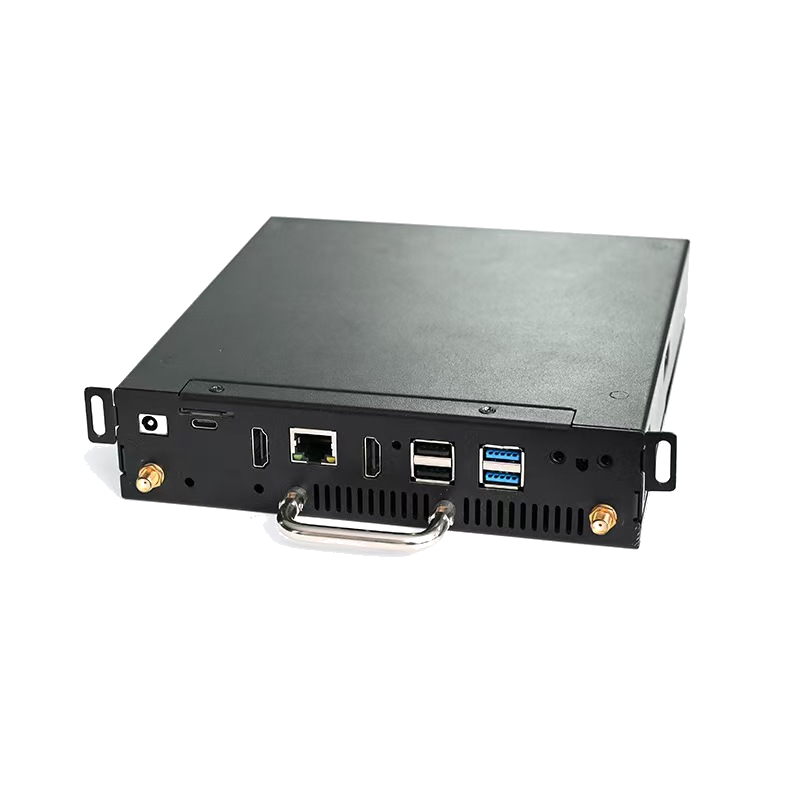
The AOS-SOR358464H is a Rockchip RK3588 Android and Linux OPS module. It uses an octa-core CPU running up to 2.4 GHz with an integrated 6 TOPS NPU, ships with 4 GB LPDDR4 memory as standard and up to 16 GB as an option, and uses eMMC storage. Operating system options are Android 13, Ubuntu or Debian. The module is described as having 8K multimedia capability that depends on firmware and interface configuration. Its material list covers a sheet-metal enclosure, PCB assembly and aluminum heat sink; buyers should confirm the cooling configuration against their intended load profile.
The commercially relevant detail is the NPU. A 6 TOPS on-module accelerator changes what a display endpoint can do locally — that is why the listed application environments include edge-AI display terminals alongside digital signage, interactive displays, smart retail and information kiosks. Where a signage or kiosk project needs scheduled media decoding plus local inference rather than a Windows application estate, this is the architecture that fits without adding a separate box.
What to confirm for signage deployments
Digital signage and information display projects are described as indoor commercial environments with scheduled or continuous media playback and remote content updates, operating with local or network-based content management. The module decodes and displays scheduled video, images and information content. Before specifying, the application notes require confirmation of codec, resolution, content management software, storage, network and thermal requirements — five items that determine whether a chosen content platform will actually run on the selected firmware image.
Discrete-GPU OPS: Intel H610 with 12th and 13th Gen Core (AOS-SOH61I41SXG)
The AOS-SOH61I41SXG is a slot-in OPS PC on the Intel H610 platform, supporting selected 12th and 13th Gen Intel Core i3, i5 and i7 processors. Video outputs include HDMI, HDMI and DisplayPort, with up to 8K 60 Hz output subject to the selected CPU, GPU and display configuration. Optional discrete graphics are available by project, and memory, storage, video outputs, cooling and operating system are configurable.
This is the category for GPU-assisted workloads. It is specified for large-format commercial displays, LED meeting displays, video walls, visualization systems and multi-display projects. The application note for large-format visualization describes high-resolution graphics, optional multi-display output and extended operation in an indoor controlled environment, with the module installed in the display OPS slot and running continuously or on a defined schedule.
The associated special requirements are unusually specific and worth reading as a procurement checklist: confirm the GPU model, the power budget, heat dissipation, the output resolution and display compatibility. In this category the module and the display share a thermal and electrical envelope, so the configuration decision and the enclosure decision cannot be separated.
OPS-C Pluggable Module: Intel Alder Lake-U (AOS-SOHAUF41SC)
The AOS-SOHAUF41SC is an Intel Alder Lake-U OPS-C PC with CPU options that include the Intel Core i5-1235U and i5-1240P. Memory is configurable as SO-DIMM and storage as M.2 SSD; installation is through an OPS-C slot. Windows or Linux options depend on configuration. Wake-on-LAN, auto power-on and watchdog functions are available through BIOS configuration. Its listed environments are interactive whiteboards, education technology, corporate meeting displays and commercial display systems, with project-based OEM and ODM support.
The engineering emphasis here is serviceability and unattended operation. A removable module with a standard slot reduces on-site maintenance to a swap, while auto power-on and watchdog functions address the practical failure mode of a display that must return to service after an unplanned power event. For education and meeting-room fleets, those BIOS-level behaviors often matter more than a marginal processor difference.
Mapping Module Type to Project Environment
The fastest route from a project brief to a module type runs through four questions: what environment will the display operate in, which software must run, does the workload need GPU or NPU acceleration, and what does the slot standard allow. The application notes for these categories answer the first question directly.
Education technology and interactive whiteboards
Classroom deployments are described as indoor environments with daily touch interaction and networked teaching applications, running teaching software, touch applications, media playback and video conferencing. Operation is through an OPS-C slot, either locally or over the customer's network, with supporting equipment that includes an interactive flat panel, touch module, camera, microphone, speakers and LAN or Wi-Fi. The OPS-C pluggable module is the product listed against this scenario, and the domestic-platform OPS-C module is also listed for education environments. Before mass production, the documented requirement is to verify mechanical size, connector pinout, display resolution, cooling and the operating system image.
Corporate meeting and collaboration
Meeting-room deployments use multi-user touch and video conferencing in an indoor room, with scheduled and on-demand use. The module supplies the computing platform for conferencing, document sharing, whiteboarding and presentation, and operates in slot-in installation with local operation, network access and optional auto power-on. Supporting equipment includes an interactive display, camera, microphone array, speakers, touch controller and network. The confirmation list is camera, microphone, touch, display output, operating system and conferencing software compatibility. The domestic-platform OPS-C module is listed against this scenario, and the OPS-C pluggable module is also specified for corporate meeting displays.
Digital signage and smart retail
Signage projects run in indoor commercial environments with scheduled or continuous media playback and remote content updates. The Android AI module is listed for this scenario, decoding scheduled video, images and information content through local or network-based content management. The binding checks are codec support, resolution, content management software, storage, network and thermal behavior.
Large-format visualization, video walls and LED meeting displays
Visualization projects combine high-resolution graphics with optional multi-display output and extended operation in a controlled indoor environment. The discrete-GPU module is listed for LED meeting displays, video walls and visualization systems, where the module provides high-resolution content playback and optional GPU-assisted workloads. The confirmation list here is GPU model, power budget, heat dissipation, output resolution and display compatibility.
Market Trend: Modular Compute Is Becoming a Standard Line Item
Two market datasets frame why platform choice now deserves a framework rather than a default. The global interactive flat panel market was valued at approximately USD 12.6 billion in 2024, and the global industrial PC market — which includes industrial-grade OPS modules — was estimated at USD 6.48 billion in 2024 and is projected to grow at a CAGR of 6.30 percent through 2032, according to Grand View Research. It is worth noting that estimates for the industrial PC category vary by scope: Precedence Research places the 2024 figure at USD 5.36 billion, largely reflecting differences in how embedded and standalone systems are counted.
The architecture mix is shifting as well. Integrated OPS-slot compute modules and Android-based SoC modules are estimated to ship in 15 to 25 percent of new interactive flat-panel displays, which means a majority of panels still ship without integrated modular compute — but the modular share is now large enough that module availability affects display selection rather than the other way around. One AV supplier industry guide projects the global interactive whiteboard market to reach USD 730 million by 2030, with OPS penetration described as a key growth driver for modular classrooms; that figure comes from a medium-reliability source and is best treated as directional rather than as a planning baseline.
What this means for buyers is straightforward. When a meaningful share of displays in a fleet can accept a slot-in module, the module becomes a fleet-level standard rather than a per-project purchase. That shifts evaluation criteria toward slot format consistency, operating system image management and the supplier's ability to hold a configuration over time.
OPS Modules vs Traditional External PC and Media Player Setups
Most projects compare the slot-in approach against a conventional external desktop PC or a standalone media player. External PCs retain advantages: unrestricted component choice, easy bench servicing and no dependency on a display slot standard. They also add a second enclosure, cabling, a separate power supply, a mounting point outside the display and a second support path. A slot-in OPS module removes that layer and keeps the compute inside the display's own service envelope — which is why the format is broadly adopted in education, meeting and signage environments.
The trade-offs are real and should be stated before a specification is fixed.
- Slot standards are not interchangeable. Intel OPS and OPS-C are mechanically different families, with the OPS-C variant typically described at around 180.8 mm x 195.2 mm x 42.5 mm against the Intel OPS footprint of 180 mm x 119 mm x 30 mm. Confirming dimensions, connector pinout and mounting hardware with the display supplier is the single most effective step against integration failure.
- Operating system scope is fixed by architecture. The RK3588 module is offered with Android 13, Ubuntu or Debian. Software written for a Windows x86 environment is not part of that stack, so an Android AI module is not a drop-in replacement for an Intel-based module in an application-led project.
- Thermal and power budgets are constrained by the display. Discrete graphics configurations in particular require confirmation of GPU model, power budget, heat dissipation and output resolution before the module is locked in.
- Customized configurations require schedule planning. AIOSTAR lists a 60-day lead time and a monthly capacity of more than 5,000 units, with customized project minimum order quantities depending on configuration. Non-standard platforms, I/O layouts or operating system images move the decision earlier in the project timeline than a standard order would.
- Validation work precedes mass production. Mechanical size, connector pinout, display resolution, cooling and the operating system image must be verified before a project scales, and GPU-assisted and conferencing scenarios carry their own additional confirmation lists.
None of these limits argues against modular compute. They argue for treating module selection as an engineering constraint problem with a defined validation sequence, rather than as a last-step accessory choice made after the display has already been ordered.
Future Outlook
Three directions look most relevant to buyers planning display fleets beyond the current procurement cycle.
First, platform diversity inside the OPS format is now permanent rather than transitional. An evaluation framework that covers x86 Intel platforms, domestic CPU platforms and ARM SoC platforms with integrated acceleration is more durable than a single-vendor assumption, because it matches how modules are actually being specified across education, government, signage and visualization programs.
Second, acceleration is migrating into the display endpoint. A 6 TOPS NPU on a slot-in module moves inference workloads that previously required a companion box into the display itself. For signage and kiosk projects this reduces the number of devices to power, network and support, but it also means the module's thermal envelope and firmware image become part of the application design.
Third, configuration management is becoming a procurement discipline. Memory, storage, I/O, cooling, BIOS functions and operating system images are all configurable across these categories, and the sample policy — one unit for evaluation samples, with customized project quantities depending on configuration — makes it practical to validate a configuration before committing to a fleet order. Buyers who treat the sample stage as a documented integration test, rather than a formality, are better positioned when the same module must be re-ordered two years later.
FAQ
What is the difference between OPS and OPS-C module formats?
Intel's Open Pluggable Specification standardizes the mechanical and electrical interface between displays and media players using a unified 80-pin JAE connector with a footprint of 180 mm x 119 mm x 30 mm. The OPS-C standard is a variant widely adopted in the Chinese domestic market for educational interactive whiteboards, typically described at dimensions of around 180.8 mm x 195.2 mm x 42.5 mm. Because the two families differ in dimensions and mounting details, the slot specification of the target display should be confirmed before a module is ordered.
Which OPS PC category is specified for interactive whiteboards and classroom deployments?
Classroom and interactive whiteboard projects are listed against the OPS-C pluggable computer module, model AOS-SOHAUF41SC, which is designed for OPS-C slot installation in interactive whiteboards, education technology, corporate meeting displays and commercial display systems. The domestic-platform OPS-C module, model AOS-SOZK6A341SXGE, is also listed for education environments. The documented application requirement for education projects is to verify mechanical size, connector pinout, display resolution, cooling and the operating system image before mass production.
Can an Android AI OPS module run the same software as an Intel-based OPS PC?
Not by default. The Android AI OPS module, model AOS-SOR358464H, is offered with Android 13, Ubuntu or Debian. Intel-based modules such as the AOS-SOHAUF41SC and AOS-SOH61I41SXG are offered with Windows or Linux options depending on configuration. Applications built for a Windows x86 environment are therefore outside the Android module's operating system stack, so software availability should be confirmed before a platform is selected. On the Android module, 8K multimedia capability also depends on firmware and interface configuration.
When does a project need discrete graphics or an on-module NPU?
Discrete graphics are relevant for large-format commercial displays, LED meeting displays, video walls, visualization systems and multi-display projects, where the module provides high-resolution content playback and optional GPU-assisted workloads; optional discrete graphics are available by project on the AOS-SOH61I41SXG. An integrated NPU is relevant where inference runs locally on the display endpoint — the RK3588-based AOS-SOR358464H includes a 6 TOPS NPU and is listed for edge-AI display terminals. In GPU configurations, the GPU model, power budget, heat dissipation, output resolution and display compatibility should be confirmed first.
How configurable are memory, storage and I/O across these OPS PC categories?
Configuration scope differs by architecture. The Android AI OPS module ships with 4 GB LPDDR4 memory as standard and up to 16 GB as an option, with eMMC storage. The OPS-C pluggable module uses configurable SO-DIMM memory and M.2 SSD storage. The domestic-platform OPS-C module provides six USB ports, two of which are USB 3.0, with optional GT730, GT1030, GTX 1050 or GTX 1050 Ti graphics depending on configuration. Across the range, AIOSTAR lists customization of CPU platform, memory, storage, I/O, chassis size, cooling solution, BIOS functions, operating system image, logo, packaging, power adapter and cables under OEM and ODM services.
What should be verified before an OPS PC configuration moves into mass production?
The verification list depends on the application. Education projects require confirmation of mechanical size, connector pinout, display resolution, cooling and operating system image. Meeting-room projects require confirmation of camera, microphone, touch, display output, operating system and conferencing software compatibility. Digital signage projects require confirmation of codec, resolution, content management software, storage, network and thermal requirements. Visualization projects require confirmation of GPU model, power budget, heat dissipation, output resolution and display compatibility. On the supply side, AIOSTAR lists one unit as the minimum order quantity for evaluation samples, with customized project minimums depending on configuration, a 60-day lead time and a monthly capacity of more than 5,000 units. Quality control covers incoming material inspection, functional and interface testing of finished units, burn-in testing when specified, and temperature, humidity, vibration and drop testing that can be arranged to project requirements. A one-year warranty applies unless otherwise agreed in the quotation or proforma invoice.
Reference document: Aiostar Introduction 2026 (PDF). Product information: aiostar.com.