
OYD3120 vs OYD3626: Comparing Two Chenille Sofa Fabrics
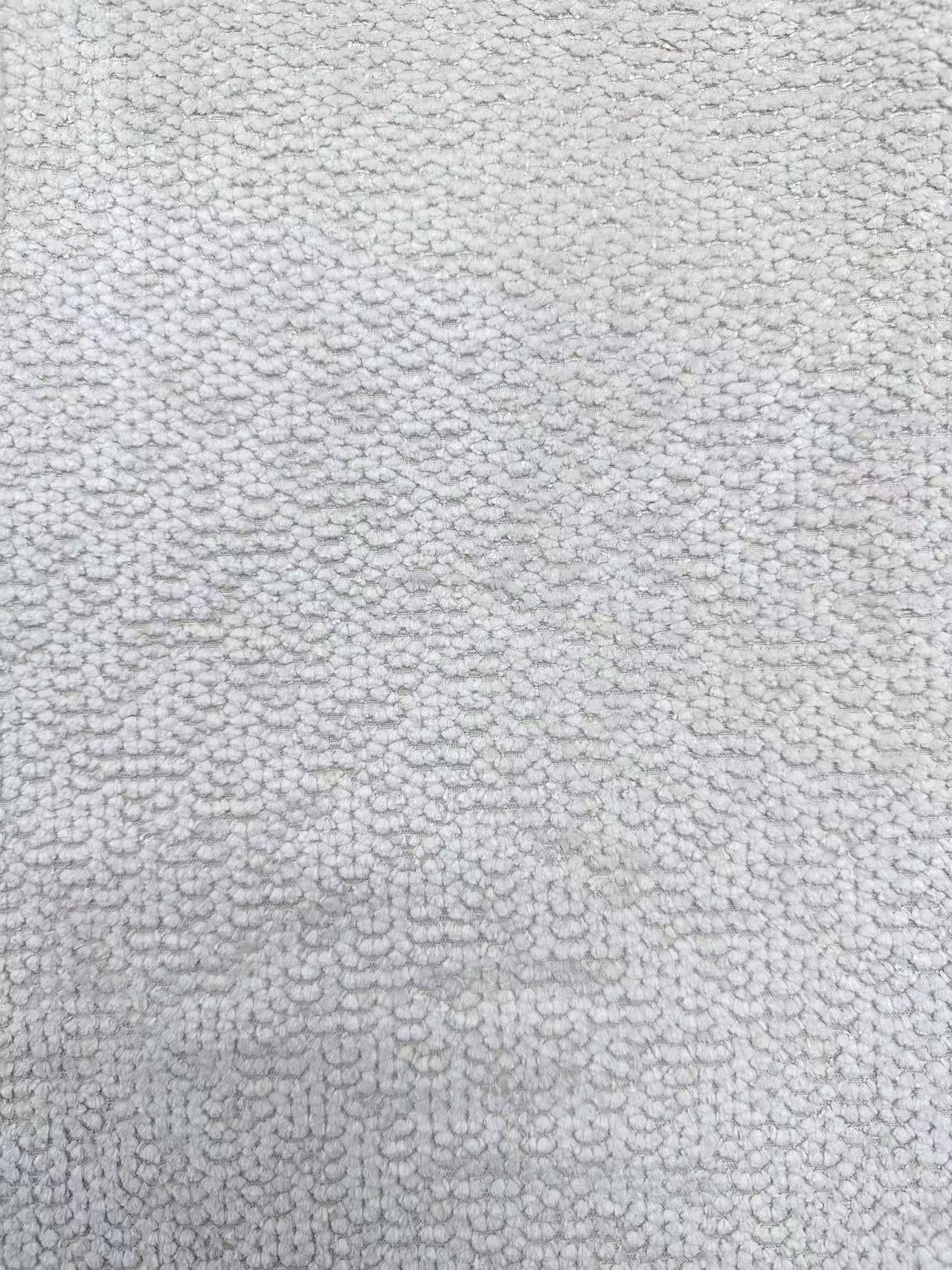
OYD3626, a chenille plain woven fabric listed for modern-style large sofas and soft beds. Image source: OYD Textile.
Chenille is a construction, not a specification. That distinction becomes concrete the moment a sourcing team has to choose between two articles from the same mill that look almost identical in a swatch book but sit in different positions on a specification sheet.
OYD3120 and OYD3626 are both 100% polyester chenille-type upholstery fabrics produced by OYD Textile (Haining OuYuda Textile Co., Ltd.), a sofa and upholstery fabric manufacturer based in Haining, Zhejiang, China, whose range covers chenille, woven, linen, velvet, circular knit and jacquard upholstery fabrics. Both articles are listed at 142±2 cm width. Both are described as pet-friendly, water-repellent, stain-resistant and easy to clean. Both carry GRS (Global Recycled Standard) and OEKO-TEX certification, and both list fire-retardant performance as a feature. What separates them is measurable: fabric weight, construction type, colour range, and the applications their product data assigns to each.
This comparison is written for buyers in the research and evaluation stage — the point at which a shortlist exists but a purchase specification has not yet been fixed. It uses the facts published in the two product records. Where a question cannot be answered from that material, it says so rather than filling the gap.
Why “Chenille” Alone Is Not a Buying Specification
Procurement documents cannot be built around a category word. A specification line has to carry fields that can be measured, tested or documented: weight per square metre with a stated tolerance, usable width, fibre composition, colour count, the scope of each certification, and the finishes applied. Chenille answers a hand-feel question. It does not answer a compliance question, and it does not tell a production planner how the fabric will behave at cutting and draping.
That is why two chenille articles from the same mill can end up on different sides of the same decision. Once the visual and tactile tests are passed, the choice usually narrows to four constraints: weight, construction, certification coverage, and the size of the colour programme. OYD3120 and OYD3626 separate on all four.
The Verified Specification Baseline
Set side by side, the two records share most of their compliance and care-related claims. The differences sit in the structural fields.
| Specification field | OYD3120 | OYD3626 |
|---|---|---|
| Article number | OYD3120 | OYD3626 |
| Fabric type | Chenille fabric | Woven fabric (chenille plain) |
| Composition | 100% Polyester | 100% Polyester |
| Weight | 420±10 GSM | 350±10 GSM |
| Width | 142±2 cm | 142±2 cm |
| Colour range | 26 colourways | 27 colours |
| Certification | GRS; OEKO-TEX | GRS; OEKO-TEX |
| Functional features | Pet-friendly; water-repellent; stain-resistant; easy to clean; fire-retardant performance | Pet-friendly; water-repellent; stain-resistant; easy to clean; fire-retardant performance |
| Stated application | Modern-design large sofas and upholstered soft beds; high-end furniture upholstery | Modern-style large sofas and soft beds |
| Applicable industries | Furniture manufacturing; fabric wholesale; interior design; home decor; hotel projects | Same list as OYD3120 |
| Manufacturer | OYD Textile | OYD Textile |
Two observations follow directly from the table. First, the compliance story is identical: both articles hold GRS and OEKO-TEX certification, so neither can be preferred over the other on certification alone. Second, the two weight ranges do not touch — 420±10 GSM and 350±10 GSM are separate weight classes with no overlap. A buyer can therefore treat them as different materials rather than as close variants of a single article.
What the 70 GSM Weight Difference Changes
Weight per square metre is the most portable way to describe upholstery fabric substance, and it is one of the first fields a furniture factory checks against a pattern layout. At 420±10 GSM, OYD3120 sits in the heavier part of the chenille band. OYD3626 is listed at 350±10 GSM, in the mid-weight band.
In practice, the difference shows up in three places. Body and coverage: a heavier fabric generally fills a cushion or sofa back with more substance, which is why higher weights are commonly associated with large sofas and upholstered beds. Drape: the product record for OYD3120 specifically notes soft tactile texture and great draping performance for high-end furniture upholstery — relevant where the design leaves fabric uncovered across a large panel. Colour depth: OYD3120 is described as a yarn-dyed chenille, a route in which colour is applied to the yarn before weaving and which is normally chosen when a designer wants depth and pattern definition rather than a flat surface.
OYD3626 is described as a chenille plain fabric with a timeless classic design. A plain construction is not a lesser construction; it is a different design decision. It produces a quieter surface, which is often preferred when the sofa shape itself carries the design and when a single house colour has to run consistently across many pieces in one project.
It is worth noting that the marketing bullet lists attached to both records are effectively the same — ultra-soft handfeel, high weight, pet-friendly, water-repellent, stain-resistant, easy to clean, fire-retardant performance. That is a useful signal in itself. The differentiators between OYD3120 and OYD3626 are not in the feature bullets; they are in the specification lines.
Certification and Compliance: What GRS and OEKO-TEX Do and Do Not Cover
Both certifications appear on both records, and they answer two different questions.
GRS — the Global Recycled Standard — addresses recycled content. It verifies recycled material claims along a certified chain of custody, and it is the certification buyers point to when a tender, a retail customer or a brand owner requires documented recycled content.
OEKO-TEX addresses product safety. It is the certification textile buyers reference when the requirement is that the material has been tested against harmful substances.
Neither certification is a fire-performance certification. Fire-retardant performance is listed as a product feature on both OYD3120 and OYD3626, but the available product data does not name the underlying test standard or classification level. A buyer specifying against a defined fire-safety regime should therefore request the test documentation that applies to the exact article and colourway, rather than relying on the feature line alone.
Quality inspection before shipment. Model-level documentation, not factory-level certificates, is what a buyer can verify against a specific article. Image source: OYD Textile.
For a buyer in the evaluation stage, this distinction changes the request list. The correct ask is not “send your certificates”, but “confirm which models and which colourways each document covers.”
Application Fit: Large Sofas, Soft Beds and Hotel Projects
The application fields in the two records overlap almost completely. OYD3120 is described as suited to modern-design large sofas and upholstered soft beds. OYD3626 is described as suitable for modern-style large sofas and soft beds. Both records list furniture manufacturing, fabric wholesale, interior design, home decor and hotel projects among applicable industries.
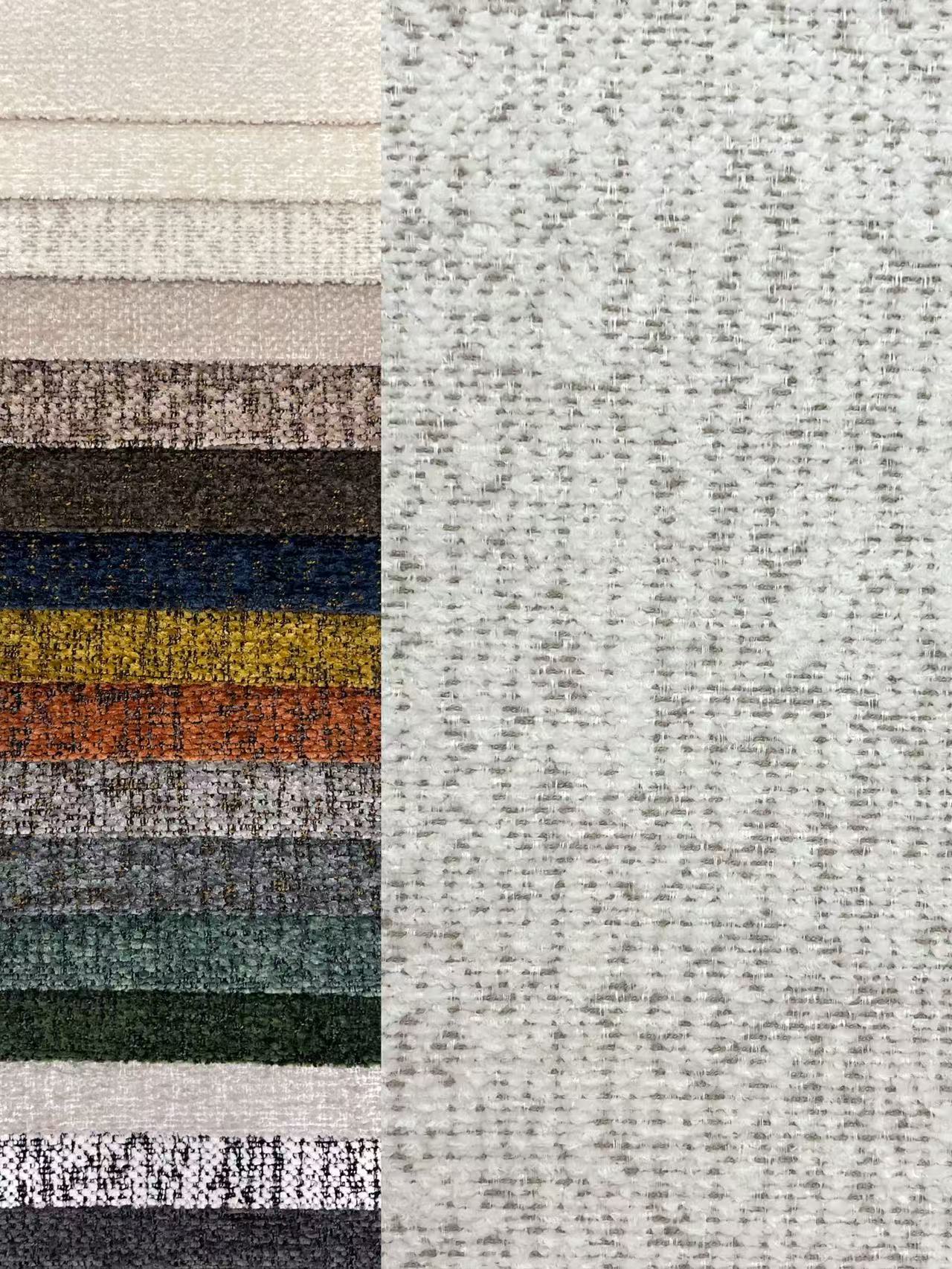
OYD3120, a yarn-dyed chenille listed in 26 colourways for modern-design large sofas and upholstered soft beds. Image source: OYD Textile.
Because the industry labels are the same, application fit has to be decided on physical terms rather than on category terms. A practical reading for a sourcing team:
- Large sofa or bed with visible drape, where the design depends on colour depth — start sampling with the heavier, yarn-dyed article, OYD3120 at 420±10 GSM.
- Plain-surface design, repeated across many pieces in one scheme — the mid-weight plain chenille, OYD3626 at 350±10 GSM, matches the brief, and its 27-colour programme supports scheme variation without changing the article.
- Hotel or contract programme — the sequence is different. Start from the project’s written fire-safety and documentation requirements, confirm which models and colourways are covered, then match weight and colour.
Colour Range as a Procurement Variable: 26 vs 27
On paper, 26 colourways for OYD3120 and 27 colours for OYD3626 is a rounding difference. Operationally, a colour count is not a marketing number — it is a workload multiplier.
Every colourway used in a project adds a sample approval, a dye-lot reference, a stock line and a repeat-order risk. A 26- or 27-colour programme is wide for a single upholstery article, and for interior designers and wholesalers a wide programme is usually the reason one article can serve several schemes. For a contract buyer, though, the relevant question is narrower: how many of those shades can be repeated reliably across the production window of the project.
Colour count should therefore be treated as the entry point to a colour-approval process, not as the answer to it. Whichever article is chosen, the shades actually used should be confirmed against physical samples rather than against a printed colour card.
Comparison With Conventional Chenille Sourcing — and the Limits of the Evidence
Against conventional chenille sourcing, these two articles sit at the documented end of the market rather than the commodity end. The usual alternative is a chenille bought on appearance and price alone, where the buyer relies on an unverified recycled-content claim, an umbrella factory certificate, or a verbal assurance about fire performance. OYD3120 and OYD3626 both come with named certifications — GRS and OEKO-TEX — plus declared weight, width, composition and colour ranges. That published detail is what makes this comparison possible in the first place.
The advantage has a boundary, and it is worth stating plainly. Based on the available product data:
- No abrasion-cycle figure — for example a Martindale rub count — is published for either article, so a durability comparison between them cannot be made from the records.
- The fire-retardant claim is stated without a named standard or classification, so it cannot be matched against a specific national fire-safety regime from the data alone.
- Both articles carry the same certification set, so certification is not a differentiator between OYD3120 and OYD3626 — it is a shared baseline.
- The TÜV Rheinland Textile Test Report, report number 180339570a 001, is documented for OYD3235, not for these two models.
- Price, MOQ and lead time are not published per model. In the available documentation, order terms depend on whether a colourway is a stock item or requires custom production, and they are confirmed per order.
None of these gaps makes either fabric unsuitable. They define what a buyer still has to verify directly, which is the normal condition of sourcing in this category.
Market Signals: Performance Fabric, Certification and Fire Safety
Three published data points frame why these specification fields have moved to the centre of upholstery sourcing.
The global sofa market was estimated at $244.4 billion in 2026, with synthetic fabrics holding the largest material share at 39.8% (Grand View Research, Sofa Market Size, Share & Trends Report, 2026–2033). Within that market, the furniture performance fabric segment — the stain-resistant, high-durability part of the category — was valued at $4.8 billion in 2025, with polyester holding a 38.4% material share (Dataintelo, 2026). Two 100% polyester articles with water-repellent, stain-resistant and easy-clean finishes are therefore mainstream products rather than niche ones. Easy-clean performance is closer to a baseline expectation than a premium differentiator.
Regulation is moving in a similar direction. The UK Furniture and Furnishings (Fire) (Safety) (Amendment) Regulations 2025 came into force in October 2025, removing the display label requirement and shifting emphasis to permanent labels (UK Government, Department for Business and Trade; 1988 No. 1324, as amended). For upholstery suppliers and their customers, that change moves fire-safety proof away from a swing tag a buyer can inspect in a showroom and towards documentation retained with the product. It raises the value of a model-level test document and lowers the value of a general certificate.
Supply-side context matters too. China’s exports of textile yarns and fabrics reached $130.01 billion from January to November 2025, a 0.9% year-on-year increase (China Customs, reported by Threadify Analytics). Flat-to-modest growth at that scale suggests a fabric market competing on specification, colour programme and documentation rather than on volume growth alone.
Sources: Grand View Research (2026); Dataintelo (2026); UK Government / Department for Business and Trade; China Customs via Threadify Analytics (2025).
Future Outlook
Three developments are likely to shape how articles like OYD3120 and OYD3626 are evaluated over the next procurement cycles.
Documentation will be requested per model. As fire-safety regimes move towards permanent marking and retained records, buyers will increasingly ask which article and which colourway a test document covers. Suppliers who can answer that at quotation stage spend less time in clarification, and buyers who ask it early avoid a late-stage compliance problem.
Recycled content will continue moving from claim to requirement. With polyester holding the largest material share of a $244.4 billion sofa market, GRS certification on a polyester chenille article is a commercially relevant credential rather than a sustainability footnote — particularly for buyers supplying European retail and contract customers.
Weight and construction will remain the honest differentiators. Once two articles share a certification set, a finish package and a comparable colour range, the remaining specification fields — GSM, construction and drape — carry the decision. Buyers who build shortlists around those fields will make faster and more defensible choices than buyers who build them around certification logos.
Frequently Asked Questions
Are OYD3120 and OYD3626 the same fabric at different weights?
They are separate articles. Both are 100% polyester chenille-type upholstery fabrics from OYD Textile with a width of 142±2 cm, but OYD3120 is listed at 420±10 GSM as a chenille fabric with a yarn-dyed construction and 26 colourways, while OYD3626 is listed at 350±10 GSM as a chenille plain woven fabric with 27 colours. The 420±10 GSM and 350±10 GSM ranges do not overlap, so they behave as separate weight classes rather than as close variants of one article.
Do both models carry the same certifications?
Yes. OYD3120 holds GRS (Global Recycled Standard) and OEKO-TEX certification, and OYD3626 holds the same two certifications. Because the certification set is identical, certification cannot be used as the deciding factor between the two articles. Weight, construction, colour programme and application fit carry that decision.
Is the TÜV Rheinland test report valid for OYD3120 or OYD3626?
No. The TÜV Rheinland Textile Test Report, report number 180339570a 001, issued by TÜV Rheinland and applicable to furniture and upholstery textile fabrics for the EU and USA markets, is documented for OYD3235 — a different article in the same sofa fabric range. Buyers who require third-party test documentation for OYD3120 or OYD3626 should confirm the covered model before ordering.
What does “fire-retardant performance” mean on these product records?
Fire-retardant performance is listed as a product feature on both OYD3120 and OYD3626. The available product data does not name the test standard or the classification level behind that statement, so it is best treated as a material-level performance claim rather than as proof of compliance with a specific national fire-safety regime. Buyers with a defined fire requirement should request the test documentation that applies to the exact model and colourway.
Which of the two is specified for hotel projects?
Both product records list hotel projects among the applicable industries, alongside furniture manufacturing, fabric wholesale, interior design and home decor. The differentiator for a hotel or contract programme is therefore not the industry label but the physical specification and the documentation the project requires — primarily weight and drape, the colour programme, and model-level fire and safety test coverage.
What determines MOQ and lead time for each model?
Neither article carries a single fixed MOQ or lead time. In the available product documentation, order terms depend on whether the selected colourway is a stock item or requires custom production, and they are confirmed per order. Buyers comparing the two should therefore request terms against a specific colourway rather than against the model number alone.
The full product documentation for OYD Textile’s upholstery range is available for download in the OYD Textile catalogue (PDF). Model-level specifications such as those compared above are best confirmed against physical samples before a purchase specification is fixed.