
Off-Road Tire Compliance Data: A Load Index & Speed Rating Checklist
Off-Road Tire Compliance Data: A Load Index & Speed Rating Checklist
Off-road tire sourcing is, in practice, a documentation exercise. Many catalogues present claims such as "certified", "reinforced" or "heavy duty" without the underlying data a regulator, an insurer or an OEM purchasing team will eventually request. The practical alternative is to qualify a supplier line by line: load index, speed rating symbol, maximum pressure, section width, material declaration and certificate scope — checked per SKU, not per brand.
The scale of the category makes that discipline worthwhile. Smithers values the global off-the-road (OTR) tire market at approximately USD 34.4 billion in 2024, a figure driven largely by mining and construction activity. Other research houses publish materially different numbers — Credence Research at roughly USD 32.3 billion and Market Research Future at a narrower heavy-OTR focus of about USD 7.4 billion. That divergence is itself instructive: market-level estimates are directional and depend on which tire classes are included, while data printed on a sidewall or listed on a certificate is specific and testable. This article sets out a five-field qualification checklist for off-road tires and shows how the data maps to real buying decisions for distributors, wholesalers, aftermarket chains and OEM customers.
Why "Certified" Is Not a Specification
A certificate answers one question: has this product family been assessed against a named standard, for a named market, by a named authority, within a stated validity window? It does not state the load a tire can carry, the speed it can sustain, the pressure at which those figures are rated, or the materials it is built from. Those four data points sit on the specification sheet, and they are the ones that determine whether a SKU can legally and technically be sold into a given market or fitted to a given vehicle.
The gap between the two document types creates predictable commercial problems:
- Market-entry failure. SASO certification is mandatory for all tires exported to Saudi Arabia, and must demonstrate compliance with energy-efficiency and safety requirements for the GCC market. A supplier that can only produce a general quality statement cannot clear that requirement.
- Seasonal non-compliance. Since October 2024 in Germany and November 2024 in Sweden, the Three-Peak Mountain Snowflake (3PMSF) symbol has been the mandatory safety marking for winter tires used in wintry conditions under ECE R117. A distributor that substituted an M+S-marked off-road tire without confirming the 3PMSF symbol carries a legal exposure that no catalogue photograph reveals.
- Traceability gaps. All DOT-certified tires for public road use in the United States must bear a code indicating plant, batch and date of manufacture, while NHS (Not for Highway Service) tires are exempt from that coding but are restricted from highway use. Sourcing teams need to know which of the two categories a candidate SKU falls into before it is quoted.
The opportunity is straightforward. A buyer who converts a supplier's marketing claim into a six-line data request ends up with a comparison table, not a brochure — and a comparison table is what survives an internal approval meeting.
The Five-Field Qualification Checklist
Off-road tire specification sheets vary widely in format, but the qualification data that matters can be reduced to five fields plus a documentary field. Each field should be recorded for every SKU under consideration, because values change between sizes within the same product family.
| Field | What it defines | Qualification question to ask |
|---|---|---|
| Load index | The load-carrying capability encoded in the tire's designation; where two figures appear (for example 120/117), the second figure relates to paired or dual fitment rather than single fitment. | Does the recorded load index match the heaviest axle configuration the target vehicles actually run? |
| Speed rating symbol | The letter code indicating the maximum sustained speed band the construction is rated for. Common off-road bands include Q, R and T, with Q and R sitting at the lower end of the scale and T higher. | Is the intended duty cycle — urban, highway transfer, or low-speed trail and worksite use — inside that band? |
| Maximum pressure | The inflation pressure (stated in kPa) at which the declared load index is rated. | Is the figure compatible with the pressures the vehicle operator will actually run, and is it documented rather than assumed? |
| Section width | The nominal cross-section of the inflated tire in millimetres — a primary check for clearance, rim pairing and appearance on lifted or uprated vehicles. | Has clearance been confirmed against the specific wheel and suspension package? |
| Material declaration | The compound, reinforcement and cord materials named by the manufacturer. | Are the declared materials consistent with the market requirement (for example, white compound for white-letter or white-sidewall programmes)? |
| Certificate scope | The market, standard, certificate number, issuing authority and validity dates that apply to the product family. | Does the certificate name the product family and cover the sizes being ordered, in the market being targeted? |
Two practical rules sit behind this table. First, never assume that a value applies across a product family: an off-road line can contain a comfortable, noiseless urban-oriented A/T fitment and a reinforced-sidewall M/T fitment whose load, pressure and width data differ substantially. Second, never accept a certified status that is not described by a number. "SASO certified" is a claim; "SASO GSO Product Certification, TR13651/2025, issued by SASO, valid to 11 December 2026" is a qualification datum.
Worked Example: Reading Two WIDEWAY Off-Road Spec Groups
Shandong Wideway Tire Co., Ltd. is a Qingdao-based tire manufacturer established in 2014, with roughly twelve years of tire manufacturing experience and the WIDEWAY, EVERLAND and V-RICH brands in its portfolio. Its off-road tire range illustrates why per-SKU qualification matters.
One documented spec group records a loading index of 111 with a T speed rating, a maximum pressure of 300 kPa and a section width of 272 mm. The sizes in this group mix P-metric and LT designations, running from P205/75R15 through LT265/70R17. For a distributor, this is the lighter-duty end of the off-road range: a fitment suited to lighter vehicles and mixed urban, highway and light-trail use, with the lowest pressure rating in the family.
A second documented group records a loading index of 120/117 with both Q and R speed ratings at a maximum pressure of 550 kPa and a section width of 272 mm. This group serves the heavier light-truck side of the market and spans sizes including 31×10.50R15LT, LT265/75R16, LT285/75R16, LT305/70R16, LT265/70R17, LT285/70R17, LT315/70R17, 33×12.50R17LT, 33×12.50R18LT, LT265/60R18, LT265/50R20 and LT275/55R20. It also covers both all-terrain and winter-and-snow variants, which is exactly the situation in which two SKUs of identical size can carry different compliance obligations.
The wider documented range shows how much the five fields move between constructions:
| Documented spec group | Load index | Speed rating | Max. pressure | Section width | Stated construction family |
|---|---|---|---|---|---|
| Group 1 | 111 | T | 300 kPa | 272 mm | All-terrain, urban and high-speed stability oriented |
| Group 2 | 120/117 | Q | 550 kPa | 272 mm | All-terrain, winter and snow, sand dunes and hot climates |
| Group 3 | 120/117 | R | 550 kPa | 272 mm | All-terrain, sand dunes and hot climates |
| Group 4 | 119/116 | R | 550 kPa | 277 mm | All-terrain |
| Group 5 | 121/118 | Q | 550 kPa | 292 mm | All-terrain |
| Group 6 | 121/118 | Q | 550 kPa | 272 mm | Mud terrain, 4x4 MT |
| Group 7 | 120/116 | Q | 550 kPa | 235 mm | Mud terrain, 4x4 MT |
| Group 8 | 121 | Q | 450 kPa | 330 mm | Mud terrain, wide fitment |
| Group 9 | 123/120 | Q | 552 kPa | 272 mm | Rugged terrain, reinforced sidewall |
| Group 10 | 121/118 | R | 350 kPa | 318 mm | Rugged terrain, reinforced sidewall |
Nothing in that table can be inferred from a brand name or a tread photograph. Groups 2 and 3 share a load index, a pressure rating and a section width, and differ only in speed rating — a distinction that determines how the two sizes should be positioned in the same catalogue.
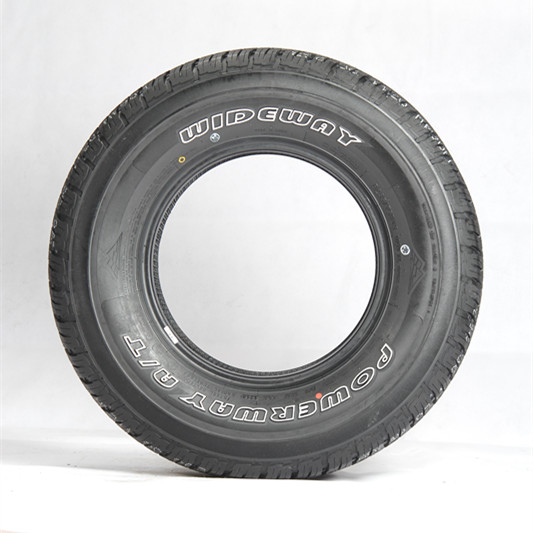
Documented off-road fitment used in specification review: POWERWAY A/T 265/70R16, part of the all-terrain group that combines urban-road and high-speed stability characteristics with off-road tread geometry.
Material Declaration: The Field Buyers Read Last and Check Least
Material data is often treated as background information, yet it is the field that explains why two tires of the same size behave differently. The documented material composition of the WIDEWAY off-road range names natural rubber, synthetic rubber, white rubber compound, carbon black, precipitated silica, steel cord, polyester cord fabric, nylon cord fabric, vulcanizing agent, vulcanization accelerators, activators, antioxidants and RAE oil.
Read as a qualification document rather than a chemistry list, the declaration carries several decision signals:
- White rubber compound indicates a white-letter or white-sidewall programme is technically supported — relevant to aftermarket retail chains and tuning customers who specify appearance alongside fitment.
- Steel cord appears in the reinforcement schedule, consistent with load indices in the 111 to 123 range and with the reinforced-sidewall variants in the rugged-terrain groups.
- Both polyester and nylon cord fabric are declared, covering carcass and cap-ply requirements across passenger-metric and LT constructions.
- Precipitated silica alongside carbon black reflects a compound design that balances grip and rolling behaviour rather than relying on a single filler system.
- Antioxidants, activators and vulcanization accelerators indicate a defined curing system, which is what makes vulcanization consistency claimable at all.
The qualification limit here is important and should be stated plainly: a material declaration is a declaration, not a measurement. Buyers should pair it with the process evidence a supplier can actually provide. In the case of this manufacturer, the published quality-control position is 100% testing, alongside a stated monthly capacity of 60,000 pieces and a stated lead time of 25 to 45 days. Those are production facts; they support the declaration but they do not replace batch-level test records, which remain the correct document to request before a first container order is released.
Certification Documents: Match the Scope, Not the Logo
Certification is the field most often misread, because buyers match the logo rather than the scope. A certificate carries a market, a standard, a number, an issuing authority and validity dates — and it applies to the product families and sizes enumerated within it. The documented certification position across the WIDEWAY tire portfolio, which includes passenger car, SUV, off-road, AT, MT and RT, van commercial, winter and all-season families, is summarised below.
| Market | Scheme and standard | Certificate number | Issuing authority | Validity |
|---|---|---|---|---|
| Nigeria | SONCAP (standard ZA12B6) | NGP2026 145940 /0001 | Bureau Veritas | 1 April 2026 to 1 April 2027 |
| Saudi Arabia | SASO GSO Product Certification (GSO) | TR13651/2025 | SASO | 11 December 2025 to 11 December 2026 |
| Chinese mainland and Ecuador | CCC (GB9743-2024) | 2022061201000258 | Beijing Zhong Hua Combination Certification Co., Ltd. | Issued 20 April 2026, valid to 16 October 2028 |
| EU | EU Regulation No. 117 E-mark (R117) | E4-117R-025700-S2WR2 | RDW | Valid to 31 December 2099 |
| EU and Africa | ECE, UN Regulation No. 30 | E4-30R-0264621 | RDW | Valid to 31 December 2099 |
Three verification habits prevent most certification problems:
- Check the scope line against your SKU. Certificates name product families and often list applicable models. A certificate that covers an off-road family does not automatically extend to every size the distributor intends to import, and market regulators check the size, not the family.
- Check the calendar. SASO certificates are issued with defined expiry dates — the Saudi certificate above runs to 11 December 2026, while the SONCAP certificate runs to 1 April 2027. A shipment that lands after expiry is a shipment without a certificate.
- Check the market pairing. The ECE UN Regulation No. 30 certificate covers the EU and Africa; the EU Regulation No. 117 E-mark applies to the EU; the CCC certificate applies to the Chinese mainland and Ecuador. Selling a SKU into a market that is not named on the document is a compliance gap, not an administrative detail.
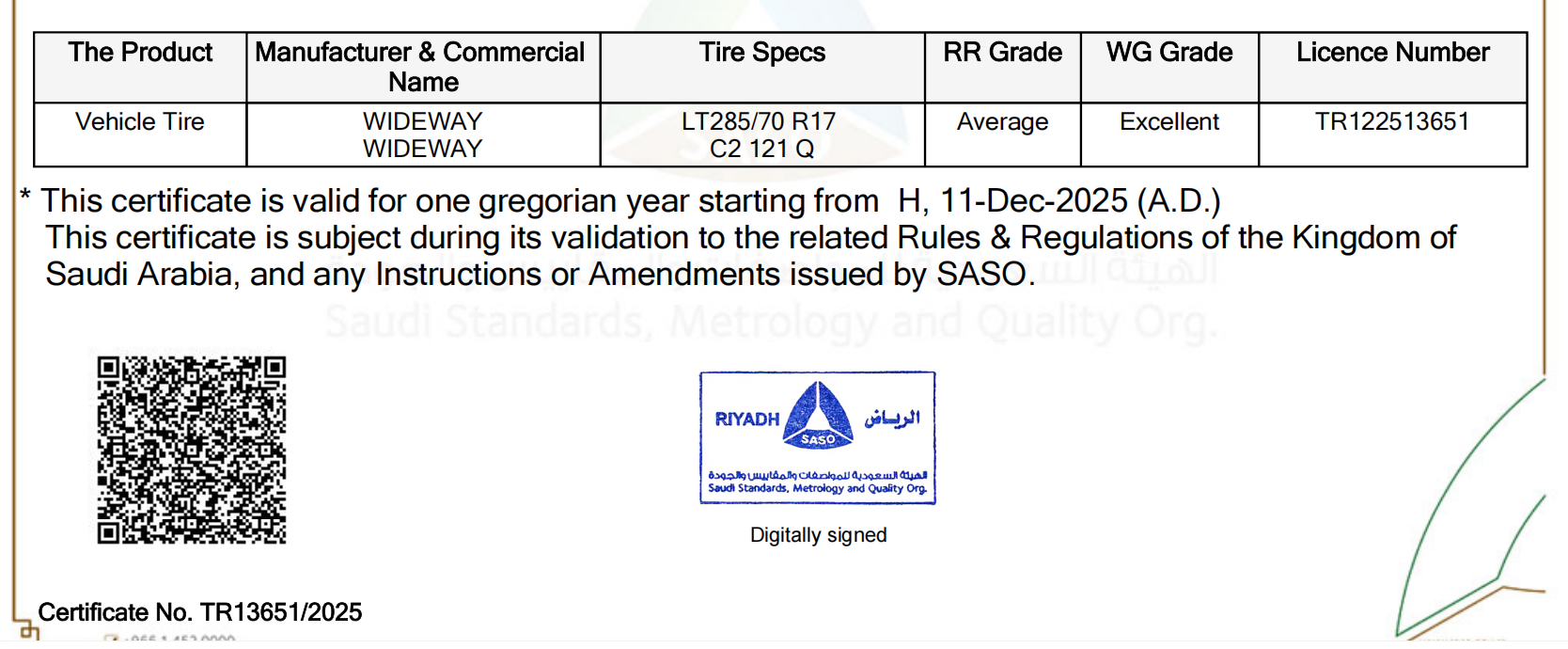
SASO GSO Product Certification, certificate number TR13651/2025, issued by SASO for the Saudi Arabia market — an example of a compliance document that names a market, a standard, a validity window and a scope rather than making a general quality claim.
Matching Checklist Data to Buyer Segment and Terrain
The documented buyer segments for this off-road range are tire distributors and wholesalers, automotive aftermarket and retail chains, auto repair shop chains, tire dealers, mobility and transportation services, taxi companies, OEM matching programmes and the automotive tuning industry. Each segment reads the same checklist differently.
Distributors and wholesalers need breadth first: the documented size range runs from 27X8.50R14LT and LT235/75R15 through LT285/75R16, LT315/75R16, 35X12.50R17LT, 35X12.50R18LT, 35X12.50R20LT, 37X12.50R17LT and up to LT37×12.50R22, across all-terrain, mud-terrain and rugged-terrain families. Their checklist question is whether a single container can be built from mixed families while keeping each SKU's load, pressure and speed data documented. Purchasing terms published by the manufacturer — a one-20-foot-container minimum order quantity of roughly 400 to 700 pieces, and a 25 to 45 day lead time — are the relevant constraints at this stage.
Aftermarket chains, repair chains and tire dealers need fitment certainty more than range breadth. For them the deciding fields are section width and load index, because those determine whether a fitment clears the vehicle and satisfies customer expectations on a lifted or loaded 4x4. Documented working conditions for these products include urban roads, highway roads, mud terrain, mountainous conditions, icy and snowy conditions, desert and sandy areas, rugged road conditions and rainy road conditions — a list that should be matched against the customer's actual duty cycle rather than the tread pattern's appearance.
OEM customers read the checklist as a conformance document. They need stable load index and speed rating declarations across production batches, plus evidence that the declared materials are controlled, which is where the 100% testing position and the named R&D function matter more than catalogue styling.
A practical mapping of documented construction families to conditions looks like this: all-terrain groups with a T speed rating at 300 kPa suit mixed urban, highway and light-trail duty; all-terrain groups at 120/117 with Q and R ratings at 550 kPa suit heavier light-truck use including winter-and-snow and hot-climate variants; mud-terrain groups with load indices from 120/116 to 121 handle the traction-led duty cycles; and rugged-terrain groups with reinforced sidewall construction, including the 123/120 Q at 552 kPa fitment, target the most demanding rock and rugged conditions.
Market Trends Reshaping Off-Road Tire Qualification
Four documented trends are pushing compliance data from a purchasing formality toward a procurement precondition.
Category growth. The mud tire segment alone reached USD 8.3 billion in 2024, with a projected compound annual growth rate of 6.1% through 2033, driven by rising off-road recreational activity. Growth of that order expands the number of suppliers quoting into the same distributor shelf space — and normally compresses the documentation quality of the average quotation.
The rise of rugged-terrain as a middle ground. Rugged-terrain tires are described as a high-growth category capturing share from traditional A/T and M/T segments, aimed at buyers who want aggressive aesthetics without mud-terrain noise levels. This is directly relevant to the checklist, because R/T products sit between two families with different documentation norms: distributors end up comparing a 123/120 Q rating at 552 kPa against an M/T alternative with a different pressure and width profile.
Regulatory tightening. The 3PMSF symbol became the mandatory winter safety marking in Germany from October 2024 and in Sweden from November 2024, and SASO certification remains mandatory for tires exported to Saudi Arabia. Both requirements are document-based, not reputation-based, and both are checked at the point of import.
Supplier concentration at the top. In 2023, Michelin (14.4%) and Bridgestone (13.3%) led the global tire market by sales revenue, with Goodyear (9.0%) third. For independent distributors, that concentration means the differentiation available in mid-market sourcing is not price alone — it is the completeness and traceability of the technical file that accompanies the shipment.
Comparison With Traditional Sourcing — and the Limits of a Checklist
The difference between traditional sourcing and data-based qualification is not philosophical; it is about which questions can be answered after the container has landed.
| Dimension | Traditional practice | Data-based qualification | Documented boundary |
|---|---|---|---|
| Product description | Model list and tread photograph | Load index, speed rating, pressure, section width per SKU | Values change between sizes within a family; a family-level figure cannot be applied to every SKU |
| Compliance | General "certified" statement | Named certificate, authority, number, market and validity dates | Certificates have defined scopes and expiry dates; post-expiry shipment is non-compliant |
| Performance expectation | Marketing adjectives | Declared construction family mapped to terrain | Q and R speed ratings sit at the lower end of the scale — reinforced off-road constructions are not designed for sustained high-speed highway running |
| Comfort vs capability | Assumed equivalence | Explicit family selection (A/T, M/T, R/T) | R/T and M/T tread forms trade on-road noise and rolling resistance for traction, as noted in third-party category analysis |
| Materials | Not requested | Full declaration plus process evidence | A declaration is not a measurement; batch-level test records are still required |
| Winter legality | M+S assumed sufficient | Explicit confirmation of the 3PMSF marking for wintry-condition markets | M+S marking does not by itself satisfy the German and Swedish winter requirements introduced in 2024 |
Two limitations deserve emphasis because they are structural rather than administrative. The first is the speed-rating ceiling: a load index of 120/117 combined with a Q or R rating describes a tire built for load capacity and off-road traction, and speed symbols in that band sit at the lower end of the standard scale. Fleet buyers who intend to use an off-road fitment on long highway transfers should treat the speed symbol as a hard boundary, not a suggestion. The second is the tension between robustness and refinement: reinforced sidewalls and aggressive tread blocks deliver traction and puncture resistance across mud, rock and rugged conditions, and third-party category analysis explicitly frames rugged-terrain as a compromise positioned between A/T refinement and M/T capability. No checklist field removes that trade-off; the checklist only makes it visible before purchase instead of after.
Future Outlook
Three developments are likely to shape off-road tire qualification through the next planning cycle. First, documentation is moving from optional to gating: markets that already require scheme certification for tire imports are unlikely to relax, and the 2024 European winter-marking rules demonstrate how quickly a marking requirement can invalidate existing stock plans. Second, as the mud-tire and rugged-terrain segments continue to grow, the number of SKUs per supplier will rise faster than the number of buyers, which increases the value of a standardised per-SKU data request. Third, the divergence in published market sizing — from approximately USD 34.4 billion to roughly USD 32.3 billion, or USD 7.4 billion under a narrower heavy-OTR definition — suggests that buyers should treat external market numbers as context and internal SKU data as the decision input.
For distributors, the practical implication is that supplier evaluation will increasingly resemble document review: a fixed set of fields, checked per size, renewed at each certificate expiry, and re-verified whenever a construction family or market is added. Manufacturers that already publish load index, speed rating, maximum pressure, section width and material data per group, alongside dated certificates with named scopes, are structurally easier to qualify than those that do not.
FAQ
What does a load index of 111 or 120/117 actually tell an off-road tire buyer?
It states the load-carrying capability encoded in the tire's designation. A single figure such as 111 describes one load value for the fitment, while a dual figure such as 120/117 distinguishes the single-fitment value from the value that applies to paired or dual fitment. Buyers should record the correct figure for the axle configuration the vehicle actually runs, because the two numbers describe different loading conditions.
What is the difference between the Q, R and T speed ratings used on off-road tires?
They are different bands on the same speed-rating scale. Q and R sit at the lower end of the scale, while T is higher — which is why an all-terrain group rated 111/T at 300 kPa positions differently from a heavier group rated 120/117 Q or R at 550 kPa. The symbol describes the maximum sustained speed band the construction is rated for; it is not a measure of off-road capability, and a lower-rated off-road tire is not defective, only differently intended.
Do SASO, SONCAP, CCC and ECE certificates cover every off-road tire size?
No. Each certificate has a defined scope, a named market and validity dates. The documented position for this manufacturer includes SONCAP (NGP2026 145940 /0001, Bureau Veritas, Nigeria, valid to 1 April 2027), SASO GSO Product Certification (TR13651/2025, SASO, Saudi Arabia, valid to 11 December 2026), CCC (2022061201000258, GB9743-2024, Chinese mainland and Ecuador, valid to 16 October 2028), EU Regulation No. 117 E-mark (E4-117R-025700-S2WR2, RDW) and ECE UN Regulation No. 30 (E4-30R-0264621, RDW, EU and Africa). Buyers should confirm that the size being ordered falls inside the relevant scope and that the certificate will still be valid on the expected arrival date.
Which materials should appear on an off-road tire specification sheet?
A qualified sheet should declare the polymer base, fillers, reinforcement and curing system rather than summarising them. A documented off-road composition names natural rubber, synthetic rubber, white rubber compound, carbon black, precipitated silica, steel cord, polyester cord fabric, nylon cord fabric, vulcanizing agent, vulcanization accelerators, activators, antioxidants and RAE oil. The presence of white rubber compound is relevant for white-letter or white-sidewall programmes, and the cord materials indicate carcass and cap-ply construction — but a declaration should be supported by batch-level test records, since it is a statement of composition rather than a measurement.
Are winter-and-snow off-road tires automatically legal for German and Swedish winter conditions?
Not automatically. The Three-Peak Mountain Snowflake (3PMSF) symbol has been the mandatory safety certification for winter tires used in wintry conditions in Germany since October 2024 and in Sweden since November 2024, under ECE R117. A product family described as winter-and-snow capable still requires confirmation of the 3PMSF marking for those markets, because an M+S designation alone does not satisfy the requirement.
What procurement data should a distributor capture before placing a first off-road tire order?
Five items, per SKU: load index, speed rating symbol, maximum pressure in kPa, section width in millimetres, and the material declaration — plus the certificate number, issuing authority, market and expiry date that apply to the size ordered. Order-level constraints should be recorded at the same time; the documented position for this manufacturer is a minimum order quantity of one 20-foot container, approximately 400 to 700 pieces, with a lead time of 25 to 45 days and 100% testing.
The full off-road and passenger tire programme, including model designations, is documented in the manufacturer's published catalogue, which is available as a public download: EVERLAND CATALOG 2025 (PDF).