
Office Chair Market Signals: Ergonomics, Mesh Seating, and Supplier Evidence
The office chair is one of the most searched furniture categories in business procurement, yet it is not a single product type. For buyers at the awareness and research stage, the term covers task seating for daily computer work, conference chairs for meeting rooms, executive chairs for senior workstations, and a growing cluster of ergonomic and mesh back models designed for prolonged sitting.
Understanding what an office chair contains, who makes it, and how it is tested matters early in the buying process. This article explains the product categories, the technical details that separate durable models from disposable ones, the environments these chairs are specified for, and the market context buyers should consider before they move into shortlisting and vendor discussions.
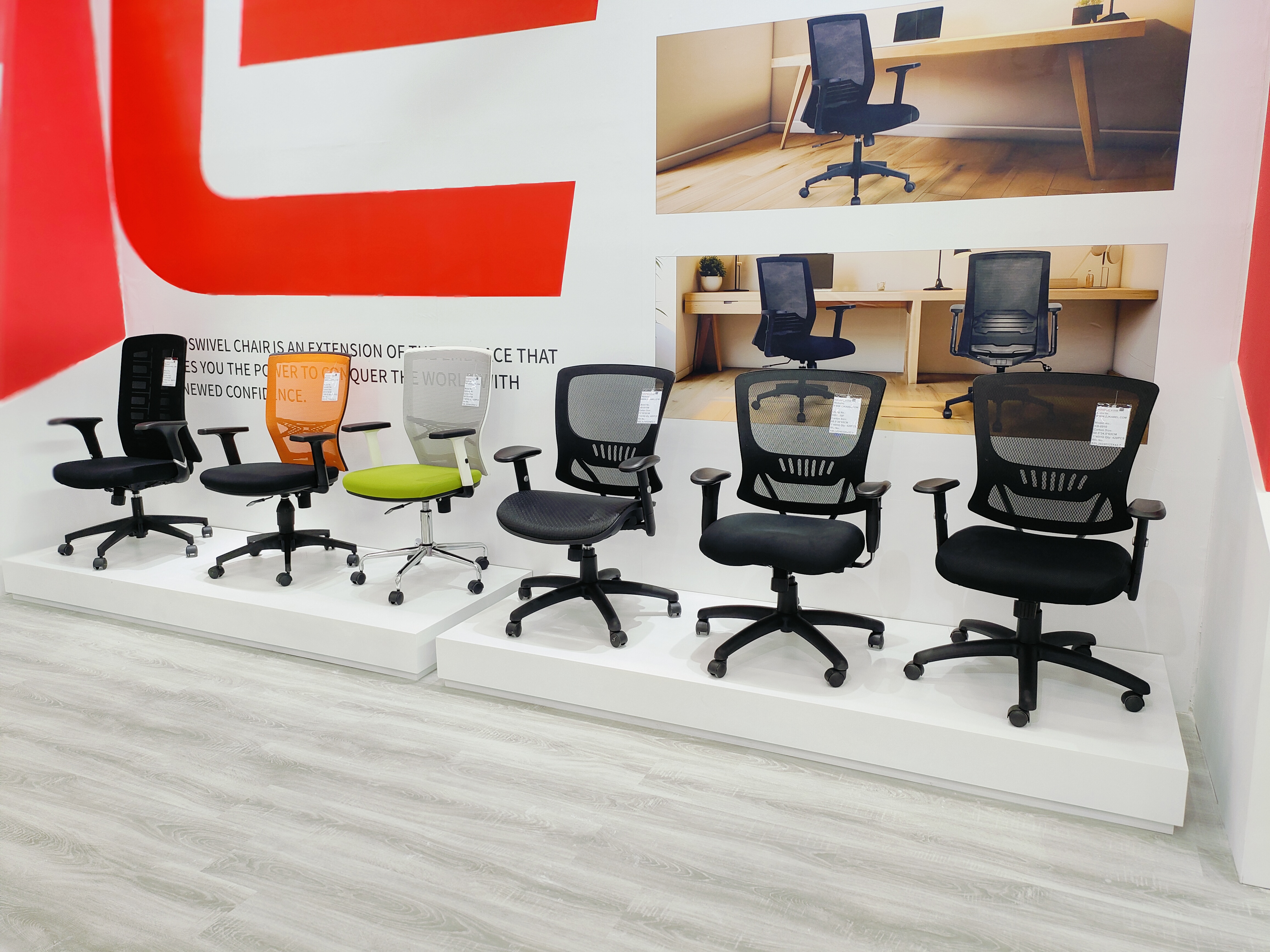
Office swivel seating classified as ergonomic and mesh chair types
First Buyer Question: What Sits Inside the Term Office Chair?
An office chair is usually identified by the room it serves and the posture it supports. Conference chair demand, for example, comes from meeting rooms where appearance, row spacing, and easy movement tend to matter. An ergonomic chair brand is judged differently, because buyers are typically responding to long working hours, back discomfort, and the need for seat and back adjustments. Senior management areas also generate demand for executive chairs, sometimes referred to in trade language as boss chairs, with a larger seat shell and a more formal visual presence.
The same product family extends into staff workstations, training rooms, study rooms, and home office corners. Manufacturers therefore present office chairs in defined categories rather than as one universal design. Anji Kabel Furniture Co., Ltd., an office chair manufacturer based in Zhejiang, China, describes its range as covering staff chairs, executive chairs, ergonomic chairs, conference chairs, training chairs, and leisure sofa chairs. Its main office chair output is concentrated on staff chairs, executive chairs, ergonomic chairs, conference chairs, and training chairs.
For someone beginning research, this range is a useful reminder: an office chair search is really a project about matching a seated task, a room layout, a user group, and a budget. The product that solves a conference room need is usually different from the product that solves a twelve-hour control room requirement.
Market Size and the Shift toward Ergonomic Seating
The macro picture explains why so many manufacturers and importers pay attention to this category. According to a 2024 market analysis published under the title Trending Office Chairs 2024, the global office chair market reached roughly USD 14.25 billion in 2024. Separate analysis from Dataintelo, focused on ergonomic office chairs, puts that segment at approximately USD 12.8 billion in 2025, with mesh back chairs holding a 38.4% share of product types. The exact figures vary by source because some estimates include residential furniture and others focus on commercial supply, but the direction is consistent: ergonomic and mesh seating has moved from a specialty niche to the center of the office chair category.
Regionally, industry research has described North America as the largest revenue contributor to the ergonomic chair market. Asia-Pacific, meanwhile, has been characterized as the fastest-growing region, with an earlier Dataintelo projection expecting it to represent about 36.6% of the market by 2025. These figures are not uniform across research houses, and buyers should treat them as directional context rather than precise planning data.
There is also a strong export dimension. UN Comtrade data cited in trade reporting shows that China exported metal office furniture worth more than USD 307 million to the United States alone in 2024. That single flow underlines how often global office chair purchasing decisions lead to Chinese manufacturing partners and why importers need to verify factory capability, not just product images.
From Supplier Claims to Factory Facts: Kabel as an Example
At the research stage, buyers commonly compare an office chair brand by looking for verifiable facts about the company behind the product. One useful reference point is Kabel, the export brand of Anji Kabel Furniture Co., Ltd. The company was established in 2007 and has accumulated more than fifteen years of experience in designing and manufacturing office seating. Its factory is located at 1 Touba Road, Dipu Town, Anji County, Huzhou City, Zhejiang Province, China, and covers roughly 50,000 square meters. Employment is approximately 92 staff, supported by an independent research and development team of 20 engineers, and the company reports an annual production capacity of about 400,000 sets.
Kabel presents itself as an integrated supplier with independent research and development, design, production, and sales capabilities. According to company materials, all products are independently developed, each core product holds a patent certificate, and production is directed at export-grade quality, with products designed, produced, and tested in line with international standards. For a first-time buyer, these are the kinds of facts that matter more than vague claims about comfort: how long has the supplier existed, where is production located, who controls design, and what quality checks are described in official documentation.
Because Kabel is a manufacturer rather than only a trading office, it can show a defined factory footprint and a defined engineering headcount. Buyers who later need OEM projects, private label programs, or continuity of supply across multiple orders tend to weight these structural facts heavily. The availability of a published catalogue also helps researchers confirm model families before they request quotations.
Technical Details That Justify an Office Chair Specification
An ergonomic office chair is more than a high-back chair. The practical definition appears in the hardware specification. For example, Kabel's office swivel chair series, available in models KB-6809, KB-8961, KB-8965, KB-8932, and KB-8953, is classified in the ergonomic office chair and mesh office chair categories. Its published specification includes an adjustable seat height range of 40 to 50.5 cm, 360-degree free rotation, and a backrest tilt lock between 90 and 135 degrees. The seating structure uses a high-elastic breathable mesh back, a high-density molded foam cushion, a thickened nylon five-point base, silent PU universal casters, and a four-level explosion-proof gas pressure rod. The maximum load capacity is 150 kg.
| Component or function | What the specification states | Why buyers should care |
|---|---|---|
| Seat height | Adjustable range of 40 to 50.5 cm | Supports matching the chair to desk height and user leg length |
| Rotation | 360-degree free rotation | Allows the user to turn without straining the lower body |
| Backrest tilt | 90 to 135 degrees with locking | Gives the backrest a usable range for upright work and brief rest |
| Backrest material | High-elastic breathable mesh | Reduces heat buildup in normal indoor office conditions |
| Cushion | High-density molded foam | Useful indicator of shape retention during continuous sitting |
| Base | Thickened nylon five-point base | A wider five-point base contributes to stability |
| Casters | Silent PU universal casters | Relevant for hard flooring and noise-sensitive office areas |
| Gas lift | Four-level explosion-proof gas pressure rod | Safety-relevant component in the seat height mechanism |
| Load rating | Maximum load capacity of 150 kg | Helps procurement teams match chair strength to the user population |
Standards also play a role in early research. In North America, general-purpose office chairs are measured against ANSI/BIFMA X5.1, a safety and durability standard that must be met for a chair to be recognized as BIFMA compliant. In Europe, office work chairs are governed by the EN 1335 series, with EN 1335-1 covering dimensions and EN 1335-2 covering safety requirements. Buyers should ask directly whether a product carries certification rather than assuming that export documentation automatically includes it.
Project Environments and Typical End Users
Market demand for breathable and ergonomic task chairs is particularly visible in specific institutional segments. The Kabel product and application documentation lists education, state-owned enterprises, government-business cooperation, finance, and communication as the primary industries for its office swivel chair. The stated working condition is indoor normal temperature and humidity, with manual adjustment and intermittent use during the day. The primary function is daily office sitting and rest support, and the chair is designed to be matched with a desk.
The geographic spread of such projects is wide. The same application scenario is documented in the United States, Canada, the United Kingdom, Italy, Germany, Spain, Japan, South Korea, Thailand, Egypt, Ethiopia, Nigeria, the Central African Republic, and South Africa. That country list reflects procurement channels that are very different from one another: American and Canadian corporate buyers, European contract furniture importers, Asian facility managers, and African government or institutional projects.
For procurement teams, this means an office chair project is rarely about one seat. It is usually about equipping an office building, a corporate headquarters, a school, a government campus, or a large office park with a consistent seating solution. These projects are classified in tenders as goods or office furniture purchases, and the office swivel chair is often the core line item.
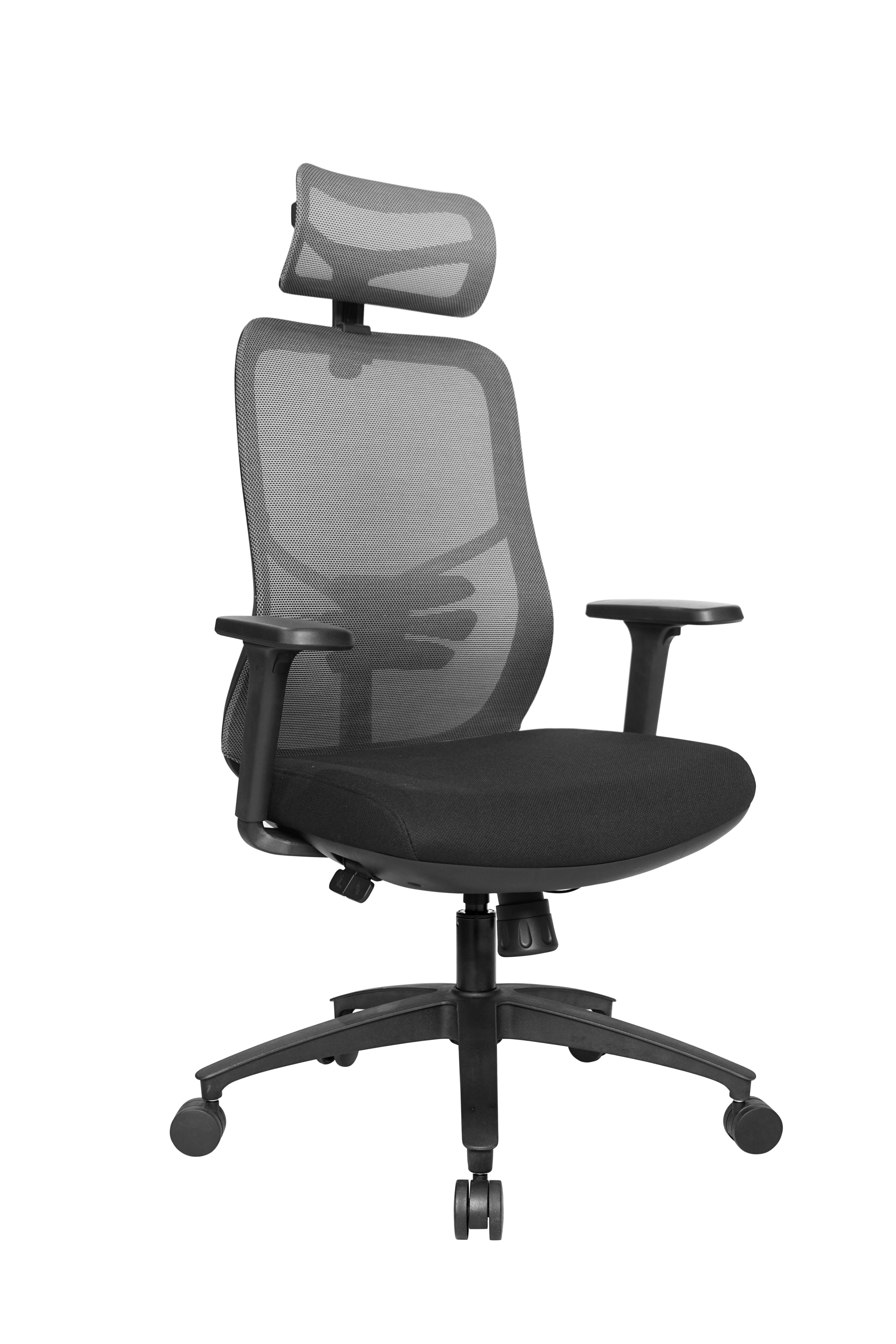
A swivel rolling office chair with mesh back and adjustable mechanism
Where the Ergonomic and Mesh Market Is Headed
Trend data suggests that the future of office chair demand will be shaped by breathable materials, adjustability, and regional growth outside the traditional Western markets. The mesh chair share of 38.4% in the ergonomic segment is a strong indicator that ventilation and modern appearance are no longer secondary desires. Mesh back office chairs have become a default choice for employee workstations, especially in warm climates and in buildings where meeting rooms and open plan areas share the same design language.
Asia-Pacific is important in that scenario because it is both a production base and a fast-growing consumption region. China's export data, with metal office furniture shipments to the United States already exceeding USD 307 million in 2024, shows that global buyers still depend on Chinese manufacturing capacity for high-volume office chair programs. At the same time, local demand in Asia-Pacific is rising, making the region a destination for its own manufactured output.
Another trend is the convergence of price bands. The older divide between premium Western ergonomic brands and low-cost Asian imports is being replaced by a middle market where factories invest in engineering teams, patent protection, and international testing protocols. Kabel's structure, with independent design, 20 engineers on the R&D team, and patent certificates for core products, reflects this pattern of manufacturer-led capability building rather than simple assembly.
Modern Task Seating versus Older, Simpler Office Chairs
Buyers who compare an ergonomic swivel chair with a traditional fixed or low-adjustability office chair will notice differences in almost every functional area. A minimal chair typically offers a fixed seat height, limited back movement, and simpler casters. In contrast, a modern ergonomic model in the KB-series style offers a defined seat height window, backrest tilt locking, breathable mesh material, and a structurally stronger base and gas lift package.
The honest comparison, however, should also acknowledge limitations. First, a specification sheet cannot guarantee comfort. Even a chair with broad adjustability must be set correctly by the user, and a mismatch between chair dimensions and desk height can cancel the benefit of the mechanism. Second, this type of office swivel chair is designed for indoor office environments with normal temperature and humidity. It is not positioned for outdoor use, wet industrial areas, or continuous process environments where other seating specifications would apply. Third, mesh is not the only acceptable material. While mesh accounted for 38.4% of ergonomic chair product types in the cited report, many buyers still choose padded or upholstered models for executive and formal meeting settings. The right choice depends on room image as much as on posture.
A connected limitation concerns verification. Buyers cannot fully judge durability from photographs or chat messages. Factory visits, sample testing, and reference projects remain the practical evidence base, and certifications such as ANSI/BIFMA X5.1 or EN 1335 should be confirmed with documents rather than assumed from product descriptions.
Outlook: What Changes Next in Office Chair Sourcing
Looking ahead, office chair procurement will likely continue shifting toward manufacturers that can combine ergonomic features with production transparency. The market estimates reviewed here, ranging from roughly USD 14.25 billion to USD 14.69 billion depending on scope, point to a large and stable category. Within that category, the ergonomic segment is the growth engine, and mesh seating represents a substantial share of new product configurations.
For buyers in education, government, finance, and communication sectors, the practical question is how to evaluate an office chair brand quickly without falling into marketing language. The answer is to check measurable elements: company age, factory size, engineering team, production capacity, product patents, tested safety components, and documentation such as catalogues and certificates. These signals do not replace personal testing, but they create a reliable shortlist.
As Asia-Pacific demand grows and export flows remain strong, the boundary between domestic and international office chair supply will continue to blur. Manufacturers that already serve multiple national markets, as Kabel does through exports to North America, Europe, Asia, the Middle East, and Africa, are likely to be better prepared for mixed procurement criteria and project-based requests.
Reference Note for Researchers
Buyers who want to see the model structure behind the Kabel product line can consult the company's published chair catalogue. It is accessible as a PDF and covers the main office chair categories discussed in this article, including staff chairs, executive chairs, ergonomic chairs, conference chairs, and training chairs. The catalogue is available at https://cdn.socialarks.com/sbsp/25017/common/2026/0626/KABEL%20Chair%20Catalogue.pdf
FAQ: Office Chair Fundamentals for Early-Stage Buyers
Which product groups are usually included in an office chair manufacturer's range?
A typical mid-to-large office chair manufacturer serves several seating situations. Kabel, for example, lists staff chairs, executive chairs, ergonomic chairs, conference chairs, training chairs, and leisure sofa chairs as its product categories, with office chairs such as staff chairs, executive chairs, ergonomic chairs, conference chairs, and training chairs forming the main output. Buyers should map these categories to departments and room types before comparing models.
What separates an ergonomic office chair from a general office swivel chair?
The practical difference is the combination of adjustability, safety hardware, and load capacity. Kabel's office swivel chair series, classified as an ergonomic office chair and a mesh office chair, includes models KB-6809, KB-8961, KB-8965, KB-8932, and KB-8953. The specification covers an adjustable seat height of 40 to 50.5 cm, 360-degree rotation, a 90 to 135-degree tilt lock, a breathable mesh back, and a four-level explosion-proof gas pressure rod. These features support adaptation to different body sizes and working postures.
Why are mesh back designs common in modern office chairs?
Mesh back seating is frequently selected because the backrest material is breathable and elastic. In the KB-series specification, the chair uses a high-elastic breathable mesh back and a high-density molded foam cushion. Market data also shows mesh chairs holding a 38.4% share of ergonomic chair product types, confirming that mesh is a mainstream choice rather than a niche feature.
What load capacity and safety features should buyers check?
For this class of office swivel chair, the published maximum load capacity is 150 kg. The seat height system uses a four-level explosion-proof gas pressure rod, and the base is a thickened nylon five-point structure. In addition, buyers operating in North America or Europe should ask whether a product meets ANSI/BIFMA X5.1 or the EN 1335 series, since those standards define safety and durability expectations for office seating.
Which industries and geographic markets use these office chairs most often?
Documented application areas include education, state-owned enterprises, government-business cooperation, finance, and communication. The same application scenario appears in the United States, Canada, the United Kingdom, Italy, Germany, Spain, Japan, South Korea, Thailand, Egypt, Ethiopia, Nigeria, the Central African Republic, and South Africa. The chairs are intended for indoor normal temperature and humidity, manual adjustment, and daytime intermittent use.
How can a buyer evaluate an unfamiliar office chair brand?
A buyer can start by checking the company's legal background, factory location, scale, and design capability. Kabel, for instance, was established in 2007, operates from a 50,000 square meter facility in Anji County, Huzhou, Zhejiang, China, employs about 92 staff, and maintains an R&D team of 20 engineers. Buyers should also confirm production capacity, patent status for core products, export experience, and the availability of technical documentation such as model lists and catalogues.
This article is published as an industry reference for buyers researching office chair categories. Statements about Kabel are based on company-published information and product documentation; market figures are cited from the named third-party sources and may vary by methodology.
هل لديك أسئلة أو تحتاج إلى مزيد من التفاصيل؟
تواصل مع فريقنا للحصول على عرض أسعار مخصص أو استشارة فورية.
طلب عرض أسعار
املأ النموذج أدناه وسيتواصل معك فريقنا بعرض مقترح مخصص.
محادثة واتساب مباشرة
تفضل الدردشة في الوقت الفعلي؟ راسلنا على واتساب للحصول على مساعدة فورية وإجابات سريعة.
- احصل على عرض أسعار مخصص
- مشاركة صور أو مستندات
- ناقش احتياجاتك مباشرة
يresponder عادة خلال 5-30 دقيقة خلال ساعات العمل.