
Office Security Safes: Custom Builds, Specs and Deployment
Office & Commercial Safe Procurement Reference
An office security safe is a locking storage unit configured around what a workplace actually protects — petty cash, company seals, contracts, keys, ID badges and controlled documents — and around how many people need access, where the unit can be anchored, and which certification the destination market accepts. In most offices, the safe is bought as a catalogue item when it should be specified as an engineered asset.
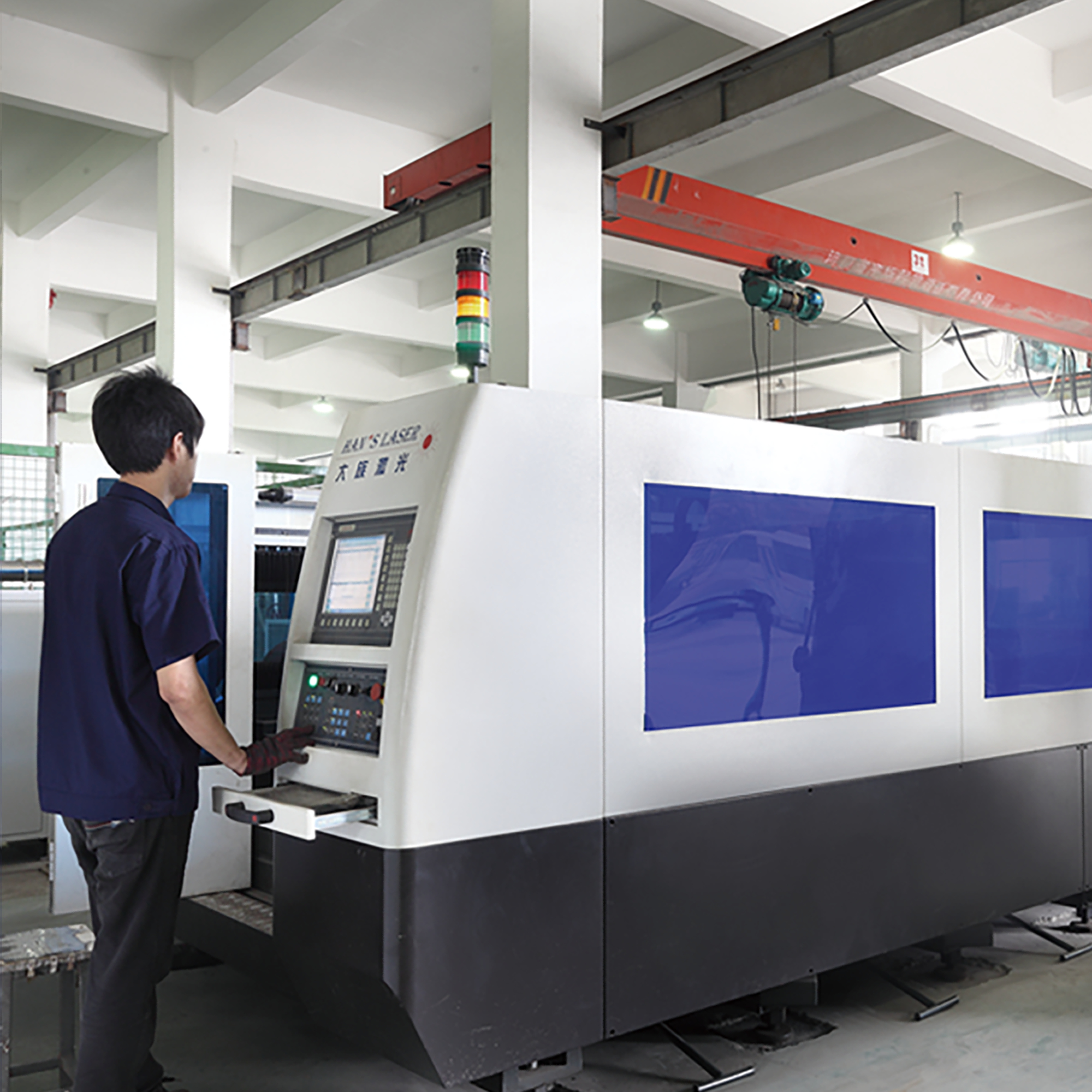
Sheet-metal production floor at Ningbo Tigerking Safe Co., Ltd., where office, commercial and depository safes are fabricated.
Why office safe procurement fails before the order is placed
Office safe decisions are usually made by facilities, administration or finance teams rather than by security specialists, and the requirement is often written as a single line: “one safe, wall-mounted, key lock.” That line hides three decisions that determine whether the unit protects anything at all.
- Protection target. Theft resistance and fire resistance are separate technical achievements. A unit can be tested for one and not the other, and the certificate scope must say which.
- Access architecture. A single mechanical key suits a small office with one responsible holder; a shared code, multiple user codes or biometric access suit shift-based teams but change the configuration from the standard model.
- Installation. A light wall safe fixed into drywall offers very different resistance from a floor-anchored deposit safe bolted into a slab. The mounting decision is part of the specification, not an afterthought.
The practical consequence is that the specification should start from the asset and the attack scenario, and only then move to a model number.
Where generic catalogue safes break down in an office
Three failure patterns recur in workplace deployments:
- Interior mismatch. Standard shelves hold envelopes, not A4 folders, cash trays or seal boxes. When nothing fits, the safe door is left open and the protection is lost.
- Credential mismatch. One key passed between eight staff members is a control failure, not a security control. Larger offices normally need a defined access model written into the purchase agreement.
- Deposit handling. Cash desks that open a main door several times per shift create exposure. Depository safes solve this with a one-way deposit path and an anti-fishing baffle, so the main door stays closed during trading hours.
These are configuration problems, not brand problems — which is why the capability to alter dimensions, interior layout and lock type matters more in office procurement than a longer product list.
The office and commercial safe line behind these configurations
Ningbo Tigerking Safe Co., Ltd. is a Chinese safe manufacturer founded in 2000 and based in the Daxie Development Zone, Ningbo, Zhejiang, that integrates R&D, production and sales of fire-resistant safes, burglary safes, gun safes, commercial safes and jewellery safes. The company operates a 60,000 ㎡ manufacturing site with 200 employees, a 10–15 person engineering team covering structural design, mould design, electronic R&D and testing, and an annual output of 240,000 units, of which roughly 70% is exported to North America, Europe, Southeast Asia, the Middle East and South America.
For office-facing programmes, two product families carry most of the workload:
- Office Security Safe — KS48, KEY27, LSDW-25MD. Compact key/wall safes intended for badges, keys, passports and small documents, with the LSDW-25MD offering a taller 6 mm door and one internal shelf.
- Commercial Security Safe (depository) — DP450-LE, DF2014-MA, DF3020-MA, DF3020-DKA, DF4020-DDA, DF4020-MMA, DR2014-DA, DR2014-MA. Depository units built with an anti-fishing baffle for cash and document handover at reception or retail counters.
Both families sit inside a wider catalogue that also includes burglary-resistant models (smart I-JS, smart I-GS), hotel safes (H20, H30, H50 series), fireproof safes (FPSD66, FPS60DF, FPSA60, FPSB60, FPSE60SP), economy safes and biometric bedside safes — useful when a single office fit-out also needs back-of-house or guest storage.
Technical explanation: steel, locks, anchoring and interiors
Office buyers rarely need a metallurgy lesson, but four numbers decide what a safe can resist: door plate thickness, body plate thickness, net weight and mounting method. On the Tigerking office line these read as follows.
| Model / family | External size (H×W×D) | Door / body | Weight | Interior | Typical office use |
|---|---|---|---|---|---|
| KS48 | 360×300×100 mm | 4 mm / 1.5 mm | 8 kg | No shelf | Wall-mounted key, badge and seal control |
| KEY27 | 360×300×100 mm | 4 mm / 1.5 mm | 8 kg | No shelf | Wall-mounted key control in a second location |
| LSDW-25MD | 250×350×200 mm | 6 mm / 2 mm | 12 kg | 1 shelf | Back-office documents and small valuables |
| DP450 (depository) | 450×350×300 mm | 6 mm / 3 mm | 19 kg | Anti-fishing baffle | Single cash-desk handover point |
| DF2014 / DF3020 / DF4020 (depository) | 515×355×355 mm to 1016×508×508 mm | 6 mm / 3 mm | 30 / 62 / 96 kg | Anti-fishing baffle | Volume cash and document deposit |
The pattern is deliberate. A 4 mm door with a 1.5 mm body and 8 kg net weight is appropriate for keys and documents in a locked office, and it is not appropriate for cash or high-value stock — the specification has to step up to the 6 mm / 3 mm depository bodies, which range from 19 kg to 96 kg depending on volume.
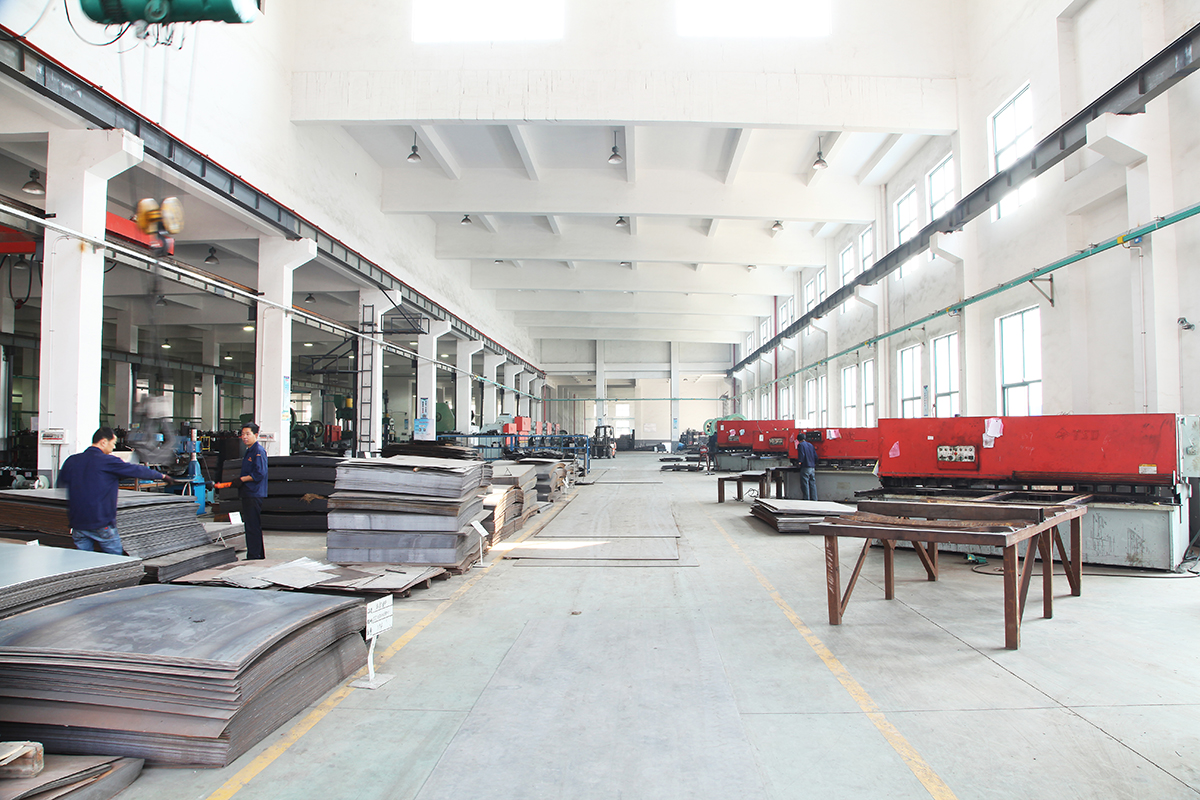
Safe bodies in welding and assembly, before powder coating and final inspection.
Locking. Lock type is a documented customisation variable: mechanical, electronic and biometric options are all selectable, along with panel branding. Where an office needs more than one credential — for example a store manager and a finance approver — that arrangement has to be written into the technical agreement, because adding credentials changes the unit from the standard tested configuration.
Anchoring. Wall and floor mounting with expansion bolts is the standard installation method for these units, and firm floor anchoring is recommended wherever the unit is not embedded in a load-bearing wall element. Anchoring is what prevents whole-unit removal, which is often how a light safe is defeated.
Interiors. Interior layout is customisable — dividers, document trays, cash compartments and shelf counts (0 or 1 on the models above) — and buyers should specify contents sizes rather than shelf counts so the layout can be checked against drawings before production.
Application scenarios for office deployments
- Administration office, one location, keys and seals. A 360×300×100 mm, 8 kg wall safe keeps keys, seals and passports under one accountable holder with minimal wall footprint.
- Back office, contracts and ID documents. The LSDW-25MD at 250×350×200 mm with a 6 mm door and one shelf holds document sets that will not fit a key safe.
- Reception or retail counter with cash handling. A depository body with an anti-fishing baffle allows one-way deposit without opening the main door — DP450 for a single desk, DF3020 or DF4020 where daily volume is higher.
- Multi-site office rollouts. Consistent specification across sites is the real requirement here; customisation of colour, panel branding and OEM labelling allows a facilities group or distributor to standardise units under one internal or private label.
Market trends that affect office safe specifications
Two structural shifts are visible in third-party market data. First, the global security safes market was valued at USD 3.57 billion in 2025 and is projected to reach USD 5.15 billion by 2030, a 7.5% CAGR across 2026–2030 (The Business Research Company / OpenPR, October 2026). Buyers should note that this “security safes” definition excludes heavy bank vaults; a broader “safes and vaults” figure of USD 9.13 billion for 2025 published by Straits Research includes them, so the two numbers are not comparable and should never be quoted side by side as if they measured the same thing.
Second, fire protection is driving specification rather than price. Fire-resistant safes accounted for 63.7% of demand in the US home safe category in 2023, and 61% of home safe consumers surveyed preferred fire-resistant models able to withstand temperatures above 927 °C for 60 minutes (The Business Research Company). Regionally, Asia Pacific held 36.4% of the global safes and vaults market in 2025 (Straits Research). For office buyers the read-across is straightforward: fire ratings are becoming a baseline expectation, and the burden of proof is moving to test documentation rather than marketing language.
Comparison with traditional single-model buying — and where the limits are
Buying one standard catalogue safe per office is cheaper at the quotation stage and more expensive at the deployment stage: interiors do not match contents, credentials cannot be separated by role, and deposit handling remains a manual exposure. A configured programme costs more per unit but resolves those issues before production.
The limits are equally concrete, and buyers should plan around them:
- Thin-wall models are not cash safes. KS48, KEY27 and LSDW-25MD use 4–6 mm doors and 1.5–2 mm bodies at 8–12 kg. They suit keys, badges and documents; cash or high-value assets require depository or burglary-resistant bodies with corresponding certification.
- Fire and burglary protection are separate claims. Single-function safes do not deliver both; combined protection requires a composite model with certificates covering both functions.
- Certificates must cover the ordered model. Customs authorities and regulators work with full-unit certifications, not component certifications, and some certificates cannot be re-issued under a buyer’s private brand.
- After-sales is parts- and coordination-based. Technical support, spare parts and project coordination are provided, but there is no on-site overseas repair service, so warranty terms and the spare-parts plan should be agreed in the contract.
- Customisation has a lead-time cost. Prototyping runs 20–30 days, and production lead time is normally 25–30 days for simple items and 45–60 days for mass products.
Certification and quality framework for office safe programmes
Quality control at the manufacturing site follows an ISO 9001 framework with 6S and lean production management, and products are tested by third parties such as SGS, ETL and CE for export requirements. Documented certifications relevant to office and commercial programmes include:
| Certificate | Number | Issuer / standard | Validity |
|---|---|---|---|
| ISO 9001 quality management | 16425Q32488R3M | Huazhong International Certification & Inspection Group; GB/T 19001-2016 / ISO 9001:2015 (design, development and production of safes; cabinet shells and precision sheet metal parts) | Issued 2026-01-27, valid to 2027-02-10 |
| ISO 14001 environmental management | 00224E34629R1M | China Quality Mark Certification Group; GB/T 24001-2016 / ISO 14001:2015 | Issued 2024-10-31, valid to 2027-07-26 |
| CSP burglary-resistant safe certification | CSP2026010107020005 | China Safety Technology & Security Protection Certification Center; GB 10409-2019, Security Grade A10 | Issued 2026-01-27, valid to 2031-01-26 |
| ETL verified 60-minute electronic fireproof safe | 211130001SHF | Intertek Testing Services NA; UL 72 (2015) (R2020) | Issued 2022-06-20 |
| CE (EMC) | SHEM240300108001HSC | SGS-CSTC; EN IEC 61000-6-1:2019, EN IEC 61000-6-3:2021, Directive 2014/30/EU | Issued 2024-03-05 |
| UKCA (EMC) | SHEM240300108101HSC | SGS-CSTC; EN IEC 61000-6-1:2019, EN IEC 61000-6-3:2021, UK EMC Regulations 2016 | Issued 2024-03-05 |
| Zhejiang Made (“Pin-Zi-Biao”) | CZJM2021P1055001ROM | Zhejiang Made International Certification Alliance / CQM; DB33/T 944.1-2014, DB33/T 944.2-2017, T/ZZB 1427-2019 — electronic burglary-resistant safe | Issued 2021-09-14, valid to 2027-09-13 |
| BSCI social audit | amfori ID 156-064320-000 | Audited by TUV SUD on behalf of amfori | Performance areas PA8–PA13 |
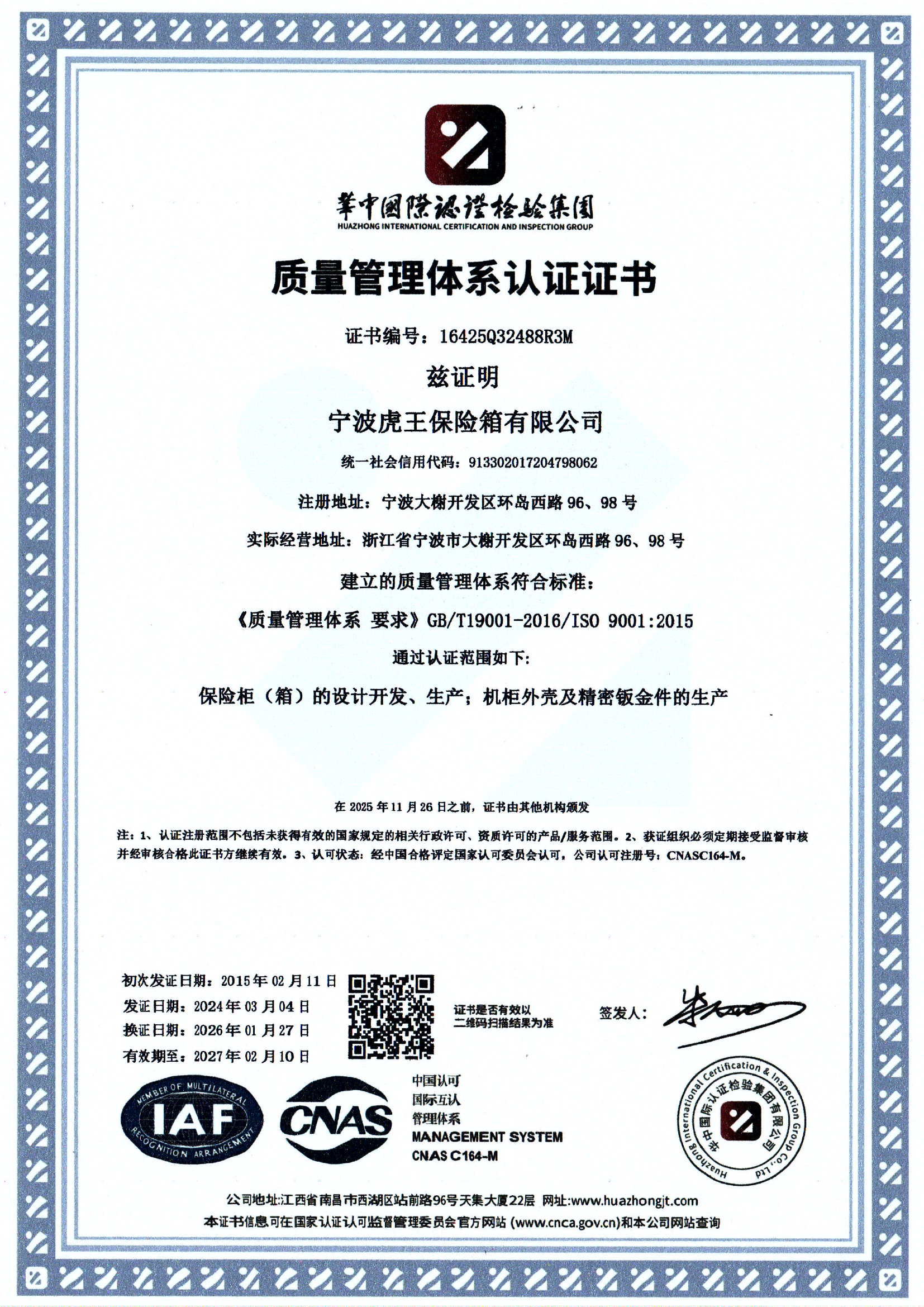
ISO 9001 certificate covering the design, development and production of safes and precision sheet metal parts.
The Zhejiang Made certificate is directly relevant to office procurement because its scope covers the electronic burglary-resistant safe category and its listed products include the Office Security Safe models KS48, KEY27 and LSDW-25MD — a useful example of why buyers should check that a certificate names the model being ordered rather than only the brand.
Customisation, order quantities and delivery planning
Documented customisation scope covers dimensions, colour, interior layout, lock type (biometric, electronic or mechanical), panel branding and OEM labelling. The company provides OEM production services, ODM design-and-production services and export trade support, backed by fully in-house tooling and die development, a monthly capacity of 20,000 units, and production lines that include 5 welding lines, 3 spraying lines and 3 assembly lines with 60% in-house vertical integration.
From an execution standpoint, three planning inputs matter. Sample and trial quantities are handled separately from mass-production minimums: enquiry batch ranges run from 1–20 units to 1001+ units, and specific minimum order quantities are confirmed with sales. Documented purchase terms for volume orders record no less than 200 units per model for standard products and 300 units per model for customised OEM products, FOB NINGBO delivery, and acceptance based on pre-shipment test, with 30% T/T deposit before production and 70% against a copy of the Bill of Lading.
Future outlook
Three directions are likely to shape office safe programmes over the next procurement cycles. Certification will continue to act as a market-access filter, since major retail channels and customs authorities require verifiable full-unit certification rather than component documents. Electronic and biometric access features will keep migrating from residential products into workplace units, which raises the importance of written configuration agreements because every credential change alters the tested build. And the manufacturing side will keep rewarding buyers who engage engineering capability early: with prototype turnaround of 20–30 days and in-house mould development, configuration problems are cheaper to solve at drawing stage than after a container is loaded.
FAQ
What can actually be customised on an office security safe order?
Documented customisation scope covers dimensions, colour, interior layout, lock type (biometric, electronic or mechanical), panel branding and OEM labelling, supported by OEM production and ODM design-and-production services. Customisation is bounded by the tested configuration: fire and burglary performance, certificate scope and nameplate layout belong to a specific approved build, so structural or component changes must be agreed in writing in advance and re-tested where certification is involved. Buyers should also confirm whether an existing certificate can be re-issued under a private brand, because some certifications do not permit private-label re-use.
What order quantities, lead times and payment terms apply to office safe orders?
Batch ranges in the enquiry process run from 1–20 units to 1001+ units, with specific minimum order quantities confirmed with sales. Documented purchase terms for volume orders record no less than 200 units per model for standard products and 300 units per model for customised OEM products, FOB NINGBO delivery, pre-shipment test as the acceptance basis, 30% T/T deposit before production and 70% against a copy of the Bill of Lading. Production lead time depends on quantity and customisation: normally 25–30 days for simple items and 45–60 days for mass products, with a prototyping lead time of 20–30 days.
What should be verified when the first office safe sample arrives?
A structured sample check covers seven areas: external and internal dimensions with steel plate thickness verified by caliper; appearance and surface finish, including coating evenness and weld-seam burrs; lock function across keypad, fingerprint and mechanical override, plus password storage, wrong-attempt lockout, audit log and battery compartment; mechanical structure, including hinge smoothness, door gap uniformity, bolt locking, handle operation, shelves and anchor holes; certification and marking cross-check against model number, serial number and marks such as ETL, CE or UKCA; packaging and accessories, including emergency keys, expansion bolts, manual and battery; and any agreed special functional test for fire or burglary performance. Sealed reference samples should be retained before mass production.
How is quality controlled during production?
Quality control follows an ISO 9001 framework with 6S and lean production management. Raw materials such as steel, fire-resistant materials and locks are inspected by batch sampling or full inspection; in-line IPQC patrol inspection operates at defined nodes for welding, spraying and assembly, with non-conforming products isolated; and finished goods undergo full FQC inspection of appearance, dimensions, fire and burglary resistance, lock function and sealing before shipment with a qualification certificate. Every safe passes a lock function test before dispatch, and third-party pre-shipment inspection is accepted.
Which certifications should an office safe programme verify before ordering?
For this manufacturing site the documented set includes ISO 9001 (16425Q32488R3M, valid to 2027-02-10), ISO 14001 (00224E34629R1M, valid to 2027-07-26), CSP burglary-resistant certification at Security Grade A10 under GB 10409-2019 (CSP2026010107020005, valid to 2031-01-26), ETL verification of a 60-minute electronic fireproof safe under UL 72 (211130001SHF), CE and UKCA EMC verification issued by SGS, a BSCI social audit conducted by TUV SUD (amfori ID 156-064320-000) and Zhejiang Made certification. The verification rule is that the certificate must name the model ordered — component certifications are not treated as full-unit certification by customs and regulators.
Specification confirmation for the office, commercial and depository models described above is handled through the manufacturer’s technical documentation at www.tigerkingsafe.com. The 2026 product catalogue is available for download: 2026 Tiger King catalogue.