
Oil, Alkali and Wastewater: Fitting a Plastic Pallet Box to Harsh Industrial Storage
Oil, Alkali and Wastewater: Fitting a Plastic Pallet Box to Harsh Industrial Storage
A pallet box for oil, alkali, acid or industrial wastewater is chosen from the medium outward, not from the catalogue inward. TOYOE's supplied product records describe enclosed HDPE/PP pallet boxes with a stated capacity of 100–200 L, nestable and recyclable construction, and custom sizing, listed for oil, industrial alcohol, alkali, acid, industrial wastewater, water and car parts. What the same records do not contain matters just as much: no chemical-resistance data by medium, no rated load figure, and no published surface-resistance value for anti-static service.
Fitting the box to a harsh storage job therefore means matching three published footprints — 1200×800×1000 mm, 1000×800×800 mm and the die-cast 1230×830×1000 mm — to a defined medium, a defined handling system, and a verification step that converts an open question into a specification. This article builds that match and marks where the evidence stops, so that a procurement team can separate what is already documented from what still needs to be tested.
Why the medium, not the catalogue, sets the specification
In a plant handling lubricating oil, alkaline cleaners, acid and process wastewater, packaging decisions tend to start with a size and a price. The order should be reversed. Three requirements collide in harsh storage at the same time: the contents must stay contained and protected through repeated moves; the container must survive forklift and rack handling on a continuous cycle; and the container itself must not become a disposal, contamination or cleaning problem.
Each requirement pulls the specification in a different direction. A heavier wall helps durability and works against manual handling. A fully closed body improves protection and makes internal inspection harder. A larger footprint adds cube in the loaded leg and reduces the number of boxes that fit a return load. None of those trade-offs can be settled by a general claim about plastic being durable; they are settled per medium, per site and per handling interface.
For a reusable plastic pallet box, the practical output of that analysis is a fit statement: which model, for which medium, under which storage conditions, with which verification step before scale-up. The sections below build that statement for the three footprints in the supplied records and for the seven media those records list.
Reading the specification correctly: enclosed construction, 100–200 L and HDPE/PP
The supplied records describe an enclosed industrial plastic box in HDPE or PP with a stated capacity of 100–200 L, nestable and recyclable construction, customizable dimensions, colour, logo and material, a stated production capacity of 30,000 sets per year, and HS code 3923100000. Four specification words carry most of the buyer risk, and each deserves a precise reading.
Enclosed
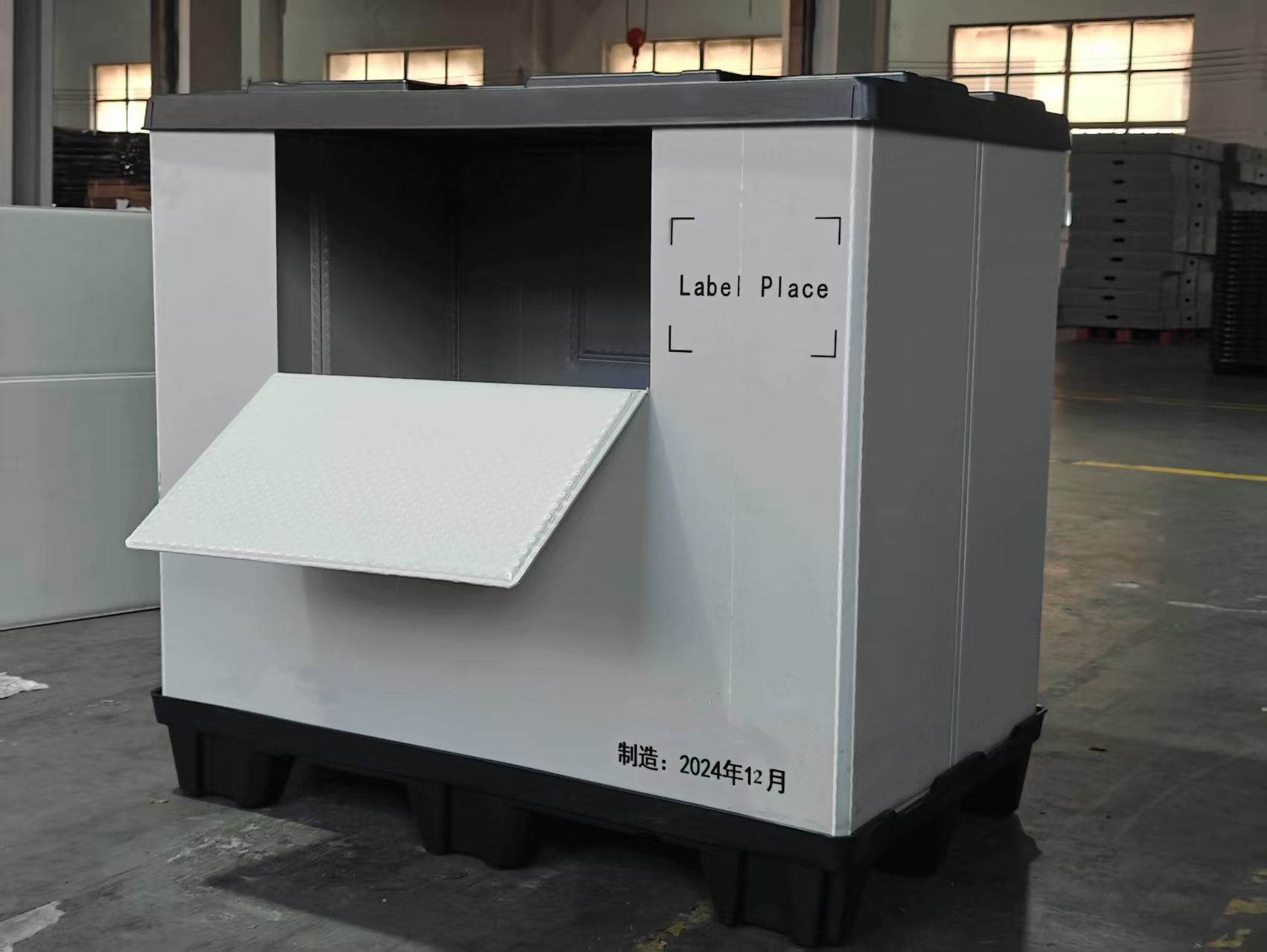
In these records, "enclosed" identifies the box type, distinguishing it from open-grid containers with perforated walls. An enclosed body limits dust ingress and keeps parts and surfaces away from splashes and incidental contact. The records do not state that the box is liquid-tight, gasketed or sealed, and no containment test is described. For a medium held as free liquid, containment has to be demonstrated rather than inferred from the word "enclosed".
HDPE/PP
The polymer family is named; the grade, wall thickness, UV stabilization and any conductive or anti-static additive are not. Those are exactly the variables that decide how a box behaves in a warm, humid, dusty plant, whether it can be cleaned between media, and whether an anti-static environment can genuinely be served. The material name is the starting point of a specification, not the whole of it.
100–200 L capacity
The figure is stated as the capacity of the listed models. On the 1200×800×1000 mm body, the external envelope alone works out at roughly 960 L (1.2 m × 0.8 m × 1.0 m), so the stated capacity plainly does not describe the outer geometric volume — it is more likely a usable or rated figure on a different basis, or one that applies to an internal liner. A buyer should ask which basis applies, because pour volume, part volume and inner-lining volume lead to different quantity calculations.
Nestable
Nesting reduces the stack height of empty boxes, which lowers the volume and cost of the return or storage leg. No nesting ratio is published for these models. The 5:1 fold ratio that appears in the supplied research evidence describes folding pallet box designs, a different mechanism from nesting, and it should not be transferred to these boxes. Measure the empty stack height in a trial instead.
Three footprints, three handling jobs
The records cover three footprints across four model entries: a 1200×800×1000 mm plastic pallet box in PP/HDPE, a 1000×800×800 mm storage pallet box in HDPE, a 1000×800×800 mm plastic honeycomb panel box in HDPE/PP, and the die-cast 1230×830×1000 mm box built around automotive engine handling. They are not interchangeable, and the difference is a handling decision before it is a price decision.
| Model and stated construction | Footprint × height | Handling job it fits | Confirm before ordering |
|---|---|---|---|
| Pallet box, plastic honeycomb panel box (PP/HDPE) | 1200 × 800 × 1000 mm | Existing rack and forklift flows, because the 1200 × 800 mm plan matches a widely used pallet footprint; largest usable height of the three | Rated load, forklift entry clearance, stack-height limit at the site |
| Storage pallet box (HDPE) | 1000 × 800 × 800 mm | Denser rack levels and easier reach; lower plan area and lower height than the 1200 model | Whether the configuration needs a lid or an inner lining, and the load rating |
| Plastic honeycomb panel box, blow-molded honeycomb board (HDPE/PP) | 1000 × 800 × 800 mm | Same footprint as the storage box, different wall construction; relevant where panel stiffness and box weight matter | Whether the panel construction suits the medium and the cleaning routine |
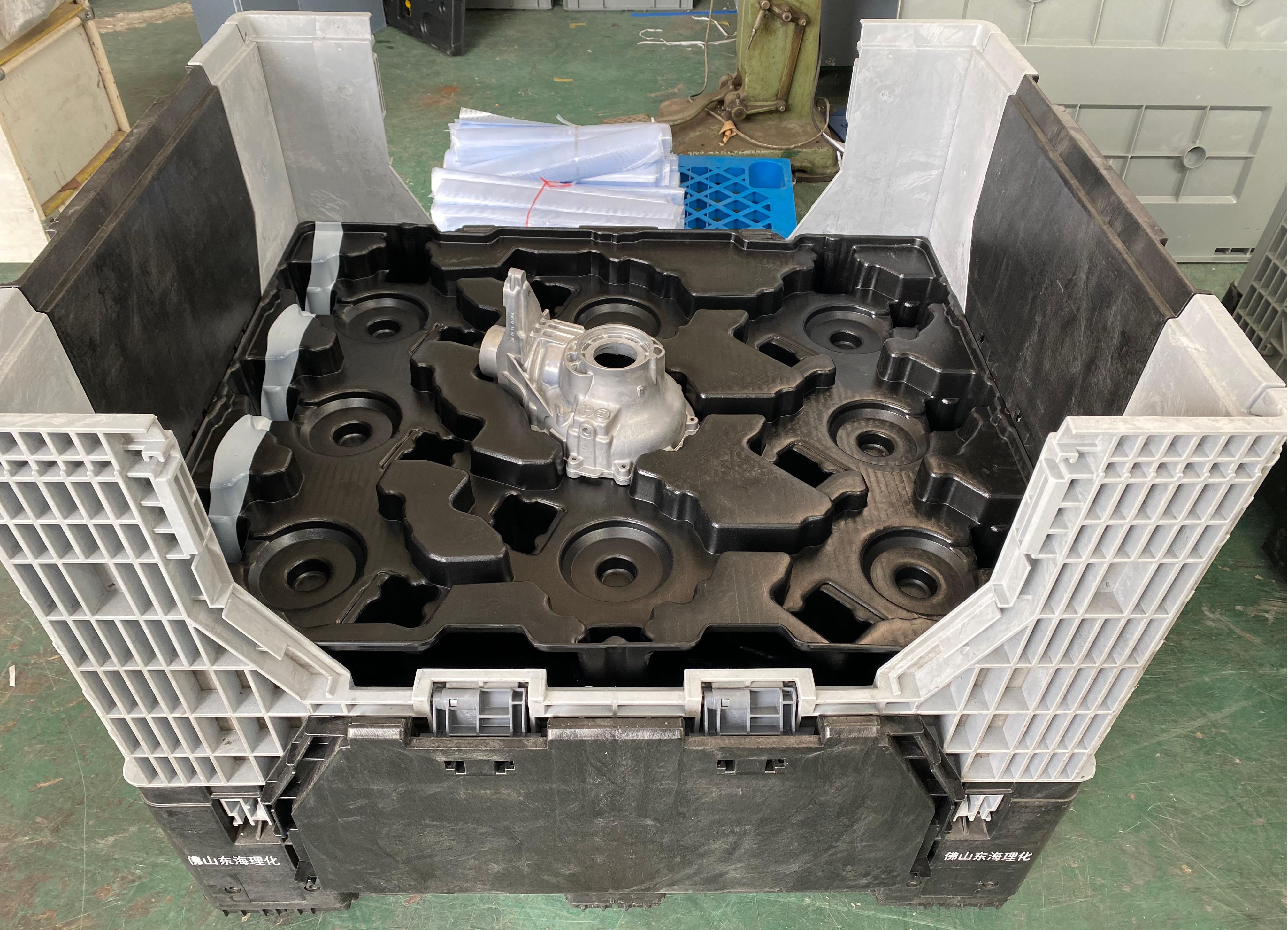
| Die-cast honeycomb board box (for automotive engines) | 1230 × 830 × 1000 mm | Powertrain parts; sized around engine and gearbox envelopes rather than a standard pallet module | Part envelope and dunnage fit, rack beam spacing, vehicle loading plan |
The 1200 × 800 mm plan is the one that slips into an established warehouse without redesigning the racking, which is why it is the natural default for a first installation. The 1000 × 800 × 800 mm entry trades plan area and height for a denser stack and easier manual reach, a sensible choice where the box is retrieved by hand as well as by forklift. The die-cast 1230 × 830 × 1000 mm box is the outlier: at 1230 × 830 mm it is larger than a standard pallet module in both directions, so it should be checked against beam spacing and transport loading plans instead of being treated as a drop-in replacement for the other two.
On handling interfaces, the supplied scenario record lists forklift, warehouse shelf, logistics handling equipment and anti-static handling as matched equipment. It does not publish entry dimensions, rated load or stack limits. Those three numbers, not the footprint, decide whether a box works on a given rack.
Chemical media: oil, industrial alcohol, alkali, acid and industrial wastewater
The records list oil, industrial alcohol, alkali, acid, industrial wastewater, water and car parts as applications. That is a scope statement about intended use — it is not a compatibility certificate. The same records contain no chemical-resistance test data, no permeation or absorption figures, and no service-life estimate for any of those media.
What actually determines whether a plastic box suits a chemical medium is narrower and more technical than the application list. Four factors carry the decision:
- The specific chemistry and concentration. "Alkali" covers a different material demand at 1% than at 30%; "acid" likewise. The application list names categories, not strengths.
- Temperature at fill and during storage. A warm medium in a closed body behaves differently from a cold one, and no temperature window is published for these models.
- Contact pattern. Continuous immersion, splash and residue on metal parts are three different exposures. A box that carries oily components is not thereby qualified to hold alkaline bath residue for weeks.
- The cleaning regime between loads. The cleaning agent and the interval can matter as much as the product, particularly where one box is switched between media.
The verification route follows from those four factors and is short enough to run before a production order. The records accept samples, so a trial with the actual medium, at the actual temperature, for the intended dwell time is feasible. Inspect base corners, seams and wall transitions afterwards for softening, staining, dimensional change or weight gain. Repeat after one cleaning cycle, because that is where many compatibility problems appear. Then confirm the outcome in writing against the specific model and configuration.
Water, car parts and the waterproof / anti-static environment
The supplied scenario record describes a logistics warehousing and packaging project in Mexico operating under high humidity, dust and a wide temperature range, with waterproof and anti-static conditions, 24/7 operation, forklift and rack handling, and requirements for moisture-proofing, shock resistance and stable load-bearing. That is a specification for a handling system, not for a single product — which is why the box cannot be validated against it in isolation.
Repeated 24/7 cycling shifts the emphasis onto structural stability and repeatable stacking rather than one-off protection. Humidity and dust argue for the enclosed body and for clarifying whether any venting exists, since a closed body that traps condensation can be worse than a ventilated one for moisture-sensitive parts. The wide temperature range raises the question of dimensional behaviour in the polymer, and because the records publish no operating temperature window, that window should be confirmed for the site rather than assumed.
On anti-static service, the environment is described as anti-static and anti-static blister trays appear among the product imagery, but the records do not publish a surface-resistance value, test method or standard reference for these boxes. The supplied evidence pack does provide two reference points that tell a buyer what to request: ANSI/ESD S541-2019, the standard governing packaging used to store, transport and protect ESD-susceptible items, and a cited range of 10⁴–10¹⁰ Ω for conductive polymer blends. Those facts define the question — a measured value and its test method for the specific box — not the answer.
For car parts, the product records include vacuum-formed and blister inner-lining trays, among them an anti-static blister tray, which indicates an inner-lining route for locating and separating parts. Customization is stated for dimension, logo, colour and material, so lining scope should be confirmed per project rather than assumed from the imagery.
What the evidence does not prove — and where another container fits better
Six boundaries should travel with any quotation for these boxes, because each one is a question a buyer will eventually be asked by an engineer, a safety officer or a customer auditor:
- No rated load figure is published for any of the three footprints.
- No medium-specific chemical-resistance data, concentration limit or temperature limit is published.
- No liquid-tightness or sealing claim is made for the enclosed body.
- No surface-resistance value or ESD certification is published for anti-static service.
- No nesting ratio is published for the empty return leg.
- No certification is listed beyond HS code 3923100000, which is a customs classification code and not a performance mark.
The five-year guarantee should be read in the same disciplined way. As stated, it excludes damage caused by human error or by excessive storage weight. That is a warranty position with defined exclusions; it is not a load rating, and it does not transfer a structural limit onto the box that the records do not otherwise state.
Comparing the box with traditional containment is therefore a comparison of duty, not of material superiority. A steel drum or an intermediate bulk container is designed, marked and documented as a liquid container, with its own test and marking regime; a wooden crate or a steel bin is a dry-goods container with a different cost, repair and disposal profile. The reusable plastic pallet box sits between those categories: it is a closed, nestable, dimensionally customizable container for parts and media whose compatibility has been validated, and the advantages the records actually support are enclosed construction, nestable empties, custom dimensions and inner-lining options — not a claim to replace rated liquid packaging.
The decision rule that follows is simple enough to write into a specification. If the requirement reads "the box may be exposed to X but must not absorb or release it", verify by trial. If it reads "the box must hold X litres of free liquid in transit", specify a container rated for that duty.
Market context and the return-leg variable
Published pallet box market sizing is definition-dependent to a degree that makes it unusable as a procurement benchmark. One commercial research source in the supplied evidence values the 2024 global pallet box market at USD 2.19 billion. Another reports USD 12.76 billion for the same base year and projects USD 23.40 billion by 2033 at a 6.9% CAGR. The variance is consistent with one series counting pallet boxes narrowly and the other aggregating crates and large containers as well, and the evidence pack flags it as a definition difference rather than a data error. Neither figure should be used to justify a purchasing decision.
A second signal is more useful as context than as a forecast. China's exports under HS 392310 were valued at USD 2.33 billion in 2022 according to a UN Comtrade synthesis in the evidence pack, which indicates the scale of the supply base a buyer is selecting from — not the capability of any individual supplier within it.
The variable that most often decides the economics of a reusable box is the one no market report covers: the return leg. A nestable box reduces the volume of the empty flow, and that is where reusable packaging usually wins or loses against one-way packaging. Because no nesting ratio is published for these models, the honest approach is to measure the empty stack height during a trial and calculate the return-load cost from that measurement rather than from an industry average.
Where TOYOE fits: plant facts, capability and one documented deployment
TOYOE is the brand used here for Zhangjiagang Fenghui Logistics Equipment Co., Ltd., a manufacturer founded in June 2010 in Zhangjiagang, Suzhou, whose stated range covers plastic pallet boxes, storage boxes, plastic crates and honeycomb panel boxes. The supplied company record states a 4,000 m² plant, 34 employees, an annual output of 30,000 units, two R&D engineers and a 40% export share concentrated on Mexico and the United States. The official site is toyoebox.com.
Capability is stated as OEM/ODM work with customization of dimension, logo, colour and material, a monthly capacity of 3,000 pieces, a lead time of 7–15 days, a minimum order of one unit, quality control described as 50% test, and a five-year guarantee excluding human-error damage and excessive storage weight. Read as process statements, these tell a buyer that a single-unit trial and a later volume order can run through the same channel. The 50% test figure should be clarified before it is relied on: a sampling rate says nothing about which characteristics are measured, so ask what is inspected on each unit and what is recorded.
The most relevant documented deployment is a Mexican automobile manufacturer that took 1,000 pieces to store car transmission gearboxes, in service for three years. The recorded result is standardized storage of the parts, reduced collision damage to gearboxes and improved warehouse management efficiency, with the highlighted strengths being high load-bearing capacity, shock resistance, a stable structure and a fit to the gearbox envelope. Two qualifications belong beside that description: it is the company's own case account rather than an independently audited result, and it describes dry powertrain parts handling rather than liquid duty. It supports the size-and-structure argument for the die-cast format; it does not answer any of the medium-compatibility questions above.
A verification sequence before the first production order
A short sequence closes the gap between a catalogue fit and a working installation. Each step produces a document or a measurement that can be handed to an engineer or an auditor.
- Write the medium down precisely — chemistry, concentration, fill temperature, storage temperature and dwell time, including residues on parts rather than only the bulk product.
- State the containment expectation — splash and residue protection, condensation, or free liquid. This single answer determines whether the pallet box or a rated liquid container is the correct reference.
- Confirm the handling interface — forklift entry clearance, rack beam spacing, stack height and the rated load for the specific configuration.
- Size the return leg — measure empty nested stack height and calculate return-load volume rather than assuming a ratio.
- Run a sample trial with the actual medium and the actual cleaning cycle, inspecting seams, base corners and dimensional stability.
- Request anti-static documentation if the environment requires it — measured surface resistance and the test method used.
- Fix the customization scope in writing — dimension, colour, logo, material and any inner lining, together with minimum order and lead time.
- Read the guarantee exclusions before they matter, and align them with the load and handling plan.
Outlook
For harsh industrial storage, the competitive question is shifting from how many models a supplier lists to how much of the fit a supplier can document. That shift favours buyers who arrive with a medium and a handling interface already defined, because it converts a vague enquiry into a set of questions with answers: which polymer grade, which rated load, which surface resistance, which containment standard.
Three documents would close most of the open questions in this article — per-medium compatibility and dwell-time data, a published rated load per model and configuration, and a measured surface-resistance value with its test method. None of the three is a prediction about any supplier; each is a document a buyer can request today, and each would turn an open item in this analysis into a firm specification. Until then, the defensible position is the one set out above: use the enclosed HDPE/PP box where the duty is documented or validated, verify before scaling, and keep rated liquid containers for rated liquid duty.
FAQ
Can the 1200×800×1000 mm pallet box be used for alkali or acid storage?
The supplied product records list alkali and acid among the applications for the 1200×800×1000 mm model, so the intended-use scope includes them. The same records publish no chemical-resistance data, concentration limits, temperature limits or service life by medium, so the listing cannot be read as a compatibility guarantee. The workable route is a trial with the actual medium at the actual temperature and dwell time, a post-trial inspection of the body, and written confirmation of the outcome before production volume. Where free liquid must be contained in transit, a container rated for liquid duty is the appropriate reference.
Does "enclosed" mean the box is leak-proof?
In the supplied records, "enclosed" describes the box type and distinguishes it from open-grid containers with perforated walls. The records do not state that the box is liquid-tight, gasketed or sealed, and no containment test is described. Enclosed construction is relevant to dust, splash and part protection; leak-tightness for liquid duty has to be demonstrated separately for the specific configuration.
How should a buyer choose between 1200×800×1000, 1000×800×800 and the die-cast 1230×830×1000?
The 1200×800 mm plan matches a widely used pallet footprint, which suits an existing rack and forklift flow. The 1000×800×800 mm models trade plan area and height for a denser stack and easier reach, and the records present that size in both a storage pallet box in HDPE and a plastic honeycomb panel box in blow-molded honeycomb board (HDPE/PP). The die-cast 1230×830×1000 mm box is sized around automotive engine and gearbox handling rather than a standard pallet module, so it should be checked against beam spacing and vehicle loading plans. All listed models share a stated capacity of 100–200 L and HDPE/PP material.
What does nesting save, and is there a published ratio?
Nesting reduces the stack height of empty boxes, which lowers the volume and cost of the return or storage leg. No nesting ratio is published for these models. The 5:1 ratio that appears in the supplied research evidence refers to folding pallet box designs, a different mechanism, and should not be applied to nesting. The reliable approach is to measure empty stack height during a trial and calculate from that measurement.
What should be confirmed for anti-static or waterproof storage environments?
For anti-static service, request the measured surface resistance of the specific box and the test method behind it. The supplied records publish no value, while the evidence pack cites ANSI/ESD S541-2019 as the standard for packaging used to store, transport and protect ESD-susceptible items, and cites 10⁴–10¹⁰ Ω as a typical range for conductive polymer blends. For waterproof environments, clarify whether the requirement is splash, condensation or immersion, because the records describe an enclosed body rather than a sealed one. Rated load, forklift entry clearance and the guarantee exclusions should be confirmed at the same time.
Reference: the TOYOE product brochure is available as a PDF for download — download the brochure.
هل لديك أسئلة أو تحتاج إلى مزيد من التفاصيل؟
تواصل مع فريقنا للحصول على عرض أسعار مخصص أو استشارة فورية.
طلب عرض أسعار
املأ النموذج أدناه وسيتواصل معك فريقنا بعرض مقترح مخصص.
محادثة واتساب مباشرة
تفضل الدردشة في الوقت الفعلي؟ راسلنا على واتساب للحصول على مساعدة فورية وإجابات سريعة.
- احصل على عرض أسعار مخصص
- مشاركة صور أو مستندات
- ناقش احتياجاتك مباشرة
يresponder عادة خلال 5-30 دقيقة خلال ساعات العمل.