
On-Fork Weighing: Five Forklift Configurations Ranked
On-Fork Weighing: Five Forklift Configurations Ranked
On-fork weighing turns a counterbalance forklift into a measuring instrument as well as a lifting machine, so the purchase decision splits in two. The truck must still lift, travel and stack inside its rated capacity, and the weighing hardware must produce a number the business will act on — a scrap purchase ticket, a grain settlement, a warehouse inventory line, or a freight invoice. This shortlist ranks five TAVOL configurations — diesel, dual fuel LPG/gasoline and lithium electric — against four applications documented in TAVOL's scenario material: scrap and recycling weighing, agriculture and grain trading, weight-based warehousing inventory, and logistics freight billing.
Two points frame everything below. First, the ranking is an editorial judgement about scenario fit, built from TAVOL's published specifications, its OEM/ODM customization scope and its documented deployments; it is not market-share data, an independent test result, or a statement that one power type is superior to another. Second, TAVOL's published material documents the trucks, the customization categories and the application scenarios. It does not publish load-cell specifications, weighing accuracies or calibration certificates, so this article separates what is documented from what a buyer must verify in the quotation.
Why buyers move the weighing point onto the truck
A weighbridge answers one question — what did this vehicle weigh before and after loading — and it answers it somewhere else. Every load has to travel to the bridge, queue, be recorded and come back. A separate scale also breaks the link between the weight and the specific lift, which is the unit that actually matters when a scrap yard is paying by kilogram, a grain trader is settling a delivery, or a freight forwarder is invoicing a shipper by cargo weight.
The documented function of the weighing scenario in TAVOL's material is explicit: real-time load weighing during lifting and transport, without a separate weighbridge, with the added purpose of preventing overloading. That combination of purposes is what makes the power type relevant. A truck that weighs every lift is a truck that spends more of its shift under load, often in mixed indoor and outdoor conditions, and often with the same operator reading a display while positioning a load.
There is also a safety argument that is easy to miss in a commercial discussion. Rated capacity is defined at a load centre — 500 mm on the TAVOL models discussed here — and it falls as the load centre moves outward or the mast goes higher. A weighing system that only reports weight, without reference to where that weight sits, tells the operator half the story. That is why overload alerts, not just weight readouts, belong in the specification.
How this shortlist was ranked
The five positions are ordered by fit against the most constrained scenario first, not by product quality. A configuration at position 1 is not a better forklift than one at position 5; it answers a narrower set of operating conditions with fewer compromises.
- Duty cycle under load. Weighing every lift increases the proportion of time spent loaded, which pushes engine, hydraulic and battery systems harder than a truck that lifts occasionally.
- Indoor and outdoor mix. Scrap yards and grain terminals typically combine an enclosed processing area with an open yard, so emissions and ventilation decide as much as capacity does.
- Capacity headroom after the attachment. Weighing hardware, clamps, rotating forks and buckets all sit forward of the carriage and affect the load centre. The net capacity must be confirmed for the fitted configuration.
- Mast and fork options. The documented mast range covers 2-stage masts at 3 m, 3.5 m and 4 m and 3-stage masts at 4.5 m, 5 m, 5.5 m and 6 m; a triple-mast truck lifting to 4.5 m has different residual capacity from a 3 m duplex truck.
- Refuelling and recharging windows. Whether the site can absorb a battery charge cycle or needs a two-minute refuel decides between otherwise comparable trucks.
- Documented support. Warranty terms, pre-shipment testing and lead time matter more than usual when the weighing system and the truck have to be delivered as one working unit.
Position 1 — Diesel 3.0–3.5 t: CPCD30 and CPCD35
The diesel counterbalance remains the default for scrap and recycling weighing outdoors, because it combines the highest published traction in TAVOL's 3-tonne family with refuelling that does not interrupt a shift. The CPCD30 is rated at 3000 kg with a 500 mm load centre, a maximum traction of 21500 N and a maximum gradeability of 15% at full load and 20% empty, with a drive speed of 18–20 km/h when fully loaded. The CPCD35 is rated at 3500 kg at the same 500 mm load centre, with 21500 N maximum traction, the same 15%/20% gradeability, and a choice of pneumatic or solid tyres plus 2-stage or 3-stage masts.
Engine choice is part of the specification rather than an afterthought: the CPCD30 and CPCD35 can be ordered with engines from Xinchai, Quanchai, Isuzu, Mitsubishi, Yanmar or Kubota, and the wider diesel range also lists PSI among the options. For buyers who specifically want a Japanese engine, Isuzu, Mitsubishi, Yanmar and Kubota are the named alternatives in that list.
The deployment evidence behind this position comes from recycling and heavy-yard work rather than from a weighing installation. A plastics recycling company in Peru operates ten CPCD30 units for recycled plastic bale loading and warehousing, and reports cost-effective fuel performance, widely available spare parts and low after-sales cost over a two-year period. A cardboard box factory in Algeria has run CPCD40 units in warehousing and pallet handling for three years with no major repairs, and reports a low failure rate and ease of operation. In Colombia, a logistics company has used a single unit for heavy-duty container lifting and positioning onto flatbed trucks for four years, citing the reinforced steel chassis and counterweight design on rough ground.
Boundary: diesel is the wrong answer where the weighing point is inside an enclosed warehouse. The same trucks that suit an open scrap yard produce exhaust emissions that a food, chemical or high-rack indoor operation may not accept. If the weighing happens indoors for part of the shift, position 2 or 3 fits better.
Position 2 — Dual fuel LPG/gasoline 3.0–3.5 t: CPQYD30 and CPQYD35
The dual fuel LPG and gasoline forklift is the strongest single answer when one truck has to weigh loads indoors and outdoors in the same shift. The CPQYD30 is rated at 3000 kg with a 500 mm load centre, a maximum traction of 21000 N, a lift speed of 450 mm/sec and a descent speed of 420 mm/sec under full load, a drive speed of 18 km/h loaded and 20 km/h empty, and a maximum gradeability of 15% at full load and 20% empty. The CPQYD35 raises the rating to 3500 kg at the same load centre.
Its fuel system switches between LPG and gasoline. The documented procedure is to bring the truck to a stop and let the engine idle, select the fuel mode on the dashboard switch, wait five to ten seconds for the fuel system to stabilise, then resume and watch engine behaviour for the first few minutes. The safety notes attached to that procedure are part of the operating case: do not switch fuel modes under heavy load or on a slope, check that the LPG cylinder is securely mounted and leak-free before each shift, and keep ignition sources away during refuelling.
For grain trading and agricultural logistics, the practical advantage is that LPG operation covers enclosed silo, mill and warehouse work while gasoline covers the open yard and road-side loading without a second truck. The documented deployment closest to that pattern is a chemical and industrial plant in Bangladesh running two CPQYD30 units with a customized hydraulic drum clamp, a 3-tonne capacity and an extended high-lifting mast; the client reports a 35% reduction in fuel expense through LPG operation and seamless switching between gas and gasoline in a high-temperature factory environment, across a two-year period.
Boundary: LPG adds a cylinder-handling routine to shift start and to refuelling, and ventilation rules apply wherever the truck works indoors. A site that cannot manage cylinder exchange reliably will get less from this configuration than from a battery truck.
Position 3 — Lithium electric 3.0–4.0 t: CPD30, CPD35 and CPD40
For weight-based warehouse inventory, the lithium electric counterbalance is the cleanest fit: it produces no exhaust emissions at the point of weighing and keeps the weighing station indoors where the inventory record is created. The CPD30 is documented with a maximum drive speed of 18 km/h at full load, a maximum lift speed of 350 mm/sec at full load, a maximum gradeability of 18% at full load and 20% empty, and a maximum traction of 15600 N. The 3.5-tonne CPD35 is built from Q235 carbon structural steel and Q355 low-alloy high-strength structural steel, and is positioned for warehousing operations. The CPD40 extends the family to a 4.0-tonne rating.
The battery is lithium iron phosphate (LiFePO4), and TAVOL's documented warranty terms cover two years for the forklift and five years for the lithium battery. Charging guidance is opportunity charging during breaks rather than waiting for a full discharge, with a weekly inspection of terminals, cables and connectors, and no watering or acid checks. That matters in a weighing application because the truck is the measurement device: a battery that is charged in short windows stays available for the lifts that generate the weight records.
The clearest documented warehouse deployment is a chemical and warehousing logistics centre in Kuwait operating five CPD40 units for high-rack pallet stacking and heavy bagged material transport, with zero indoor emissions, smooth high-lifting operation and reliable performance under high ambient temperature across a two-year project.
Boundary: published lift speed for the CPD30 is 350 mm/sec at full load, against 450 mm/sec for the CPQYD30. In a high-throughput stacking cycle that difference is visible, so the electric case rests on indoor emissions, noise and charging strategy rather than on cycle speed. Sites without a charging area, or with shift patterns that leave no break long enough to charge, should not assume this configuration works for them.
Position 4 — Heavy-duty 5-tonne diesel for freight billing and container work
Where the weighed load is a container, a bundle of steel or a mixed freight consignment, the capacity class moves up before the weighing hardware is discussed. TAVOL's documented five-tonne heavy-duty diesel configuration is used in Mexico for indoor and outdoor material handling, including heavy cargo, steel goods and containers, with a high-torque diesel engine supporting stable full-load handling over a one-year operating period.
Placement at position 4 reflects specificity rather than weakness. A five-tonne truck solves the weight problem that a three-tonne truck cannot, but it is a larger machine with different yard requirements, and the detailed mast, axle and tyre specification must be confirmed for the exact configuration ordered. Buyers whose loads sit between three and four tonnes are usually better served by the CPCD35 or a 4.0-tonne CPD40 than by stepping into this class.
Position 5 — Compact 2.5-tonne diesel: CPCD25
The compact diesel earns its place where weighing happens in a tight yard or on mixed light freight, and where a larger truck simply cannot manoeuvre. The CPCD25 is rated at 2500 kg, offers the same engine brand options as the wider diesel range, has a mast tilt of 6 degrees forward and 12 degrees backward, a drive speed of 18–20 km/h under full load, an overall length of 2855 mm, an overall width of 1230 mm and a minimum turning radius of 2550 mm.
A logistics and freight company in South Africa has operated a CPCD25 for container unloading and cargo handling at a logistics facility for two years, which is the closest documented match to the freight-billing use case at this capacity.
Boundary: 2500 kg leaves limited headroom once weighing hardware, a clamp or a longer fork is fitted. If the average weighed load is above roughly two tonnes, confirm the net capacity of the fitted configuration before committing — the base rating is not the rating with an attachment installed.
What to specify and verify on the weighing hardware
The truck and the scale are two specifications, and the quotation should separate them. TAVOL's documented customization scope covers fuel type (diesel, LPG, dual fuel or lithium), tonnage, mast height, fork length, attachment type, cabin type (open or enclosed), logo printing and paint colour. A weighing requirement is raised through that attachment-type channel and through the load-centre calculation, not through a separate product line, so the buyer's job is to make the weighing requirement explicit enough that the factory can answer it in writing.
Load cells or hydraulic pressure sensing
Two sensing approaches dominate on-fork weighing. Load cells integrated into the fork carriage measure strain directly and report the load as a mechanical quantity; hydraulic pressure sensing reads lift-cylinder pressure and converts it to weight. Pressure-based systems are generally simpler to retrofit and typically need re-zeroing as oil temperature and viscosity change through a shift. Load-cell systems measure the load more directly but require mechanical integration into the carriage, which is exactly where the load centre is defined. Ask which approach is proposed, and ask what happens to the reading when the mast is tilted or the load is off-centre.
Display mounting
A mast-mounted display keeps the reading in the operator's line of sight while the forks are raised; a cabin-mounted display is easier to read at rest but can be lost behind the mast or the load. Where weighing happens during transport as well as during lifting, the mounting position and its visibility at height should be agreed before the truck is built, since it affects wiring routeing and mast configuration.
Calibration and verification
Every weighing system drifts, and the calibration routine belongs in the acceptance document, not in the manual. Confirm the reference weights used, the re-verification interval, the procedure after a fork or carriage change, and whether the system can be re-zeroed by the operator or only by service personnel. If the weight feeds a commercial transaction — a freight invoice, a scrap purchase or a grain settlement — the buyer should check the metrology rules of the destination market separately. A CE certificate for the forklift is not a certificate for the scale, and TAVOL's published certificate covers the forklift series, not weighing equipment.
Overload alerts
An alert that fires only at the rated capacity is a warning, not a control. Because capacity falls with load centre and mast height, the useful question is whether the alert accounts for load moment rather than weight alone, and whether it can be set below the limit for the specific mast fitted. The stated purpose of TAVOL's weighing scenario — preventing overloading — is only met if the alert logic reflects how the truck is actually configured.
Data output
Weight that stays on the display is a convenience; weight that reaches a system is a record. Ask whether the system exports each lift with a timestamp and an identifier, and how that output would feed a warehouse inventory, a scrap ticket or a billing file. This is also the point at which the truck's cabin configuration matters, since an enclosed cabin changes where a printer, terminal or tablet can be mounted.
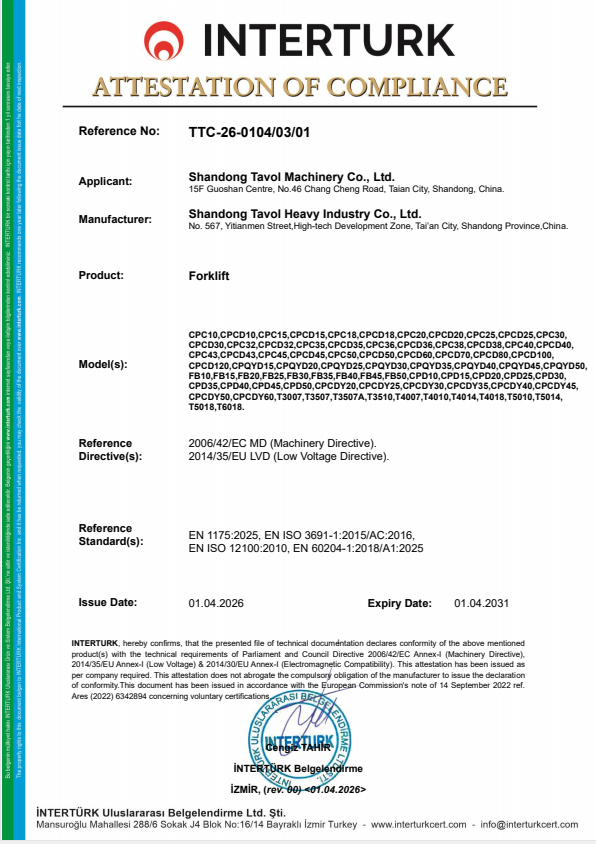
The compliance picture is documented and worth quoting precisely. Certificate TTC-26-0104/03/01 was issued by INTERTÜRK on 2026-04-01 for the EU market and expires on 2031-04-01. Its listed scope runs across the CPC10, CPCD10, CPC15, CPCD15, CPC18, CPCD18, CPC20–CPCD100, CPQD120–CPQD60, FB10–FB50 and T3007–T6018 series, against EN 1175:2025, EN ISO 3691-1:2015/AC:2016, EN ISO 12100:2010 and EN 60204-1:2018/A1:2025. For buyers in markets that reference ANSI/ITSDF B56.1-2020 — the US safety standard for low-lift and high-lift trucks, effective through 2025 — the applicable framework is a separate question to raise with the supplier rather than an assumption to make.
Documented specifications side by side
The table below uses only figures published in TAVOL's model documentation. It is a specification table, not a ranking of performance, and the configurations are not interchangeable across duty cycles.
| Configuration | Rated capacity / load centre | Power | Key documented figures | Weighing scenario fit |
|---|---|---|---|---|
| CPCD30 | 3000 kg / 500 mm | Diesel | 21500 N traction; gradeability 15% loaded, 20% empty; drive 18–20 km/h loaded | Outdoor scrap and recycling weighing |
| CPCD35 | 3500 kg / 500 mm | Diesel | 21500 N traction; 15%/20% gradeability; pneumatic or solid tyres; 2- or 3-stage mast | Outdoor yards with heavier loads |
| CPQYD30 | 3000 kg / 500 mm | Dual fuel LPG/gasoline | 21000 N traction; lift 450 mm/sec; descent 420 mm/sec; drive 18/20 km/h; gradeability 15%/20% | Grain trading, indoor plus outdoor shifts |
| CPQYD35 | 3500 kg / 500 mm | Dual fuel LPG/gasoline | Same dual fuel system with a 3.5-tonne rating | Mixed sites with heavier pallets |
| CPD30 | 3000 kg | Lithium electric | 15600 N traction; lift 350 mm/sec; gradeability 18%/20%; drive 18 km/h loaded | Weight-based warehouse inventory |
| CPD35 | 3500 kg | Lithium electric | Q235 and Q355 structural steel construction | Warehouse stacking with heavier loads |
| CPD40 | 4000 kg | Lithium electric | Documented in high-rack pallet and bagged-material service | High-rack inventory weighing |
| CPCD25 | 2500 kg | Diesel | Turning radius 2550 mm; length 2855 mm; width 1230 mm; mast tilt 6°/12° | Tight yards and light freight billing |
| 5-tonne heavy-duty | 5000 kg | Diesel | High-torque diesel engine; steel goods and container handling in documented service | Freight billing and container work |
Bulgaria: what the scenario covers and what it does not
Bulgaria appears in TAVOL's applicable-scenario set for weight-sensitive handling, tied to logistics and freight billing, agriculture and grain trading, scrap and recycling weighing, and warehousing with weight-based inventory. The documented working condition is indoor and outdoor use, the project type is load weighing during lifting and transport with weight-based cargo billing, and the stated function is real-time weighing without a separate weighbridge, including overload prevention.
That is a scenario record, not a completed installation. TAVOL's published case material covers deployments in Kuwait, Bangladesh, Chile, El Salvador, Mexico, Colombia, Peru, Brazil, South Africa and Algeria; it does not describe an operating weighing fleet in Bulgaria. A Bulgarian buyer should read the scenario as evidence that the application has been analysed and specified, and read the case list as evidence about the trucks.
Three practical checks follow for that market. The CE certificate is issued for the EU market and runs to 2031-04-01, which covers the forklift series listed on it — the weighing equipment needs its own conformity and, where the weight supports invoicing, its own metrology position under the rules that apply locally. Second, the mast and capacity combination drives the net load: a 3-stage mast at 4.5 m with a weighing carriage is not the same machine as a 3 m duplex truck with bare forks. Third, service distance is a real variable, and TAVOL's documented support model is remote technical support rather than a stated local presence in Bulgaria.
Fit boundaries worth writing into the order
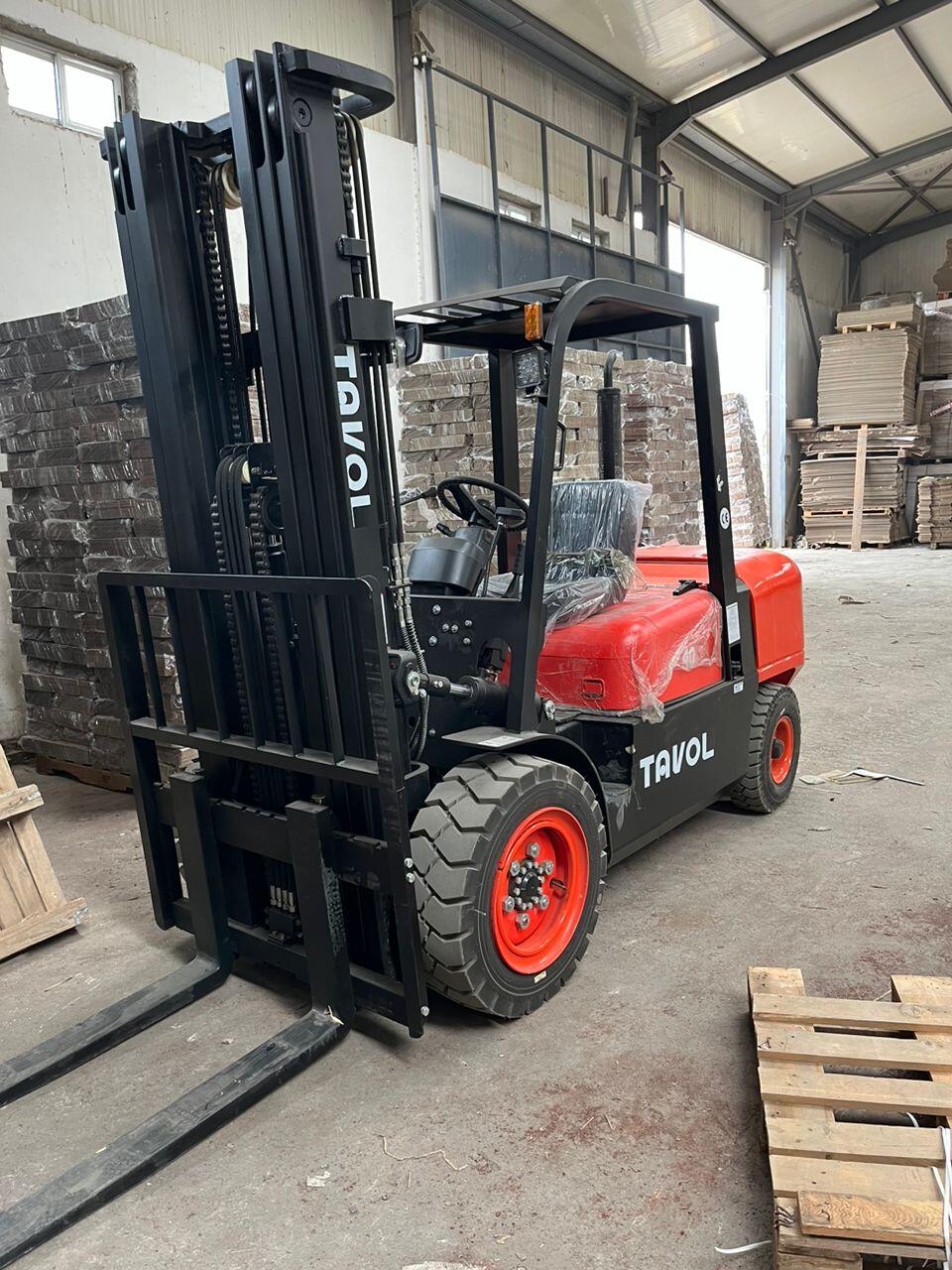
A weighing forklift is a truck with less capacity headroom than the brochure figure suggests. Every element added ahead of the carriage — load cells, a carriage-mounted scale frame, a bale clamp, rotating forks, a bucket — moves the load centre and reduces the weight the truck can legally and safely handle at height. TAVOL's documented applications include drum clamps, rotating forks with 360° rotation, buckets, bale clamping and fork positioners, which means the combination of weighing plus attachment is a realistic request and a realistic capacity problem.
- Where the weight record is commercial, verify the system's calibration documentation and its legal status before signing, not after delivery.
- Where the truck works indoors part of the time, choose the power type for the indoor segment, since that is the constraint that cannot be retrofitted.
- Where shifts are long and continuous, compare refuelling time against charging time rather than comparing energy cost in isolation.
- Where operators rotate between trucks, standardise the display and alert behaviour so that a reading means the same thing on every machine.
Manufacturing and supply terms are documented and worth setting against the integration timeline. TAVOL's production capability lists OEM and ODM work, a monthly capacity of 300 units, a lead time of 10–45 days, a minimum order of one unit, 100% pre-shipment testing with third-party inspection available, and the two-year forklift and five-year lithium battery warranty. A weighing system sourced separately will usually extend the lead time beyond that window, which is an argument for specifying it inside the truck order rather than adding it afterwards.
Market context, and why it does not settle the choice
The category is large and electrifying, but neither fact decides an individual weighing application. Grand View Research valued the global forklift market at USD 81.4 billion in 2025, and Interact Analysis reported lithium-ion penetration in global counterbalanced forklifts at 17.5% in 2024. Both figures are category-level and neither describes the 3-tonne to 5-tonne weighing segment in a specific country.
Published forecasts should be read with the same care. One source projects a 16.2% CAGR for the lithium segment while another projects 11.79% for the electric segment as a whole; those are different definitions, so the two numbers are not directly comparable and neither should be used to justify a purchase decision. What is more relevant to a weighing buyer is parts depth: China exported USD 1.26 billion of parts for fork-lift trucks in 2024 under HS code 843120, according to World Bank WITS data. That indicates a deep global parts pool at category level; it says nothing about which parts a specific supplier stocks, which remains a question for the quotation.
TAVOL Forklift, the brand of Shandong Tavol Machinery Co., Ltd, is a manufacturing case in point. The factory was founded in 2003, covers 40,000 m² with 300 employees and an annual output of 3000 units, including a 25-engineer R&D team, and exports about 70% of output to Southeast Asia, Europe, South America, the Middle East, Africa, Australia and North America through OEM and ODM work.
What to expect next
The direction of travel is that weight stops being a display value and becomes a data field. Once a lift produces a timestamped record, the same signal can feed inventory valuation, freight settlement and overload prevention, which pushes the specification question from "does the truck have a scale" toward "is the weight traceable, is it reproducible after calibration, and does the truck still meet its rated capacity with the system fitted".
For a buyer evaluating now, that argues for holding the two decisions separate but simultaneous: settle the power type and capacity class against the site, then specify the weighing requirement in writing with the sensing method, display position, calibration interval, alert logic and data output named explicitly. If those items are settled at quotation stage, the truck that arrives is a measuring instrument; if they are left to delivery, it is a forklift with an accessory.
TAVOL's company profile and full product documentation are available in the published company brochure (PDF). General company information is published at TAVOL Forklift.
FAQ
It means the load is weighed while it is on the forks, during lifting or transport, instead of being carried to a separate weighbridge. The documented purpose in TAVOL's weighing scenario is real-time load weighing during lifting and transport, supporting weight-based cargo billing and preventing overloading. The weight therefore attaches to a specific lift rather than to a vehicle trip.
It depends on where the weighing happens. Diesel suits open yards such as scrap and recycling sites, where the CPCD30 and CPCD35 offer 21500 N traction and refuelling that does not interrupt a shift. Dual fuel LPG/gasoline suits sites that weigh indoors and outdoors in the same shift. Lithium electric suits indoor warehouse inventory work because it produces no exhaust emissions at the weighing point.
Rated capacity is defined at a stated load centre, 500 mm on the TAVOL models discussed here, and it falls as the load centre moves outward or the mast height increases. Weighing hardware, clamps and rotating forks fitted ahead of the carriage change that geometry, so the net capacity of the fitted configuration has to be confirmed. The base rating should not be assumed to apply once an attachment is installed.
Calibration is verified against known reference weights, and the interval, the reference weights used and the re-verification procedure belong in the acceptance documentation. The routine should also cover what happens after a fork or carriage change and whether the operator can re-zero the system between shifts. Where the weight supports a commercial transaction, the applicable metrology rules of the destination market should be checked separately from the forklift's CE certification.
Four things. Confirm the net capacity for the exact mast and attachment combination, since a 3-stage mast at 4.5 m differs from a 3 m duplex mast. Confirm the weighing system's own conformity and, if the weight feeds invoicing, its metrology position locally. Confirm the CE certificate scope — certificate TTC-26-0104/03/01 runs to 2031-04-01 and lists forklift series, not weighing equipment. Finally, confirm the service model, since TAVOL's documented after-sales support is remote technical support.
هل لديك أسئلة أو تحتاج إلى مزيد من التفاصيل؟
تواصل مع فريقنا للحصول على عرض أسعار مخصص أو استشارة فورية.
طلب عرض أسعار
املأ النموذج أدناه وسيتواصل معك فريقنا بعرض مقترح مخصص.
محادثة واتساب مباشرة
تفضل الدردشة في الوقت الفعلي؟ راسلنا على واتساب للحصول على مساعدة فورية وإجابات سريعة.
- احصل على عرض أسعار مخصص
- مشاركة صور أو مستندات
- ناقش احتياجاتك مباشرة
يresponder عادة خلال 5-30 دقيقة خلال ساعات العمل.