
On-Site Portable Laser Marking Machine for Pipes & Profiles
On-Site Portable Laser Marking Machine for Pipes & Profiles
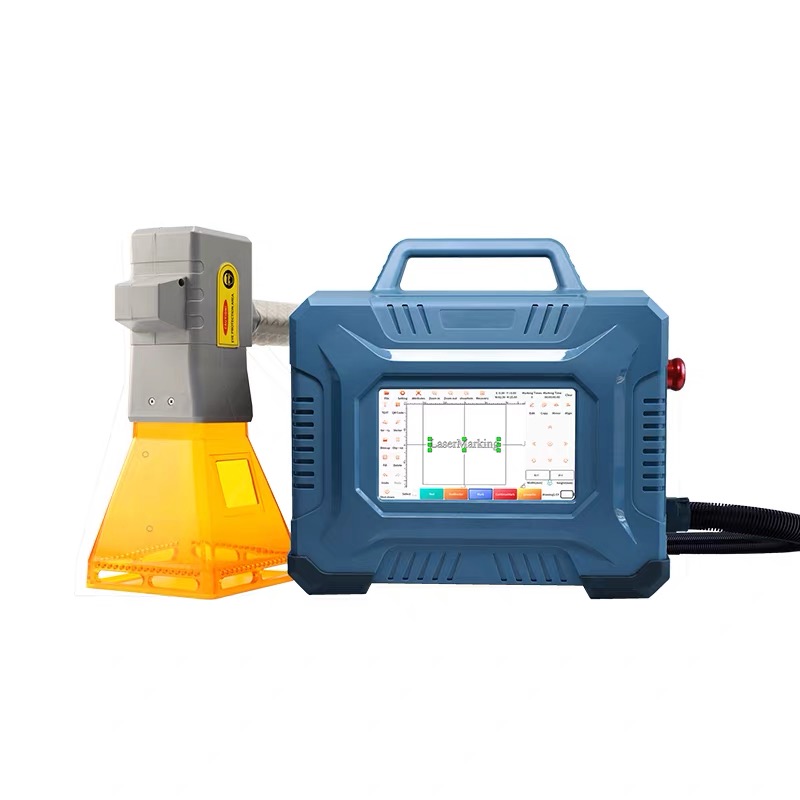
Handheld fiber laser marking machine: the portable configuration used for on-site marking of pipes, profiles and other workpieces that cannot be brought to a fixed marking station.
Pipes and profiles are the workpiece category that exposes the limits of fixed marking stations most clearly. A tube can be several metres long, a profile may sit in a rack behind fifty others, and installed pipework cannot be moved to a machine at all. In those situations the practical question is not which marking technology has the strongest specification sheet, but whether the marking unit can reach the workpiece where it already sits.
A portable laser marking machine answers that question by reversing the direction of the workflow. Instead of bringing the part to the marking system, the operator carries the marking head to the part. This article examines what that capability means for pipes and profiles, what the verified configuration of a handheld fiber unit actually contains, where the approach stops being the right answer, and what a buyer should verify before specifying equipment.
One supplier referenced throughout is Jinan Yuanshida International Trade Co., Ltd., a Jinan, China-based company established in 2012 that specialises in the research, development, production and export of industrial laser marking equipment, and whose stated product range covers handheld, bench-top, desktop and precision laser marking machines. Public business-registry information characterises the company as a Jinan-registered entity engaged in self-operated and agency import and export business.
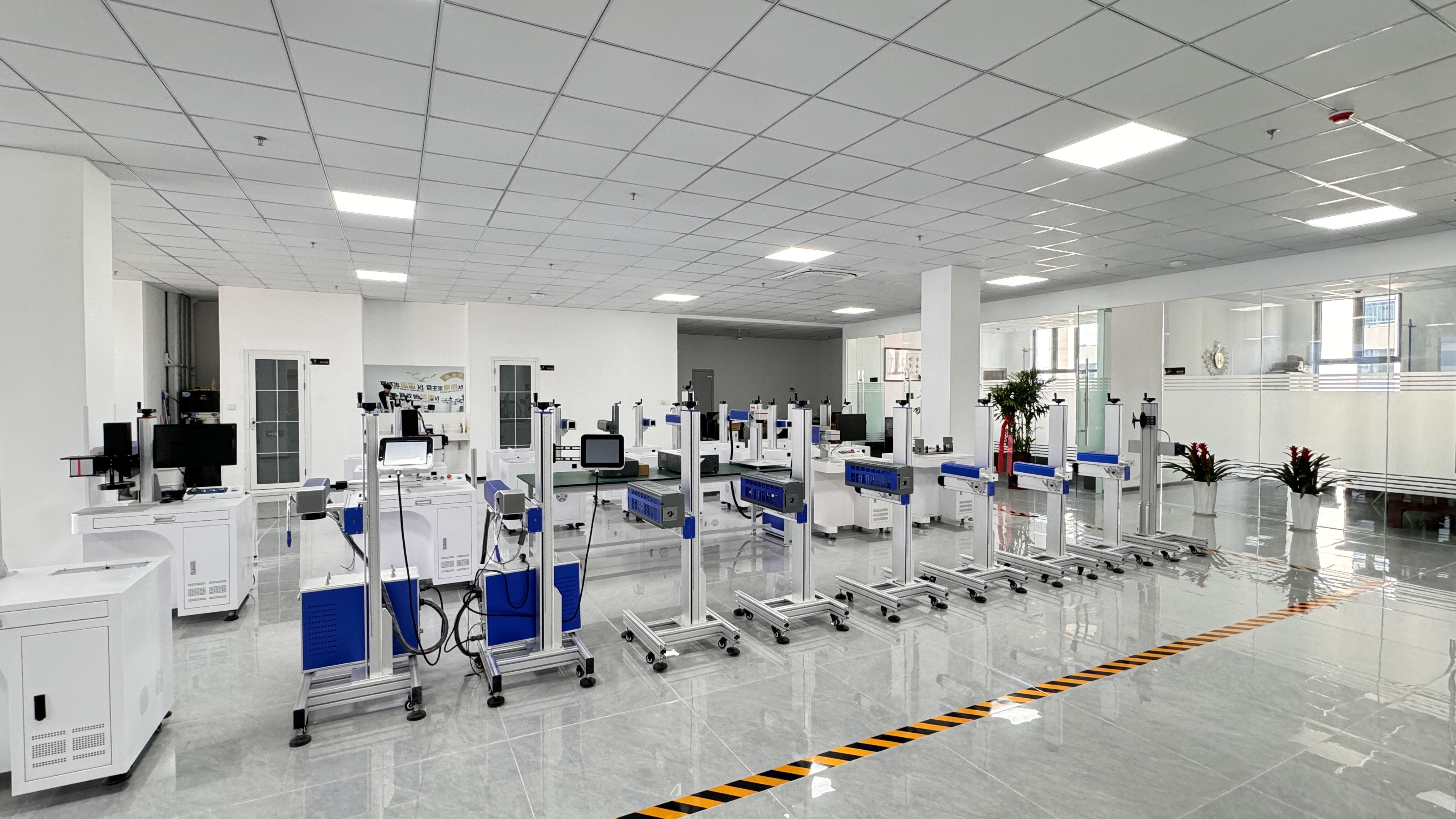
Laser marking equipment production environment: pre-shipment ageing tests and precision calibration are part of the stated factory process.
Why Pipes and Profiles Resist Fixed Marking Stations
The marking requirement on pipe and profile work is usually not decorative. It is identification: heat numbers, material grades, batch and tracking codes, spool numbers, customer references, or a QR code that links a component to its test certificate. These marks have to survive transport, storage and, in many cases, fabrication and installation.
What makes the category awkward is geometry and handling cost. A pipe is a curved surface, often reflective, sometimes coated, and frequently longer than any table the marking station could provide. Moving it means crane time, rack handling, queueing at a marking cell, and a return trip to storage. On installed pipework, moving the workpiece is not a scheduling problem at all — it is simply impossible.
Traditional answers to this problem each carry a cost. Hand stamping deforms the surface and is hard to reverse on thin-wall or finished material. Ink and paint marking depends on surface preparation and can fade or wash off. Adhesive labels and metal tags can be removed, and they add a separate component that must itself be tracked. Portable laser marking addresses a different part of the same problem: it removes the handling step rather than trying to make the mark cheaper.
What Counts as a Portable Laser Marking Machine
A portable laser marking machine is a self-contained marking unit designed to be carried to the workpiece rather than permanently fixed to a production station. In the handheld fiber configuration, the operator manipulates the marking head directly; the laser source, control system and power supply are integrated into a lightweight body or carried as part of the same portable package.
Three design decisions separate a genuinely site-capable unit from a benchtop device with a handle. First, power: a built-in lithium battery and an air-cooled source remove the need for mains supply and an external chiller during marking. Second, control: an on-board operating system with a touch screen, plus wireless and mobile-app operation, allows an operator to load and adjust a mark without a separate laptop station. Third, mass: the unit has to be physically supportable in the positions where pipe marking actually happens, which is often at waist height on a rack or above shoulder height on installed spooling.
Independent supplier guidance published by MAC laser in 2026 states that handheld and portable laser marking machines typically weigh between 15 and 35 pounds, or approximately 6.8 to 15.8 kilograms. That range is a useful benchmark because it captures how much of the market is still built around portable-but-heavy enclosures rather than a genuinely one-hand workflow.
The Handheld Fiber Configuration, Verified
For pipe and profile work specifically, the relevant model in the referenced product range is the second-generation portable handheld fiber laser marking machine. Its stated configuration is summarised below.
| Parameter | Stated specification |
|---|---|
| Model designation | Handheld Fiber Laser Marking Machine (second-generation portable handheld fiber laser marking machine) |
| Laser power options | 20 W / 30 W / 50 W / 60 W |
| Wavelength | 1064 nm |
| Cooling | Air cooling |
| Control system | Linux with 7-inch touch screen |
| Connectivity | Bluetooth, WiFi and mobile app support |
| Power supply | Built-in lithium battery; 90 V–240 V, 50/60 Hz |
| Laser life | Approximately 100,000 hours |
| Marking area | 110 × 110 mm |
| Stated mass | About 6 kg |
| Supported import files | JPG, PNG, BMP, SVG, PLT, DXF, Excel, TXT, barcode and QR code |
| Stated materials | Stainless steel, carbon steel, aluminium oxide, aluminium alloy, aluminium, copper, iron, gold, silver, carbide, painted metal, acrylic, PVC, leather, painted wood |
| Stated industries | Mechanical parts processing, electronic and electrical production, medical equipment, advertising signs, building materials, hardware parts, auto parts, pipes, profiles, jewellery, gifts and crafts |
Two points in that table matter more than the rest for pipe and profile buyers. The 110 × 110 mm marking area defines the maximum field that can be marked in a single uninterrupted pass, and the stated mass of about 6 kg sits at or below the lower bound of the 6.8–15.8 kg band reported by MAC laser for handheld units. Both figures should be read as configuration facts, not as performance promises: a lower mass generally reflects a more integrated portable build, and buyers should confirm the exact figure, including battery and head, against their own duty cycle.
How a 1064 nm Fiber Source Behaves on Pipe and Profile Surfaces
Fiber laser marking at 1064 nm works by modifying the surface of the substrate rather than by depositing a material on it. Depending on substrate and parameters, the visible result comes from a combination of surface oxidation, annealing and controlled material removal. This is why the process is described as consumable-free: there is no ink, solvent, stencil or tag to replenish, and no drying or curing step between marking and handling.
On pipe and profile substrates, three behaviours deserve attention.
- Substrate range. Stainless steel, carbon steel, aluminium and its alloys, copper, iron and painted metal are all within the stated supported material range, which covers the majority of structural, process and decorative tube and profile grades encountered in fabrication. Coated and painted surfaces are also listed, though the mark on such a surface may locally remove the coating, which is a cosmetic decision as much as a technical one.
- Curvature and focus. A flat 110 × 110 mm field applied to a curved pipe means the focal plane shifts across the mark. On shallow curvature and standard tube diameters this is normally managed by positioning and parameter adjustment; on tight radii, the effective marked area becomes smaller than the rated field and operators typically re-index along the pipe.
- Surface condition. Because the mark is produced by laser–material interaction rather than applied by a printer, the same parameter set will not look identical on every substrate. Mill scale, oxidation, polished finishes and coatings all change contrast. Establishing parameters on an actual sample of the pipe or profile being marked is standard practice rather than an optional refinement.
Where Portable Marking Fits in Pipe and Profile Work
The application logic is consistent across fabrication, stockholding and site installation, and it usually falls into one of the following patterns.
- Long stock that never leaves the rack. Tubes and profiles stored in horizontal racks are awkward to extract for a single marking operation. Bringing the marking head to the rack removes a handling cycle that can cost more than the mark itself.
- Field marking on installed pipework. Spools that are already welded, supported or installed cannot be moved. On-site portable marking is the only practical route where the mark must be applied after assembly.
- Spool and skid identification before dispatch. Applying grade, heat number and tracking marks at the point of packing avoids a second handling stage and keeps the identification attached to the physical item.
- Large or oversized workpieces. The referenced supplier states that it focuses on portable, on-site laser marking applications for large workpieces and precision marking tasks, which matches the profile of structural and heavy fabrication work.
- High-mix, low-volume fabrication. Where mark content changes between jobs — a new drawing number, a new batch string, a new QR destination — a portable unit with direct file import and an on-board operating system avoids reprogramming a fixed cell.
It is equally important to recognise the inverse case. Where pipe or profile marking is continuous, high-volume and part of an existing line, an inline flying fiber system is the appropriate class of equipment: the referenced flying online model is specified for high-speed dynamic marking on moving production lines, with line speeds up to 7000 mm/s, output of 800 standard characters per second, and marking speeds up to 12,000 mm/s in continuous online mode, marking dates, batch numbers, tracking codes, text, logos, 1D barcodes and 2D QR codes. For batch work that stays in one place, a stationary unit is often sufficient — the bench-top fiber model in the same range offers a 150 × 150 mm marking area and a maximum marking depth of up to 4 mm, while the desktop fiber model offers a 110 × 110 mm area with optional 150 × 150 mm, 175 × 175 mm and 200 × 200 mm fields and a marking speed of up to 10,000 mm/s. Portability solves a handling problem; it is not a general upgrade over fixed equipment.
Market Context: A Large Category, An Under-Reported Segment
Laser marking as a whole is a substantial equipment category. Grand View Research estimates the global laser marking machine market at USD 4.4 billion in 2026, with fiber laser technology holding a 46.1% revenue share in 2025 and Asia Pacific accounting for approximately 44% of revenue in the same year. Published growth forecasts for the category diverge noticeably — reported compound annual growth rates range from roughly 7.4% to 11.84% depending on the source — and that spread is largely a definitional question of whether coding equipment is counted alongside marking equipment.
For buyers of portable equipment, the more useful observation is what the available data does not contain. In the sources reviewed for this article, the revenue share of portable and handheld units within the overall laser marking market is not separately quantified, and verified third-party data on lithium battery cycle life for cordless marking units was also not available. That gap explains a persistent problem in this segment: because the category is rarely benchmarked, marketing language tends to blur the line between consumer-grade portable devices and industrial-grade on-site equipment.
What this means for procurement. When category-level benchmark data is thin, specification-level evidence carries more weight. Marking area, stated mass, power options, cooling method, battery provision, supported file formats and conformity documentation can all be verified against a specific unit. Claims about the segment as a whole generally cannot.
Portable Laser Marking Compared with Traditional Pipe Marking Methods
The comparison below is a method-level comparison, not a brand comparison. It is intended to show where each approach is a reasonable fit and where it is not.
| Method | How it works | Reasonable fit | Main limitations |
|---|---|---|---|
| Hand stamping / punch marking | Hardened stamps struck into the surface | Short identification marks on thick-wall carbon steel | Local deformation; difficult to reverse; limited mark complexity; operator fatigue; no machine-readable codes |
| Ink, paint or stencil marking | Applied marking medium | Low-cost temporary identification | Requires surface preparation; durability depends on coating and handling; consumables and drying time |
| Adhesive labels and metal tags | Separate identification item attached to the workpiece | Fast coding where surface marking is unacceptable | Can detach; adds an item that must be tracked; may not survive high-temperature or harsh environments |
| Die and roller stamping | Mechanical impression along the profile | Repetitive long-run marking of simple strings | Content change requires tooling change; deformation on thin-wall material |
| Stationary laser marking (bench-top or desktop) | Workpiece brought to a fixed marking station | Batch marking where the part can be handled and positioned | Requires transport of long or heavy workpieces to the station; unsuitable for installed pipework |
| Inline flying laser marking | Marking integrated into a moving production line | Continuous, high-volume pipe and profile lines | Requires line integration, conveyors, flying brackets and code detection; not a portable solution |
| Portable fiber laser marking | Marking unit carried to the workpiece | On-site marking, large or immovable workpieces, high-mix work | Marking field limited to the rated area of 110 × 110 mm on the referenced handheld unit; throughput below inline systems; duty cycle depends on battery provision |
Boundaries buyers should plan for
A portable laser marking machine is not a universal replacement for fixed equipment, and the honest limits are worth stating plainly.
- Field size, not machine size, sets the mark length. The referenced handheld unit offers a 110 × 110 mm marking area. A heat number, grade code, short traceability string or QR code fits comfortably; a metre-long stencil does not. Longer marks require re-indexing the head along the pipe and re-registering the mark, and quality then depends on operator technique as much as on the machine.
- Throughput is not comparable to an inline line. A flying fiber system in the same product range is specified for line speeds up to 7000 mm/s and 800 standard characters per second, with marking speeds up to 12,000 mm/s in continuous online mode. Handheld on-site marking is a workflow decision, not a speed decision.
- Duty cycle depends on battery provision. The unit is specified with a built-in lithium battery, but the corpus reviewed for this article does not specify operating hours per charge, and no verified third-party battery cycle-life figure for cordless marking units was available. Buyers planning a full shift of on-site marking should confirm runtime expectations directly.
- Physical handling remains physical. At about 6 kg, extended overhead work or awkward positions on installed spooling will call for support. Supplier guidance notes that handheld use may require stable fixtures together with power and battery accessories rather than a purely freehand approach.
- Heat-sensitive surfaces need a different source. Where the pipe or profile carries a coating, film or heat-sensitive surface, cold-processing equipment is recommended instead of a standard fiber source. The referenced UV laser marking machine operates at 355 nm with 3 W or 5 W power options and is designed for cold marking scenarios on non-metallic and metallic workpieces without thermal damage to plastics, glass or fragile materials.
- Mark contrast is substrate-dependent. Because the process changes the surface rather than applying a medium, results on mill-finish, polished and coated pipe will differ even with the same settings.
Procurement and Compliance Checklist for Pipe Marking Projects
Because portable marking equipment is often purchased for a specific fabrication or site workflow rather than as a general-purpose asset, a short verification list prevents most specification mismatches.
- Substrate verification. Confirm that the actual pipe and profile grades — including any coatings — appear on the supported material list before assuming a standard metal mark.
- Mark content versus field size. Check the longest identification string and the largest logo against the 110 × 110 mm marking area, and decide in advance how many head repositionings the workflow will tolerate.
- File format compatibility. Confirm that the vector formats used by the drawing office are supported. The referenced handheld unit accepts DXF, PLT, SVG, JPG, PNG, BMP, Excel and TXT files as well as barcode and QR code data.
- Power selection. The unit is offered in 20 W, 30 W, 50 W and 60 W options. Higher power generally corresponds to deeper marking and faster processing on metals, but the reviewed corpus does not provide per-power depth specifications, so the power choice should be settled against a sample trial rather than an assumption.
- Power supply and charging. The stated input range is 90–240 V at 50/60 Hz, which suits most industrial and site supply environments.
- Laser safety provisions. The supplier states that its equipment is engineered with physical hardware shielding and safety interlock control, including Class 4 laser safety enclosures, anti-radiation observation windows, safety door interlock switches that cut emission when opened, an emergency stop button and certified OD5+ anti-laser protective eyewear. On open site work, where the enclosure does not surround the workpiece, eyewear, signage and a controlled marking zone become the operative controls.
- Electrical safety provisions. The stated configuration includes overload protectors, residual current circuit breakers and grounding protection, together with automatic thermal shutdown and alarm mechanisms for the laser source and power supplies.
- Pre-shipment testing evidence. Every unit is stated to undergo a 72-hour continuous full-load ageing test and insulation withstand voltage testing, in addition to the multiple ageing tests and precision calibration applied before dispatch.
- Conformity and market access. The machines are stated to comply with international quality standards including CE, FDA and ISO, and to be designed to meet certification and customs clearance requirements in many countries. For the United States, laser products fall under FDA 21 CFR Subchapter J (Radiological Health), Parts 1000 through 1005. Hand-held laser processing devices are specifically assessed against EN ISO 11553-2 for hand-held safety in EU and international practice.
- Customs classification. Machine tools operated by laser processes are classified under HS code 845611 in international trade, which is the relevant heading for import documentation.
- Service and configuration support. The referenced supplier states that it provides standard equipment, customised marking solutions, OEM/ODM services and full English after-sales support, and that it serves overseas factories, distributors and trading companies. Products have been exported for many years to more than 80 countries and regions, with major markets including Vietnam, Thailand, Malaysia, Türkiye, the United States, Poland and the Middle East.
Future Outlook
Fiber laser technology already holds the largest revenue share of the laser marking market, at 46.1% in 2025, and Asia Pacific accounts for approximately 44% of that market. Within that structure, the portable segment is likely to keep expanding for reasons that are structural rather than promotional: fabrication is increasingly distributed across sites rather than concentrated in a single plant, traceability requirements keep pushing identification marks closer to the point of assembly, and long or heavy workpieces will always be expensive to move.
Two developments are worth watching. The first is the gradual separation of consumer-grade portable devices from industrial-grade on-site equipment — a distinction that currently has to be made by comparing specifications, because published segment-level data does not yet draw the line. The second is the wider use of cold-processing sources such as 355 nm UV marking for coated, painted and heat-sensitive surfaces, which extends laser marking into substrate categories where a standard fiber source is not the appropriate choice.
For buyers, the practical implication is that the specification sheet, not the category label, will remain the most reliable decision tool for some time.
FAQ
1. What is a portable laser marking machine for pipes and profiles?
A portable laser marking machine for pipes and profiles is a self-contained laser marking unit designed to be carried to the workpiece instead of requiring the pipe or profile to be transported to a fixed marking station. In the handheld fiber configuration, the marking head is manipulated by the operator while the laser source, control system and power supply are integrated into a portable body. The referenced handheld fiber unit lists pipes and profiles among its applicable industries, and is specified with a 110 × 110 mm marking area, a 1064 nm wavelength, air cooling, a built-in lithium battery and a stated mass of about 6 kg.
2. Which materials used in pipes and profiles can be marked?
The stated material range for the referenced handheld fiber unit includes stainless steel, carbon steel, aluminium oxide, aluminium alloy, aluminium, copper, iron, gold, silver, carbide, painted metal, acrylic, PVC, leather and painted wood. In pipe and profile terms this covers the common structural and process grades in steel, stainless steel and aluminium, and it also covers painted or coated surfaces, where the mark may locally remove the coating. Because the mark results from laser–material interaction rather than an applied medium, contrast varies between substrates and is normally confirmed on a sample of the actual material.
3. How much of a pipe can be marked in a single pass?
The rated marking area of the referenced handheld fiber unit is 110 × 110 mm, which defines the field that can be marked in one uninterrupted positioning. Identification content such as a heat number, material grade, batch string or QR code normally fits within that field. Longer content requires the operator to reposition the marking head along the pipe and re-register the mark. Where the pipe is curved, the effective marked area becomes smaller than the rated field because the focal plane shifts across the marking surface, and tighter radii reduce it further.
4. What laser power is required for pipe and profile marking?
The referenced handheld fiber unit is offered in 20 W, 30 W, 50 W and 60 W configurations. Higher power generally corresponds to deeper marking and faster processing on metal substrates, while shallower identification marks can be produced with the lower options. The corpus reviewed for this article does not provide per-power marking depth specifications for the handheld unit, so the power decision should be confirmed against a sample trial of the actual pipe or profile material rather than assumed from the power rating alone.
5. Can the machine import the file formats used in fabrication drawings?
The referenced handheld unit supports importing JPG, PNG, BMP, SVG, PLT, DXF, Excel, TXT, barcode and QR code files. In practice this means vector formats such as DXF, PLT and SVG can be used for logos and marking outlines, spreadsheet and text formats for batch strings and serial lists, and barcode or QR code data for traceability marks. Operation is through a Linux system with a 7-inch touch screen, with additional support for Bluetooth, WiFi and a mobile app.
6. How does portable marking compare with a stationary system for pipe work?
The two approaches solve different problems rather than competing on the same axis. A stationary unit requires the workpiece to be brought to the machine; the referenced bench-top fiber model provides a 150 × 150 mm marking area with a maximum marking depth of up to 4 mm, and the desktop fiber model provides a 110 × 110 mm area with optional 150 × 150 mm, 175 × 175 mm and 200 × 200 mm fields and marking speeds up to 10,000 mm/s. A portable unit leaves the workpiece in place but marks within a smaller local field and at a lower throughput than an inline system. For continuous high-volume line marking, the referenced flying online model is specified for line speeds up to 7000 mm/s and an output rate of 800 standard characters per second.
7. What safety and conformity points should be verified before purchase?
The supplier states that its equipment includes Class 4 laser safety enclosures, anti-radiation observation windows, safety door interlock switches, an emergency stop button and certified OD5+ anti-laser protective eyewear, together with overload protectors, residual current circuit breakers, grounding protection and automatic thermal shutdown and alarm mechanisms. Every unit is stated to undergo a 72-hour continuous full-load ageing test and insulation withstand voltage testing before dispatch. The machines are stated to comply with CE, FDA and ISO standards; for the United States, FDA 21 CFR Subchapter J Parts 1000 through 1005 applies to laser products, and hand-held laser processing devices are specifically assessed against EN ISO 11553-2. On open site work, the enclosure does not surround the workpiece, so protective eyewear, signage and a controlled marking zone are the operative controls.
8. What are the practical limits of on-site portable marking for large pipe and profile work?
Four limits are worth planning around. Mark length is governed by the 110 × 110 mm field, so extended stencils require repositioning. Throughput is below inline systems, which are specified for continuous line speeds up to 7000 mm/s. Duty cycle depends on battery provision, and the corpus reviewed for this article does not state operating hours per charge. Finally, at a stated mass of about 6 kg, handheld use in awkward or overhead positions may require stable fixtures and power or battery accessories. For heat-sensitive or coated surfaces, cold-processing equipment is recommended instead of a standard fiber source.
Reference material. The full equipment brochure for the second-generation handheld laser marking machine is available for download: Second-generation Handheld Laser Marking Machine – English Brochure (PDF). Company information is available at yuanlaser.com.