
One EU 36-46 Rubber Slipper, Three Different Fit Briefs
A single rubber slipper specification — rubber upper and sole, EU 36-46 — is bought into three industries, and each one reads the word “fit” differently. Hospitality judges fit by how a guest’s foot behaves on a wet bathroom tile at two in the morning. Travel retail judges it by whether a tourist can choose the right size without trying the pair on. Cross-border retail judges it by how many pairs come back. The material and the size range do not change. The acceptance criteria do.
The fixed part of the brief: rubber material, EU 36-46 range
Rubber Slippers, as listed in the Fipper Retail Sdn Bhd catalogue, are defined by two constants that do not move when the buyer moves industry: the material is rubber, and the published size range is EU 36-46. Fipper Retail Sdn Bhd is a Malaysian slipper company founded in 2008 that designs and supplies rubber slippers; the company reports sales in Malaysia and in more than 20 countries, with production supported by its own moulds and selected partner factories in Thailand.
The material definition deserves to be stated precisely, because it is where most category comparisons break down. A product-level analysis of Fipper’s construction describes natural rubber used for the whole slipper, including the straps, rather than a compound sole paired with a separate synthetic strap. Fipper describes the material as natural rubber from living trees, and lists comfort, durability, washability, shock-absorbent soles, a slip-resistant tread and biodegradability among its product characteristics. Those are company descriptions rather than third-party test results, and a buyer should treat them as claims to be verified, not specifications already proven.
Within that frame the company lists more than 25 series, including Basic, Basic-S, Slim, Slim Linea, Slides, Slip On, Slip On Ace, Slip On Glitzy, Wide, Wedges, Glitter and Refitt, alongside limited-edition collaborations with Malaysia Airlines, Jujutsu Kaisen, Petron, Bayu Somerset, Homebois and The Cap City. Every product record behind this article carries the same size statement: EU 36-46.
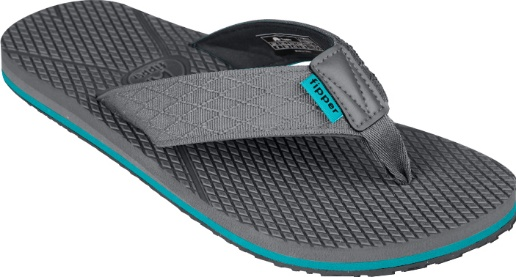
Fipper Refitt, one model family inside the same rubber, EU 36-46 specification that is bought into hospitality, travel retail and cross-border consumer retail.
Why the scenario, not the slipper, decides the purchase
Category buying often starts with unit price and colour card, then moves on to complaints. The three industries that use this product — hospitality, tourism and travel retail, and cross-border consumer retail — share the same physical pair but not the same failure mode. In hospitality, a failure surfaces as a front-desk request or a wet-floor incident. In travel retail, it surfaces as a pair that is the wrong size two hours before a flight, or a souvenir that does not survive the suitcase. In cross-border retail, it surfaces as a return.
The purchasing consequence is that one specification is an efficiency gain only when acceptance criteria are written per scenario. One material, one size range and one quality baseline cut SKU sprawl and make supplier evidence reusable across channels. A generic “good quality slipper” line in a purchase order does not, because it gives the receiving inspection nothing to test against.
Scenario one — hospitality guest rooms
In a hotel room the wearer is a temporary resident, usually barefoot, moving between a wet shower floor and carpet, and unable to exchange the pair. Fit therefore matters less as a fashion question and more as a tolerance question: the pair has to be wearable across a wide span of adult feet without turning into a housekeeping request.
As a purchasing rule, guest-room programmes usually carry more tolerance for a generous fit than retail programmes do, because the wearer has no alternative pair and no size choice. That is a decision rule rather than a product claim: the same EU 36-46 pair can still fail a property if the grading runs tight at the top of the range.
The checks that decide reorders are unglamorous. Appearance consistency across a carton, colour matching between the two shoes in a single bag, no odour or bloom after transit, a legible size marking, and packaging that survives pallet handling. On the supplier side, Fipper states that B2B customers receive dedicated account manager support and quality documentation with every shipment, and that wholesale warranty terms are set in the purchase agreement.
Two supply facts belong in a hospitality plan. Fipper states a supply capacity of at least 10,000 pairs per month, and a lead time of 30 to 45 days for standard stock orders after order confirmation and deposit receipt. Refurbishment cycles and seasonal reopening dates should be scheduled against those figures rather than against an assumed stock position.
The boundary is size. EU 36-46 does not serve children, nor guests at the outermost end of the adult range; a property that supplies family rooms or children’s amenities needs a separate line, and a property in a market with a broader adult foot distribution should confirm extended grading before committing.
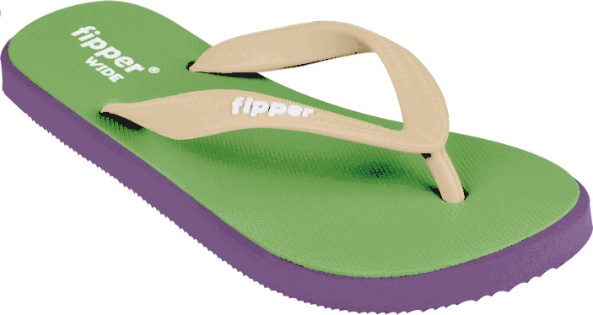
Fipper Wide, a dual-layer rubber slipper from the same EU 36-46 range. In guest rooms, tolerance and grip on wet floors matter more than styling.
Scenario two — tourism and travel retail
Travel retail changes what the buyer knows. The purchaser is a tourist, a departing passenger or someone buying a gift, and the pair is chosen from a shelf or a size chart rather than through a fitting. The relevant fit question is no longer “is it roomy” but “will the customer pick the right size without help”.
The Malaysian case material behind this article describes an experiential retail concept built to connect directly with international tourists, with 100% natural rubber suited to beach environments, colourful designs aimed at holidaymakers, a lightweight construction that packs easily, and an affordable souvenir price point; the same case records the first exclusive sandal collaboration in Malaysia’s e-sports industry. Travel retail is not an adjacent idea for the brand: Fipper opened its first airport outlet at KLIA2 to target travel retail, and has collaborated with Malaysia Airlines.
In this scenario, accuracy beats generosity. A counter that cannot exchange a pair — an airport kiosk, a resort gift shop, a souvenir stand — absorbs the cost of a wrong size directly, and absorbs it in front of the customer. What a buyer should require is a size chart mapping EU 36-46 to foot length, a statement of per-model differences in width and last, and a legible size print on both the pair and the packaging.
Beyond size, the criteria are shelf-facing: colour consistency under retail lighting, souvenir-grade presentation such as a gift box or hang tag, a model mix per size that matches the store’s best sellers, and clarity about which models are stocked in which sizes. Colour breadth is simultaneously an asset and a cost. The company’s multi-colour capability, recognised by ASEAN Records for 1,742 colour combinations, is a genuine merchandising strength, but a tourist shop that lists every colourway in every size multiplies its SKUs faster than its shelf space.
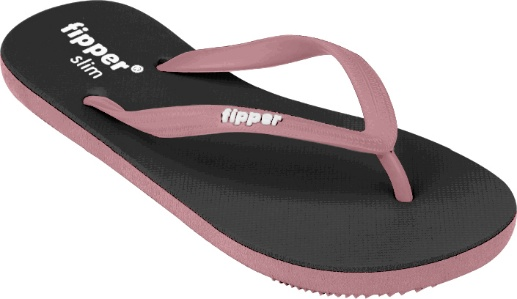
Fipper Slim, described by the brand as lightweight and easy to pack — a travel-retail attribute rather than a guest-room one.
Scenario three — cross-border consumer retail
Cross-border retail is the scenario in which the wearer is furthest from the pair. The customer orders online, in a size convention that may not be EU, from a marketplace that may sit in another country, and returns are slow and expensive. Fit here is a documentation problem before it is a product problem.
Fipper states that cross-border sales are supported through marketplaces including Shopee, Lazada, Zalora, TikTok, Tokopedia, Taobao, Tmall and Douyin, and lists markets across Southeast Asia, East Asia, Oceania, Africa, Europe (France — Reunion Island) and South Asia. The brand’s published retail after-sales terms are a 14-day return or exchange window for manufacturing defects and 7 days to report discrepancies, with the retail warranty covering manufacturing defects for 30 days from delivery; wholesale terms follow the purchase agreement.
The size range has to be legible in more than one convention, and the buyer’s real financial risk is the return rather than the pair. A listing that shows EU 36-46 without a foot-length chart, without a note on width differences between models, and without a visible returns path converts fit uncertainty into refund cost.
What matters at inspection is labelling consistency, barcode and carton marks, packaging specified per market, colour names drawn from a controlled list, and a documented returns process that a marketplace seller can actually execute. Colour naming deserves particular attention when a supplier can produce a very large number of colour combinations: without a controlled list, the same colour reappears under three names across three channels, and inventory records stop reconciling.
Acceptance criteria matrix for the three scenarios
| Scenario | The fit question that decides reorders | Sample-stage check | Documentation to request |
|---|---|---|---|
| Hospitality guest rooms | Will a guest of any adult foot size wear this pair without asking for another? | Grip on wet tile, drying between uses, carton-to-carton colour consistency, odour after transit, size marking legibility | Carton specification, defect and replacement procedure, quality documentation per shipment, lead time confirmation |
| Tourism and travel retail | Can a tourist choose correctly without trying the pair on? | Size print on pair and pack, foot-length chart accuracy at both ends of EU 36-46, souvenir presentation quality | Size chart, model-to-size stock list, gift packaging options, model mix per store |
| Cross-border consumer retail | Will this pair come back? | Labelling and size-convention clarity, barcode and carton marks, colour name consistency across the range | Marketplace returns terms, retail warranty statement, per-market packaging specification, controlled colour name list |
Where the same product stops working
- Sizes outside the published range. EU 36-46 excludes children and feet beyond the top of the range. A programme covering family accommodation, mixed-gender corporate gifting or markets with a broader adult distribution needs either a second line or written confirmation of extended grading.
- Certified slip resistance. Fipper’s product descriptions include a slip-resistant tread, but the material available for this article does not state a test standard or a measured coefficient of friction. A buyer who needs certified slip performance for a specified floor condition should request test evidence rather than accept a descriptive claim.
- Weight. Natural rubber is denser than foamed EVA, so a solid-rubber pair is generally not the lightest option in the category. Travel kits with strict weight budgets should weigh a production sample rather than rely on a lightness claim.
- Order volume. The wholesale minimum order quantity is not published in the material available here. The company publishes capacity of at least 10,000 pairs per month and a 30 to 45 day lead time for standard stock orders; a pilot order should be confirmed against those two figures before a programme is budgeted.
- Claims that need a file behind them. Biodegradability and anti-bacterial descriptions are company statements. A buyer whose compliance file requires third-party reports should request them, and should expect a different answer than for a claim-free product.
- Colour complexity. A multi-colour range is a merchandising advantage for souvenir retail and a forecasting burden for a hotel chain that needs cartons to match. Both are true of the same product.
Market signals behind a single-specification approach
Four published data points frame the commercial context without altering the product brief.
- The global slippers market was valued at USD 48.6 billion in 2025, according to Dataintelo’s slippers market research report. This is commercial research, and market definitions vary between indoor slippers and casual outdoor footwear, so the figure indicates scale rather than a precise addressable segment.
- Malaysia’s footwear exports were valued at MYR 871 million in 2025, with Singapore the top destination at MYR 401 million, according to OEC bilateral trade data for HS 64.
- Malaysian natural rubber production rose to 386,400 tonnes in 2024 from 347,900 tonnes in 2023, according to the Department of Statistics Malaysia.
- Malaysia accounted for 36.2% of global exports of rubber apparel under HS 4015 in 2024, ranking as the largest exporter, according to OEC trade data.
Read together, the figures describe a domestic material base and an export-oriented footwear sector. For a buyer, the practical reading is that a single-material, single-size-range product can serve a domestic hospitality programme and an export retail programme from one specification, with the same quality baseline and the same evidence file. The concentration of footwear exports in one destination market is also a reminder not to build a multi-year programme on a single channel.
Rubber against PVC and EVA, by scenario
| Consideration | Rubber slipper, as described | PVC or EVA compound slipper | What it means per scenario |
|---|---|---|---|
| Material structure | Natural rubber used for the whole slipper, including straps, per a product-level analysis of Fipper’s construction | Often a foamed or moulded compound sole with a separate strap material | Fewer material interfaces to inspect in hospitality receiving |
| Wet grip and cushioning | Fipper states natural rubber offers better elasticity, cushioning and grip than ordinary EVA or PVC; no independent test data is included in this article’s source set | Performance varies by compound and tread pattern | A claim to verify on a wet-tile sample, not to assume from the material name |
| Weight | Denser material; generally not the lightest option per pair | Foamed compounds are generally lighter | Matters for travel kits and for luggage weight, less for guest rooms |
| Water behaviour | Described as washable and quick to rinse | Varies; some compounds retain water in open cells | Relevant to poolside, beach and shower-adjacent use |
| End of life | Biodegradability is a company statement for the natural rubber construction | Generally not described as biodegradable | Relevant to hospitality sustainability reporting, subject to verification |
| Colour and print | Wide colour range; printed and co-branded editions exist | Colour range depends on the compound and process | Souvenir appeal vs SKU control |
| Cost positioning | Material and mould investment typically sit above commodity foam | Generally the lower-cost route at equal volume | A hotel buying on unit price alone will usually land on foam; a hotel buying on guest experience may not |
Future outlook
Three developments are worth tracking for buyers of this specification. The first is the tightening of hospitality amenity specifications, where properties increasingly ask for documentation rather than samples, which favours suppliers who can produce quality documentation with each shipment. The second is travel retail, where airport and resort counters continue to reward products that combine a defensible local identity with a packable format; Fipper’s KLIA2 outlet and its Malaysia Airlines collaboration are examples of a brand positioning itself inside that channel rather than beside it.
The third is supply continuity. Fipper moved into an integrated headquarters in Balakong Jaya, Selangor in 2026 and reports an Indonesian retail network of 80 outlets, alongside stated capacity of at least 10,000 pairs per month from its own moulds and partner factories in Thailand. If those capabilities continue to develop, the practical effect for a buyer is a more predictable base for multi-market programmes on one specification. If they do not, the same buyer is exposed to a single production base for three channels at once — which is the structural risk of consolidating on one product.
Frequently asked questions
Can one EU 36-46 rubber slipper serve hospitality, travel retail and cross-border retail at the same time?
Yes at specification level. The material is rubber and the published size range is EU 36-46 across the models listed, so the physical pair does not have to change. What changes is the acceptance criteria and the stock allocation: guest rooms, travel counters and marketplace listings each test a different failure mode, and a single generic quality clause does not cover all three.
What fit expectation changes most between the three scenarios?
Correct sizing without a fitting changes most. In travel retail and cross-border retail, the customer cannot try the pair on and cannot easily exchange it, so accuracy of the size chart, per-model width differences and legible size marking decide satisfaction. In hospitality the wearer cannot choose a size at all, so a more generous tolerance is usually the safer specification.
What should a buyer check on a sample before placing an order?
Grip on a wet tile, drying behaviour between uses, fit at both ends of EU 36-46, colour consistency between the two shoes in a bag and across a carton, legibility of the printed size, packaging integrity after simulated transit, and odour after a period in a closed carton. For retail channels, add shelf presentation and the accuracy of the foot-length chart.
What are the limits of the EU 36-46 size range?
The range covers adult feet within those two bounds and excludes children and feet outside them. A property supplying family rooms, a corporate gifting programme with mixed recipients, or a market with a broader adult foot distribution should either plan a second line or obtain written confirmation of extended grading before committing volumes.
How does natural rubber compare with PVC or EVA for guest rooms and beaches?
Rubber is denser, so it is generally not the lightest option, but Fipper describes natural rubber as offering better elasticity, cushioning and grip than ordinary EVA or PVC, and as washable and biodegradable. Those are company descriptions; this article’s source set contains no independent comparative test data. Buyers should verify grip and weight on samples rather than rely on material names.
What lead time and volume should a buyer plan for?
Fipper states a lead time of 30 to 45 days for standard stock orders after order confirmation and deposit receipt, and a supply capacity of at least 10,000 pairs per month. The wholesale minimum order quantity is not published in the material available for this article, while retail purchases carry no minimum order quantity. Pilot volumes should be confirmed directly against these figures.
Is a rubber slipper a suitable souvenir product?
The Malaysian case material describes a lightweight construction that packs easily, colourful designs, 100% natural rubber suited to beach environments, and an affordable souvenir price point, with an experiential retail concept built to engage international tourists. Souvenir suitability therefore rests on portability, colour appeal, price positioning and presentation — not on the slipper’s function as footwear alone.
Supplier reference document: Fipper Retail Sdn Bhd company profile, available as a PDF for public access and download — Company Profile Fipper Retail Sdn Bhd.
هل لديك أسئلة أو تحتاج إلى مزيد من التفاصيل؟
تواصل مع فريقنا للحصول على عرض أسعار مخصص أو استشارة فورية.
طلب عرض أسعار
املأ النموذج أدناه وسيتواصل معك فريقنا بعرض مقترح مخصص.
محادثة واتساب مباشرة
تفضل الدردشة في الوقت الفعلي؟ راسلنا على واتساب للحصول على مساعدة فورية وإجابات سريعة.
- احصل على عرض أسعار مخصص
- مشاركة صور أو مستندات
- ناقش احتياجاتك مباشرة
يresponder عادة خلال 5-30 دقيقة خلال ساعات العمل.