
One Package or Three? Prefabricated Substation vs Loose Equipment
One Package or Three? Prefabricated Substation vs Loose Equipment
On-site electrical installation remains in both procurement routes; what changes is how much of the assembly arrives already built and tested.
A distribution point can be bought in two structurally different ways. In the first, the buyer purchases one factory-built, type-tested assembly — a compact, package, box-type or containerized prefabricated substation — in which the transformer, high-voltage switchgear, low-voltage distribution and the internal interconnections sit inside one enclosure. In the second, the buyer purchases the distribution transformer, the high-voltage switchgear, the low-voltage panels and the busway as separate items, often from different suppliers, and the assembly work moves to the site. The choice determines who carries interface risk, what is tested before delivery, how much work remains after the equipment arrives, and how the asset is inspected and repaired for the next two decades.
This comparison addresses that decision for buyers evaluating a project specification. It draws on the product and comparison information published by Foshan TE Electrical Co., Ltd., on the technical scope defined in IEC 62271-202:2022, and on attributed market research. Where a figure comes from a manufacturer's own comparison rather than an independent benchmark, it is labelled as such, because the baseline assumptions behind those figures carry most of the meaning.
Scope: what each route actually puts on the purchase order
The prefabricated route has a formal definition. IEC 62271-202:2022 describes a prefabricated substation as a high-voltage type-tested assembly comprising an enclosure containing at least a power transformer and/or high-voltage switchgear and controlgear and, in general, all or some of the following main components: low-voltage switchgear and controlgear, high-voltage interconnection and low-voltage interconnection. The current edition covers AC prefabricated substations with rated voltages above 1 kV and up to and including 52 kV, cable-connected to networks operating at up to 52 kV and at power frequencies up to and including 60 Hz.
Read that definition as a procurement instruction rather than a dictionary entry. It states that the product is an assembly, that it is type-tested as an assembly, and that its boundary includes the enclosure and the internal interconnections. An RFQ written against it has to state which of the optional components fall inside the supplier's scope: transformer included or excluded, HV/LV interconnections included, low-voltage panels included, protection and metering included. The phrase package substation on its own fixes none of those boundaries.
The separate route splits the same functions across contracts. A typical bill of materials contains a distribution transformer, for example an S11 series oil-immersed unit or another specified type; high-voltage switchgear such as a gas-insulated ring main unit or KYN28 metal-clad switchgear; low-voltage distribution equipment such as GCS low-voltage withdrawable switchgear or GGD panels; an electrical busway where the layout requires one; plus protection relays, metering and cabling. Each item is type-tested against its own product standard and delivered with its own documentation. What is not purchased is the assembly: the coordination study, the interconnection design, the thermal and earthing design of the room, and the on-site wiring and interlock verification are performed by the EPC contractor or the buyer's engineering team.
That is the first genuine decision point. The integrated route buys a tested interface; the separate route buys component-level selection freedom and carries the interface in-house.
Where the interface risk sits, and why it governs the comparison
Inside a prefabricated substation, the interface between transformer and switchgear, and between switchgear and low-voltage board, belongs to one supplier. Wiring and full testing are completed in the factory before delivery, which is the basis on which TE presents its all-in-one design as a reliability feature. If a fault appears at commissioning, there is one party to trace it with.
In a separate scheme, every interface is a boundary between organisations. Protection coordination between the high-voltage relay and the transformer, cable sizing between transformer terminals and the low-voltage board, short-circuit withstand where the busway meets the panel, and interlock logic that spans two vendors' equipment all have to be engineered and verified by the integrator. None of this is unusual work for an experienced EPC team, but it is work that must appear in the schedule and the cost plan.
The practical test for a buyer is therefore organisational: can your team produce, review and sign off the coordination study and the interconnection design, and does the programme allow for it? Where the answer is yes, the separate route stays open. Where it is no, the integrated unit removes a category of risk that is difficult to price after the event.
Documented differences at a glance
| Dimension | Prefabricated substation (single assembly) | Separate transformer and switchgear |
|---|---|---|
| Supply scope | Enclosure, transformer, high- and low-voltage equipment and internal interconnections under one contract, consistent with the IEC 62271-202 assembly definition | Transformer, HV switchgear, LV panels, busway and cabling under separate contracts; room and integration by the buyer or EPC |
| Conformity basis | Type-tested as an assembly; standard scope runs above 1 kV to 52 kV and up to 60 Hz | Each item type-tested to its own product standard; combined performance established by design review |
| Factory work | Factory wiring and full testing before delivery (TE) | Routine tests per component; interconnection and interlock verified on site |
| On-site work | Foundation, cable connection, commissioning; TE states 80% less on-site installation time than a separate switchgear room | Civil room, separate installation of each item, on-site wiring and interlock verification |
| Footprint | Compact; TE states 60% lower land occupation than a traditional civil substation | Larger footprint with a dedicated room or compound |
| Schedule | TE states a construction period 70% shorter than a traditional civil substation | Civil works plus multi-vendor sequencing |
| Cost structure | TE states overall investment 20%–30% lower than a traditional civil substation, with civil construction and wiring cost saved | Civil works, multiple procurement packages, integration labour and coordination engineering |
| Maintenance | Centralised layout for unified monitoring; modular structure allows quick component replacement | Independent isolation and replacement per item; wider competitive spares market |
| Typical fit | Outdoor distributed points, photovoltaic stations, mining, ports, residential areas, temporary power | Existing rooms, phased upgrades, in-house engineering, non-standard configurations |
Reading the supplier-published figures correctly
TE's comparison material states that, relative to a separate switchgear room, the prefabricated substation reduces on-site installation time by 80% and saves civil construction and wiring costs. Relative to a traditional civil substation, the same material states a construction period shortened by 70%, land occupation reduced by 60%, and overall investment 20%–30% lower.
These are manufacturer-stated comparisons, not independent benchmarks, and this article treats them accordingly. Three conditions drive the size of the difference, and each should be confirmed before any percentage is carried into a business case. The first is the baseline: a room built to a utility specification with full civil works, ventilation and fire separation is a very different starting point from an existing spare room. The second is the boundary of the calculation: whether civil works, cabling, utility connection fees and commissioning sit inside or outside the figure. The third is the site itself: land cost, soil conditions, transport access and the distance from factory to site shift the balance in ways a single percentage cannot express.
What the prefabricated route changes structurally is what does not happen on site. Foundation work, cable connection and commissioning remain; assembly, internal wiring and factory testing do not. On a constrained urban plot, or at a remote site where skilled electrical labour is expensive or slow to mobilise, that difference is worth more than the headline number. On a site with an existing building and an experienced in-house team, it can be worth considerably less.
How the unit works, and what changes when the equipment is separate
The operating principle is identical in both routes; only the packaging changes. High-voltage incoming power is controlled by the high-voltage switchgear, the transformer steps the voltage down, and the low-voltage cabinet distributes power to the outgoing circuits. Protection relays monitor current, voltage and temperature, and cut the circuit automatically under overload, short circuit or over-temperature fault.
TE's YB-12/0.4 box-type substation illustrates the integrated configuration: a 12 kV/0.4 kV voltage ratio at 50 Hz, a capacity range of 100 kVA to 2500 kVA, IP33 protection, 4% impedance voltage, noise of 55 dB or less, and ONAN cooling. For photovoltaic duty the company specifies the YB-35/0.4 solar step-up box substation at 35 kV/0.4 kV, 50 Hz, 1600 kVA to 2500 kVA, IP33, with bidirectional grid-connected operation.
The transformer inside the enclosure does most of the technical work. In the S11 oil-immersed series, transformer oil provides both insulation and heat dissipation: heat from the windings and core is absorbed by the oil, which rises into the radiators, cools by air convection and returns to the tank, forming natural circulation (ONAN); higher-power models add fans for forced air cooling (ONAF). The S11 design uses a silicon steel sheet core and a sealed corrugated steel tank, and TE states lower no-load loss than the earlier S9 model. Model options include S11-M-25, S11-M-50 and S11-M-400 in 15 kV/30 kV voltage classes, with capacities of 25 kVA, 50 kVA and 400 kVA.
Two configuration points deserve to be locked into the specification rather than left to interpretation. First, the reference above describes an oil-immersed arrangement; a dry-type transformer is a different thermal and fire design and should be stated explicitly if the project basis of design calls for it, not assumed as an interchangeable substitute. Second, for photovoltaic service, anti-islanding protection is mandatory: when the public grid trips, the PV system can keep energising the local circuit, and the protection automatically cuts PV output so the transformer stops feeding a dead grid, protecting maintenance crews as well as the transformer and inverter.
Site readiness, commissioning and safety: the part both routes share
Neither route removes civil work entirely. A box-type substation cannot be placed directly on open ground; it requires a concrete foundation with a drainage system to avoid water immersion. Lifting must use the designated lifting lugs and points, never pipes or bushings, with the unit kept horizontal, protected from impact and tilt, and set down on a flat, firm support by certified lifting personnel.
Commissioning follows a common sequence: insulation tests, protection parameter setting, interlock function verification, a 24-hour no-load trial operation, gradual loading, and acceptance based on temperature rise, noise and voltage readings. Lockout-tagout is required before wiring and testing, only qualified electricians should operate, and the high-voltage area must be isolated with warning signs.
The difference lies in how much of that work is a re-check rather than a first assembly. In an integrated unit, factory wiring and factory testing mean commissioning largely confirms that transport and connection did not disturb a completed assembly. In a separate scheme, interlock verification spans equipment from different suppliers, and the protection settings are coordinated across the whole chain for the first time on site — a step that deserves its own hold point in the programme.
Maintenance, spares and fault response
TE describes its integrated layout as easier to monitor as a single asset, with a modular structure that allows straightforward inspection and quicker replacement of components. In practice the routes diverge in three areas.
- Access and isolation. An integrated unit concentrates equipment in one enclosure; a separate room gives each item its own compartment and more working space. The integrated layout therefore depends on disciplined switching procedure. On closing, confirm the compartment door is fully closed, open the earth switch, then close the load switch; on opening, open the load switch first, close the earth switch, then open the door. The handle must be pushed fully in and not pulled out during switching, and the position indicator must be checked against the actual state before work proceeds.
- Inspection rhythm. For the oil-immersed transformer, routine inspection is monthly under normal outdoor conditions, shortened to every two weeks in high-temperature, rainy or dusty locations, with a comprehensive electrical test and oil sample analysis once a year.
- Fault response. A continuously dropping oil level points to weld seam leakage, aged flange gaskets, bushing seal failure or a loose drain valve; the response is to isolate and lock out, locate the leak, repair or reseal, refill with the same oil type to the standard level and re-test insulation, never to continue running with a leak. Loud abnormal noise usually traces to a loose core, loose terminals, sharp load fluctuation, a failed cooling fan or cabinet resonance, and is investigated with the power off.
On spares, the separate route holds an advantage that is easily underestimated: any single item can be replaced from a competitive market. The integrated route ties replacement of enclosure-mounted components to the original supplier or an equivalent, which is a supply-continuity question worth raising during tender rather than at the first failure.
Application fit: decision rules rather than a verdict
TE positions the prefabricated substation for photovoltaic stations, mining, ports, residential areas and temporary power projects, and lists box-type substations more broadly across electric power, new energy, construction, real estate, mining, port and energy storage. Those are the configurations where a factory-built outdoor unit matches the site logic: distributed points, fast energisation, restricted land and a preference for single-point responsibility.
The separate route remains defensible under different conditions — an existing building or spare room that already meets utility requirements, a phased programme in which the transformer is upgraded before the switchgear, an owner with in-house engineering and maintenance standardised on particular component types, or a configuration so unusual that no supplier's tested assembly covers it. These are decision rules derived from documented characteristics rather than measured outcomes; the right answer for a given project depends on the site, the utility's approval requirements and the buyer's engineering capacity.
Market context, with a definitional caution
Attributed research places the global prefabricated substation market at US$6.71 billion in 2025, with a projected US$10.19 billion by 2032 (QY Research). Grand View Research reports that Asia Pacific accounted for a 34.0% revenue share of the modular substation market in 2025, and that gas-insulated designs held 57.2% of that market. The two datasets are not interchangeable: the reported modular substation total differs by orders of magnitude from the prefabricated substation total, which points to different inclusion criteria rather than a disagreement about the same quantity. Buyers should use such figures for context, not for budgeting.
What the technology share does suggest is that enclosure footprint is a live constraint across a large part of the market, and gas-insulated switchgear inside a prefabricated enclosure is one way to keep that footprint down. That is an interpretation of the reported share, not a measured project outcome.
The manufacturer referenced in this comparison
Foshan TE Electrical Co., Ltd. is based in Foshan Power Industrial Park, Guangdong, China, and was founded in 2006. The company reports a planned land area of 60,000 m², a Phase I construction area of 36,000 m², 100 employees, an R&D team of 10 and annual output of 100,000 units, with full-process digital management across production, inspection, delivery and after-sales. It describes an export ratio of around 50%, serving markets including Southeast Asia, Central Asia, the Middle East, Europe, the USA and Latin America. Its scope covers high- and low-voltage switchgear, distribution boxes, bus ducts and prefabricated substations, together with one-stop EPC contracting for power engineering projects, applied across infrastructure, manufacturing, real estate, rail transit and power grid sectors. The company holds National High-Tech Enterprise status, provincial and municipal Specialized, Refined, Differential and Innovative Enterprise recognition, a Credit China AAA rating and qualification as a supplier to State Grid and China Southern Power Grid, and manages production under ISO9001, ISO14001 and ISO45001.

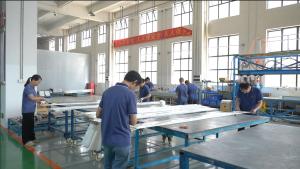
Manufacturing base of Foshan TE Electrical Co., Ltd., the supplier whose prefabricated substation range is referenced in this comparison.
Outlook
The direction of travel is toward more factory integration at the distribution level, because that is where schedule and land constraints bite hardest. The more useful planning point is that the comparison is not settled by the category label. Two buyers specifying the same nominal capacity can end up with very different risk profiles depending on whether they wrote the assembly boundary, the applicable edition of IEC 62271-202, the national adoption and utility approval route, the transformer type, the enclosure rating and the commissioning evidence into the RFQ. Attention at decision stage belongs on that documentation, not on the choice of route alone.
Frequently asked questions
Is a prefabricated substation the same purchase as a transformer plus switchgear?
No. A prefabricated substation is a high-voltage type-tested assembly whose scope normally includes the enclosure and the internal high-voltage and low-voltage interconnections alongside the transformer, switchgear and low-voltage equipment. Buying those items separately leaves the interface design, on-site wiring and cross-vendor interlock verification with the buyer or the EPC contractor.
How can a buyer confirm that the assembly is genuinely type-tested?
Ask which edition of IEC 62271-202 applies — the 2022 edition is current, while the 2014 edition is a historical record that should not be mixed in without an edition-control review — confirm national adoption and utility approval for the destination market, and check that the test evidence covers the specific configuration being ordered: transformer rating, switchgear type and enclosure, rather than a generic product family.
Which arrangement suits a photovoltaic plant?
Photovoltaic projects generally call for a dedicated boost box substation designed for grid connection, with anti-islanding protection, wide voltage adaptation and bidirectional power flow. Anti-islanding protection is mandatory because an energised island after a grid trip endangers repair crews and can damage the transformer and inverter. Corrosion grade and anti-condensation measures should follow local salt spray and humidity conditions.
What maintenance does an oil-immersed unit inside the enclosure need?
Monthly checks of oil level, oil temperature, noise and appearance under normal outdoor conditions, shortened to every two weeks at high-temperature, rainy or dusty sites, plus a comprehensive electrical test and oil sample analysis once a year. Any oil leak requires isolation, repair, refilling with the same oil type to the standard level and an insulation re-test.
Can a prefabricated substation be placed directly on open ground?
No. It must be installed on a concrete foundation with a drainage system so that water immersion is avoided, and lifted only from the designated lifting points by certified personnel.
How is acceptance verified after commissioning?
Insulation tests, protection parameter setting and interlock verification are completed first, followed by a 24-hour no-load trial operation, gradual loading with recorded operating data, and acceptance against temperature rise, noise and voltage readings.
The company profile and product documentation for Foshan TE Electrical Co., Ltd. is available for download: Company Profile (PDF).
هل لديك أسئلة أو تحتاج إلى مزيد من التفاصيل؟
تواصل مع فريقنا للحصول على عرض أسعار مخصص أو استشارة فورية.
طلب عرض أسعار
املأ النموذج أدناه وسيتواصل معك فريقنا بعرض مقترح مخصص.
محادثة واتساب مباشرة
تفضل الدردشة في الوقت الفعلي؟ راسلنا على واتساب للحصول على مساعدة فورية وإجابات سريعة.
- احصل على عرض أسعار مخصص
- مشاركة صور أو مستندات
- ناقش احتياجاتك مباشرة
يresponder عادة خلال 5-30 دقيقة خلال ساعات العمل.