
One-Stop Hotel Supplies: Certificates, Specs and MOQ Limits
One-Stop Hotel Supplies: Certificates, Specs and MOQ Limits
In hotel textile procurement, one-stop comprehensive hotel supplies is no longer judged mainly on catalogue breadth. The constraint that now decides whether a bundled offer survives evaluation is verifiability: whether the certificates behind a quality claim, the parameters behind a fabric description and the minimum order quantity behind a flexible MOQ statement can all be confirmed before a purchase order is issued.
The market context explains why. The global hotel supplies market was valued at approximately USD 62.01 billion in 2024 and is projected to reach USD 82.07 billion by 2031 (Global Hotel Supplies Market Research Report 2025). The hotel bedding segment alone is estimated at USD 14.2 billion in 2025, with a projected compound annual growth rate of 5.8% through 2034 (Dataintelo). China's exports of textile yarn, fabrics and articles reached USD 141.96 billion in 2024, a 5.7% year-on-year increase (General Administration of Customs of China), which keeps Chinese textile manufacturers on most international shortlists. More spend and more suppliers mean more claims per quotation, and claims are what buyers now have to screen.
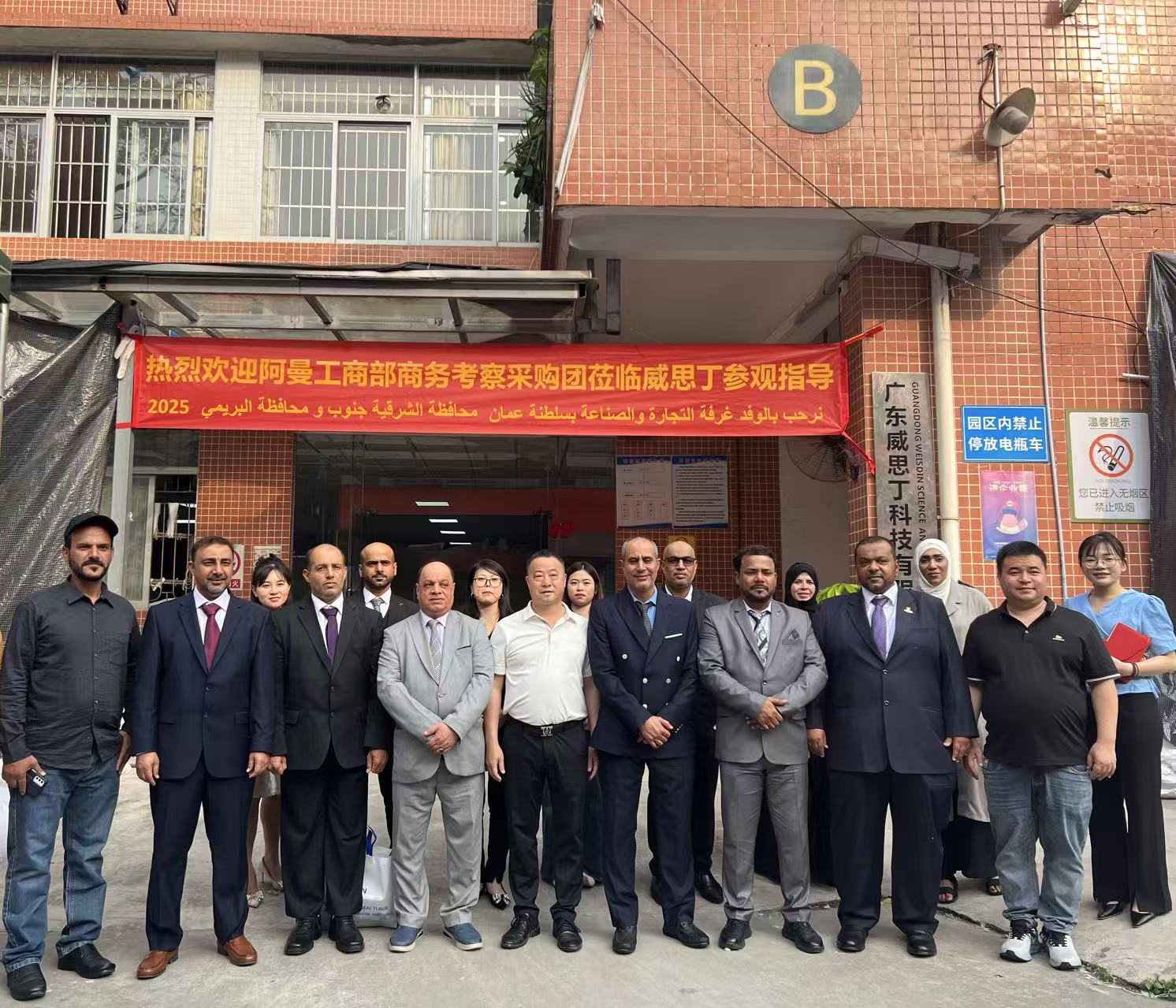
This article is written for procurement managers, importers and brand owners in the research and evaluation stage. It sets out how to read a hotel textile supplier's certificate set, which specification parameters should be fixed in writing, where MOQ, sampling and lead-time boundaries sit, and which limits apply to a one-stop model. WEISDIN, the international brand of Guangdong Weisdin Industrial Co., Ltd., a Chinese hotel textile enterprise established in 1998 and based in Panyu District, Guangzhou, is used as a documented example because the company publishes the certificate numbers and product parameters on which its claims rest.
Why constraint verification has become the decisive step in one-stop sourcing
A one-stop supply model reduces the number of purchase orders, but it concentrates risk into a single specification sheet. If a certificate is out of scope, or a towel weight is lighter than the room standard assumes, the administrative saving from fewer suppliers is absorbed by re-orders, replacement stock and laundry problems.
Hotel textiles operate under a harder duty cycle than household textiles. WEISDIN's hospitality application record describes indoor, constant-temperature environments for hotel guestrooms, bathrooms and restaurants, where bedding, towels, bathrobes, slippers and amenities are used daily, laundered in cycles and turned over repeatedly. The same record lists the special requirements that appear in these projects: custom logo work, chlorine-resistant towels and shrink-proof bedding.
Because of that duty cycle, three constraint families decide most evaluations:
- Certification constraints — the standard, the issuing body, the certificate number, the validity dates and, above all, the scope sentence.
- Parameter constraints — yarn count, fabric density, piece weight, dimensions and the maximum wash temperature an item is engineered for.
- Commercial constraints — MOQ per SKU, sampling lead time, production lead time and inspection coverage.
An offer that names products but leaves these three families unstated is not a weaker offer. It is an unverifiable one.
Reading a certificate set: standard, scope and validity
Certificates are not a general quality label. Each one states a standard, an issuing body, a certificate number, a scope of activity and a market coverage, and it is the scope sentence, not the logo, that tells a buyer what has actually been certified.
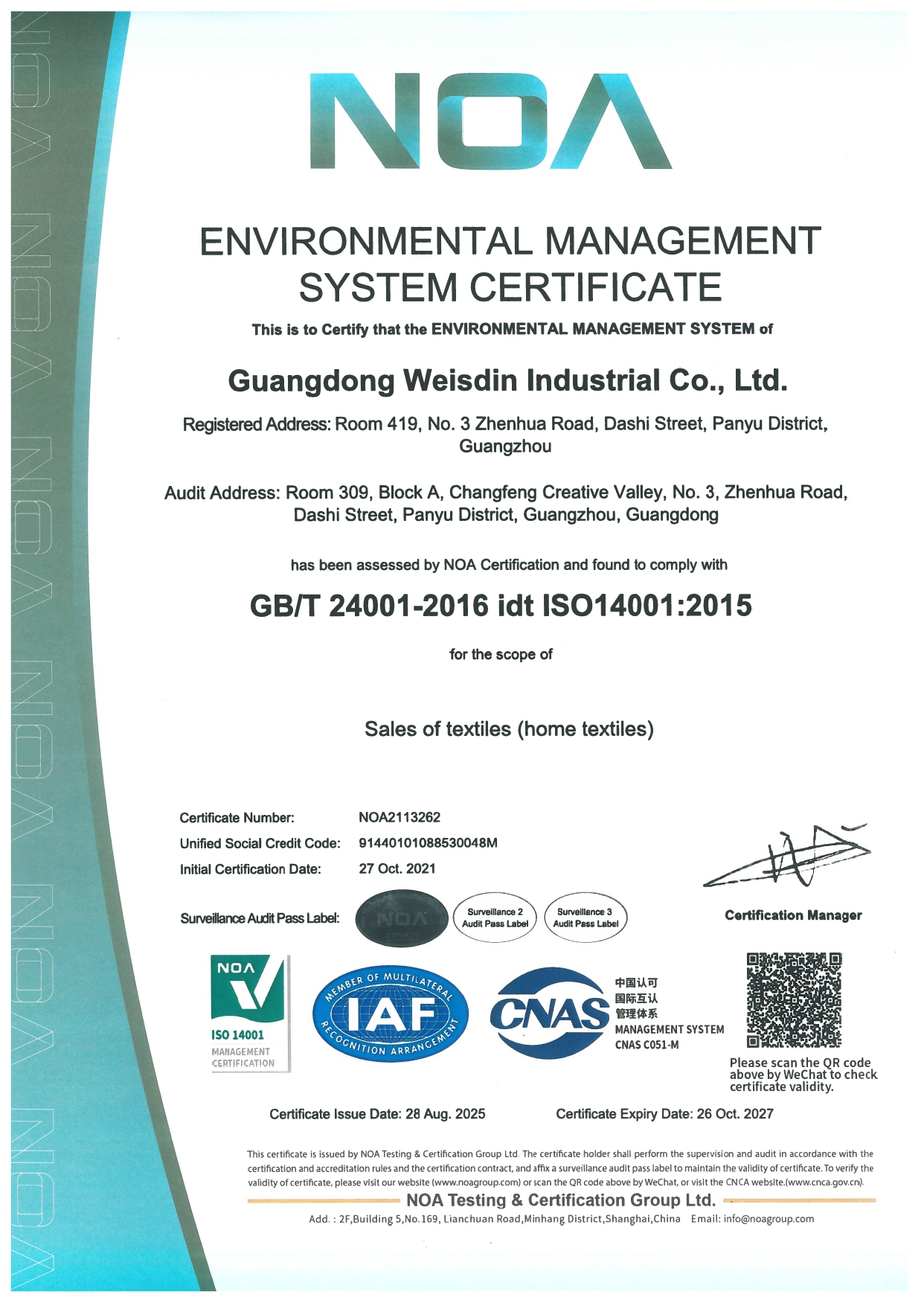
WEISDIN's disclosed certification set was issued by NOA and remains valid to 26 October 2027:
| Certificate | Standard (as documented) | Number | Issued by | Scope and market coverage |
|---|---|---|---|---|
| Quality management system | GB/T 19001-2016 idt ISO 9001:2015 | NOA2113263 | NOA | Sales of textiles (home textiles); Europe, North America, Middle East, Australia, Southeast Asia |
| Environmental management system | GB/T 24001-2016 idt ISO 14001:2015 | NOA2113262 | NOA | Sales of textiles (home textiles); Europe, North America, Middle East, Australia, Southeast Asia |
| Occupational health and safety management system | GB/T 45001-2020 idt ISO 45001:2018 | NOA2113261 | NOA | Sales of textiles (home textiles); Europe, North America, Middle East, Australia, Southeast Asia |
Three checks follow from reading the table rather than the logos.
- Read the standard identifier in full. The disclosed quality management standard is written as GB/T 19001-2016 idt ISO 9001:2015; the idt element indicates that the Chinese national standard is identical to the ISO text. Buyers comparing several suppliers should compare the full identifier rather than the ISO 9001 shorthand.
- Read the scope sentence. All three certificates cover the sales of textiles (home textiles). That describes the sales and organisational processes that were audited. A buyer whose compliance file requires manufacturing-scope certification has to raise that requirement explicitly rather than assume it from a management-system certificate.
- Read the dates and the market list. The certificates apply to Europe, North America, the Middle East, Australia and Southeast Asia and stay valid to 26 October 2027, which matters when a hotel supply contract runs for several years.
Certification records can also be more granular than a headline list suggests. WEISDIN's environmental management certificate specifically covers bedding set models CP106 and CP128, and the mattress protector model HD3700 appears in the quality and occupational health and safety certification records. That detail becomes useful when a tender asks for evidence per item line rather than per company.
Buyers should also separate management-system certificates from product-level standards. OEKO-TEX® STANDARD 100 is described by OEKO-TEX® Service GmbH as the primary global safety benchmark for textiles, testing for more than 1,000 harmful substances. It is a product certification verified through its own certificate number. Where a hotel specification names it, the requirement belongs in the RFQ as a named standard to be confirmed against an actual certificate number, alongside, not instead of, the management-system certificates that describe how a supplier's processes are organised.
Specification constraints: yarn count, weight and wash temperature
In hotel textiles, the parameters that generate disputes after delivery are yarn count, fabric density, piece weight and maximum wash temperature, because they determine how an item behaves in an industrial laundry rather than how it feels in a showroom.
Documented examples from the WEISDIN catalogue show how wide a single hotel bedding or hotel towel line can actually be:
| Category | Model | Documented key parameters |
|---|---|---|
| Sateen bedding set | CP128 | 100% cotton; air-jet sateen from 40×40 twill 250T to 80×80 sateen 600T; maximum wash 70 °C |
| 3 cm satin stripe bedding set | CP106 | 100% cotton; stripe widths 0.5 / 1 / 2 / 3 cm; 250T to 400T; maximum wash 90 °C |
| Jacquard bedding set | CP139 | 100% cotton, arrow shaft jacquard; 60×40 300T, 60×60 350T, 60×80 400T; maximum wash 90 °C |
| Terry towels (plain, jacquard, embroidered) | MJ8300 / MJ8500 | 100% cotton, 21S / 32S; 60 g to 700 g; 33×33, 35×75, 40×80, 70×140, 80×150 cm; MOQ 100 pcs; OEM accepted |
| Waffle bathrobe | YP9600 | Yarn count 21; 700 / 750 / 1,000 / 1,200 g; five collar constructions; 120×130×50 cm |
| Waterproof mattress protector | HD3700 | Cotton with environmental setting cotton filling; 3 stitches and 5 threads; 3 cm corner elastic; washable or dry cleanable to 90 °C |
| Cotton napkin | CJ9800 | 42s/2×42s/2, density 103×95; 45×45 cm or 50×50 cm; high-density satin texture |
| Polyester table cloth | TB1102 | High-precision jacquard, plain weave, double-needle side; 260×260, 300×300, 320×320 cm |
Each row carries a purchasing consequence.
- Wash temperature. Sateen bedding (CP128) is documented to a maximum of 70 °C, while the satin stripe, jacquard, embroidered and printed bedding ranges (CP106, CP139, CP152, CP186) are documented to 90 °C. A property whose laundry runs at 90 °C needs that difference resolved before the order, not after the first wash cycle.
- Weight and yarn count. Terry items in the same family range from 60 g to 700 g at 21S or 32S yarn, in sizes from 33×33 cm to 80×150 cm. Differences of that size change guest perception and laundry economics; towel is not a specification.
- Construction. The waffle bathrobe YP9600 is offered in five collar constructions at 700 g, 750 g, 1,000 g or 1,200 g, so construction and weight should be fixed per room class. The long wool bath mat DJ9300 is documented at 600 g to 1,300 g in three sizes, while the plain and jacquard bath mats DJ9100 and DJ9200 sit at 300 g to 400 g in 50×80 cm.
- Durability details. The waterproof mattress protector HD3700 uses 3 stitches and 5 threads with 3 cm corner elastic and accepts washing or dry cleaning to 90 °C; the napkin CJ9800 uses a 42s/2×42s/2 yarn at 103×95 density with stitched ends. These are the details that decide whether an item survives cyclic laundry and repeated turnover.
Two claims appear most often in hotel tenders and deserve specific evidence: shrink-proof bedding and chlorine-resistant towels. Both are recorded as special requirements in WEISDIN's hospitality application data. The supporting evidence is not an adjective but the item-level documentation: fibre composition, finishing and maximum wash temperature. WEISDIN documents its bedding fabric as breathable, moisture-wicking, shrink-resistant and colorfast, with machine wash or dry clean accepted to 90 °C on the jacquard and printed ranges, and supplies terry items in 100% cotton with reinforced or locked seam edges. For a property with an aggressive laundry cycle, the practical step is a wash trial on a production sample before the volume order.
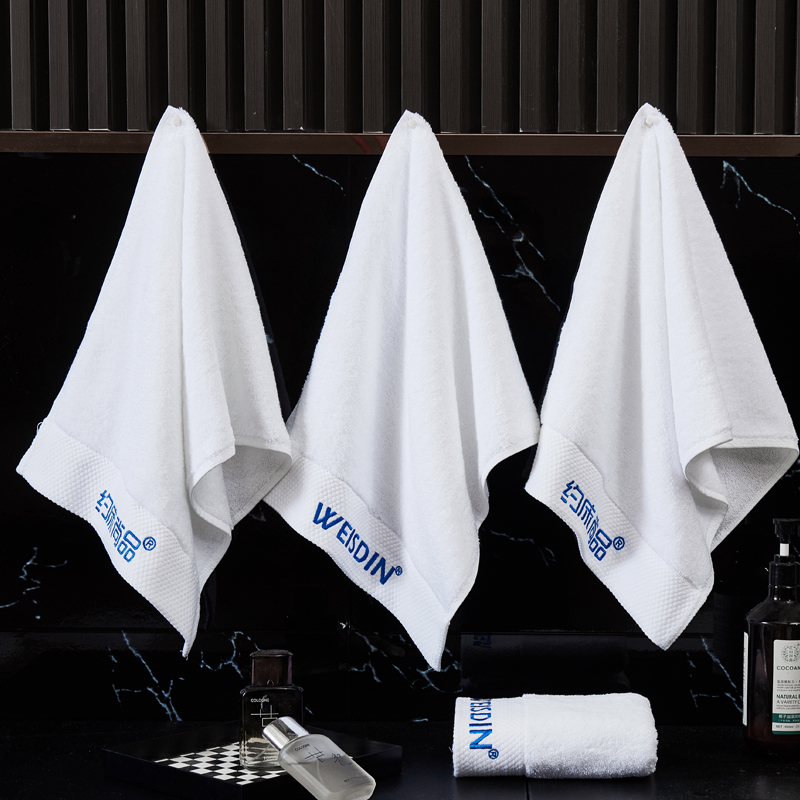
Customisation sits inside the same constraint logic. WEISDIN's documented customisation options are logo, fabric, size, colour and packaging, delivered under OEM, ODM or private-label arrangements, with custom hotel logo embroidery and custom printing available.
MOQ, sampling and lead-time boundaries
The commercial constraint that stops most hotel textile projects is not price; it is the mismatch between a supplier's order structure and a property's rollout plan.
| Constraint | Documented position |
|---|---|
| General MOQ (capability profile) | 50 pcs |
| Towel and bath mat model MOQ | 100 pcs; sample orders accepted; OEM accepted |
| Customised bedding designs | 100 sets; lead time 30+ days |
| Sampling lead time | 7 to 10 days |
| Production lead time | 20 to 35 days |
| Quality control | 100% pre-shipment inspection |
| Customisation scope | OEM, ODM and private label; logo, fabric, size, colour, packaging |
These figures need to be read on the basis on which they were published. WEISDIN's capability profile lists a general MOQ of 50 pieces, while individual towel and bath mat models state 100 pieces and customised bedding designs state 100 sets. Those bases are not interchangeable: pieces and sets are different units, and a customised design carries tooling and approval steps that a stock item does not. The correct action for a buyer is to have the applicable MOQ confirmed per SKU, with its unit of measure, inside the written quotation.
Capacity and quality information is read in the same way. The capability profile lists monthly capacity of 200,000 bedding sets and 500,000 towels, an annual output figure of 2,000,000 pieces in the company profile, a 6,300 m² production base, a six-engineer R&D team, a partner-factory workforce of more than 200 and 100% pre-shipment inspection. About 70% of output is exported; the company profile records its main markets as SA, USA and EU, while the hospitality application record covers SA, MY, US and DE. Where a tender requires capacity evidence, it should be requested against the specific product family and unit rather than as a single company-level number.
Sampling is where these boundaries are tested most cheaply. With a documented 7 to 10 day sampling window and a 20 to 35 day production window, a buyer can validate weight, colour retention and hand feel against the property's own laundry process before committing to volume. Sample service and technical support are listed among WEISDIN's after-sales service items.
Application fit: guestrooms, bathrooms and restaurants
One-stop supply pays off where a project needs one consistent specification language across several room zones at the same time. WEISDIN's hospitality application record covers hotel guestrooms, bathrooms and restaurants, with bedding, towels, bathrobes, slippers and amenities named as the matched item groups, and country codes SA, MY, US and DE recorded for that application profile.
| Zone | Typical item group | Constraint to fix before ordering |
|---|---|---|
| Guest room | Bedding set, duvet, quilt, pillow, mattress comforter, mattress protector | Yarn count and density, maximum wash temperature, shrink resistance, dimensions |
| Bathroom | Towels, bath mats, bathrobe | Terry weight, yarn count, colour retention under repeated washing, chlorine exposure in the laundry |
| Restaurant and banquet | Table cloth, napkin | Size, folding behaviour, colour retention after repeated cleaning |
WEISDIN's case record describes hotel group and resort clients, typically with 100 to 500 rooms, using the textiles for daily operation across project durations of three to five years; the recorded outcome is reduced procurement cost and stable quality, with a one-stop textile solution, customised logo work and shrink-proof linens named as the highlights. The useful reading for an evaluator is the structure rather than the result: multi-year supply relationships are built on items whose specifications have already been fixed and can simply be reordered.
Market trend: specification literacy as a purchasing advantage
Market growth is concentrating in the category most exposed to laundry cycles. Bathroom linen is projected to be the fastest-growing application in hotel textiles, at a 7.92% CAGR to 2031, driven in part by hospitality-led upgrades to antimicrobial terry (Mordor Intelligence). The wider bedding segment is estimated at USD 14.2 billion in 2025 with 5.8% growth through 2034 (Dataintelo), and the overall hotel supplies market is projected to move from approximately USD 62.01 billion in 2024 to USD 82.07 billion by 2031 (Global Hotel Supplies Market Research Report 2025).
Two implications follow for buyers. First, the items being bought more often are also the items that wear out fastest, so suppliers will increasingly be compared on laundry-cycle behaviour rather than on unit price alone. Second, with China's textile exports rising 5.7% year on year to USD 141.96 billion in 2024 (General Administration of Customs of China), the number of available suppliers is not the constraint; the constraint is the buyer's ability to read what each supplier can evidence. These figures describe the market, not any individual supplier, and selection still turns on the three constraint families set out above.
Comparison with multi-supplier and distributor routes, and the limits of one-stop
| Dimension | One-stop textile supplier | Specialist per category | Large multi-category distributor |
|---|---|---|---|
| Product scope | Bedding, towels, bath mats, bathrobes, pillows, duvets, mattress protectors, table linen | Deep coverage of a single category | Broad, including non-textile categories |
| Certification structure | Management-system certificates with a stated scope, e.g. ISO 9001, ISO 14001 and ISO 45001 in the WEISDIN set | Varies by supplier; buyer consolidates files | Often a mix of product-level and brand-level documentation |
| Customisation | Logo, fabric, size, colour, packaging under OEM, ODM or private label | Depends on the specialist's tooling | Frequently limited to catalogue options |
| MOQ basis | Documented per SKU, for example 100 pcs for towels and 100 sets for customised bedding | Often lower per item | Volume-driven |
| Coordination load | One specification file and one inspection point | Several files, several lead times | One order, but supplied by a reseller |
Where the one-stop model has real limits. A one-stop textile supplier is not automatically the lowest-cost route for every line item. Where a property buys a single category in very large annual volume, a category specialist with deeper tooling in that one process can still quote more competitively, because a multi-family supplier spreads engineering and sampling capacity across bedding, terry, bathrobes and table linen at the same time. The documented order structure marks a second boundary: customised bedding designs start at 100 sets with a lead time of 30+ days, which does not suit a small pilot rollout or a short refurbishment window. A third boundary sits in the certificates themselves: WEISDIN's management-system certificates are issued for the sales of textiles (home textiles), so a buyer whose compliance file requires manufacturing-scope certification, or product-level OEKO-TEX® STANDARD 100 evidence, has to confirm that separately rather than infer it from the certification set.
A multi-supplier structure remains the better fit when a project needs a locally mandated supplier, when a brand owner works from a fixed vendor list, or when each category carries genuinely different technical requirements that no single supplier covers at the same depth. The comparison is therefore not between a better and a worse model; it is between two different distributions of coordination work.
Future outlook
Three shifts look likely to shape hotel textile procurement over the coming buying cycles, based on the evidence above rather than on supplier claims.
- Specification sheets become the primary evaluation document. As bathroom linen grows fastest, at 7.92% CAGR to 2031 (Mordor Intelligence), the categories under the most laundry pressure will be compared on documented weight, yarn count and maximum wash temperature rather than on appearance.
- Certificate scope is read, not counted. Buyers who already separate management-system certificates from product certifications will ask for scope sentences, certificate numbers and validity dates as a matter of routine.
- Sampling is treated as a validation gate. A 7 to 10 day sampling window is a low-cost way to test shrink resistance, colour retention and hand feel against a property's own laundry process before committing to a 20 to 35 day production run.
None of this removes the value of a one-stop supply model. It changes the test that model has to pass: not whether one supplier can list every item, but whether the constraints attached to those items can be verified in writing.
FAQ
What certificates should a hotel textile supplier provide before an order is confirmed?
At minimum, a current management-system certificate set showing the standard identifier, certificate number, issuing body, scope sentence and validity dates. WEISDIN's disclosed set, issued by NOA and valid to 26 October 2027, covers quality management (GB/T 19001-2016 idt ISO 9001:2015, certificate NOA2113263), environmental management (GB/T 24001-2016 idt ISO 14001:2015, certificate NOA2113262) and occupational health and safety management (GB/T 45001-2020 idt ISO 45001:2018, certificate NOA2113261), all with a stated scope of sales of textiles (home textiles). If a specification also names a product-level standard such as OEKO-TEX® STANDARD 100, request that separate product certificate and its number.
How can a buyer verify a shrink-proof or chlorine-resistant hotel textile claim?
Verification rests on item-level documentation plus a wash trial. Documented data points to check include fibre composition, maximum wash temperature and finishing details. WEISDIN documents its jacquard and printed bedding ranges as machine washable or dry cleanable to 90 °C with shrink resistance and colourfastness, and supplies terry items in 100% cotton with reinforced or locked seam edges. Chlorine-resistant towels and shrink-proof bedding are recorded as project-level special requirements in the hospitality application data, so the practical test is a laundry trial on a production sample under the property's own wash conditions.
What minimum order quantity applies to custom embroidered hotel logo items?
Documented figures differ by item type. Towel and bath mat models state a MOQ of 100 pieces and accept sample orders; customised bedding designs state 100 sets with a lead time of 30+ days; and the capability profile lists a general MOQ of 50 pieces. Because these are stated on different bases, pieces versus sets and stock versus customised, the applicable MOQ should be confirmed per SKU in the quotation.
What wash temperatures and care instructions are documented for hotel bedding?
The documented range varies by construction. The satin stripe (CP106), jacquard (CP139), embroidered (CP152) and printed (CP186) bedding sets are machine washable or dry cleanable to a maximum of 90 °C with low-temperature tumble drying; the sateen set (CP128) is documented to a maximum of 70 °C with high-temperature tumble drying; the duvets (CX2120, BX280) and the quilt (BX296) are dry-clean only to 90 °C maximum with low-temperature drying and flat air drying; and the waterproof mattress protector (HD3700) is washable or dry cleanable to 90 °C. Care instructions should be matched against the property's laundry capability before order confirmation.
How long do sampling and production take for a one-stop hotel textile order?
WEISDIN's capability profile lists a 7 to 10 day sampling period and 20 to 35 days for production, with 100% pre-shipment inspection. Customised bedding designs are documented separately at 30+ days. Sample service and technical support are listed among the supplier's after-sales service items.