
Optical Fiber Cable Shortlist: GYTA53, MPO Adapters, Fan-Out, Loopbacks
Optical Fiber Cable Shortlist: GYTA53, MPO Adapters, Fan-Out, Loopbacks
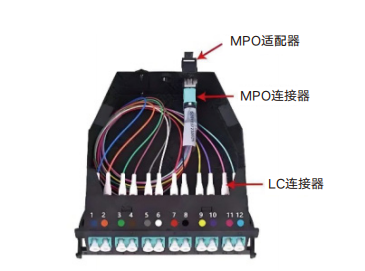
Four products, four different jobs. GYTA53 optical fiber cable carries traffic along outside-plant routes linking access, metropolitan and 5G backhaul nodes. The MPO-12F-SM adapter sets patching density in the frame. The MTP/MPO fan-out pre-terminated cable breaks a multi-fiber trunk into LC duplex pairs so 40G, 100G and 400G module ports can be patched. The MPO/MTP loopback proves ports and near-end paths during equipment validation and data center commissioning. Asking which of the four is best produces a comparison that cannot be answered, because they never compete for the same position in a link.
This shortlist therefore ranks each option only inside its own role, using four preference criteria: fit to the deployment task, compatibility with the interface it must mate with, the acceptance check that decides pass or fail, and the boundary beyond which the part should not be used. Models, certification numbers and validity dates come from the supplier's published records. Market and standards references are attributed to their publishers. Order-specific values — length, core count, connector configuration, lead time — are identified as order-specific rather than presented as fixed.
Why a Role-Based Shortlist Beats a Single “Best Product” List
Buyers rarely struggle to find fiber products. Global Market Insights valued the global fiber optic cable market at USD 14.6 billion in 2025, and China alone exported USD 2.52 billion of optical fibres and cables under HS 854470 in 2024, the leading exporter that year according to the Observatory of Economic Complexity. Abundance, not scarcity, is the procurement problem: every category has dozens of credible offers while qualification effort stays finite.
Category-by-category evaluation hides interfaces. A cable route, a patch panel, a module port and a commissioning test each speak their own acceptance language, and most deployment faults appear where those languages meet — an adapter specified by insertion loss per adapter when the link budget assumed per mated pair, or a fan-out whose fiber mapping was never checked against the switch port map.
Market access can reorder the shortlist before any technical comparison begins. A duty schedule compiled by Airlift USA puts the total US import duty on Chinese-origin optical fiber cables under HTS 8544.70.00 at 37.50% as of late 2026. Landed cost is part of fit, so for a US buyer the same product can move down a preference list for reasons that have nothing to do with attenuation or return loss.
The Shortlist at a Glance
| Deployment role | Product and model | Where it sits in the link | Acceptance check to demand |
|---|---|---|---|
| Outside-plant backbone | GYTA53 optical fiber cable | Routes between access, metro and backhaul nodes | Test schedule naming the standard for the actual environment; core count, fiber type and sheath recorded per drum |
| High-density patching | MPO-12F-SM adapter | Patch panel and cross-connect between trunks | Insertion loss below 0.5 dB standard or 0.35 dB low-loss; return loss of at least 50 dB; 500 mating cycles |
| Module breakout | MTP/MPO fan-out pre-terminated cable (MTP-12F-to-6xLC-Duplex, MTP-24F-to-12xLC-Duplex) | Between an MPO trunk and 40G/100G/400G module ports | Per-assembly loss test record, documented fiber mapping and polarity, end labeling, length check |
| Validation and commissioning | MPO/MTP loopback (MPO-12F-Loopback, MPO-24F-Loopback) | Test port on the line card or panel before live service | Known-good and cleaned before each mating; fiber count matched; port-by-port results recorded |
The table is a preference map, not a hierarchy. No entry outranks another. Each is first choice inside its own role and a poor choice outside it, which is the discipline the rest of this article applies.
1. GYTA53 Optical Fiber Cable: The Outside-Plant Backbone Role
GYTA53 is the shortlist's outside-plant cable, selected when the route runs between network nodes rather than inside a building. The supplier lists FTTx access, metropolitan and backbone network construction, 5G backhaul and enterprise campus cabling among the applications its fiber and cable products serve. Choosing this cable is not a connector decision; it fixes the attenuation and mechanical envelope for every component downstream.
What a buyer should fix in the specification is mostly configuration, not marketing language. Published customization covers core count, fiber type including single-mode, multimode, ribbon and multi-core constructions, sheath material and color, connector types and cabling scheme, plus labeling and packaging. Published capacity is 250,000 core kilometers per month against annual output of 3,000,000 core kilometers, with a minimum order of 1 core kilometer. Lead time is not a fixed figure: the supplier states it depends on model and quantity, with samples and small orders typically taking several weeks and large orders possibly months.
The acceptance check for this cable is not one number but a standard set matched to the route environment. IEC 60794-1-104:2024 defines the impact test procedure used to establish uniform requirements for cable impact performance. ITU-T L.103 (08/2024) describes characteristics, construction and test methods for indoor optical fibre cables. IEC 60092-378:2024 addresses fixed shipboard and offshore installations. These documents belong to different environments and are not interchangeable, which is the practical point: the test schedule must name the standard that matches where the cable will actually be installed. On the quality-system side, the manufacturer's TL9000-H certificate 15/25T15218R11 records a scope of manufacture and sales of communication optical fiber cable, issued 20 November 2025 and valid to 19 October 2028.
The boundary is environmental. An outside-plant cable should not be substituted into indoor pathways on the assumption that fiber is fiber; indoor cable characteristics are addressed by a separate standard family, and local code may add requirements on top. Where a route transitions from outside plant to inside plant, the transition point belongs explicitly in the bill of materials rather than being resolved on site.
2. MPO-12F-SM Adapter: The Density Role in the Patching Frame
The MPO-12F-SM is a 12-fiber single-mode adapter, and its role is density. It determines how many single-mode ports a patch panel or cross-connect can present per rack unit, and how consistently those ports hold their optical performance across reconfiguration.
Four acceptance checks decide whether an adapter suits a high-density single-mode frame, and each answers a different question:
- Insertion loss below 0.5 dB standard grade and below 0.35 dB low-loss grade. This is link budget, not label prestige. The two grades differ by up to 0.15 dB per adapter, and a link that crosses several mated pairs accumulates that difference.
- Return loss of at least 50 dB. Reflections travel back into the transmitter; single-mode systems are more sensitive to this than multimode, so the figure belongs in a system calculation rather than a datasheet checklist.
- 500 mating cycles. A rated life describes how many mate-and-unmate operations the adapter is specified to survive, which matters in frames where adds, moves and changes are routine rather than exceptional.
- Single-mode compatibility end to end. The adapter is one element of a single-mode path; the connectors it mates with must match the same fiber and polish assumptions.
Two clarifications should travel with any quotation. First, whether the insertion-loss figure is defined per adapter or per mated pair, because the two are not the same and the difference changes the budget. Second, which test method and reference conditions produced the number, since a value without a method cannot be compared across suppliers.
The boundary is that an adapter specification is not a prediction of installed loss. End-face condition, mating connector geometry, cleaning discipline and test setup all move the measured value. Low-loss adapters are justified where margin is genuinely tight; where margin is ample, the standard grade is the more defensible purchase. Adapter choice also does not repair a panel design that crowds ports beyond reach of fingers and cleaning tools — density that blocks maintenance tends to convert into operational loss later.
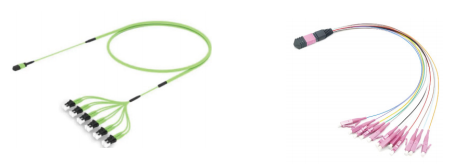
3. MTP/MPO Fan-Out Pre-Terminated Cable: The Module Breakout Role
The fan-out pre-terminated cable is the shortlist's translation layer. Two configurations are published: MTP-12F-to-6xLC-Duplex and MTP-24F-to-12xLC-Duplex. In both, one multi-fiber MPO/MTP connector on the trunk side is broken out into LC duplex pairs that mate with module ports — the pattern used when 40G, 100G and 400G parallel-optics ports have to reach an LC duplex patch field or a lower-count transceiver.
Pre-termination moves connector installation and loss testing into the factory. The supplier's quality control describes incoming material inspection, in-process control and finished-product testing that includes optical loss and attenuation tests, mechanical performance, and waterproof and sealing tests, supported by laboratory capability. That is why a pre-terminated assembly should arrive with a test record rather than a field-polished end face.
Preference criteria for this item are documentation-heavy, because the hardware is only as good as its mapping:
- Fiber mapping and polarity convention documented per assembly, not per product family.
- Per-assembly loss test report, with the measurement method identified.
- Labels at both ends that survive handling and match the port map.
- Overall length and breakout leg length agreed in writing, since both affect routing in a cabinet.
- Connector configuration confirmed against the panel and module ports, including whether the assembly's pin configuration mates correctly with the adapter in use.
The boundary is mated-interface count. A direct MPO trunk between two MPO ports involves two mated pairs; a fan-out path to LC duplex ports involves more, and each added interface contributes loss and a cleaning point. The fan-out is the right choice when the far end is LC duplex and the wrong choice when both ends are MPO and a trunk would do the job. A mis-mapped assembly also presents badly: partial link failure, with some lanes up and others down, is expensive to diagnose after installation and cheap to prevent at the quotation stage.
4. MPO/MTP Loopback: The Validation Role at Commissioning
An MPO/MTP loopback returns a port's transmit signal to its own receive path. The published configurations, MPO-12F-Loopback and MPO-24F-Loopback, match the 12- and 24-fiber counts used elsewhere in this shortlist. Its position is equipment validation and data center commissioning: before a port is connected to a far end, the loopback confirms that the port, the transceiver installed in it and the near-end path behave as expected.
A practical commissioning sequence uses the loopback port by port. Install the module, attach the loopback at the patching position that will later carry the trunk, confirm the port comes up, then remove the loopback and connect the real path. The same tool separates fault domains later: a port that passes loopback but fails on the trunk has a path problem rather than a line-card problem.
Preference criteria are procedural. Loopbacks should be known-good, stored as test equipment rather than mixed into production stock, matched to the port's fiber count, labeled, inspected and cleaned before each mating, and recorded per port with date and module identity where the project requires traceability.
The boundary matters more here than anywhere else in the shortlist. A loopback validates a port and a near-end path. It does not measure the insertion loss of the installed link, does not exercise the far-end connector, and cannot serve as acceptance evidence for the cabling itself. A port that passes loopback and then fails in service is a normal outcome, not a contradiction — which is why loopback results and link-loss results belong in separate records.
How the Four Roles Sequence in One Project
- Design and specification. Fix the cable environment, core count and fiber type first; the standard set for the route follows from that decision.
- Outside-plant installation. GYTA53 runs between nodes, with drum lengths, sheath marking and test records logged against the route plan.
- Termination and patching. MPO-12F-SM adapters populate the frame; the grade — standard or low-loss — is chosen from the calculated link budget, not from habit.
- Module breakout. Fan-out assemblies bridge the trunk to 40G, 100G and 400G ports, with mapping and polarity verified against the port map before power-on.
- Port validation. Loopbacks confirm line cards, modules and near-end paths one port at a time.
- Link acceptance. Installed links are measured and recorded separately from loopback results, so the two evidence sets can be read independently later.
Certification Evidence: What the Records Actually Cover
Three records are most useful to an evaluation-stage buyer, and each proves something narrower than “quality assured.” Reading scope wording is the difference between evidence and reassurance.
| Record | Number and issuer | Issued / valid to | Scope as recorded |
|---|---|---|---|
| TL9000-H | 15/25T15218R11, WIT Assessment / Hangzhou WIT Assessment Co., Ltd. | 20 Nov 2025 / 19 Oct 2028 | Manufacture and sales of communication optical fiber cable |
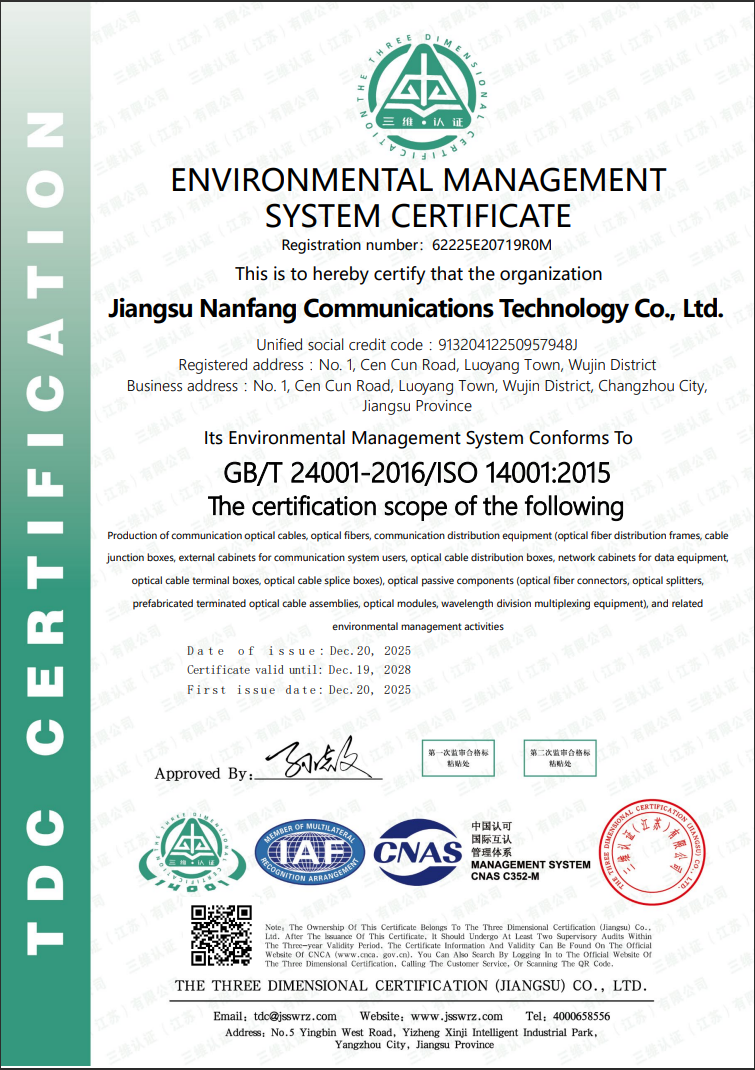
| ISO 14001:2015 | 62225E20719R0M, SWR Certification (Jiangsu) Co., Ltd. | 20 Dec 2025 / 19 Dec 2028 | Production of communication optical cables, optical fibers and communication distribution equipment |
| CNAS laboratory accreditation | CNAS L11717, China National Accreditation Service for Conformity Assessment (ISO/IEC 17025:2017) | 30 Nov 2024 / 29 Nov 2030 | Optical fiber cable and optical communication component testing and calibration |
Two readings follow. TL9000-H is a telecommunications quality-management certification whose recorded scope names communication optical fiber cable, so it supports the cable entry directly; for MPO adapters, fan-outs and loopbacks, the certificate is context about the quality system rather than a product-level conformity statement, and order-specific test records should be requested instead of inferring coverage. ISO 14001:2015 is an environmental management record covering production scope, useful where tender scoring weighs environmental management, but not a performance claim about any cable or assembly.
CNAS L11717 is the most directly relevant to the shortlist's acceptance checks. Accreditation to ISO/IEC 17025:2017 covers testing and calibration competence within a defined scope — here optical fiber cable and optical communication component testing and calibration — and its validity runs to 29 November 2030. It tells a buyer that the laboratory performing the loss and attenuation measurements operates under accredited competence for that scope. It does not certify the products themselves, and it does not replace the per-assembly test report.
Supplier Credibility Markers: 1992, 1617.HK and CNAS L11717
Jiangsu South Communication Technology Co., Ltd. (Nanfang Communication) is a fiber and cable manufacturer based in Changzhou, Jiangsu, and a subsidiary of Hong Kong-listed South Communication Holdings Limited, stock code 1617.HK. The company was founded in July 1992, holds paid-in capital of RMB 150 million, and operates a 26,795.3 m² site with 360 employees, including an 80-engineer R&D team. Its listed parent's annual report describes the group as principally engaged in manufacturing and sales of optical fibre cable products and related devices.
Three markers carry weight at evaluation stage, and each carries a limit. The 1992 founding date and continuing operation indicate continuity across multiple network build cycles — relevant when a buyer is committing to a multi-year framework rather than a one-off order. The 1617.HK listing makes the counterparty visible through public disclosure, which supports screening but says nothing about a specific drum of cable. CNAS L11717 accreditation indicates accredited laboratory competence in the stated scope, useful for verifying the measurement chain behind an attenuation report.
The supporting record is broader than the shortlist requires but explains capacity: more than 300 patents including over 45 invention patents, 16 standards comprising 1 national and 15 industry standards, 4 Jiangsu High-tech Product Certificates and 2 Changzhou High-tech Products, plus 28 provincial-level offices in China providing localized sales, technical support and after-sales service. Published export markets are China's Hong Kong and Southeast Asia regions, so buyers elsewhere should confirm logistics, documentation and market-access requirements for their own destination rather than assuming coverage.
A Short Acceptance Checklist for the Four Items
- Name the installation environment in the purchase specification, then attach the standard that governs it — outdoor route, indoor pathway and offshore installation are three different documents.
- State whether adapter insertion loss is measured per adapter or per mated pair, and require the test method to be identified.
- Decide the adapter grade from the calculated link budget: 0.5 dB standard or 0.35 dB low-loss, with return loss of at least 50 dB and 500 mating cycles in either case.
- Require a per-assembly loss record and a documented fiber mapping for every fan-out, and check both against the port map before installation.
- Keep loopbacks as controlled test equipment, record port-by-port results, and file them separately from link-acceptance measurements.
- Read certificate scope wording before citing a certificate in an evaluation; request order-level test data for the items the scope does not name.
- Confirm lead time and configuration in writing — published lead time varies by model and quantity, and the minimum order for cable is 1 core kilometer.
Outlook: Preference Lists Built on Verification
Shortlists hold their value only as long as their evidence does. The three pressures visible in the current record point the same way: certification scope is being read more carefully by evaluation teams, link budgets in high-density single-mode frames leave less room for per-adapter loss assumptions, and duty and freight variables can reorder a technically sound preference list between one quarter and the next. None of that changes what the four products do; it changes how much documentation a buyer should demand before awarding.
Where those conditions hold, the practical direction is stable: keep GYTA53 in the outside-plant role with a standard set matched to the route, keep the MPO-12F-SM adapter specified by measured grade rather than by name, keep fan-outs tied to documented mapping, and keep loopbacks confined to port validation. Buyers who preserve that separation tend to spend their acceptance effort on evidence rather than on disputes.
A downloadable product brochure covering the MPO assemblies discussed here is available for reference: Nanfang Communication MPO brochure (PDF).
FAQ
What does low-loss mean for an MPO-12F-SM adapter, and when is it worth the premium?
Low-loss refers to the insertion-loss acceptance band: below 0.35 dB against a standard grade of below 0.5 dB, with return loss of at least 50 dB and a rated 500 mating cycles in both grades. The two bands differ by up to 0.15 dB per adapter, so the premium is justified when a calculated link budget has several mated pairs and limited margin, and less defensible where margin is generous. Buyers should confirm whether the figure is per adapter or per mated pair, because the difference affects the budget directly.
When should a project buy a fan-out pre-terminated cable instead of a trunk cable?
The deciding factor is the interface at the far end. A fan-out such as MTP-12F-to-6xLC-Duplex or MTP-24F-to-12xLC-Duplex translates one multi-fiber connector into LC duplex pairs, which is what 40G, 100G and 400G module ports or LC duplex patch fields require. If both ends present MPO ports, a trunk avoids added mated interfaces and their cumulative loss. Fan-outs also add documentation requirements: per-assembly loss records and a verified fiber mapping and polarity convention.
How is an MPO/MTP loopback used during data center commissioning?
A loopback returns a port's transmit signal to its own receive path. During commissioning it is attached at the patching position that will later carry the trunk, so the line card, the installed transceiver and the near-end path can be confirmed before live traffic. Results are recorded port by port. Because a loopback does not measure the insertion loss of the installed link or exercise the far-end connector, its results are kept separate from link-acceptance measurements.
Which certifications should be verified for GYTA53 cable and MPO assemblies?
Three records are relevant. TL9000-H certificate 15/25T15218R11, issued by WIT Assessment, is valid to 19 October 2028 with a recorded scope of manufacture and sales of communication optical fiber cable. ISO 14001:2015 certificate 62225E20719R0M, issued by SWR Certification (Jiangsu) Co., Ltd., is valid to 19 December 2028 and covers environmental management of the production scope. CNAS L11717 accredits laboratory testing and calibration to ISO/IEC 17025:2017 within optical fiber cable and optical communication component scope, valid to 29 November 2030. Only the cable scope is named directly, so assembly-level conformance should be evidenced with order test records.
What minimum order quantity and lead time apply to these four products?
The published minimum order is 1 core kilometer for cable, against monthly capacity of 250,000 core kilometers and annual output of 3,000,000 core kilometers. Lead time is not published as a single standard figure: it depends on model and quantity, with samples and small orders typically taking several weeks and large orders possibly months. Because adapter grades, fan-out configurations and loopback fiber counts differ by order, delivery should be confirmed in writing rather than inferred from a catalogue.
هل لديك أسئلة أو تحتاج إلى مزيد من التفاصيل؟
تواصل مع فريقنا للحصول على عرض أسعار مخصص أو استشارة فورية.
طلب عرض أسعار
املأ النموذج أدناه وسيتواصل معك فريقنا بعرض مقترح مخصص.
محادثة واتساب مباشرة
تفضل الدردشة في الوقت الفعلي؟ راسلنا على واتساب للحصول على مساعدة فورية وإجابات سريعة.
- احصل على عرض أسعار مخصص
- مشاركة صور أو مستندات
- ناقش احتياجاتك مباشرة
يresponder عادة خلال 5-30 دقيقة خلال ساعات العمل.