
Optical Fiber Cable vs MPO Adapter, Fan-Out and Loopback: Buyer Decision Matrix
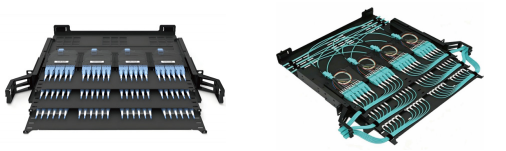
An optical fiber cable, an MPO fiber optic adapter, an MTP/MPO fan-out pre-terminated cable and an MPO/MTP loopback perform four different jobs in the same network, and they are not interchangeable in a bill of materials. The cable carries traffic across distance and environment; the adapter aligns and holds two MPO connectors inside a panel; the fan-out cable splits a 12- or 24-fiber MPO interface into LC or SC duplex pairs at the cabinet; the loopback returns an optical signal to its own transmitter so that a port, module or piece of equipment can be validated before live traffic is commissioned.
Buyers working through the awareness and research stages run into trouble at exactly this point. A request for quotation that lists optical fiber cable as a single line item often comes back with four incompatible answers: an armored outdoor cable quoted by the kilometer, a 12-fiber adapter quoted by the piece, a 24-fiber breakout assembly quoted by the assembly, and a test loopback quoted as equipment. Those offers cannot be compared, because they do not solve the same problem. This decision matrix maps function, published specifications, application fit and boundary conditions for each category, using product data from Nanfang Communication and independent market and standards evidence.
Start with function, not price
Function is the only reliable first filter, because it decides which test method, which performance parameter and which acceptance criterion will apply to the purchase.
Optical fiber cable — GYTA53
A communication cable built on a silica glass core, available with G.652 or G.657 fiber, FRP strength members, armoring of galvanized steel wire or steel tape, and a PE or LSZH sheath. It acts as the physical-layer transmission and distribution infrastructure of a network, providing signal transmission, fiber distribution and patching or access functions. Documented application ranges cover telecommunications, ISPs, data centers, FTTx, enterprise campuses, industrial sites, smart city projects, 5G backhaul and metropolitan backbone networks. Attenuation in dB/km, operating wavelengths, tensile strength and minimum bend radius are specified per model datasheet rather than by category.
MPO fiber optic adapter — MPO-12F-SM
A passive high-density connector interface that positions and retains two MPO ferrules. Published performance data: insertion loss below 0.5 dB for the standard grade and below 0.35 dB for the low-loss grade; return loss of at least 50 dB on single-mode; 500 mating cycles in line with IEC requirements; operating temperature from -40 °C to +85 °C; support for 4 to 72 fibers in single-mode or multimode. Housing colors identify the multimode grade — black with an eared flange, aqua for OM3 and violet for OM4. Construction is a ceramic ferrule, plastic housing and metal flange. Documented applications are data centers, telecom networks and high-density cabling systems.
MTP/MPO fan-out pre-terminated cable
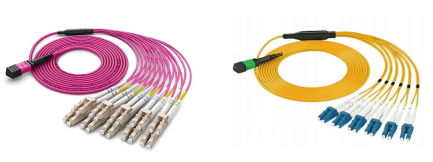
A factory-terminated breakout assembly that converts one MPO interface into LC or SC duplex legs. Published configurations are MTP-12F-to-6xLC-Duplex and MTP-24F-to-12xLC-Duplex, with 12 or 24 fibers and either a breakout or fan-out structure. Fiber options are OS2/G.657A or OM3/OM4/OM5; jacket options are LSZH or PVC with an OFNR choice; ferrules are ceramic. Typical insertion loss is 0.35 dB with a 0.75 dB maximum, and 0.10 dB typical with a 0.35 dB maximum in the low-loss grade. Return loss is at least 60 dB for APC and at least 50 dB for PC. Documented applications are data center cabinet interconnection, typically for 40G, 100G and 400G SR4 and PSM4 module connections.
MPO/MTP loopback
Classified as test equipment in the fiber optic loopback category, built from ceramic or MTP ferrule, plastic housing and fiber cable, in models MPO-12F-Loopback and MPO-24F-Loopback. Insertion loss is 0.7 dB or lower for the 8- and 12-fiber versions and 1.0 dB or lower for the 24-fiber version; return loss is at least 65 dB on single-mode and at least 25 dB on multimode; mating life is at least 100,000 cycles; and the documented link failure rate is below 0.1%. Fiber options span OS2, OM1, OM2, OM3, OM4 and OM5. Documented applications are network testing, data center commissioning and equipment validation.
The buyer decision matrix
| Product | Function | Published performance data | Best-fit applications | Main boundary to plan for |
|---|---|---|---|---|
| Optical fiber cable (GYTA53) | Physical-layer transmission and distribution; signal transmission, fiber distribution, patching and access | Silica glass core; G.652/G.657 fiber; FRP strength member; galvanized steel wire or steel tape armoring; PE or LSZH sheath; attenuation, tensile strength and bend radius per datasheet | Telecom, ISP, data center, FTTx, enterprise, industrial, smart city, 5G backhaul, metropolitan backbone | Specifications are model-level, so a family name is not a specification; armored construction is bulky for tight in-building routing |
| MPO fiber optic adapter (MPO-12F-SM) | Aligns and retains two MPO ferrules inside a panel or cassette | IL standard <0.5 dB, low-loss <0.35 dB; RL ≥50 dB (SM); 500 mating cycles (IEC compliant); -40 °C to +85 °C; 4-72F SM/MM | Data centers, telecom networks, high-density cabling systems | Each adapter adds a mated interface to the loss chain; 500-cycle life sets a re-patching budget |
| MTP/MPO fan-out pre-terminated cable | Breaks one MPO interface into LC or SC duplex legs at the cabinet | IL typical 0.35 dB / max 0.75 dB; low-loss typical 0.10 dB / max 0.35 dB; RL ≥60 dB (APC), ≥50 dB (PC); 12F or 24F; LSZH, PVC or OFNR jacket | Data center cabinet interconnection; 40G/100G/400G SR4 and PSM4 module connection | Leg length, fiber count, polarity and connector type must be fixed before production |
| MPO/MTP loopback | Returns an optical signal to its own transmitter for validation | IL ≤0.7 dB (8F/12F), ≤1.0 dB (24F); RL ≥65 dB (SM), ≥25 dB (MM); ≥100,000 mating cycles; link failure rate <0.1% | Network testing, data center commissioning, equipment validation | It is a test aid, not permanent infrastructure, and does not replace cable-plant measurement between two endpoints |
Matching the product to the project scenario
Installation conditions decide the cable family long before price is discussed. Documented operating conditions for these products include indoor cabling, duct or ducting installation, aerial or self-supporting routes, direct burial, and outdoor harsh environments that require weatherproofing, waterproofing, rodent protection and temperature resistance. The table below pairs typical project types with the products that carry the work.
| Project scenario | Primary product | Supporting products | What to lock down in the specification |
|---|---|---|---|
| FTTH / FTTx access | Outdoor optical fiber cable | PLC splitters, cable splice closures, FTTH distribution boxes, bow-type drop cable, connectors | Fiber type, core count, sheath and environmental rating, labeling |
| 5G backhaul and metropolitan backbone | Outdoor optical fiber cable | Optical modules, WDM units, connectors, splice closures | Attenuation, tensile strength, minimum bend radius, operating wavelength |
| Data center cabinet interconnection | MTP/MPO fan-out pre-terminated cable | MPO adapters, MPO high-density patch panels, direct attach cable modules, trunk cables | Fiber count, leg length, polarity, connector type, insertion loss grade |
| Data center commissioning and equipment validation | MPO/MTP loopback | Adapters, test cords, patch panels | Connector type, fiber count, IL and RL grade, mating life |
| Enterprise and campus networks | Indoor optical cable | Fiber optic connectors, MPO patch panels, optical modules | Flame-retardant or LSZH sheath, core count, bend radius |
| Industrial IoT and smart city | Outdoor optical cable with environmental protection | Splice closures, distribution boxes, connectors | Waterproof sealing, crush and tensile resistance, corrosion and weather resistance, temperature range |
| High-density cross-connect in telecom networks | MPO fiber optic adapter | Patch panels, pre-terminated trunk cables, MT-FAU assemblies | Insertion loss grade, return loss, mating-cycle budget, housing color per fiber grade |
How the four categories interact in a link budget
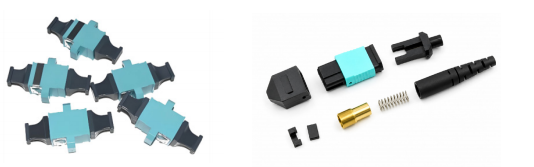
Insertion loss accumulates at every mated interface, which is why the adapter grade chosen at the design stage has consequences far from the adapter itself. The published figures make the arithmetic visible. An MPO adapter contributes below 0.5 dB in the standard grade and below 0.35 dB in the low-loss grade. A fan-out pre-terminated cable contributes 0.35 dB typical with a 0.75 dB maximum in the standard grade, or 0.10 dB typical with a 0.35 dB maximum in the low-loss grade. When a cross-connect path passes through more than one adapter, the difference between standard and low-loss grades is applied more than once.
Return loss behaves differently from insertion loss and matters most in single-mode systems. The MPO adapter is specified at 50 dB or better on single-mode; the fan-out cable reaches 60 dB or better with APC ferrules and 50 dB or better with PC. The loopback separates the two fiber worlds clearly: at least 65 dB on single-mode and at least 25 dB on multimode, reflecting how much back-reflection multimode systems normally tolerate. The loopback insertion loss of 0.7 dB or lower for 8- and 12-fiber versions, and 1.0 dB or lower for 24-fiber, describes the loss of the test path itself, so it must stay small enough not to obscure the condition being validated.
Where each option meets its limits
Every category has a boundary, and buyers who understand them early avoid change orders later.
- Armored outdoor cable is not indoor cable. GYTA53-type construction with steel wire or steel tape armoring provides mechanical and environmental protection, but it is bulkier and less flexible than indoor or bow-type drop cable. It is not the first choice for tight in-building routing. A second limit is subtler: GYTA53 is a family designation. Because attenuation, tensile strength and minimum bend radius are confirmed per model datasheet, comparing two suppliers on the model name alone is not a specification comparison.
- Adapters wear out faster than test equipment. The MPO adapter is rated for 500 mating cycles in line with IEC requirements, while the loopback is rated for at least 100,000 cycles. In panels that are re-patched frequently, adapter life becomes a maintenance item rather than a permanent fixture.
- Pre-terminated assemblies cannot be adjusted on site. Fan-out cable leg lengths, fiber counts, polarity and connector types are fixed at the factory. The documented configurations cover 12 fibers to six LC duplex legs and 24 fibers to twelve LC duplex legs. A late change in cabinet layout cannot be solved by re-termination in the field.
- A loopback is a validation tool, not infrastructure. It is classified as test equipment for network testing, data center commissioning and equipment validation. It confirms the condition of a port or an equipment path during commissioning, and it does not replace measurement of the installed cable plant between two endpoints.
- Standards are environment-specific. ITU-T L.103 describes characteristics, construction and test methods for indoor optical fibre cables. IEC 60794-1-104:2024 defines the impact test procedure E4 for optical fibre cables. IEC 60092-378:2024 applies to optical fibre cables for shipboard and offshore fixed installations. A test regime that qualifies a product for one environment does not automatically qualify it for another.
Market and standards signals shaping 2026 sourcing
Three independent data points frame the buying environment. The global fiber optic cable market was valued at USD 14.6 billion in 2025, according to Global Market Insights. China was the leading exporter of optical fibres and cables in 2024, with exports totaling USD 2.52 billion under HS 854470, according to trade data aggregated by the Observatory of Economic Complexity. For US-bound Chinese-origin optical fiber cable classified under HTS 8544.70.00, a customs-duty summary published by Airlift USA in September 2026 lists a total import duty of 37.50%, effective from late July 2026.
The duty figure is a landed-cost variable, not a product-performance variable. It changes the arithmetic of sourcing origin and logistics, while insertion loss, return loss and mating cycles remain the technical criteria. Reading the two together is what separates a cost decision from a specification decision.
On the standards side, the direction of travel is toward environment-specific qualification. ITU-T L.103 (08/2024) covers indoor cable characteristics, construction and test methods. IEC 60794-1-104:2024 defines a uniform impact test procedure. IEC 60092-378:2024 addresses shipboard and offshore fixed installations. For buyers, the practical implication is that one global acceptance test is rarely sufficient: the test plan should follow the deployment environment, not the purchase order template.
What to verify before committing to a supplier
Jiangsu South Communication Technology Co., Ltd. operates as Nanfang Communication. Established in 1992, it is a subsidiary of South Communication Holdings Limited (Stock Code: 1617.HK) and is located in Changzhou, Jiangsu Province, China. The company has a paid-in capital of RMB 150 million and a manufacturing facility covering 26,795.3 m², with approximately 360 employees including an R&D team of 80 engineers, and an annual production capacity of 3,000,000 core kilometers.
Its published credentials include certifications for ISO9001 quality management, TL9000 telecommunications industry quality management, ISO14001 environmental management, OHSAS18001 occupational health and safety management, ISO50001 energy management, and the Integration of Informatization and Industrialization Management System, alongside a CNAS-accredited laboratory. The company holds over 300 patents, including more than 45 invention patents, and has participated in the formulation of 16 standards (1 national standard and 15 industry standards). It is recognized as a High-tech Enterprise and a National-level Green Factory.
Product breadth matters when several of the four categories are needed on one project. Nanfang Communication's portfolio includes optical fibers, optical cables, ODN systems and optical components — indoor and outdoor optical cables, PLC splitters, fiber optic connectors, MPO multi-core connectors and optical modules — plus custom specialty fibers and cables, MT-FA series passive components, PM fiber arrays and system integration services. The company reports cooperative relationships with operators including China Telecom, China Mobile, China Unicom and China Broadcast Network, and operates 28 provincial-level offices across China.
On the buyer side, an acceptance checklist keeps the four categories distinct:
- Cable: fiber type (G.652 or G.657), core count, attenuation in dB/km, operating wavelength, tensile strength, minimum bend radius, sheath material (PE or LSZH) and environmental rating — each confirmed against the model datasheet.
- Adapter: insertion loss grade (standard below 0.5 dB or low-loss below 0.35 dB), return loss of at least 50 dB in single-mode, 500 mating cycles, operating temperature range of -40 °C to +85 °C.
- Fan-out assembly: typical and maximum insertion loss, return loss for the ferrule polish used, fiber count, breakout connector type and jacket material.
- Loopback: insertion loss by fiber count, return loss by fiber type, mating life and the documented link failure rate.
- Qualification testing: reference the standard that matches the deployment environment and validate on samples before volume release.
Future outlook
Two forces are pulling fiber infrastructure in the same direction. The first is density: as cabinets carry more 40G, 100G and 400G SR4 and PSM4 links, MPO adapters, high-density patch panels and pre-terminated breakout assemblies do more of the work that individual duplex connectors once did. The second is pre-termination: factory-finished assemblies move labor and quality control upstream, which raises the importance of factory process documentation and lab capability rather than field workmanship.
Longer term, product portfolios already list multi-core fiber, WDM units, MT-FA assemblies and optical modules alongside conventional cable families, which suggests that the boundary between cable, component and module will keep thinning. For buyers, the practical response is to keep the decision matrix alive: define the function first, specify the parameter that proves it, and confirm the standard that applies to the environment where the product will be installed.
FAQ
What is the difference between an optical fiber cable, an MPO adapter, a fan-out cable and an MPO loopback?
An optical fiber cable such as GYTA53 is physical-layer transmission and distribution infrastructure carried over distance. An MPO fiber optic adapter such as MPO-12F-SM aligns and retains two MPO ferrules inside a panel for high-density cross-connection. An MTP/MPO fan-out pre-terminated cable converts one 12- or 24-fiber MPO interface into LC or SC duplex legs at the cabinet. An MPO/MTP loopback is test equipment that returns a signal to its own transmitter for equipment validation and commissioning.
Which product should be specified for data center cabinet interconnection?
The documented fit is an MTP/MPO fan-out pre-terminated cable, in configurations such as MTP-12F-to-6xLC-Duplex or MTP-24F-to-12xLC-Duplex, with 12 or 24 fibers and a breakout or fan-out structure. It supports data center cabinet interconnection and is typically used for 40G, 100G and 400G SR4 and PSM4 module connections. MPO adapters and high-density patch panels support the cross-connect layer around it.
What insertion loss and return loss should an MPO fiber optic adapter meet?
Published values for the MPO-12F-SM adapter are insertion loss below 0.5 dB for the standard grade and below 0.35 dB for the low-loss grade, with return loss of at least 50 dB on single-mode. It supports 4 to 72 fibers in single-mode or multimode and operates from -40 °C to +85 °C. Buyers should confirm the grade against the model datasheet before comparing quotes.
How many mating cycles do MPO adapters and loopbacks support?
The MPO fiber optic adapter is rated for 500 mating cycles in line with IEC requirements. The MPO/MTP loopback is rated for at least 100,000 mating cycles and carries a documented link failure rate below 0.1%. The two figures reflect different roles: the adapter is a panel interface that is re-patched over its service life, while the loopback is a test item handled in commissioning and validation.
What does an MPO/MTP loopback actually validate?
The loopback is classified as test equipment in the fiber optic loopback category and is intended for network testing, data center commissioning and equipment validation. Its own performance is specified by insertion loss of 0.7 dB or lower for 8- and 12-fiber versions and 1.0 dB or lower for the 24-fiber version, with return loss of at least 65 dB on single-mode and at least 25 dB on multimode. It is a validation aid rather than permanent infrastructure and does not replace measurement of the installed cable plant between two endpoints.
Which standards and certifications matter when qualifying these products?
Standards depend on the environment. ITU-T L.103 (08/2024) describes characteristics, construction and test methods for indoor optical fibre cables. IEC 60794-1-104:2024 defines the impact test procedure E4. IEC 60092-378:2024 applies to shipboard and offshore fixed installations. On the supplier side, Nanfang Communication holds ISO9001, TL9000, ISO14001, OHSAS18001 and ISO50001 certifications and operates a CNAS-accredited laboratory, alongside more than 300 patents and participation in 16 standards.
Additional product documentation: Nanfang Communication MPO product brochure (PDF). Company information: jsnfgroup.com.
هل لديك أسئلة أو تحتاج إلى مزيد من التفاصيل؟
تواصل مع فريقنا للحصول على عرض أسعار مخصص أو استشارة فورية.
طلب عرض أسعار
املأ النموذج أدناه وسيتواصل معك فريقنا بعرض مقترح مخصص.
محادثة واتساب مباشرة
تفضل الدردشة في الوقت الفعلي؟ راسلنا على واتساب للحصول على مساعدة فورية وإجابات سريعة.
- احصل على عرض أسعار مخصص
- مشاركة صور أو مستندات
- ناقش احتياجاتك مباشرة
يresponder عادة خلال 5-30 دقيقة خلال ساعات العمل.