
Optional Units for Stick, Filled and Sandwich Ice Cream Lines
Optional Units for Stick, Filled and Sandwich Ice Cream Lines
An industrial ice cream line is rarely defined by its freezer alone. Two factories can run the same continuous freezer and still ship entirely different products: moulded stick bars with a chocolate shell, heat-sealed cups with a sauce ripple and a nut topping, or individually wrapped sandwich wafers. What separates those outcomes is the optional equipment mounted around the forming and filling platforms — the stick inserter, the coating station, the cup dispenser, the lid dispenser, the topping unit.
Snowball Machinery publishes those option families as separate configuration lists: SNLU for stick ice cream machines and SNFU for filling machines. Read alongside the product formats each platform is built for, the lists show that scenario fit is a configuration decision made before purchase, not an assumption corrected after installation. The company manufactures in Dalian, China, and reports a 4,000 m² factory, 50 employees, a 10-engineer design team and an annual output of 1,200 sets, with about 90% of production exported to North America, South America, Europe, Asia and Africa.
Why optional units, not the base machine, decide scenario fit
Snowball Machinery describes its ice cream equipment as non-standard and customized, with the customization basis stated as product design and hourly production capacity. That sentence explains why option lists matter more than a headline capacity figure. The SNCF continuous freezer series covers 50 L/h to 1,500 L/h at 100% overrun, with mix entering at +5 °C and leaving at −5 °C. The freezer determines how much frozen mix arrives at the former; it does not determine whether that mix becomes a moulded stick, a filled cone or a sandwich wafer.
Three variables drive the rest of the configuration:
- Product geometry — a moulded bar needs a mould set and a demoulding step; a filled cup or cone needs a container handling and dispensing system; an extruded sandwich needs forming, cutting and wrapping.
- Surface treatment — a chocolate shell, a sauce ripple, a dry particulate topping or no topping at all each require a different station and a different downstream handling routine.
- Closure — mould extraction, lid placement with heat sealing, or wrap sealing. These are not interchangeable finishing options; they belong to different platform types.
Spare-part planning follows the same logic. Both Snowball Machinery lists are formally titled “optional units and spare parts”, which is a practical reminder that wear items change the moment coating, stick insertion or heat sealing is added. A maintenance inventory assembled for a plain moulded line will not cover a line that also runs chocolate coating and dry topping stations.
The SNLU option set: what a stick or popsicle workflow actually adds
SNLU is the stick ice cream machine option and spare-part family. Its published scope covers all kinds of ice cream, stick ice cream, popsicle and ice lolly, with capacity customized to requirements. The named units in that family are:
- Ice water filler
- Ice cream sucker unit
- Ice cream stick inserter unit
- Chocolate coating station
- Dry coating station
- Popsicle ice cream moulds
These units are best read as stages rather than accessories. Snowball Machinery's scenario documentation for moulded stick production describes a fully automatic sequence of automatic filling, sucking, jam charging, stick inserting, demoulding and chocolate coating. The SNLU list maps onto that sequence almost item for item: the ice water filler serves the filling stage for water-ice and fruit-bar style mixes that the SNL platform also lists, the sucker unit corresponds to the sucking step, the stick inserter to stick inserting, and the coating stations to the shell and particulate finishing stages.
The mould set is the part of the configuration that changes product identity most directly. In the small-capacity popsicle application that Snowball Machinery documents, moulds can be replaced quickly and the same machine produces different popsicle shapes by changing them, covering ice pops, ice lollies, frozen novelties, fruit bars and shell-and-core lollies. That flexibility is company-reported for the semi-automatic and manual configurations, and it explains why mould design and hourly capacity are treated as inputs to customization rather than as fixed catalogue values.
Where the stick-line boundary sits
A stick line configured around SNLU assumes a moulded product. It does not, by itself, produce an extruded sandwich or a filled family pack, because those formats are formed and closed by different platforms. Buyers planning more than one format are therefore comparing two forming routes that share upstream equipment, not one route with more add-ons. The practical question is not “how many options can be added” but “which units are required by the specific mould, mix and hourly target”.
The SNFU option set: filling options for cup, cone and bulk formats
SNFU is the filling machine option and spare-part family. It is described for all kinds of ice cream, ice cream cone, ice cream cup, ice cream pints, calippo and Cornetto-type products, again with capacity customized to requirements. The listed units are:
- Cup and cone dispenser
- Chocolate or sauce sprayer
- Automatic ice cream filler
- Ice cream pencil filler
- Chocolate topping machine and sauce topping unit
- Dry topping unit
- Lid dispenser machine
- Heat sealing unit
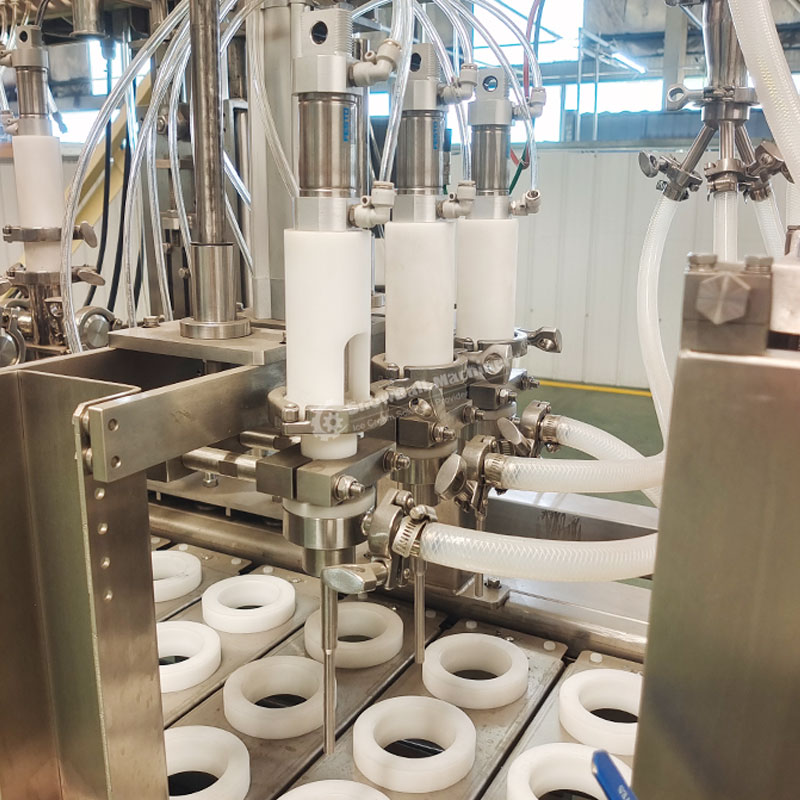
The operational scenarios published by the manufacturer connect these units to concrete tasks. In a low-output rotary filling configuration, the machine is described as handling multi-specification containers (cup, cone and calippo type) while completing chocolate or sauce topping, sprinkling of nuts and candy decorations, heat sealing and lid dispensing; a semi-automatic filler covers family pack, family size and bulk ice cream. In a larger configuration aimed at medium and large factories, the filling machine is described as switching quickly between cup and cone specifications while performing automatic cup/cone dispensing, servo filling, sauce topping, dry topping with nuts and chocolate chips, and automatic lid dispensing.
That mapping matters for two reasons. First, the topping and closure units are scenario-specific: a bulk or family-pack tub does not use a lid dispenser and heat sealer in the same way as a single-serve cup, so the option list has to be trimmed to the container rather than ordered in full. Second, container switching is described as a supported capability on certain platforms, which changes how a plant plans changeover time between a cone run and a cup run.
Sandwich products: a different forming route, not another SNLU add-on
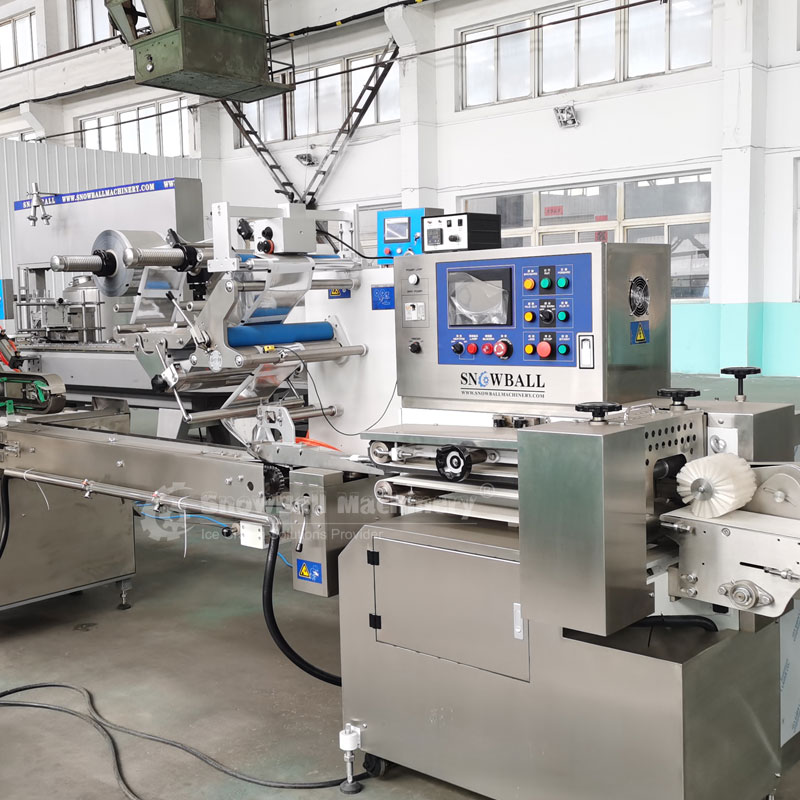
Sandwich ice cream is the scenario where configuration assumptions fail most often. A sandwich is not a moulded stick with an extra coating station; it is formed by extrusion, combined with a wafer or cookie element and closed by wrapping. Snowball Machinery lists the SNSMZ as an ice cream sandwich machine that extrudes and wraps, covering sandwich making and packing in one line, and it lists sandwich among the product formats produced on the SNEX extrusion and hardening platform — alongside cake, magnum-style bars, choco bars, bonbon, ball cone, log and wave products.
A documented European project illustrates the configuration logic in practice. The customer added a sandwich line intended for multi-specification and multi-flavour production; Snowball Machinery reports a five-year stable operating period, SS304 construction, an energy-saving design, and compliance with EU food safety and environmental standards as stated for that project. Those are company-reported case results for a single installation, not a general performance guarantee, but they show what a sandwich configuration actually requires: extrusion, product handling, wrapping and packing rather than a mould set.
The upstream implication is straightforward. A plant that intends to sell both moulded sticks and sandwiches needs two forming routes — SNL with SNLU options, and an extrusion route with sandwich and wrapping capability — sharing the same premix, pasteurization, ageing, freezing and hardening infrastructure. The shared stages are where the duplication is avoided; the forming stages are where the duplication is unavoidable.
Where the options sit in a complete line
Placing the option families on a process chain makes the fit boundaries visible. On the SNM platform, the process starts with premix preparation, HTST or batch pasteurizing, homogenizing, CIP cleaning, ageing tanks and chocolate or syrup holding. Mix then passes to the SNCF continuous freezer, in the 50–1,500 L/h range at 100% overrun, and inclusions can be dosed through the SNFF ingredient feeder, which is offered from 50 to 4,000 L/h. Only after that point does the line branch: moulding on SNL with SNLU units, filling on SNLF with SNFU units, or extrusion on SNEX. Hardening tunnels, cold storage and the SNB packing and cartoning machines close the chain.
Scenario mapping: format, platform, options and boundary
| Product scenario | Base platform | Named optional units | Boundary to confirm |
|---|---|---|---|
| Moulded stick or popsicle with chocolate shell | SNL moulded stick machine | Ice water filler, sucker unit, stick inserter, chocolate coating station, dry coating station, moulds | Mould design, hourly capacity, shell and particulate sequence |
| Water ice, fruit bar, novelty lolly | SNL semi-automatic or manual configuration | Moulds (replaceable), ice water filler | Mould replacement routine and shape range |
| Cup with sauce ripple, dry topping and heat-sealed lid | SNLF rotary or linear filling machine | Cup/cone dispenser, sauce sprayer, dry topping unit, lid dispenser, heat sealing unit | Container specification, topping order, seal integrity requirement |
| Cone, including Cornetto-type formats | SNLF cone filling configuration | Cone dispenser, automatic filler or pencil filler, sauce and dry topping units, lid dispenser | Cone geometry and changeover between container types |
| Family pack, bulk and pints | SNLF semi-automatic or family-pack filler | Automatic filler, ripple pump, topping units | Whether lid dispensing and heat sealing apply at all |
| Sandwich, extruded and wrapped | SNSMZ sandwich line or SNEX extrusion platform | Extrusion and wrapping stations rather than SNLU options | Wafer or cookie format, wrap style, packing integration |
What the option lists do not establish
Configuration transparency is not the same as verified performance, and three limits deserve attention during evaluation.
Unit-level performance is not published per option. The SNLU and SNFU lists name units and state that capacity is customized, but they do not state throughput, changeover time, utility consumption or footprint for each individual station. Those figures follow the full line plan. A buyer comparing two quotations should ask for the station-level numbers rather than inferring them from the base machine's rated capacity.
Material grade is stated as a range, not a fixed choice. Snowball Machinery specifies high-quality food-grade stainless steel SS304 / SS316 across its equipment. Which grade applies to a given station depends on the product, cleaning regime and destination-market requirements, and should be confirmed item by item rather than assumed from the platform specification.
Case evidence is company-reported. The sandwich project, the eleven-year start-up installation and the twelve-year branded-factory lines are documented by the manufacturer. They show that configurations of this type have been built and operated, not that an identical configuration will deliver the same output in a different plant, climate or product mix.
Market context: why configuration scope is a procurement question
Stratview Research values the global ice cream processing equipment market at USD 2.4 billion in 2025, and its type segmentation places continuous freezers at approximately 29.4% of that segment. IMARC Group reports North America holding over 42.0% of the market as of 2025. These are aggregate research figures rather than line-level benchmarks, but they carry a practical implication: no single equipment category dominates the equipment mix, so procurement comparisons tend to be made between complete configurations rather than between individual machines.
That is precisely where optional-unit clarity helps. A buyer who knows that a stick programme requires a mould set, stick inserter and coating station, and that a cup programme requires dispensing, topping and sealing, can compare quotations line by line instead of comparing a single freezer rating. The same logic applies to the spare-parts side of the list, where the accuracy of the wear-part inventory depends on which units were actually specified.
Outlook: expansion, spare parts and upgrading
Snowball Machinery documents expandability as a design characteristic of its lines, stating that additional ice cream product shapes can be added later with convenient upgrading, and lists equipment upgrading, maintenance, fault handling, spare-parts supply and regular inspection among its after-sales services. That combination is the reason the option list should be read as a first configuration rather than a final one.
The practical test is whether a proposed line has room for the next product. A plant that starts with plain moulded bars and later adds a chocolate coating station, or starts with cups and later adds a dry topping unit, is following the modular path the equipment is described as supporting. A plant that later decides to add sandwiches is not — that requires a separate forming route. Distinguishing between those two kinds of expansion early is the most useful outcome of mapping options to scenarios.
Frequently asked questions
Which optional units does a moulded stick or popsicle line typically need?
Within Snowball Machinery's SNLU family, the named units are an ice water filler, an ice cream sucker unit, an ice cream stick inserter unit, a chocolate coating station, a dry coating station and popsicle ice cream moulds. They correspond to the documented moulded-stick sequence of filling, sucking, stick inserting, demoulding and chocolate coating. Which of them apply in a specific project depends on the mould design, the product design and the hourly capacity.
How does a buyer choose between a moulded stick line and an extrusion line for coated bars?
The choice is a forming decision, not a coating decision. SNL is described for moulded stick ice cream, popsicles, ice lollies, frozen novelties, fruit bars and water ice, and uses replaceable moulds to define shape. SNEX is described for extruded formats including sandwich, cake, magnum-style bars, choco bars, bonbon, ball cone, log and wave products. Both routes can be finished with coating, but the shape, the demoulding step and the downstream handling differ.
What optional filling units support cup and cone formats?
The SNFU family lists a cup and cone dispenser, chocolate or sauce sprayer, automatic ice cream filler, ice cream pencil filler, chocolate topping machine, sauce topping unit, dry topping unit, lid dispenser machine and heat sealing unit. Published scenarios describe combinations of cup/cone dispensing, servo filling, sauce topping, dry topping, lid dispensing and heat sealing on rotary and larger filling configurations, with a semi-automatic filler covering family pack and bulk formats.
Can a line be expanded with additional units after installation?
Snowball Machinery states that its equipment features good expandability, with additional ice cream product shapes addable later through convenient upgrading, and lists equipment upgrading and spare-parts supply among its after-sales services. Expansion within one forming route — adding a coating station to a moulded line, or a topping unit to a filling line — is a different proposition from adding a new forming route, such as sandwiches, which requires extrusion and wrapping capability.
What information should be prepared before requesting unit and spare-part specifications?
Because the equipment is customized on product design and hourly capacity, a useful brief covers the target product formats and shapes, container dimensions for cup, cone or bulk packaging, the required hourly output, the coating or topping sequence, mould design where moulded products are planned, the intended stainless-steel grade for each station, and the utilities available on site. Supplying these points allows the option list to be narrowed to the units a specific scenario actually requires.
Requesting matching unit and spare-part details
Optional units are only useful when they match the mould, container and capacity they will run with. Buyers comparing stick, filled or sandwich configurations can request the corresponding unit and spare-part details from Snowball Machinery at ice@hiicecream.com, and the company's equipment brochure is available for download: Snowball Machinery brochure (PDF).
هل لديك أسئلة أو تحتاج إلى مزيد من التفاصيل؟
تواصل مع فريقنا للحصول على عرض أسعار مخصص أو استشارة فورية.
طلب عرض أسعار
املأ النموذج أدناه وسيتواصل معك فريقنا بعرض مقترح مخصص.

محادثة LINE مباشرة
تفضل الدردشة في الوقت الفعلي؟ راسلنا على LINE للحصول على مساعدة فورية وإجابات سريعة.
- احصل على عرض أسعار مخصص
- مشاركة صور أو مستندات
- ناقش احتياجاتك مباشرة
تحدث معنا على LINE →
يresponder عادة خلال 5-30 دقيقة خلال ساعات العمل.