
Orthodontic Supplies: A Start-Up and Restock Shortlist
Orthodontic Supplies: A Start-Up and Restock Shortlist
A clinic that is opening or restocking does not need a longer orthodontic catalogue. It needs an order that follows the way treatment consumes stock. The shortlist below is organised into six blocks — attachment, force delivery, instruments, access and visibility, chairside auxiliaries, and appliance-specific add-ons — and for each block it names the option types to consider, the decision that has to be made inside the block, and the verification step that stops a restock from turning into a substitution error.
Hangzhou DTC Medical Apparatus Co., Ltd, which trades as DTC orthodontics, is used as the reference portfolio because its published range maps closely onto those six blocks: brackets, buccal tubes, preformed bands, archwires, Niti springs, pliers and cutters, tweezers, needle holders, retractors, mirrors and elastomeric auxiliaries. The company was founded in 2004 and operates a 5,000 m² facility with 150 employees and a 30-engineer R&D team, reporting annual output of 1,000,000 units with roughly 80% of sales exported to the EU, USA, Middle East, South America, Asia, Africa and Australia. Those facts describe supplier scale; they do not tell a clinic what to put in a first order. The blocks below do that.
The problem: a category order and a clinical order are different documents
Three structural failures appear in clinic orders, and all three come from ordering by catalogue page instead of by treatment sequence. The first is an incomplete attachment set: brackets arrive without matching buccal tubes or bands, so the first banding session cannot be finished. The second is a late instrument order: cutters and pliers are treated as an afterthought and arrive after the wires they exist to cut. The third is an under-stocked auxiliary line: separators, O rings and power chains are the cheapest items in the order and the fastest to run out, so trimming them saves very little and interrupts treatment often.
None of these is a pricing problem. Each is an ordering-sequence problem, and each is avoided by writing the shortlist in the order a chairside session actually runs: attach, apply force, cut and adjust, see and access, then top up the consumables that make the next appointment possible.
Block one — attachment: brackets, buccal tubes and bands
Attachment is the block where the fewest substitutions are safe, because every later decision — ligation route, instrument choice, auxiliary consumption — is set here. The portfolio covers conventionally ligated metal brackets in the Bright, Zeal, Delicate and Monoblock series; ceramic brackets in the Ceramic Series; ceramic self-ligating brackets in the Ceramic Self-ligating Series; self-ligating brackets in the Toast, Glory I and Glory II lines; and lingual brackets in the IN-Tendo JK-SL and DTC-ORG series.
Brackets: four routes, three attributes, one decision
Breadth is exactly where a start-up order goes wrong: it is tempting to stock all four routes and finish with none of them at usable depth. The real decision inside this block concerns three attributes rather than brand names. The first is ligation — a conventional bracket is tied with an elastomeric or wire ligature, while a self-ligating design closes the slot with an integral mechanism, so the two routes draw on the tie-and-O-ring line at different rates. The second is material and appearance: metal and ceramic brackets sit at different points on the aesthetic trade-off, and a clinic that offers an aesthetic option needs the ceramic route represented in the first order even at low volume. The third is surface: labial and lingual brackets are not interchangeable, and lingual placement changes both the instrument set and the accessory list.
A practical shortlist rule follows: choose one primary route for the bulk of the order, one secondary route for the case mix the clinic actually treats, and hold the remaining series as order-on-demand. The corpus supplied for this article names the series but does not publish slot size, prescription, base type or mesh specification for each one — and those are precisely the values that make one series different from another in use. They belong on the specification request, not on an assumption. A buyer who cannot obtain a specification sheet per series cannot safely substitute one for another.
Buccal tubes and preformed bands
Buccal tubes carry the archwire on posterior teeth, and the range lists the Zeal Series and the Zeal Plus Series. Preformed bands, listed simply as Bands, are the welded-tube route. The two are related but not redundant: a clinic that bands molars needs bands, band-seating and crimping instruments, and a stock of separators to open contacts beforehand. That chain is the clearest argument for a workflow shortlist — buying the band without the separator and the Band Crimping Pliers produces an unusable purchase. As with brackets, the supplied material does not enumerate tube configuration options, so questions such as single versus double tube, or bondable versus weldable, have to be answered from a specification rather than inferred from a series name.
Block two — force delivery: archwires, springs and elastomeric auxiliaries
Force delivery carries the highest recurring spend and the most predictable consumption pattern. The range covers three archwire families — Super-elastic Niti Wires, CuNITI Arch Wires and Stainless Steel Arch Wires — plus two Niti springs, Niti Open Spring (open coil) and Niti Closed Spring With Eyelets, and the elastomeric group: Power Chains, Ligature Rings and O Rings, with a separate Lingual Chain for lingual mechanics.
The ordering logic is sequence-based rather than brand-based. A fixed-appliance sequence normally begins with a light, round, superelastic wire for alignment, progresses through increasing dimensions as the arch develops, and moves to stainless steel for finishing and sliding mechanics where stiffness is wanted. A clinic starting out therefore needs depth in the early-sequence sizes and a smaller but non-zero stock at the finishing end — the reverse of a catalogue order, which tends to buy one of everything. Springs follow the same rule: an open-coil spring is used where space has to be created, a closed spring with eyelets where space has to be closed or traction applied. Both are small, inexpensive and easy to omit, and both stop a session when absent. The elastomeric group behaves differently again — low cost, high frequency, short cycling — so the correct restock behaviour is depth rather than breadth.
Block three — instruments: cutters, pliers, tweezers and needle holders
The instrument list is derived, not chosen. Every instrument in the range corresponds to a step the first two blocks have already created: Distal End Cutter Pliers and Light Wire Cutter Pliers for trimming archwires, Light Wire Pliers for bending, Bracket Removing Pliers for debonding, Band Crimping Pliers and Crown And Band Contouring Pliers for the banding route, Crown Trimming Scissor for crown work, and Clear Aligners Pliers for aligner-adjacent treatment. The wider instrument line also includes heavy-duty orthodontic pliers, bracket positioners, force gauges and archwire formers. Small instruments complete the block: Brackets Tweezers, Tube Tweezers in long-tip and short-tip versions, Lingual Brackets Tweezers, and the Mathieu Needle Holder. The presence of a dedicated lingual tweezer is a reminder that a lingual service cannot run the same tray as a labial practice.
Two boundaries are worth stating plainly. The number of instruments in a start-up order is set by chairs and sterilisation turnaround, not by catalogue completeness — a two-chair clinic with a single autoclave cycle needs a different count from a four-chair clinic, and duplication is cheaper than a cancelled session. And the company states that its pliers are made of stainless steel selected to withstand autoclaving, and that sold pliers carry a three-year warranty; both are supplier statements to confirm in the quotation rather than assume from a catalogue page.
Block four — access and visibility: mirrors, retractors and contrasters
Access items are overlooked because they are not treatment-specific, yet they are used at every appointment. The range lists two intra-oral mirror types — an Intra Oral Glass Mirror With Hard Surface and an Intra Oral Stainless Steel Mirror — plus Cheek Retractor, Lip Retractor and Black Contrasters. The decision inside this block is material and routine rather than clinical: mirror surface, retractor size, and how many sets must stay in circulation through a sterilisation cycle. Adding a new mirror type without adding the matching handling routine tends to produce breakage rather than efficiency. Both mirror types are named within the scope of the company's ISO 13485 certificate, which matters when a purchase has to be justified internally; the retractors are listed in the range but are not among the scope items named in the certificate extract supplied for this article.
Block five — the auxiliaries that stop a session
Restocking is usually won or lost in the auxiliary block: O Rings, Ligature Rings, Power Chains, Separators, Orthodontic Chewies, Orthodontic Rotation Wedges, plus Lingual Chain, Crimpable Hook and Lingual Button. Functionally, Separators are placed ahead of banding to open interproximal space; Power Chains are the closed elastomeric chain used to close space; Orthodontic Rotation Wedges are listed for derotation work; Orthodontic Chewies are the patient-side item used to help a tray or aligner seat fully; Crimpable Hooks and Lingual Buttons are attachment points for elastics and auxiliaries.
The inventory behaviour of this block is the opposite of the attachment block. Unit value is low, frequency is high and the replacement cycle is short, so the correct order is a multiple, not a single pack. Where a clinic has never stocked a given auxiliary, it should confirm intended use and size range with the supplier first, because these product names are descriptive rather than standardised across manufacturers — a name that reads the same on two lists does not guarantee the same dimensions or the same intended application.
Block six — appliance-specific add-ons
Three groups sit outside routine fixed-appliance stock and should be ordered against a defined case load. Face masks — Adjustable Face Mask, Full Adjustable Face Mask and the Adaptable Class III Mask — are Class III-oriented appliances; the Orthodontic Pull System (High-pull system) is an extraoral traction system; and the Niti Open Spring and Niti Closed Spring With Eyelets already described in the force-delivery block can be packaged with a wire order as add-ons. The planning rule is simple: add-ons are demand-led. A clinic treating few Class III cases should hold a small reserve and confirm the available configurations, rather than treating the add-on list as part of the base shortlist.
Start-up and restock are two different orders built from the same list
A start-up order buys breadth at low depth: one primary bracket route, one secondary, one tube series, a band size range, a complete instrument tray per chair and generous auxiliary depth. A restock order buys depth at known breadth: it repeats what has already been consumed and adds only what the case mix has shown to be missing. Running the same list twice without that distinction is how a clinic ends up with four bracket series and no separators.
| Block | Start-up emphasis | Restock emphasis | Verify before ordering |
|---|---|---|---|
| Attachment | One primary bracket route plus one secondary; one tube series; band range | Repeat consumed sizes only | Slot size, prescription, base and mesh specification per series |
| Force delivery | Depth in early-sequence wire sizes | Repeat the sizes actually used | Wire family, dimension range, spring type |
| Instruments | One full tray per chair | Replace worn instruments first | Material, autoclave suitability, warranty terms |
| Access | Mirrors and retractors to match sterilisation cycle | Replace breakage, not full sets | Mirror surface type, retractor size |
| Auxiliaries | Order in multiples across all lines | Depth is the priority | Size range and intended use of each auxiliary |
| Add-ons | Small reserve only | Demand-led against case load | Available configurations of masks and traction systems |
Order quantities carry their own constraints. DTC quotes a minimum order quantity of 100 units, a monthly capacity of 5,000 units and a production lead time of 20–30 days in its capability record. The company's own Q&A describes a shorter route for selected standard items held in safety stock — 3–5 business days — and 2–4 weeks for custom-engineered runs. For a restocking clinic the planning consequence is that recurring lines should be reordered on a cycle shorter than the production lead time, while customised lines under the OEM/ODM programme, which covers package, logo, tag or product customisation, need to be planned a month or more ahead.
Comparing a workflow shortlist with category-by-category buying
Both approaches are legitimate, and the comparison is about documented trade-offs rather than a winner. Category-by-category buying — brackets from one source, wires from another, instruments from a third — tends to give the best price on each individual line and the widest choice within each category. Its cost is coordination: several specification conversations, several lead-time calendars, several documentation sets, and a substitution risk whenever one supplier's series name is mapped onto another's. Workflow buying from a single portfolio gives one specification conversation, one lead-time calendar and one documentation set, which is only possible because a portfolio of this kind spans all six blocks. Its cost is concentration: a delay or a specification gap at one supplier now affects every block.
The boundary matters. Portfolio breadth shows that a supplier can cover the blocks; it does not show that every SKU is in stock, that one series is equivalent to a competitor's, or that a given item is the right clinical choice. Breadth is a qualification signal, not a performance claim. A defensible structure is a primary workflow order plus a named second source for the one or two lines the clinic cannot afford to lose, and a specification sheet on file for every series in the primary order.
What the supplier side has to prove before the order is placed
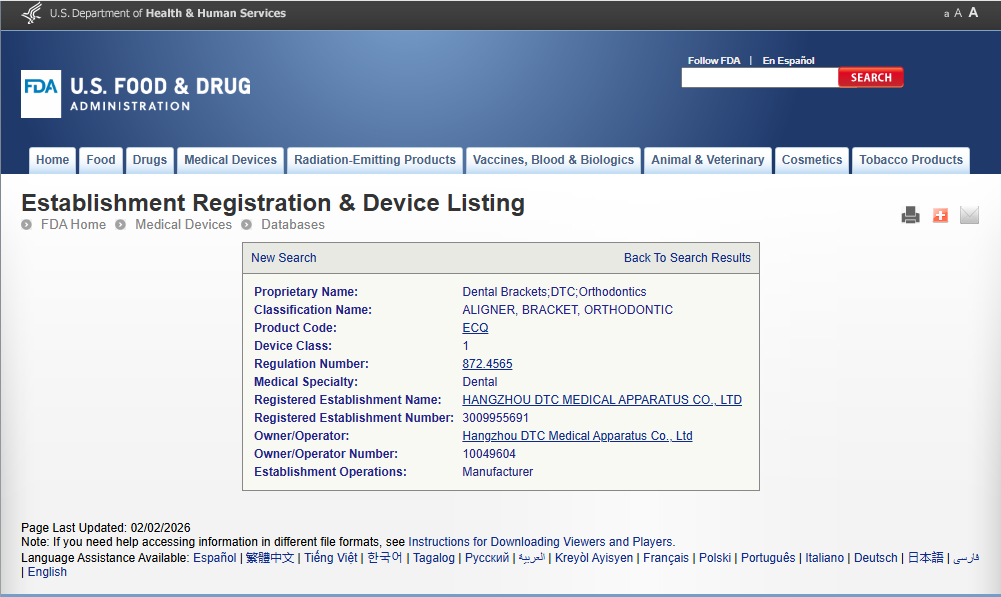
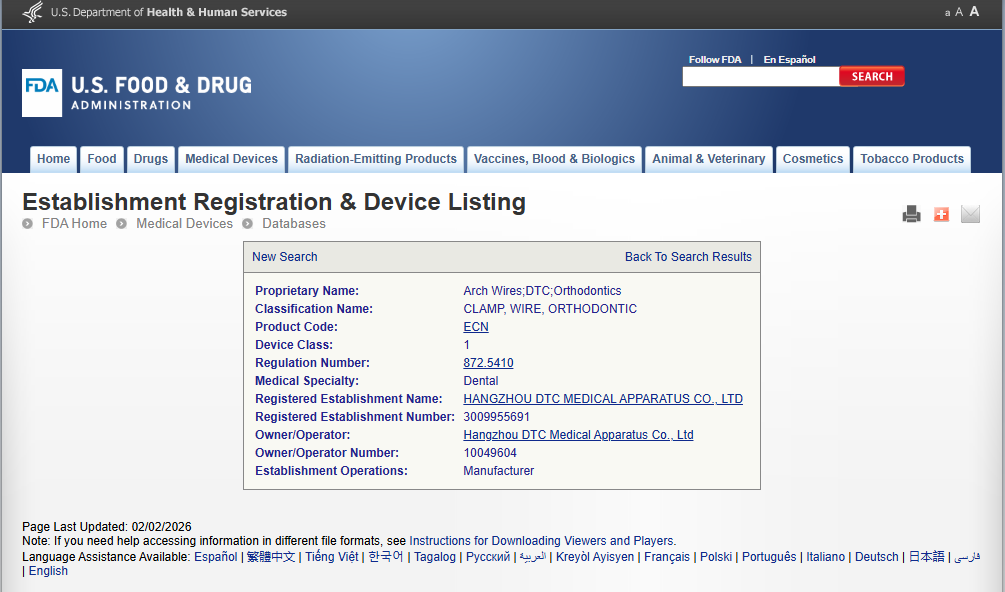
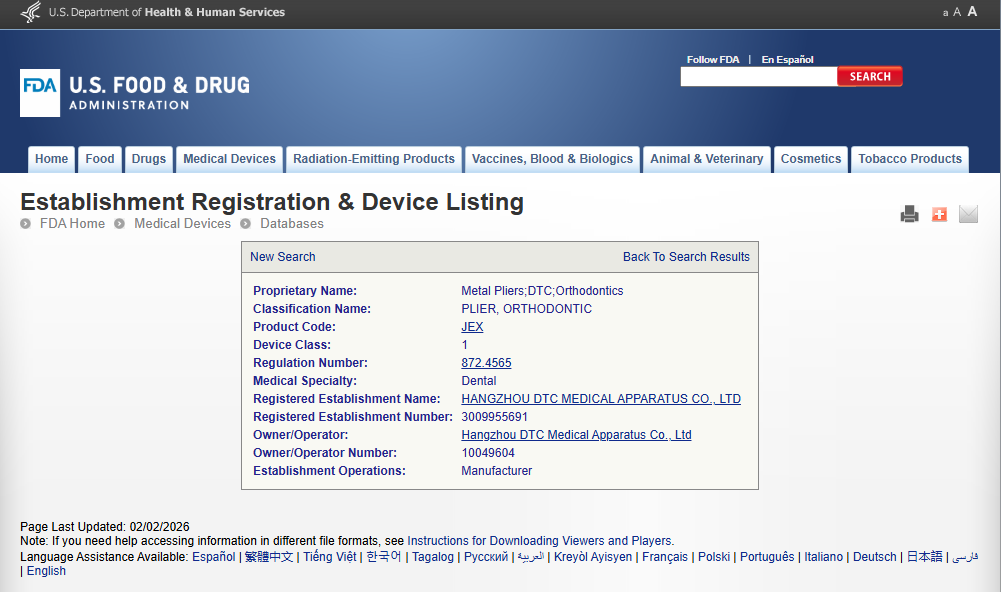
Three documents carry most of the weight. An EN ISO 13485:2016 certificate, number SX 2184523-1, issued on 22 April 2024 by TÜV Rheinland LGA Products GmbH and valid to 8 May 2027, with a scope covering design and development, manufacture and distribution of orthodontic brackets, bands, tubes, wires, lingual buttons, crimpable hooks, orthodontic pliers and dental mirrors, among other items. An FDA registration and listing numbered 3009955691, issued 12 January 2026 under 21 CFR Part 807 and valid to 31 December 2026, naming buccal tubes, brackets, preformed bands, orthodontic springs, mouth mirrors and expansion screws. And a Notified Body confirmation letter for an MDR application covering Class IIa devices, reference 244557490, dated 4 January 2024 and valid to 31 December 2028 — a transition and application document rather than a CE certificate, and it should be read as such.
The buying lesson is that a certificate belongs to a scope, not to a brand. The ISO 13485 scope names specific product families; the FDA listing names specific product codes. Archwires, for example, are not among the items named in the FDA scope extract supplied for this article, so wire documentation should be requested separately rather than assumed from a bracket listing. US regulation treats the category in the same product-specific way: 21 CFR 872.5410 defines orthodontic appliances and accessories as devices affixed to a tooth so that pressure can be exerted on the teeth, and lists preformed bands, elastic bands, metal brackets, wire clamps, tubes and wires within that definition, while orthodontic plastic brackets are classified separately under 21 CFR 872.5470 as Class II devices. A single line item called "orthodontic supplies" is therefore not a single regulatory category, and a SKU-level document map is the only version that survives an audit.
Production-side evidence completes the picture: 100% testing stated in the capability record, a quality management system the company says governs production and shipment, documentation and technical support supplied online with multi-language material, and remote after-sales support. Case records supplied by the company describe a European distributor relationship at 5,000 units running one to three years with stable operation, and clinic relationships in Australia, the US and Canada at 500–1,000 units over two to three years. These are supplier-supplied references, useful as the starting point for a reference call rather than as independent verification.
Market context: what the 2026 figures do and do not say
Market Research Future projects the global orthodontic supplies market to reach USD 11.02 billion in 2026, and the same report projects buccal placement at 89.55% of the orthodontic placement market for the year. Read together, those figures support one narrow and practical conclusion: the components consumed on the buccal side — brackets, buccal tubes, bands and the elastomeric ties that go with them — remain the volume core of a routine order, which is consistent with weighting the attachment and auxiliary blocks more heavily than the add-on block.
They do not support more than that. Commercial estimates of this market differ in product scope, and the same year has been sized differently depending on whether instruments, implants and paediatric products are counted. The figures are directional planning context, not a basis for a clinic's own volume forecast.
Outlook
For clinic planning, the durable change is not a growth rate but documentation depth. Registration requirements are already product-specific — separate US classifications for metal brackets, plastic brackets and the broader appliance category make that clear — so a supplier's ability to produce a per-SKU document set is becoming as relevant as its ability to produce the SKU. The shortlist that holds up across the next planning cycles is the one in which every block has a named document behind it, every series has a specification sheet on file, and every recurring line has a reorder cycle shorter than the production lead time. Portfolio breadth helps a clinic start; documentation and lead-time discipline are what let it restock without interrupting treatment.
Reference material: the company's English-language catalogue is available as a downloadable PDF at cdn.socialarks.com — English catalogue.
FAQ
What belongs in a first orthodontic supply order for a new clinic?
A first order should cover six blocks rather than one big category. That means an attachment set (one primary bracket route, one secondary, one buccal tube series and a band size range), a force-delivery set (early-sequence archwires, a small finishing stock and two spring types), a complete instrument tray per chair, access items (mirrors and retractors matched to the sterilisation cycle), and generous depth in low-cost auxiliaries such as separators, O rings, ligature rings and power chains. Appliance-specific add-ons such as face masks and traction systems are demand-led and belong outside the base list until the clinic has a defined case load for them.
How should a clinic choose between metal, ceramic, self-ligating and lingual brackets?
The choice rests on three attributes, not on brand names. Ligation decides whether the bracket is tied with an elastomeric or wire ligature or closes its slot with an integral mechanism, which changes how fast the tie and O-ring line is consumed. Material and appearance decide where the clinic sits on the aesthetic trade-off, so a practice offering an aesthetic option needs ceramic represented even at low volume. Surface decides the instrument and accessory set, because labial and lingual placement are not interchangeable. A common structure is one primary route for volume, one secondary route for the actual case mix, and the rest on demand — with a specification sheet held for each series, since slot size, prescription and base type are not established by the series name alone.
What should a buyer verify in a supplier's certification documents for orthodontic supplies?
Check three things: whether each document is current, what product scope it names, and what type of document it actually is. In the DTC file, the EN ISO 13485:2016 certificate SX 2184523-1 issued by TÜV Rheinland LGA Products GmbH runs to 8 May 2027 and names brackets, bands, tubes, wires, lingual buttons, crimpable hooks, pliers and dental mirrors; the FDA registration and listing 3009955691 issued under 21 CFR Part 807 runs to 31 December 2026 and names buccal tubes, brackets, preformed bands, springs, mirrors and expansion screws; and the Class IIa document reference 244557490, valid to 31 December 2028, is a Notified Body confirmation of an MDR application rather than a CE certificate. Items outside a named scope, such as archwires in the FDA extract, need their own documentation.
How do MOQ, capacity and lead time shape a restock plan?
The DTC capability record quotes a minimum order quantity of 100 units, a monthly capacity of 5,000 units and a production lead time of 20–30 days. The company's Q&A describes a shorter route for selected standard items held in safety stock, at 3–5 business days, and 2–4 weeks for custom-engineered production. The planning implication is that high-frequency lines should be reordered on a cycle shorter than the 20–30 day production window, so that stock is replenished from buffer rather than from a new production run, while customised items such as logo, tag or package work need to be scheduled a month or more in advance.
Which orthodontic items are most often under-stocked, and why?
The under-stocked lines are usually the cheap ones: separators ahead of banding, O rings and ligature rings, power chains, orthodontic chewies and rotation wedges. They carry low unit value and short replacement cycles, so they tend to be trimmed when an order is reviewed on price, and they interrupt a session immediately when they run out. Instruments are the second weak point, because the count per chair and per sterilisation cycle is often set by catalogue completeness rather than by throughput, and a single missing cutter can delay a wire change. Springs sit in the same category: small, inexpensive and easy to forget until space has to be opened or closed.
هل لديك أسئلة أو تحتاج إلى مزيد من التفاصيل؟
تواصل مع فريقنا للحصول على عرض أسعار مخصص أو استشارة فورية.
طلب عرض أسعار
املأ النموذج أدناه وسيتواصل معك فريقنا بعرض مقترح مخصص.
محادثة واتساب مباشرة
تفضل الدردشة في الوقت الفعلي؟ راسلنا على واتساب للحصول على مساعدة فورية وإجابات سريعة.
- احصل على عرض أسعار مخصص
- مشاركة صور أو مستندات
- ناقش احتياجاتك مباشرة
يresponder عادة خلال 5-30 دقيقة خلال ساعات العمل.