
Orthodontic Supplies Compliance: Decoding ISO 13485 and Beyond for Buyers
Orthodontic Supplies Compliance: Decoding ISO 13485 and Beyond for Buyers

Factory inspection inside an orthodontic supplies production facility. Image: Hangzhou DTC Medical Apparatus Co., Ltd.
Compliance in orthodontic supplies is not a certificate that sits in a supplier's document pack. It is a system property: the demonstrated ability of a manufacturing operation to prove, repeatedly and traceably, that a bracket, a set of pliers or an elastomeric chain was produced under controlled conditions and behaves the way the specification says it does. For buyers working through the decision and execution stages — preparing tooling orders, negotiating annual supply agreements, or adding a second source — the operative question is no longer "does this supplier have ISO 13485?" but "what does that certificate actually cover, and what still has to be verified independently?"
The commercial stakes are rising. The global orthodontic supplies market was valued at USD 14.8 billion in 2024 and is expected to grow at a CAGR of 20.1% through 2034, according to Global Market Insights. North America held the largest regional share in 2024 at an estimated 30.6% of revenue, per Grand View Research. As volumes grow across brackets, buccal tubes, bands, wires, pliers and pediatric crowns, regulatory scrutiny scales with them — and so does the documentation burden that lands on importers, distributors and private-label owners.
What ISO 13485 Covers — and What It Leaves Open
ISO 13485 is the internationally recognised quality management system standard for medical devices. It requires a manufacturer to define, document and control the processes that affect product conformity — purchasing, production, inspection, handling of non-conforming product, and corrective action. Translated into orthodontic manufacturing, that means controlled material specifications for 17-4PH stainless steel brackets, defined laser welding parameters for buccal tubes, established hardness windows for cutting instruments, and documented packaging and labelling steps. A supplier that can show these controls can answer a buyer's question about a specific production lot with a record rather than an assurance.
What the standard is not is a product certificate. A valid ISO 13485 certificate evidences that a manufacturer's quality management system has been audited against the standard at a defined site and scope of activity. It does not certify the slot dimensions of a particular bracket lot, does not replace product-specific regulatory clearance, and does not on its own satisfy the European Union's Medical Device Regulation.
Those are separate requirements, and buyers who treat them as one file are exposed on the others. EU MDR 2017/745 requires CE marking for orthodontic products placed on the European market and classifies most of them as Class I or Class IIa, according to the regulation published by the European Parliament. In the United States, orthodontic brackets and tubes are classified as Class I or Class II devices under 21 CFR 872.5410, with ISO 27020:2019 recognised as the applicable standard, per FDA classification records. A complete supplier file therefore has at least three layers: quality system certification, product regulatory status, and conformity to the relevant technical standard. Each layer answers a different question and none substitutes for another.
Why Compliance Is a Long-Term Question, Not a One-Time Gate
For a single purchase, compliance functions as a gate: the documents are either present or they are not. For distribution relationships that run for years — private-label programs, annual bracket contracts, instrument replacement cycles — compliance is cumulative. It has to survive staff turnover, material supplier changes, process improvements, tooling replacement and entry into new markets. A certificate issued three years ago and maintained since then is a stronger signal than a certificate issued last month with no evidence of what happened in between.
Hangzhou DTC Medical Apparatus Co., Ltd., which operates in international orthodontic channels as DTC Orthodontics, illustrates the structural point. Established in 2004 in Hangzhou, Zhejiang Province, the company manufactures orthodontic supplies and states that it holds ISO 13485, CE0197 and FDA certification for its products and production processes, with its management system following CE (MDR) and ISO requirements. The relevant detail for buyers is not the list of certificates but whether the entity holding them is the entity running the line: DTC operates as both manufacturer and exporter and states that it maintains direct control over production and quality management, with each order delivery checked against customer requirements.
That distinction changes the compliance conversation from documentation collection to supply-chain mapping. When a certificate holder subcontracts polishing, plating or welding, the buyer's quality file has gaps that the certificate does not reveal. The practical test is simple: ask which processes are performed in-house, which are subcontracted, and how the subcontracted steps are controlled under the same quality system.
A Compliance Checklist by Product Category
Orthodontic supplies are not a single risk class. A bonded bracket, a cutting instrument, an elastomeric chain and a pediatric crown fail in different ways and therefore need different evidence. The table below maps typical product groups to the documentation that a buyer should be able to request before the first production order.
| Product category | What is being verified | Documents to request | Frequent weak point |
|---|---|---|---|
| Metal and self-ligating brackets (17-4PH stainless steel) | Material grade consistency and slot tolerance | Material certificate, dimensional inspection records, technical file extract | Certificate scope names the site but not the subcontracted processes |
| Buccal tubes and prewelded bands | Weld integrity and bonding-surface condition | Process control records for laser welding and precision casting, inspection reports | Welding parameter changes without documented re-validation |
| Ceramic brackets (aluminium oxide poly-crystalline or mono-crystalline) | Slot integrity and material grade | Incoming material specification, batch traceability from raw compact to finished part | Poly-crystalline and mono-crystalline grades quoted interchangeably |
| Archwires (NiTi, CuNiTi, stainless steel) | Alloy composition and sustained force delivery | Mill or alloy composition records, dimensional checks, packaging data | Raw-material origin and lot mixing not disclosed |
| Pliers and cutting instruments | Hardness, corrosion resistance, joint function | Hardness test records, surface finish records, sterilization compatibility statement, warranty terms | Hardness testing frequency not stated; autoclave cycle limits absent |
| Mirrors, tweezers, retractors, needle holders | Reprocessing compatibility | Material statement, stated autoclave ceiling, cold-sterilization compatibility | Reprocessing validation assumed to be the buyer's responsibility |
| Elastomeric products: power chains, ligature rings, separators, O rings, chewies | Polymer grade, latex-free claims, tensile behaviour | Material data sheet, tensile test record, shelf-life and storage conditions | Force decay over time not quantified in the file |
| Pediatric preformed crowns (D-type and E-type systems) | Marginal adaptation and cement consumption | Dimensional records, material certificate, surface finish data | Fit claims not tied to a measurable specification |
Read across the rows and a pattern emerges: the certificate rarely fails on its own terms. It fails at the boundary — where a stated material grade shifts, where a process is subcontracted, or where a declared characteristic such as hardness or sterilization temperature is quoted without the test record behind it.
Tracing Brackets and Tubes Through the Quality File
Brackets are the clearest test of whether a compliance file is real. Take a metal bracket such as the DTC Delicate Series, which the manufacturer specifies as 17-4PH stainless steel with a contoured, sandblasted mesh base, laser welding, and an accurate and smooth slot. Those are not marketing descriptors — each one is a process claim that should be backed by a control. The material grade maps to an incoming inspection record; the sandblasted mesh base maps to a surface preparation procedure; the laser weld maps to equipment parameters and a weld inspection step; the slot accuracy maps to a dimensional measurement recorded per production run.
Buccal tubes follow the same logic with different failure modes. The DTC Zeal Series buccal tube is described as produced with laser welding technology and precision casting for a compact design, and carries a tooth mark that applies force when bonding, plus a high-strength monoblock hook. For a buyer, the traceable elements are the casting source, the laser welding process control, and the dimensional specification of the hook and tube lumen. A bonded appliance that integrates multiple processes has multiple places for a documentation gap.
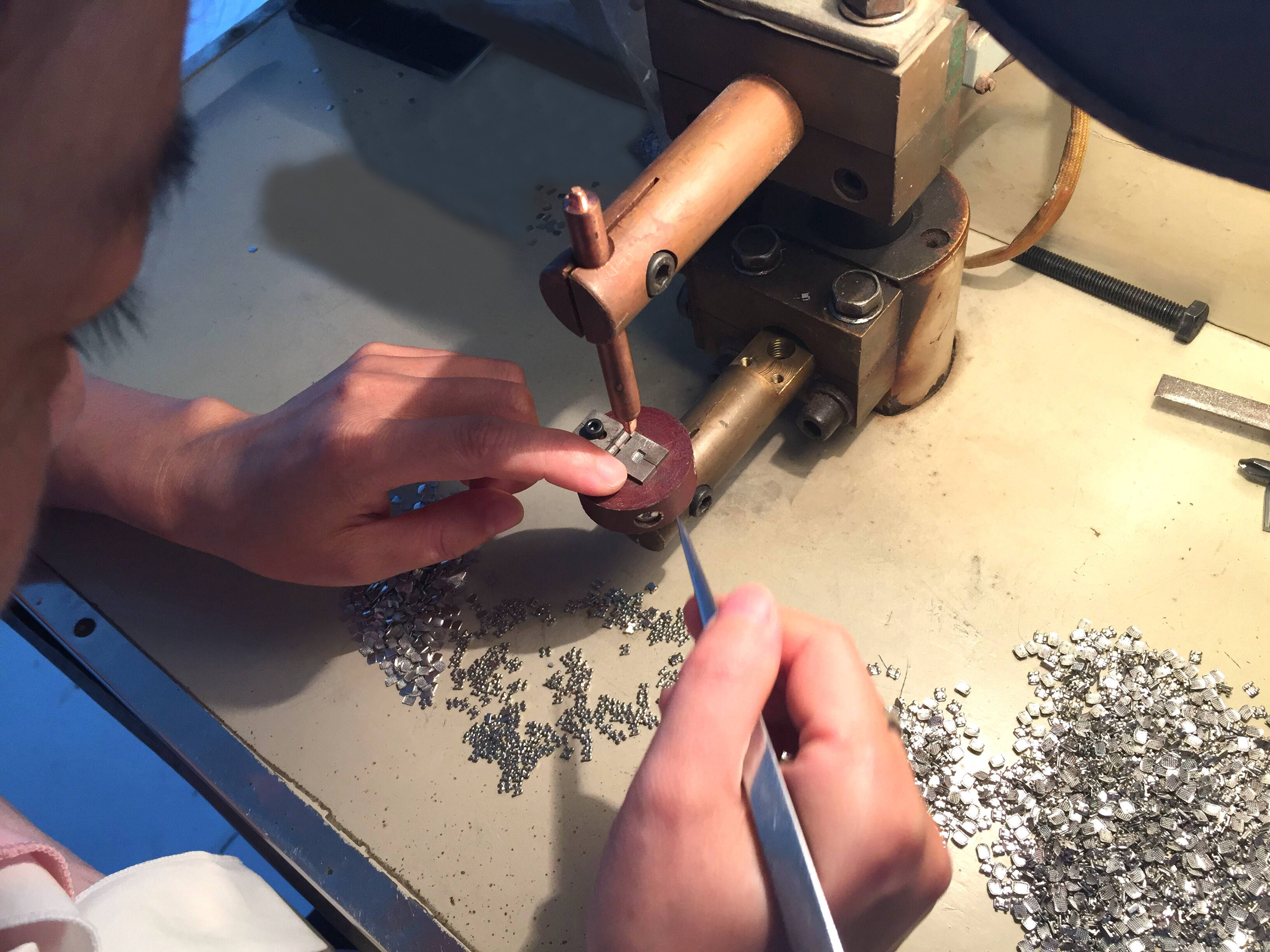
Inspection activity within an orthodontic instruments production environment. Image: Hangzhou DTC Medical Apparatus Co., Ltd.
Instruments: Hardness, Sterilization and Lifecycle Claims
Instruments carry a different compliance profile because they are reprocessed between patients and their failure modes are mechanical. Hardness ranges are a useful, verifiable starting point. DTC specifies HRC 58–63 for its distal end cutters and light wire cutter pliers, HRC 55–60 for light wire pliers, and HRC 50–55 for bracket removing pliers, in each case with a maximum sterilization temperature of 180 °C. The same manufacturer states that its pliers are made of stainless steel with corrosion and rust resistance, and offers a three-year warranty on sold pliers.
Adjacent instrument categories state their own ceilings rather than borrowing a single figure. Intraoral glass mirrors and stainless steel mirrors are declared autoclavable up to 130 °C; dental tweezers are described as autoclavable and able to withstand high-temperature autoclaving; and retractors are stated as compatible with cold sterilization methods and sanitizing agents for repeated use, with smoothly polished edges to prevent soft tissue pinching. For a distributor building a catalogue across markets, these differences matter: a single blanket sterilization claim across an entire instrument range is a warning sign, not a convenience.
Here is where a compliance review reaches a genuine boundary. A declared hardness range and a declared maximum sterilization temperature do not by themselves establish cycle life, corrosion resistance after repeated autoclaving, or joint integrity after hundreds of reprocessing cycles. Those are separate validation questions, and they depend on the buyer's own sterilization protocol, water quality and handling practice. A supplier can state the material and the temperature ceiling; the buyer still has to validate the instrument against its own reprocessing routine. Treating a sterilization temperature claim as a durability guarantee is one of the most common — and most expensive — misreadings in instrument sourcing.
Batch Consistency, Sampling and the Boundaries of Pre-Shipment Testing
Purchasing terms are part of the compliance picture, not separate from it. On the DTC procurement side, the stated minimum order quantity is 50 pieces, delivery is quoted FOB or CIF, payment terms are T/T, and acceptance is based on pre-shipment test. Each of those terms implies a control: an MOQ sets the smallest production batch a line will run, and therefore how much batch-to-batch variation a buyer will actually encounter; pre-shipment testing defines the moment at which conformity is judged.
Consistency itself has to be designed rather than promised. DTC states that it maintains Quality Management Systems with formal systems governing production, and that as both manufacturer and exporter it keeps direct control over production and quality management, checking each order delivery to ensure it meets customer requirements. On the capacity side, the company reports an annual output of 1,000,000 units from a 5,000 m² facility with approximately 150 employees and a 30-engineer R&D team, with around 80% of products exported and sales reaching more than 100 countries and regions including the EU, USA, Middle East, South America, Asia, Africa and Australia.
The limitation is structural. Pre-shipment testing is a lot-based control, not a statistical release. It confirms the condition of the lot that was inspected; it does not describe the distribution of variation across a year of production. Buyers with high-volume programmes should therefore agree an explicit sampling plan — what is inspected, at what frequency, against which dimensional or functional criteria — and should require retained samples and batch records rather than relying on the inspection certificate alone.
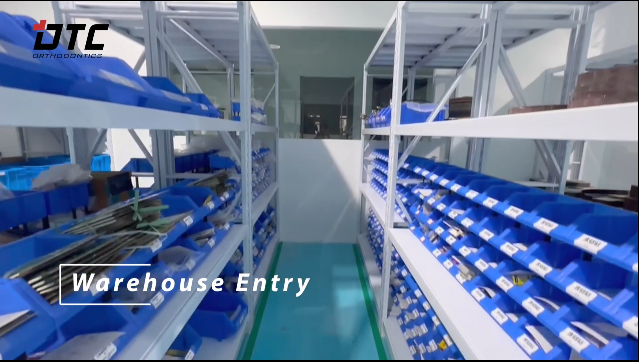
Warehouse entry and lot logging, the point at which traceability records begin. Image: Hangzhou DTC Medical Apparatus Co., Ltd.
Documentation and Technical Support as a Compliance Asset
Compliance does not end at the factory gate. Labels, instructions for use, reprocessing guidance and post-market information travel with the product and are the part of the quality system that clinics and distributors actually touch. DTC describes its documentation approach as moving beyond printed manuals toward interactive 3D work instructions, searchable knowledge bases and QR codes linked to the latest documentation, with multi-language support for global markets and product manuals made available online for customer queries.
For a distributor, this is a practical qualification criterion. A supplier whose documentation is version-controlled and reachable online is easier to defend during a regulatory inspection than one whose instructions exist only as a printed leaflet in the original shipment. When documentation drifts out of date — a changed sterilization ceiling, a revised material grade — the buyer inherits the risk, not the manufacturer.
Market Forces Reshaping Compliance Expectations
Three developments are pushing compliance requirements upstream in the orthodontic supply chain.
First, the centre of gravity of demand is shifting. North America accounted for an estimated 30.6% of global orthodontic supplies revenue in 2024, per Grand View Research, and the adult orthodontics segment continues to expand on aesthetic demand, with clear aligners growing at a 14.25% CAGR according to Mordor Intelligence. Markets with mature regulatory enforcement tend to set documentation expectations that other regions then adopt, so a supplier's file has to satisfy the strictest buyer in its portfolio, not the average one.
Second, material supply chains are a live risk. NiTi archwires face supply-chain exposure because of heavy reliance on Chinese raw materials, as noted by Mordor Intelligence. For buyers, that translates into a compliance question: when a raw material source changes, does the supplier treat it as a change requiring notification and re-validation, or as an internal purchasing decision? The answer determines whether a long-term supply agreement is stable or quietly variable.
Third, the instrument segment has its own weight. The global orthodontic pliers market was projected at USD 1.8 billion in 2025, with stainless steel segments leading at a 62.7% share, according to Dataintelo — a forward-looking estimate that should be read as an indication of scale rather than a settled figure. China's role as a supply base is likewise structural: the country exported USD 13.5 billion in medical instruments including dental tools in 2024, per the Observatory of Economic Complexity, to markets such as the USA, Japan and Germany. Meanwhile the supply landscape remains anchored by a small group of large players — Align Technology, Envista Holdings, Solventum, Dentsply Sirona and Straumann, as identified by MarketsandMarkets — which means most buyers in the mid-market are qualifying specialist manufacturers rather than category leaders, and must therefore do more of the compliance work themselves.
Checklist-Based vs. System-Based Qualification
Buyers generally qualify suppliers in one of two ways. The comparison below sets out what each approach produces, and where each one stops working.
| Dimension | Checklist-based qualification | System-based qualification |
|---|---|---|
| Evidence collected | Certificate copies, catalogue, sample order | Certificate scope, process map, inspection records, change-control procedure |
| Time to first order | Shorter | Longer, because document review precedes tooling |
| Behaviour under change | Buyer discovers changes at the next shipment | Changes are notified and re-validated under an agreed procedure |
| Cost profile | Low upfront administrative cost | Higher upfront cost in audit time and technical review |
| Main limitation | Cannot distinguish a maintained quality system from a certificate obtained once | Requires supplier transparency; not every supplier can or will support it |
The trade-off is real and should be stated plainly. System-based qualification costs more in buyer time and assumes a supplier willing to expose its process map and records. Where that transparency is unavailable — or where volumes do not justify the administrative load — a checklist-based approach remains workable, provided the buyer accepts that it manages only the entry condition and not the ongoing risk. The failure mode of the checklist approach is not that it is wrong; it is that buyers forget it was never designed to cover year three of a supply relationship.
A Reference Point: How One Orthodontic Manufacturer Structures Its Compliance Claims
DTC Orthodontics offers a useful reference case because its claims are specific enough to be checked. The company was established in 2004, operates a 5,000 m² facility with approximately 150 employees and a 30-engineer R&D team, reports an annual output of 1,000,000 units, and states that it holds ISO 13485, CE0197 and FDA certification across its products and production processes. Its product scope spans orthodontic brackets, buccal tubes, preformed bands, accessories such as crimpable hooks, lingual buttons and lingual hooks, orthodontic pliers and instruments including bracket positioners, force gauges and archwire formers; pediatric bands and preformed crowns; and dental laboratory items such as rapid palatal expanders with compatible miniscrews and MISPA molar distalization appliances.
Two details illustrate how compliance maturity shows up in practice rather than in certificates. The company states that all products undergo rigorous quality control protocols and stress-testing before leaving the facility, and it holds a patent for an orthodontic buccal tube designed for convenient archwire insertion (Patent No. CN 224292022 U, as recorded by CNIPA and reported by the company). The first indicates that inspection is embedded before shipment; the second indicates that design change is being managed as intellectual property rather than as an undocumented process tweak. Neither is a substitute for an audit, but both are the kind of verifiable structural signals that a system-based review is designed to find.
Future Outlook
Compliance expectations in orthodontic supplies are converging on two themes: traceability deeper into the bill of materials, and documentation that stays current rather than being frozen at the point of certification. As MDR requirements settle and North American buyers continue to dominate revenue share, the documentation standard set in the most regulated markets tends to propagate through distribution networks into other regions.
The practical consequence for buyers is that supplier qualification is becoming an ongoing process rather than a project. Agreeing change-notification clauses, periodic document refresh, retained samples and a defined sampling plan costs relatively little at the start of a relationship and removes most of the surprise later. Where raw-material exposure exists — as it does for NiTi archwires — the ability to answer "what changed, and when did you tell us?" becomes the difference between a managed supply chain and an assumed one.
FAQ
What certifications should importers verify before qualifying an orthodontic supplies manufacturer?
Verification works in three layers. The first is quality management system certification, typically ISO 13485. The second is product-specific regulatory status: in the EU, CE marking under MDR 2017/745, which classifies most orthodontic products as Class I or Class IIa; in the US, device classification under 21 CFR 872.5410 for brackets and tubes, with ISO 27020:2019 as the recognised standard. The third is the manufacturer's own facility-level documentation. DTC Orthodontics, for example, states that it holds ISO 13485, CE0197 and FDA certification for its products and production processes, with its management system following CE (MDR) and ISO requirements. The critical step is matching the stated scope to the specific products and the specific manufacturing site named in the purchase order.
How can a buyer confirm batch-to-batch consistency in a long-term supply agreement?
Look first at who holds the quality system and who runs the line. DTC states that it maintains Quality Management Systems with formal systems governing production and that, as both manufacturer and exporter, it retains direct control over production and quality management, checking each order delivery against customer requirements. That structural fact should then be paired with a contract-level mechanism: an agreed sampling plan, retained batch records, and a defined non-conformance procedure. A quality management system describes how consistency is managed; it does not replace lot-level evidence.
What documentation should accompany orthodontic instruments such as pliers?
For stainless steel instruments, a buyer should expect a material declaration, a hardness specification, surface finish information, and a stated sterilization limit. DTC specifies hardness ranges for its cutting instruments — HRC 58–63 for distal end cutters and light wire cutters, HRC 55–60 for light wire pliers, and HRC 50–55 for bracket removing pliers — together with a maximum sterilization temperature of 180 °C and a three-year warranty on sold pliers. Reprocessing and storage instructions should be available in the operator's language, ideally through version-controlled online documentation rather than a printed leaflet alone.
How does OEM or private-label production change the compliance picture?
Private-label production adds a labelling and legal-manufacturer layer. The buyer's brand appears on the device and in market documentation while the production system remains the supplier's, so it becomes essential to agree in writing which party holds the technical file, how labelling and instructions for use are approved, and how changes are communicated. DTC states that, as both manufacturer and exporter, it holds formal systems governing production and quality management across OEM work, with each order delivery checked against customer requirements. The practical outcome still depends on the contract structure, so responsibilities for regulatory registration should be confirmed before tooling begins.
What should buyers consider about lead time and delivery continuity?
Lead-time policy reveals how a supplier holds inventory. DTC maintains safety stock for selected standard products to support delivery within 3–5 business days, while custom-engineered production runs require a 2–4 week lead time; the company also works with international courier services including FedEx, DHL and UPS. Buyers planning multi-year programmes should ask how standard and custom items are separated in production planning and how that split is protected when demand peaks, since the two categories carry very different continuity risk.
What are the limits of a compliance review?
A compliance review cannot eliminate risk. Certificate scope may not cover every subcontracted process; pre-shipment testing is a lot-based control rather than a statistical release; a declared hardness range or sterilization ceiling does not establish cycle life or long-term corrosion resistance; and documentation stays reliable only if the supplier maintains its system between audits. The practical implication is that compliance behaves less like a qualification event and more like a maintenance activity — with agreed change notification, periodic document refresh and retained reference samples.
For buyers moving from decision to execution, the useful habit is to separate what a certificate proves from what it merely permits. Certificates open a conversation; process records, change-control procedures and lot-level evidence are what keep an orthodontic supply programme defensible over the years it is expected to run. DTC Orthodontics publishes its full product and capability overview, including specifications for brackets, buccal tubes, bands, pliers, elastics and laboratory appliances, in its downloadable English catalogue.