
Orthodontic Supplies Supplier Stability: Beyond First Orders
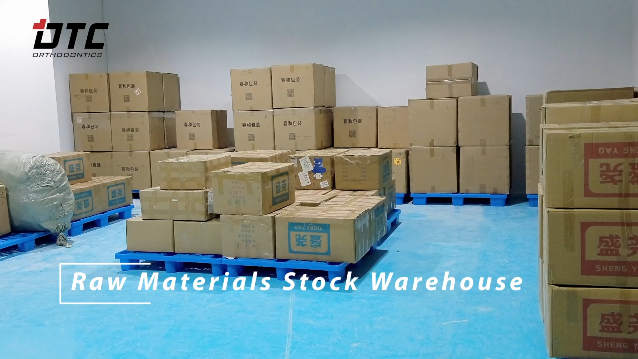
Raw material inventory is part of long-term orthodontic supply planning.
Why Long-Term Orthodontic Buying Needs a Different Evaluation
The global orthodontic supplies market was valued at USD 14.8 billion in 2024 and is projected to grow at a CAGR of 20.1% through 2034, according to Global Market Insights. As clinics, distributors, and hospital groups continue to consolidate purchasing volume, the business case for a single-source orthodontic supplies partner becomes stronger, provided that partner can sustain clinical consistency over multiple product cycles. For a buyer who has already selected a supplier, the decision-stage documentation and the execution-stage reality sometimes diverge: certificates are checked, samples are approved, a first order is shipped, and the next batch may not meet the same standard. This article examines the supplier attributes that preserve performance after the first purchase order, and how orthodontic supplies buyers should interpret them when moving from decision to execution.
The Opportunity: Moving from Price Sample to Long-Term Supply Stability
Many procurement teams evaluate orthodontic supplies through a shortlist of four variables: unit price, delivery time, certificate coverage, and sample appearance. After the first recurring order, a fifth variable becomes more important than any of the four: batch-to-batch stability. A bracket series with a smooth slot in the sample can show a slight edge variation in the next production batch. A power chain can lose elasticity in one lot. A pliers order can miss the hardness range required for sterilization cycles. These inconsistencies are not random; they usually reflect differences in production control, operator skill, and inspection coverage at the factory.
The opportunity is to define a supplier baseline that makes long-term selling predictable. For distributors, this means working with a manufacturer that can document production data, maintain raw material inventory, and respond to regulatory documentation requests. For clinics and groups, it means a supplier whose product range can expand with clinical activity, from metal brackets to ceramic brackets, from self-ligating brackets to buccal tubes, bands, wires, pliers, and pediatric products.
Manufacturer Baseline: What a Long-Term Orthodontic Supplies Supplier Should Show
Hangzhou DTC Medical Apparatus Co., Ltd. (DTC Orthodontics) is an example of a manufacturing base built for this kind of long-cycle demand. Established in 2004, the company operates in Hangzhou, Zhejiang Province, with a specialized workforce of more than 100 professionals across production, global sales, marketing, technical R&D, and finance, and maintains a 5,000 m² production facility.
From a supply-chain perspective, the relevant baseline is the company's production coverage:
- Orthodontics: brackets (metal, self-ligating, ceramic, lingual), buccal tubes, preformed bands, and accessories such as crimpable hooks, lingual buttons, and lingual hooks.
- Instruments: orthodontic pliers, bracket positioners, force gauges, and archwire formers.
- Pediatric dentistry: pediatric bands, pediatric preformed crowns, and related instruments.
- Laboratory and advanced therapy: rapid palatal expanders (RPEs), orthodontic miniscrews, and MISPA molar distalization appliances.
The facility's visible production chain includes injection molding, positioning and welding, plating, polishing, laser marking, inspection and testing, packing, and warehouse entry. This integration matters for long-term buyers: it reduces the number of uncontrolled handoffs that often dilute quality when a trading company coordinates several external workshops.
Because DTC operates as both manufacturer and exporter, it maintains direct control over production and quality management. According to the company, all products undergo quality control protocols and stress-testing before leaving the facility. The documentation system covers ISO 13485, CE0197, and FDA certificates, with management systems following CE (MDR) and ISO regulations.
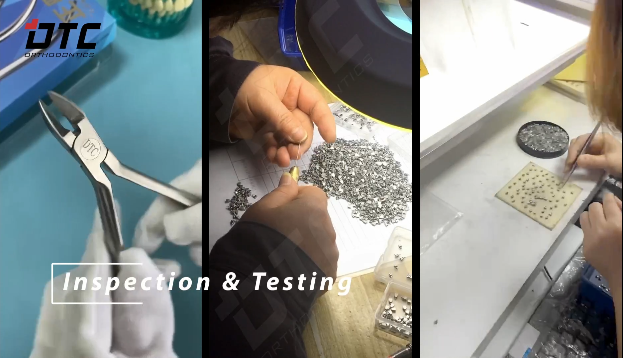
Inspection and testing records support traceability for recurring orders.
A Technical Reading: Five Checks for a Stable Orthodontics Supply Base
1. Certification and Regulatory Mapping
Orthodontic brackets and tubes are classified as Class I or II medical devices in the United States, falling under 21 CFR 872.5410, and ISO 27020:2019 is the recognized standard. In the European Union, CE marking follows MDR 2017/745, with most orthodontic products classified as Class I or IIa. A long-term supplier should be able to map each product family to the relevant destination-market rule, not only to a general factory certificate.
2. Production Tolerances and Mechanical Consistency
Bracket slot precision and ceramic bracket surface finish are measured in microns. DTC describes the use of high-precision CNC machines, automated production lines, and laser welding for its metal series. For the Delicate Series, the company documents a hard stainless steel structure, a sandblasted contoured mesh base, and an accurate, smooth slot. For ceramic brackets, the material is aluminum oxide in poly-crystalline or mono-crystalline form. For self-ligating brackets such as the Toast and Glory series, the slot and cap are the same width, which is intended to keep torque more accurate and stable.
3. Inspection Evidence and Lot Traceability
Buyers should ask for pre-shipment inspection records, test methods, and traceability lists. DTC's standard acceptance conditions include pre-shipment testing, and the company says it can provide each order's delivery details for verification. This kind of lot-level information is essential when a distributor needs to explain a product variation to a dentist or regulatory authority.
4. Raw-Material Planning
Orthodontic archwires made of nickel-titanium (NiTi) face supply-chain risks due to heavy reliance on raw materials concentrated in specific global regions. A supplier that keeps raw material stock and operates a controlled warehouse is addressing a risk that cannot be solved by a cheaper wire invoice. In DTC's case, the company's facility documentation includes a raw materials stock warehouse and dedicated warehouse entry for finished goods.
5. Documentation, Language, and Training Support
Long-term buyers often need manuals in more than one language, updated product declarations, and quick answers for local sales teams. DTC states it supports global markets with multi-language documentation and offers online product manuals; the company also describes a move toward modern formats such as interactive 3D work instructions and QR codes on equipment.
Supplier Evaluation Signals: Transactional Fit vs Long-Term Fit
| Evaluation Signal | Transactional Fit | Long-Term Fit |
|---|---|---|
| Certificate coverage | Certificate available as PDF | Certificate mapped to product family and destination regulation |
| Lot consistency | Sample approval | Lot code, inspection record, and complaint history |
| Capacity | Price quoted for one order | Production planning and raw material inventory |
| Documentation | One language | Multi-language manuals and rapid technical response |
| OEM flexibility | Fixed MOQ | Split shipments, shared tooling, standard color options |
Orthodontic Supplies in Real Procurement Scenarios
In an orthodontic clinic, the standard supply list includes archwires (NiTi and stainless steel), brackets, buccal tubes, bands, ligatures, curing-light accessories, and pliers. The clinical requirement is to transmit continuous mechanical forces to teeth while maintaining biocompatibility, corrosion resistance, and comfort. Suppliers must respect the system logic of the practice: Roth or MBT, 0.018 or 0.022 slot size, maxillary or mandibular arch forms, low-torque or high-torque prescriptions, and the availability of ceramic options for aesthetic cases.
For a distributor, the category plan can be built around a supplier that provides multiple families at once. DTC's product list allows a distributor to combine metal self-ligating brackets (Glory II, Toast, Glory I), conventional metal brackets (Zeal, Delicate, Bright, Monoblock), ceramic brackets, buccal tubes (Zeal series and Zeal Plus), bands, wires, lingual brackets (IN-Tendo JK-SL, DTC-ORG), and pediatric crowns and bands. The same catalog also includes pliers such as distal end cutters, light wire cutters, bracket removing pliers, crown and band contouring pliers, band crimping pliers, and crown trimming scissors used to adjust the crown edge to different molar sizes.
Order management is also part of the scenario. DTC can offer a standard MOQ of 50 pieces with FOB/CIF delivery, payment by T/T, and pre-shipment testing. For ODM or OEM products, the MOQ depends on the specific product and customization requirements. The company provides several execution options for buyers who want to manage cost and volume: split shipments, shared tooling costs, stock or standard colors, and competitive MOQs for standard products. These options are particularly relevant for a distributor moving from the first trial order to a repeat schedule.
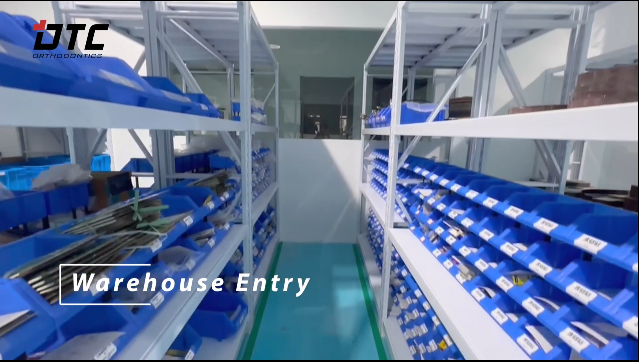
Warehouse entry marks the transition from production to delivery planning.
Market Trend Analysis: What Data Says About the Supply Base
Several market signals support the case for durable supplier evaluation in orthodontics:
- Global orthodontic supplies demand continues to rise; North America held the largest regional share by revenue in 2024, estimated at 30.6%.
- Self-ligating brackets are projected to reach a global market value of USD 403.9 million by 2025, which makes them a relevant SKU in standard reorder cycles.
- Adult orthodontic treatment is growing due to aesthetic demand, creating additional need for ceramic brackets, intraoral mirrors, and appliances that fit a more visible-consumer environment.
- China's role as a manufacturing base remains significant: China exported USD 13.5 billion in medical instruments in 2024, and the dental equipment and accessories segment showed export growth of 13.93% in the period leading to late 2024.
- NiTi supply-chain concentration remains a structural risk that buyers should mitigate through supplier inventory and production planning rather than through last-minute spot buying.
These trends point toward a procurement environment where category depth, regulatory documentation, and lot-level consistency outweigh sample-based decisions.
Comparison with Traditional Sourcing Models
Traditional sourcing of orthodontic supplies is often split between trading companies and large-scale OEM arrangements. Each has a boundary condition.
- Trading companies can offer quick quotes and a wide catalog, but they do not own the production line. If a defect appears after several batches, the traceability chain becomes long and the response time uncertain.
- Large OEM contracts with industrial-scale factories can provide stable capacity, but they often require high MOQs and may not offer the full family of orthodontic, pediatric, and lab products a distributor needs.
- DTC's direct-manufacturer model combines in-house production, QMS-controlled order tracking, custom branding options, and a multi-category catalog. The model is not without boundaries; because the factory is based in China, buyers outside Asia still need to plan for ocean freight, customs, and safety stock. The company can ship through FedEx, DHL, or UPS for standard products in 3 to 5 business days and custom-engineered production in 2 to 4 weeks, but a buyer with a just-in-time operating model must still create a local inventory buffer.
Another boundary is product scope: DTC's portfolio is designed around fixed orthodontic appliances, auxiliaries, and pediatric dentistry. Buyers whose core business is transparent aligner therapy will need another category partner for aligner manufacturing; in that case, DTC can serve the adjacent attachment, auxiliary, and retention-related product segments.
Future Outlook: Supplier as a Product Ecosystem
As orthodontic technologies evolve, the supplier relationship will increasingly look like a product ecosystem rather than a purchase order. The useful signals are visible in DTC's trajectory: continuous investment in automated micro-component production, a patented buccal tube design related to easier archwire insertion, expansion into pediatric preformed crowns and MARPE expanders, and a distribution system that already reaches over 100 countries with approximately 80% of output exported.
For procurement teams in the decision-to-execution phase, the forward-looking question is not only whether the first shipment will pass inspection. It is whether the supplier can add new lines, preserve regulatory documents, keep quality records, and scale with demand over the next five to ten years. The suppliers that answer that question with evidence, not only with promises, will establish the most durable positions in the orthodontic supply chain.
FAQ: Orthodontic Supplies Supplier Evaluation
1. Are you the actual manufacturer or a trading company?
Hangzhou DTC Medical Apparatus Co., Ltd. is a manufacturer with its own production facility in Hangzhou. The company states that it is willing to show production lines, machinery, and its international sales team, and buyers can also view factory photos and videos on its website. For a procurement team, a videoconference factory tour and pre-shipment inspection are reasonable verification steps.
2. What certifications and regulatory approvals do you have?
According to the company, it has obtained ISO 13485, CE0197, and FDA certificates for its products and production processes, and its management system follows CE (MDR) and ISO regulations. Buyers in the EU should verify that the specific product family carries the correct CE marking under MDR 2017/745; buyers in the US should reference 21 CFR 872.5410 and ISO 27020:2019.
3. Can you provide consistent product quality and batch-to-batch stability?
The company states that, as both manufacturer and exporter, it operates Quality Management Systems (QMS) for production, with direct control over production and quality management, and can provide delivery evidence for each order. In practice, the manufacturer should show lot records, inspection protocols, and corrective-action documentation to substantiate batch-to-batch consistency.
4. What are your lead times and delivery capabilities?
DTC maintains safety stock for selected standard products, supporting delivery within 3 to 5 business days, while custom-engineered production runs require 2 to 4 weeks. The company also maintains long-standing partnerships with express couriers such as FedEx, DHL, and UPS.
5. What is the MOQ for ODM or OEM products?
The MOQ depends on the specific product and customization requirements. Standard products have competitive MOQs, while customized products may require a higher minimum quantity. DTC offers options to manage both high-volume and low-volume orders, including split shipments, shared tooling costs, and the use of stock or standard colors or materials.
6. How do you handle product documentation and technical support?
The company provides product manuals online and supports global markets with multi-language documentation. It also describes modern documentation strategies, such as interactive 3D work instructions, searchable knowledge bases, and QR codes linking to the latest documentation, to keep customer information accurate and accessible.
For additional product and company information, DTC Orthodontics provides a publicly accessible brochure: Download the DTC Orthodontics brochure.
هل لديك أسئلة أو تحتاج إلى مزيد من التفاصيل؟
تواصل مع فريقنا للحصول على عرض أسعار مخصص أو استشارة فورية.
طلب عرض أسعار
املأ النموذج أدناه وسيتواصل معك فريقنا بعرض مقترح مخصص.
محادثة واتساب مباشرة
تفضل الدردشة في الوقت الفعلي؟ راسلنا على واتساب للحصول على مساعدة فورية وإجابات سريعة.
- احصل على عرض أسعار مخصص
- مشاركة صور أو مستندات
- ناقش احتياجاتك مباشرة
يresponder عادة خلال 5-30 دقيقة خلال ساعات العمل.