
Outdoor Living Solutions: Reading Aluminum Pergola, Fence and Gate Compliance Reports
Outdoor living systems are chosen on design but cleared on documentation. A bioclimatic pergola, a garden fence line or a motorised driveway gate only becomes a specifiable, repeatable product when its performance claims can be traced to a test record — and the buyers who understand how to read those records are the ones who avoid project-stage surprises.
The global aluminum pergola market was valued at USD 3.8 billion in 2025 and is projected to reach USD 7.1 billion by 2034, according to Dataintelo's Aluminum Pergola Market Research Report 2034, with North America accounting for a 34.2% share of demand in 2025. The bioclimatic pergola segment alone is expected to grow from USD 600.87 million in 2026 to USD 1,049.46 million by 2034, a 7.22% CAGR reported by Fortune Business Insights. That growth is not being absorbed by casual purchases. It is being absorbed by importers, contractors and project clients who must justify a material choice to a client, a building authority or a warranty holder.
This reference explains what a compliance package for aluminum outdoor products typically contains, how to read each test record, how those records should match a project's climate and regulatory environment, and what information a manufacturer needs before a custom aluminum gate or pergola can be engineered.
What a Compliance Report Package Actually Is
A compliance report package is the set of documents that connects a finished aluminum pergola, fence or gate to the material it was made from, the process it went through and the performance it was tested against. It is not a certificate of overall quality, and it is not interchangeable between suppliers.
For aluminum outdoor products, a complete package normally includes: raw material composition records, wall thickness measurement records, surface coating adhesion test results, dimensional tolerance inspection records, load-bearing wind resistance test results, waterproof performance test results, motor continuous operation aging test results, and a documented pre-shipment inspection protocol. Customs and standards documentation sits alongside these — for example, aluminum fence panel kits imported into the United States from China are classified under HTSUS 7610.90.0080 with a duty rate of 5.7%, a classification confirmed in U.S. Customs and Border Protection ruling NY N169385.
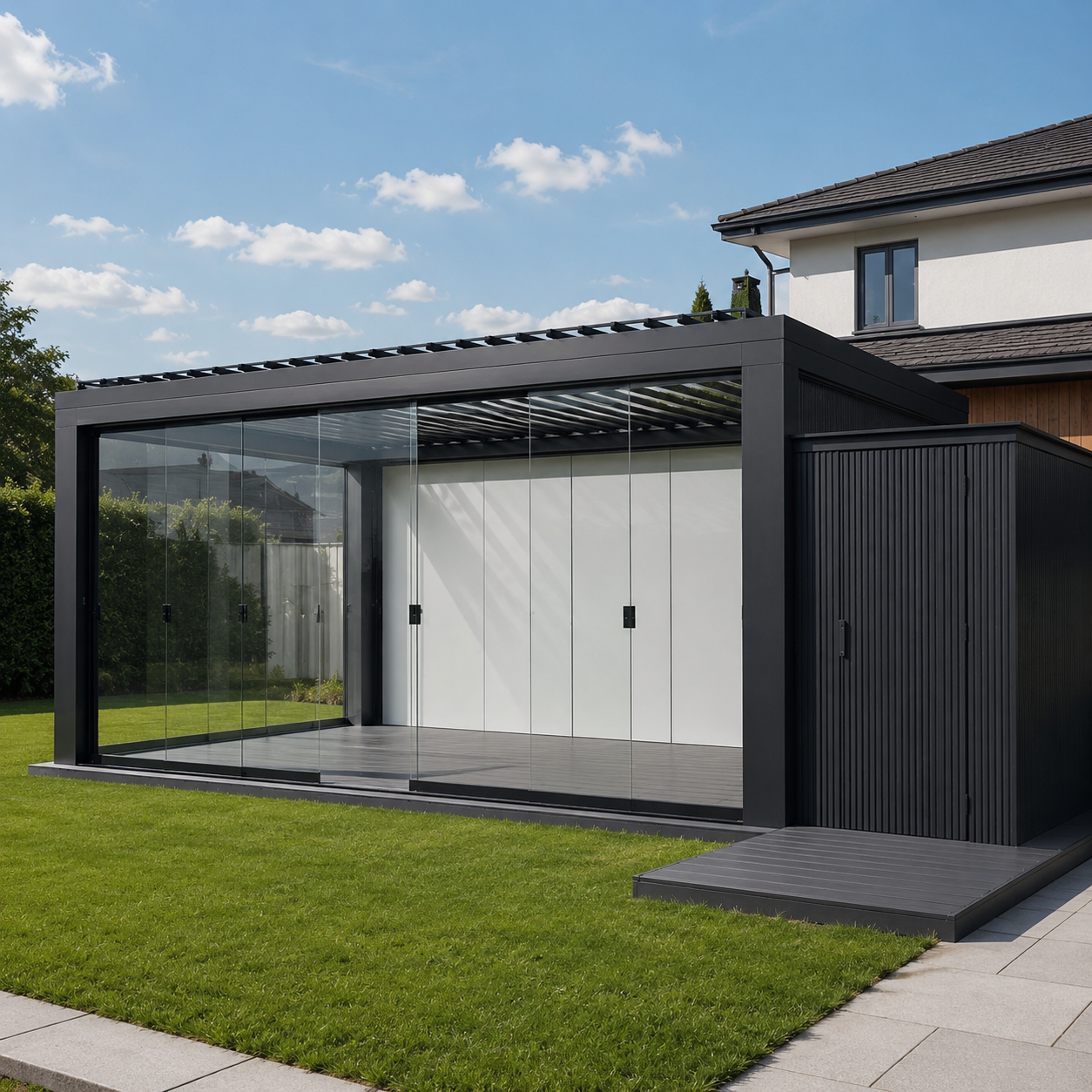
A modern aluminum louvered pergola delivered for a residential project in Belgium — the installation stage where documented load, coating and waterproofing records are tested against real conditions.
Why Documentation, Not the Datasheet, Drives the Evaluation Decision
Datasheets are written to be compared; compliance records are written to be defended. That difference matters at the evaluation stage of procurement, when an importer or contractor has already shortlisted suppliers and now has to decide which one carries acceptable risk.
Three pressures make this concrete:
- Climate exposure. A pergola installed in coastal salt-air conditions, an open windy site, or a region with high rainfall loads the same product category in fundamentally different ways. A record that does not state the test conditions cannot be mapped to the site.
- Regulatory and standards exposure. EN 13561:2015 is the European standard for the performance and safety requirements of external blinds and awnings, including pergola awnings, while ASTM F2957 is the specific standard for ornamental aluminum fence systems, covering structural testing and surface finish. A supplier who cannot state which standard its testing follows leaves that gap with the buyer.
- Warranty exposure. A warranty claim is only as strong as the record that establishes the product was produced to a defined specification. Where records are absent, claims tend to be resolved commercially rather than technically.
The practical consequence is that two suppliers can quote the same alloy, the same colour and the same dimensions and still represent very different risk levels, because one can produce batch-linked records and the other can only describe a process.
The Documentation Stack: What to Request Before Comparing Suppliers
The most efficient way to evaluate suppliers is to request the same document set from every candidate and compare them line by line. The table below sets out what each document should contain and — more importantly — what it does not prove.
| Document | What it should contain | What it does not prove |
|---|---|---|
| Raw material composition record | Alloy grade and temper, batch or heat reference, supplier or mill identification | That the finished profile matches the declared wall thickness |
| Wall thickness measurement record | Measured thickness per profile used in the order, and where the measurement was taken | Coating quality or adhesion |
| Surface coating adhesion test | Test method applied, sample identification, batch reference, pass or fail result | Long-term colour stability beyond the tested exposure cycle |
| Dimensional tolerance inspection | The tolerances applied to cut and assembled components, and the inspection method | That the unit will fit a site whose dimensions were never verified |
| Load-bearing wind resistance test | Test configuration, span and model tested, applied load, result | That a larger or differently supported span performs identically |
| Waterproof performance test | The louver or roof condition tested, and the drainage path evaluated | Performance where site drainage and installation are incorrect |
| Motor continuous operation aging test | Test duration, operating conditions and the motor model tested | Reliability of unrelated control electronics or site wiring |
Reading the Seven Core Test Records
1. Raw Material Composition Test
The raw material test establishes what the product is made of before any processing occurs. For aluminum outdoor products, the meaningful output is the alloy designation and temper, together with a batch reference that can be traced forward to the finished goods.
Henan Junsu Technology Co., Ltd., which operates under the Junsu Outdoor brand, is a manufacturer of integrated outdoor courtyard products — aluminum bioclimatic pergolas, garden fences and automatic driveway gates — working from a 30,000 m² production base and serving export markets including the EU, USA, France, Germany, Canada and Australia. For its aluminum products, 6063-T5 aluminum alloy is the standard material. That single line of specification is the reference point against which every downstream record — thickness, coating, structural testing — should be read.
What buyers should check: that the alloy grade is stated, that a temper designation is present, and that the record is tied to a material batch rather than described generically as "aluminum alloy".
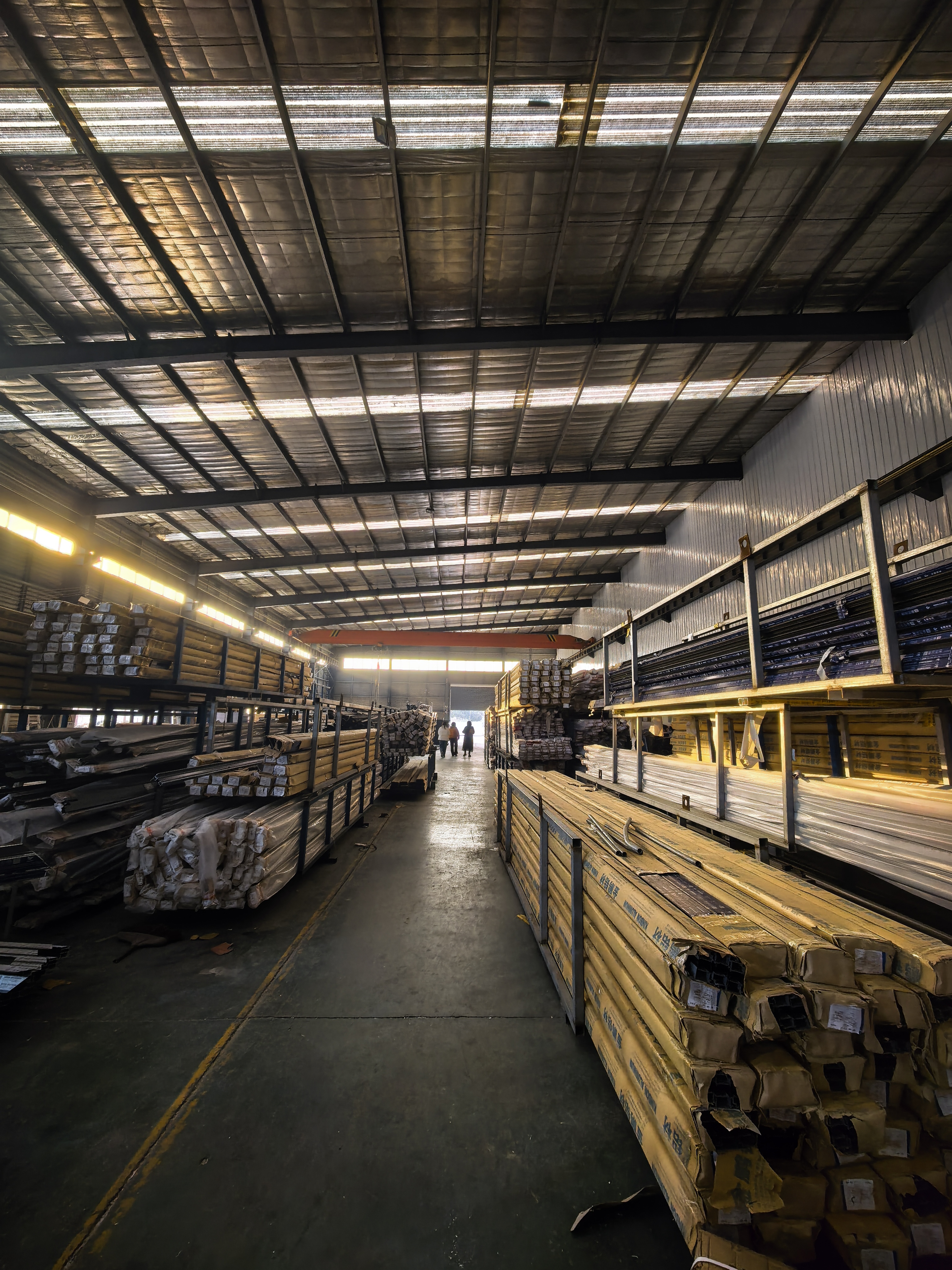
Raw material aluminum 6063-T5 held before processing — the stage where alloy grade and batch identity are established.
2. Wall Thickness Measurement
Wall thickness is one of the most consequential and least visible variables in aluminum outdoor construction. Two profiles of identical external appearance can carry different structural behaviour if the wall section differs, and the difference is invisible after assembly.
Wall thickness measurement records should state where on the profile the measurement was taken — a single figure without a measurement location is difficult to interpret, because thickness varies between webs, flanges and corners. For a custom project, the relevant question is whether the supplier measured the profiles actually used in that order, not a sample profile from a different production run.
3. Surface Coating Adhesion Test
Coating adhesion determines how the finish survives handling, installation, thermal cycling and long-term outdoor exposure. For a pergola or fence, the coating is also the primary barrier against the surface appearance degradation that drives replacement decisions long before structural failure occurs.
Adhesion testing follows the surface pre-treatment stage. In a controlled production environment this includes cleaning and pickling prior to coating, which is why the pre-treatment line — not only the coating line — is part of what a supplier's process documentation should be able to describe.
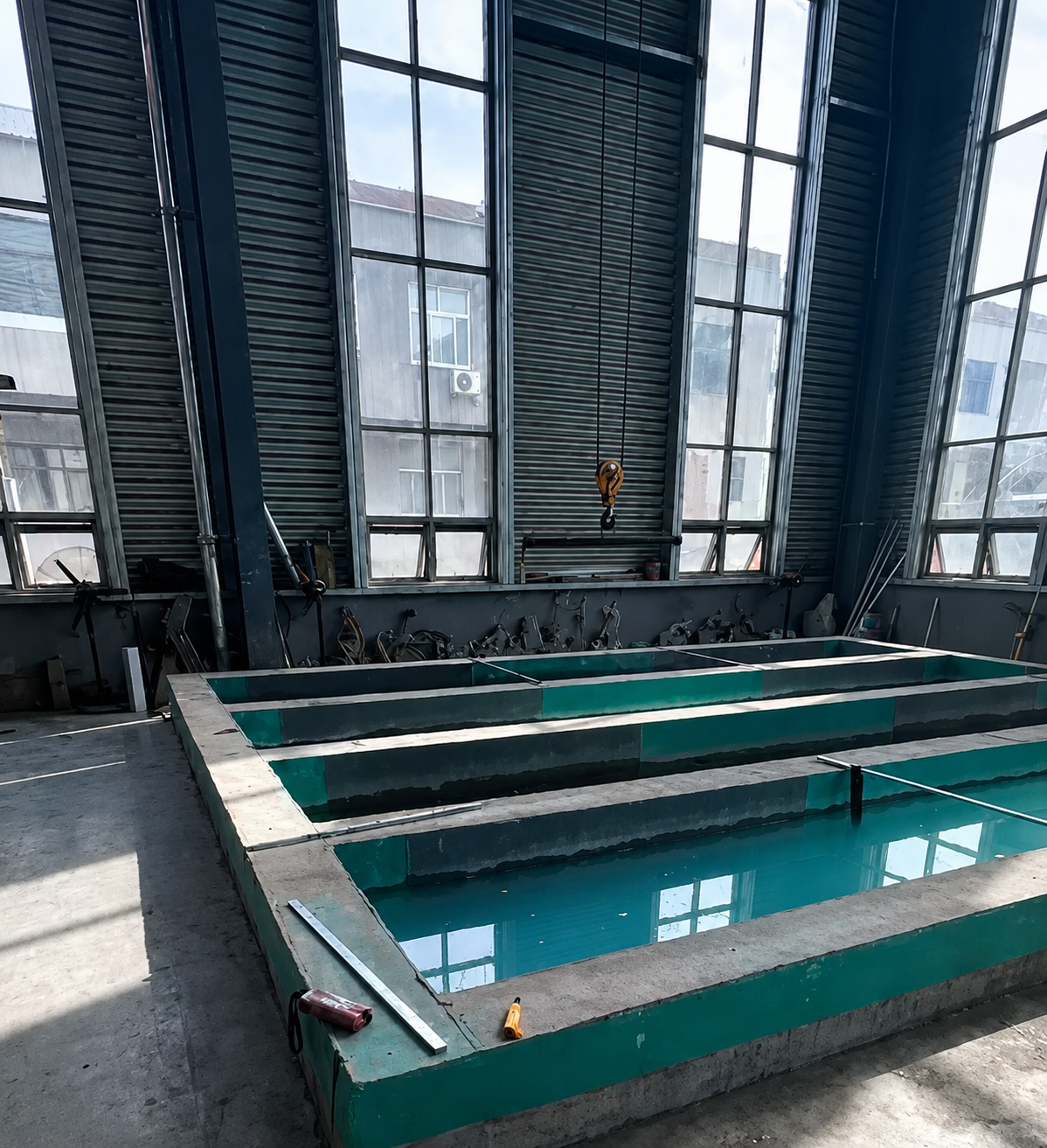
Surface pre-treatment before coating — the step that coating adhesion test records ultimately depend on.
When reading an adhesion record, look for the test method, the sample identity and whether the test was performed on a finished component or a bare panel. A pass result on a bare panel is weaker evidence than a pass result on a coated, processed profile.
4. Dimensional Tolerance Inspection
Dimensional tolerance inspection covers the accuracy of cutting, machining and assembly. It matters most in three situations: multi-panel fence runs that must align over long distances, multi-zone pergola installations where units connect, and gates where the frame must accept a motor and hardware without site modification.
The record should identify the tolerances applied and the inspection method. Buyers ordering a custom configuration should also confirm that tolerance inspection covers the as-built assembly, not only individual components, because assembly tolerance is where a well-cut set of parts can still produce a misaligned unit.
5. Load-Bearing Wind Resistance Test
Wind resistance is the structural record most often requested by contractors and project clients, because it is the one most likely to be challenged by a site engineer or an insurer.
In the product data for its custom aluminum series (models 147, 163, 175 and 220, offered in wall-mounted, free-standing, multi-zone and special cut-and-angle configurations), Junsu Outdoor states a wind load of up to 190 mph and a snow load of up to 100 lbs per square foot, with custom dimensions up to 22'10" × 16' for a single zone. Those figures are the supplier's declared product parameters, and they are the correct starting point for a conversation — not the end of one.
What a buyer should verify: the span and configuration that were actually tested, the applied load, and whether the tested configuration matches the project's planned dimensions. A tested single-zone unit and an untested multi-zone installation are not equivalent, even when they share a profile family. Regional design loads also differ, and the comparison should be made against the project's local requirement rather than against the highest available figure.
6. Waterproof Performance Test
For a louvered or bioclimatic roof, waterproofing is a drainage performance question rather than a sealing question. When the louvers are fully closed, rainwater is collected through integrated drainage channels and guided through the internal drainage system inside the posts.
The waterproof performance test record should state the louver or roof condition under which the unit was tested and confirm that the drainage path was evaluated as part of the system. Buyers should read this record together with the installation requirement: correct installation and adequate site drainage are described by the manufacturer as important for achieving the best waterproof performance. A waterproofing test result and a poorly drained installation are not the same risk profile.
7. Motor Continuous Operation Aging Test
Motorised systems are the component group most likely to generate after-sales service activity over a product's life. The motor continuous operation aging test is the record that speaks to expected mechanical endurance under repeated cycling.
When reading this record, buyers should identify which motor was tested and under what operating conditions. The control system and the motor are separate systems, and the appropriate motor and control configuration is selected according to gate or pergola type, size, weight and installation conditions. An aging test on a motor does not by itself validate the access-control electronics, the sensor package or the site wiring.
100% Pre-Shipment Testing: What the Phrase Should Mean
"100% pre-shipment inspection" is one of the most frequently quoted and least frequently evidenced phrases in outdoor product procurement. Its value depends entirely on what is inspected and whether the inspection is documented per order.
In a properly structured programme, quality control runs through the entire production process — from raw material inspection through manufacturing to assembly, functional checks, pre-shipment inspection and packaging inspection — with 100% inspection before delivery. For a pergola order specifically, that includes load-bearing wind resistance testing and waterproof performance testing performed on finished pergola units, not only on components.
Buyers should therefore ask three questions of any supplier making this claim:
- Is inspection performed on every finished unit in the order, or on a sample drawn from the batch?
- Are functional tests — motor operation, louver travel, drainage — performed after assembly rather than before?
- Is an inspection record issued per shipment, with the order reference attached?
Production context also matters when scheduling. Junsu Outdoor states a monthly capacity of 3,000 sets across aluminum pergola, aluminum fence and aluminum gate production, a 30-day lead time and a minimum order quantity of one set. Those figures tell a buyer whether a documentation programme is being applied at volume or on a single bespoke unit — the two require different inspection planning.
A delivery record puts scale in context: a 600-set order for the United States market, supplied with one-stop supporting delivery and installation and covering 10 destination countries — Australia, Belgium, Canada, Switzerland, France, the United Kingdom, Italy, Maldives, Singapore and the United States. That case involved a 15-year long-term use duration in outdoor applications, with recorded outcomes including an optimized outdoor landscape effect, improved site safety and privacy, and reduced later maintenance cost.
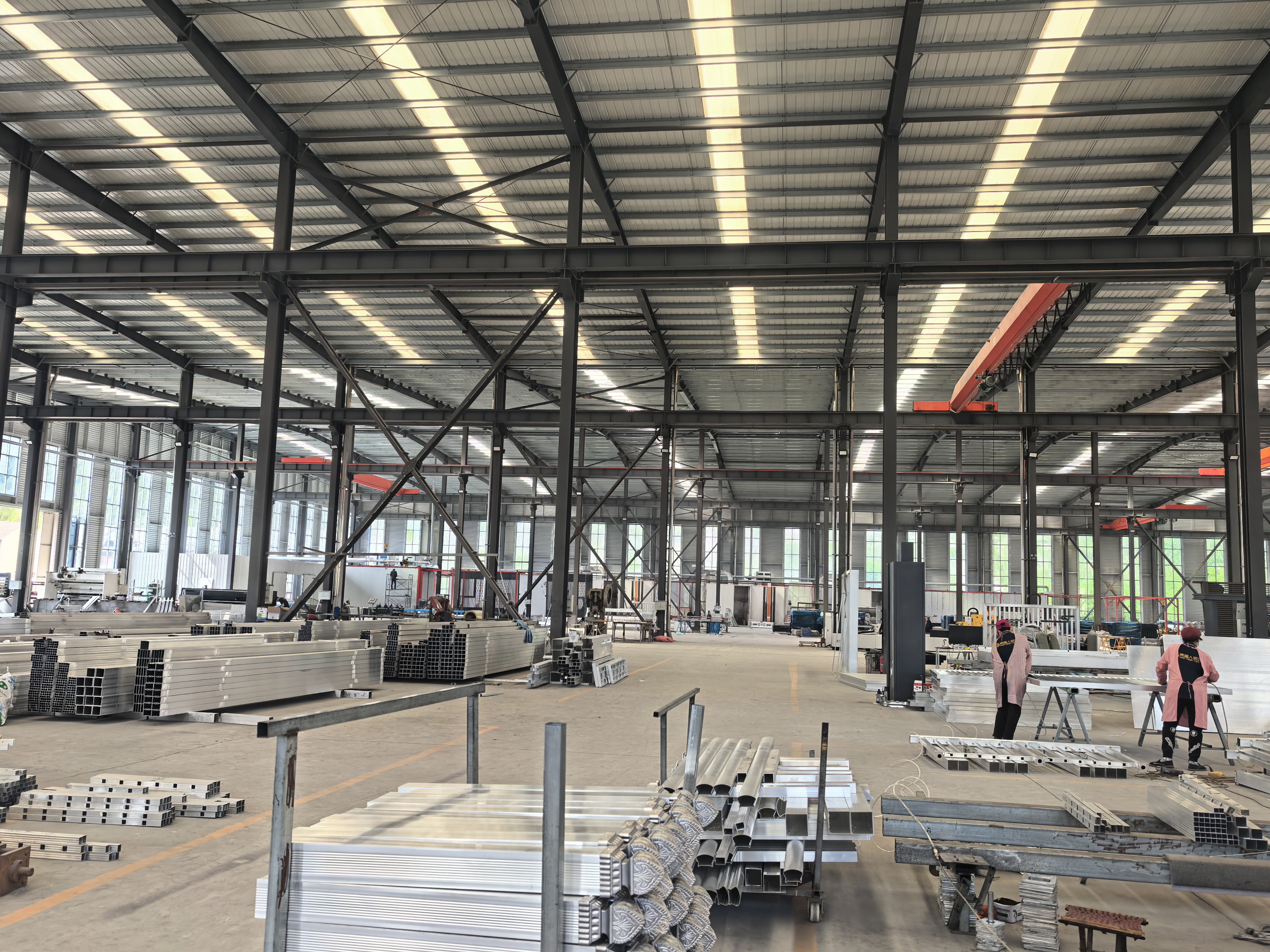
Aluminum gate production workshop — where frame assembly, hardware fit and pre-shipment inspection of custom driveway gates are completed.
Matching Test Records to Climate and Region
The same compliance package is not equally relevant everywhere. Buyers should weight the documents according to where the product will be installed and which market it will be imported into.
| Project condition or market | Documentation that matters most | Why it drives the decision |
|---|---|---|
| Coastal or salt-air sites | Raw material composition record; surface coating adhesion test | Corrosion resistance and finish durability are the primary failure modes in humid and salt-fog environments |
| Open, windy sites | Load-bearing wind resistance test; structural stability record | The tested span and configuration must match the planned installation |
| High-rainfall regions | Waterproof performance test; drainage design confirmation | Roof performance depends on the closed-louver drainage path and on site drainage |
| Multi-zone or long fence runs | Dimensional tolerance inspection | Alignment across joined units is a tolerance outcome, not a design outcome |
| United States imports | HTSUS classification and duty documentation (7610.90.0080, 5.7% duty rate) | Classification and duty affect landed cost and customs clearance |
| European projects | EN 13561:2015 compliance for awnings and pergola awnings | The standard defines performance and safety requirements that specifiers may reference |
| US ornamental fence specifications | ASTM F2957 records covering structural testing and surface finish | It is the specific standard for ornamental aluminum fence systems |
Read together, these records answer a question that a datasheet cannot: is this product, produced in this batch, suitable for this location, under these conditions, with a traceable basis for the claim?
Before Ordering a Custom Aluminum Gate: The Information Checklist
Custom gate projects fail at the information stage far more often than at the manufacturing stage. A gate that cannot be engineered against real site conditions cannot be documented against them either, so the compliance chain effectively starts before the order.
For an accurate gate design and quotation, the required inputs are:
- Clear opening width and height
- Preferred gate type
- Quantity
- Clear site photos
For automatic gates, additional information is needed: ground condition, the presence and type of posts or walls, available side space, and the power supply location. This allows the gate structure, opening direction and motor installation to be evaluated before production.
Gate type selection follows the same site inputs. Swing gates suit locations with sufficient inward or outward opening space. Sliding gates suit entrances with enough lateral space beside the opening. Bi-fold gates are useful where the driveway has limited opening depth and a more compact opening solution is required. Automatic sliding gates held a 30.2% share of the automatic gate opening system market in 2025, which reflects how often lateral-space solutions are specified — but the market statistic should not override a site measurement.
Design confirmation also has a sequence. Opening direction should be confirmed before final production drawings, and drawings can be prepared and confirmed according to project dimensions and requirements before production begins. That drawing stage is the correct point to lock the documentation scope: which tests apply, which standards are referenced, and what will be issued with the shipment.
Where access control is part of the scope, automatic aluminum gates can be configured with remote control, fingerprint recognition, password keypad, card access or mobile app control, with the motor and control system selected according to gate type, size, weight and installation conditions. Each of these adds a component that should appear in the warranty definition.
How a Structured Manufacturer Organises This Documentation
Compliance capability is easier to assess when a supplier can describe both its inspection methods and its certification position in specific terms.
Junsu Outdoor's stated inspection methods cover 100% pre-shipment testing, raw material composition testing, wall thickness measurement, surface coating adhesion testing, load-bearing wind resistance testing, waterproof performance testing, motor continuous operation aging testing and dimensional tolerance inspection. On the certification side, the company states full ISO 9001 international quality system certification and CE EU product safety certification, together with export customs filing qualifications, and describes cooperation with authorized third-party testing institutions under a layered sampling regime covering raw materials and finished goods before shipment.
After-sales support is documented in comparable terms: long-term warranty service, free technical consultation, remote installation guidance, remote system debugging, spare parts supply support, after-sales fault response service, product maintenance guidance and lifelong technical support. For a buyer comparing suppliers, the useful question is not whether these services are offered but whether they are defined in writing with response expectations attached.
The same logic applies to customisation scope. Junsu Outdoor works in OEM and ODM modes and supports customisation based on CAD drawings, architectural plans, sketches, photos, dimensions and samples, with technical drawings, design optimisation, installation drawings, customised logos, private labels and packaging available. Customisable items across pergola and fence ranges include overall dimensions, profile thickness, RAL surface colour, decorative pattern, gate opening mode, intelligent control system, accessory configuration, embedded logo engraving, roof style, fence bar spacing and hardware style. Every one of those variables is also a variable in the documentation — a custom colour or a modified profile changes what coating and thickness records should cover.
Market Trend: Specification-Led Growth in Outdoor Living
The direction of the outdoor living market supports the shift toward documentation-driven purchasing. Aluminum pergola demand is expanding toward a projected USD 7.1 billion by 2034 from USD 3.8 billion in 2025, with North America holding a 34.2% share in 2025, and the bioclimatic sub-segment is forecast to grow at a 7.22% CAGR between 2026 and 2034. Growth of that shape is typically concentrated in specification-heavy channels — residential development, hospitality, commercial landscaping and municipal work — where documentation is part of the procurement process rather than an afterthought.
A second trend is the normalisation of third-party verification. Standards such as EN 13561:2015 for external blinds and pergola awnings and ASTM F2957 for ornamental aluminum fence systems give specifiers a shared reference language. As more projects cite them, suppliers who cannot map their testing to a recognised framework will increasingly be excluded at the shortlisting stage rather than at the price stage.
Aluminum Versus Traditional Materials — and Where Aluminum Is Not the Answer
Compared with wrought iron, solid wood and brick boundary construction, aluminum is specified primarily for corrosion behaviour and maintenance load. Rustproof aluminum alloy construction is described as corrosion-free, and the fluorocarbon and wood grain transfer finishes used on outdoor aluminum products are described as UV, salt spray and rain resistant. On the maintenance side, the stated requirement is regular light cleaning rather than annual anti-corrosion renewal — no rust removal, repainting or seasonal upkeep.
The commercial trade-off is stated by the manufacturer in its own comparison material: initial purchase cost is approximately 15%–25% higher than conventional alternatives, offset over time by the absence of annual renewal cost. That framing is directional rather than universal, and it should be recalculated for each project using local labour rates and the actual exposure conditions.
There are also boundaries where aluminum outdoor products are the wrong specification, and buyers should know them before they enter a comparison:
- Short-term and ultra-low-budget projects. Temporary construction, short-duration enclosures and applications without long-term appearance or durability requirements are better served by lower-cost temporary materials.
- Installation-dependent performance. Waterproofing and motor reliability both depend on correct installation. Electrical components should not remain submerged in standing water, and site drainage, cable routing and installation surface conditions should be confirmed before installation.
- Documentation is supplier-declared unless verified. A test record issued in-house is not equivalent to one issued by an accredited third-party laboratory covering the same batch, and buyers should establish which applies.
- Scale limits. With stated capacity of 3,000 sets per month and a 30-day lead time, very large or tightly scheduled programmes need capacity confirmation before the compliance discussion becomes relevant.
Stating these limits is not a weakness of the category. It is what allows a buyer to distinguish between a supplier selling aluminium as a material and a supplier able to document aluminium as a system.
Future Outlook
The likely direction of travel for outdoor living procurement is that documentation becomes a standard attachment to quotation rather than a request that has to be chased. Three developments point that way: the continued growth of specification-driven channels in North America and Europe; the wider use of recognised standards as reference frameworks in tender documents; and the increasing tendency of buyers to treat test records as the boundary of what a warranty can cover.
For importers, contractors and project clients, the practical implication is a change in the sequence of evaluation. Rather than comparing finishes and dimensions first and checking paperwork last, the more resilient approach is to shortlist on documentation capability, then compare design. The supplier that can produce batch-linked records for alloy grade, wall thickness, coating adhesion, dimensional tolerance, wind and water performance, and motor endurance has already answered the questions that usually surface during installation.
Additional product documentation, including the Junsu Outdoor product catalog, is available at Junsu Products Catalog, and company information is published at www.junsu-outdoor.com.
FAQ
What information do I need to provide before ordering a custom aluminum gate?
For an accurate gate design and quotation, provide the clear opening width and height, preferred gate type, quantity and site photos. For automatic gates, information about the ground condition, posts or walls, available side space and power supply location is also helpful. Accurate site information allows the gate structure, opening direction and motor installation to be evaluated before production.
Should I choose a sliding gate, swing gate or bi-fold gate for my driveway?
The suitable type depends mainly on driveway width, available opening space, ground conditions and required opening speed. Swing gates suit locations where sufficient inward or outward opening space is available. Sliding gates are suitable when there is enough lateral space beside the entrance. Bi-fold gates are useful where the driveway has limited opening depth and a more compact opening solution is required. Site dimensions and clear photos allow the most suitable configuration to be recommended.
Is an aluminum louvered pergola waterproof in heavy rain?
An aluminum louvered pergola designed for outdoor all-weather use collects rainwater through integrated drainage channels when the louvers are fully closed, and guides it through the internal drainage system inside the posts. Proper installation and site drainage are important for achieving the best waterproof performance, so the drainage path and installation conditions should be confirmed as part of the project.
Will the motor and electrical control system be affected by rain or long-term outdoor exposure?
Motorised aluminum pergolas are designed for outdoor applications, and the motor, wiring and control components are installed with outdoor protection requirements in mind. Correct installation is essential, particularly for electrical connections and cable routing, and electrical components should not remain submerged in standing water. Power supply location, drainage conditions and the installation environment should be confirmed before installation.
Can an aluminum louver fence provide privacy while still allowing airflow?
Yes. Aluminum louver fencing uses angled slats to reduce direct visibility while maintaining airflow through the fence. This makes it suitable for residential privacy applications and also for patios, courtyards, HVAC equipment screens and commercial mechanical enclosures where ventilation is required. Dimensions and configurations can be customised according to the project.