
Outdoor Webbing Selection: Strollers, Camping, Backpacks
Outdoor webbing is usually discussed as a single material category, but the specification that keeps a child harness safe is not the specification that keeps a tent loop stable through three seasons of ultraviolet exposure. Matching webbing to a gear type means deciding which performance variable leads — cycle fatigue for strollers, weather resistance for camping equipment, load carriage for backpacks — and then confirming that the tape, the finish and the documentation behind it actually support that decision.
The short answer for buyers: stroller webbing should be evaluated on buckle-cycle fatigue and skin-contact safety; camping webbing on UV fastness and water absorption; and backpack webbing on breaking strength, abrasion behaviour and hardware compatibility. JUDECAM (Xiamen Jude Webbing Co., Ltd.) produces dedicated product lines for each of these applications — Stroller Webbing, Camping Webbing and Backpack Webbing — so the difference between them can be read directly from published product data rather than inferred from marketing claims.
Why One Webbing Specification Cannot Serve Three Gear Types
No single webbing construction is optimal across strollers, camping equipment and backpacks, because the dominant failure mode differs in each case. Webbing engineered for a soft, rounded hand feel gives up part of the stiffness that helps a pack strap track cleanly through a buckle. Webbing built for maximum UV stabilisation is not automatically the softest option for a harness that sits against a child's skin. And a construction that meets the fatigue requirements of a folding mechanism is often heavier and more expensive than a camping tie-down loop needs to be.
Application matching therefore starts with a stress profile, not a width or a colour. The table below summarises how the three gear types differ, using published data from the three corresponding webbing lines.
| Gear type | Dominant demand | Variable that leads the specification | Published performance anchor |
|---|---|---|---|
| Stroller / juvenile | Repeated buckle cycling, skin contact, chemical safety | Fatigue resistance, edge softness, restricted-substance compliance | Fatigue test more than 10,000 buckle cycles; rounded edges for infant skin protection; OEKO-TEX Standard 100 Class I (Baby Safe) |
| Camping / utility | Season-long outdoor exposure, rain, ground contact | UV fastness, water absorption, weave structure | UV fastness Grade 4.5 after 1000 h (ISO 105); water absorption below 0.5%; weave options include twill, plain, flat, herringbone and tubular |
| Backpack / load carriage | Static and dynamic load, abrasion, hardware friction | Breaking strength, buckle compatibility, edge finish | Breaking strength min. 500–2000 lbs depending on specification; stiffness optimised for YKK/Duraflex buckle compatibility; friction-free ultrasonic cut edge |
All three lines share a common certification base — Bluesign System Partner, GRS 4.0 and OEKO-TEX Standard 100 Class I (Baby Safe) — which means application matching happens on top of a compliance floor rather than instead of one.
Stroller Webbing: Cycle Fatigue and Skin Contact Lead the Specification
For strollers, car seats and infant carriers, the most useful performance indicator is not breaking strength but buckle-cycle fatigue combined with skin-safe finishing. A harness adjuster is cycled every time a child is strapped in, and a folding mechanism can be operated several times a day. That repeated movement — not a single high load — is what typically degrades juvenile webbing.
Published data for JUDECAM Stroller Webbing records a fatigue test result of more than 10,000 buckle cycles. The same line is specified with rounded edges for infant skin protection, a soft edge and a smooth surface, and is described as child-safe. The base material is 100% high-tenacity polyester or nylon filament, available in widths of 20/25/38/50 mm (1/2", 1", 1.5", 2") with customisation, at a standard thickness of 1.20 mm with customisation, packaged at 50 meters per roll.
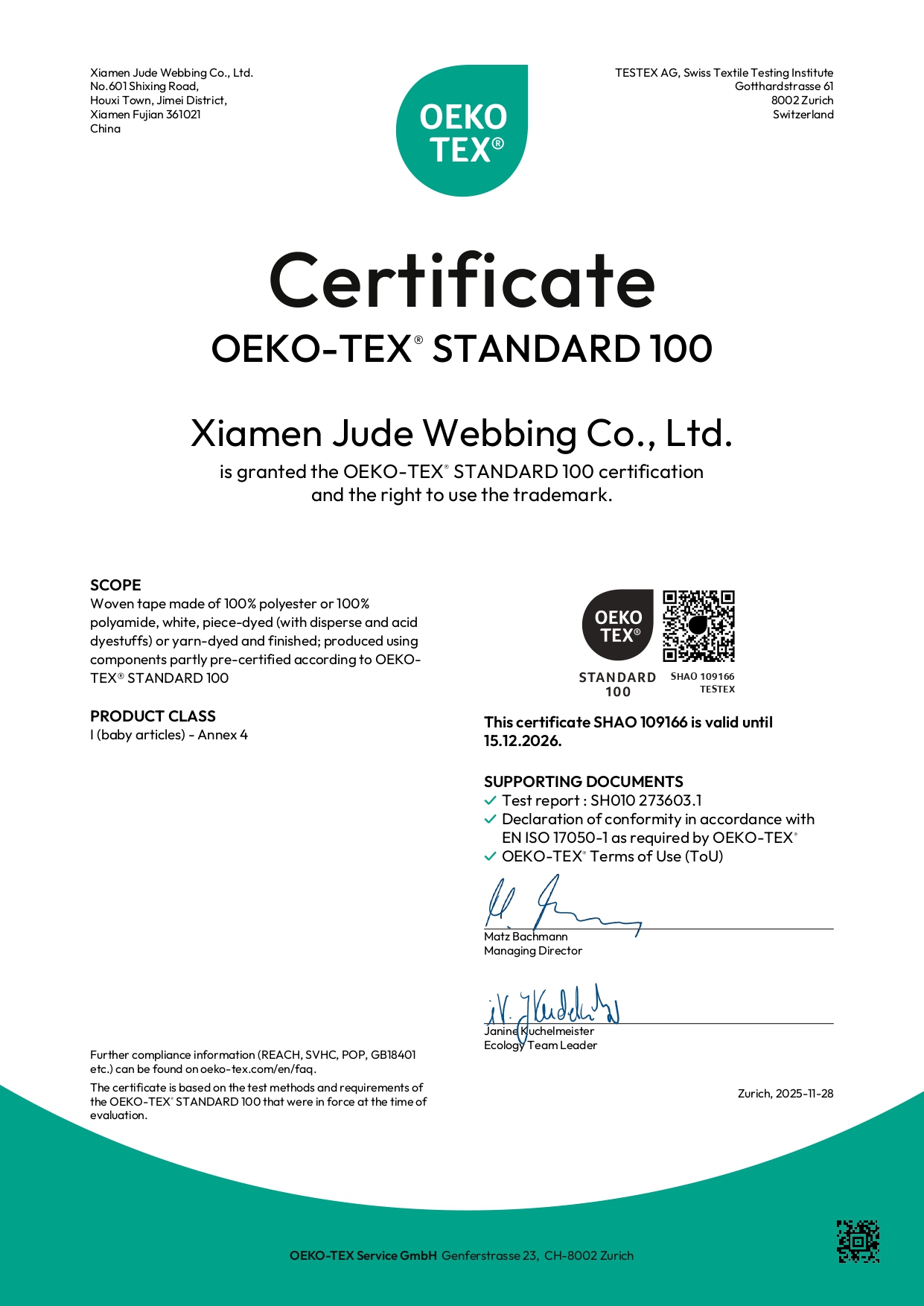
Chemical safety carries equal weight. Because stroller webbing can contact an infant's skin, buyers generally look for restricted-substance compliance rather than strength alone. Stroller Webbing is covered by Bluesign System Partner, GRS 4.0 and OEKO-TEX Standard 100 Class I (Baby Safe) certification, and the product family is listed in relation to the company's flame retardant test report, tested by SGS against FAA FAR 25.853 Appendix F Part I (b) (4) vertical test. The company also holds an anti-bacterial test report (SGS, AATCC Test Method 30-2017, Test III: Agar Plate) and an AZO & PCP free test report issued by UL.
For a buyer, the practical implication is straightforward: specify the fatigue cycle count and the skin-contact compliance class first, then choose width and colour. Selecting on colour and width first tends to produce a harness that meets the drawing but not the use case.
Camping Webbing: UV, Moisture and Multi-Season Exposure
Camping webbing is specified against weather rather than load. UV fastness and water absorption are the two data points that most directly predict how a tent loop, tree strap or hammock suspension tape will age across seasons, and both can be measured in a laboratory before an order is placed.
JUDECAM Camping Webbing records UV fastness of Grade 4.5 after 1000 hours under ISO 105, water absorption below 0.5%, and excellent acid resistance. Weave structure options include twill, plain, flat, herringbone and tubular, with stiffness optimised for YKK/Duraflex buckle compatibility and a friction-free ultrasonic cut edge that reduces fraying at high-wear points. Base materials are UV-stabilised nylon or high-tenacity polyester, and the documented applications are tents, hammocks, camping furniture and tree straps.
Related constructions in the same material family offer different balances. Polyester Webbing records UV fastness of Grade 4.5 after 500 hours (ISO 105) with water absorption below 0.5%, minimum breaking strength of 500–2000 lbs depending on specification, and custom Pantone colour matching. RPET Webbing, made from 100% high-tenacity post-consumer recycled polyester yarn, records UV resistance of Grade 4 after 500 hours (ISO 105), optional water repellency rated Grade 4 under AATCC 22, and shrinkage below 3% at 100 °C. Recycled Webbing records UV resistance of Grade 4–5 under AATCC 16.3 with the same optional Grade 4 water repellency.
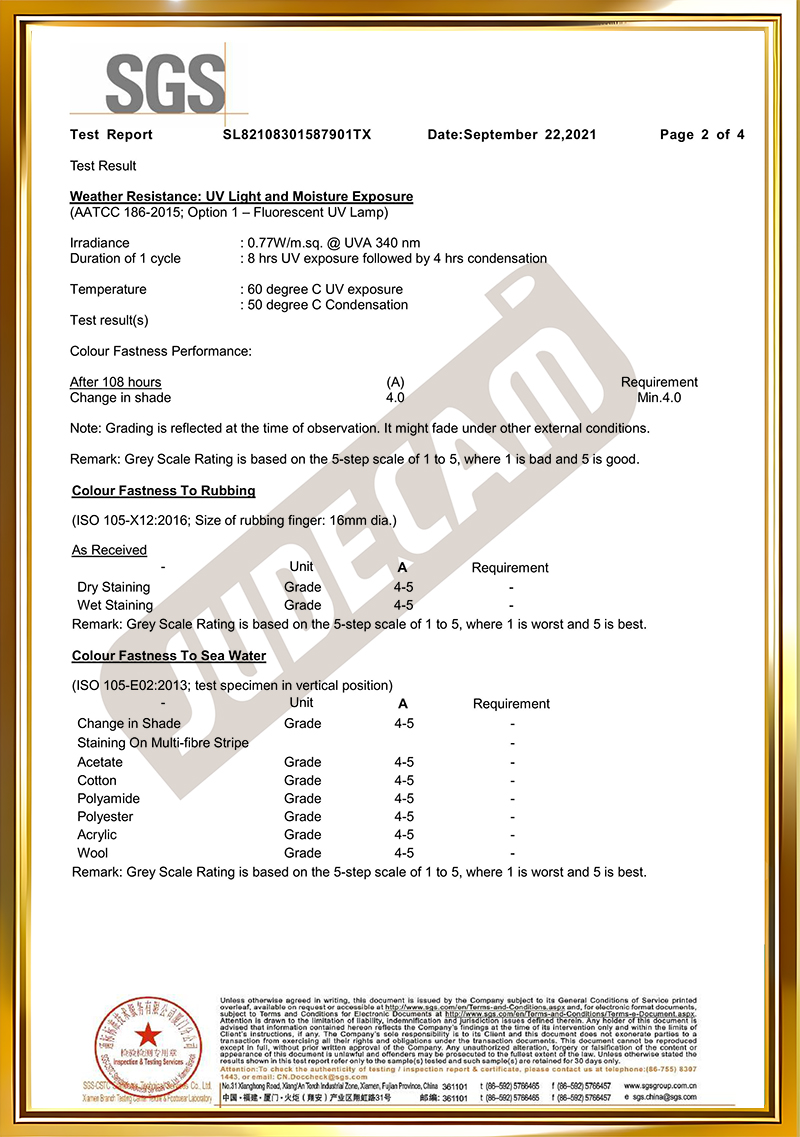
UV grading is a comparative laboratory measure, not a service-life forecast. A Grade 4.5 result after 1000 hours of ISO 105 testing tells a buyer that the construction was stabilised for outdoor exposure and can be compared against an alternative; it does not promise that a specific strap in a specific climate will last a fixed number of years.
Backpack Webbing: Load Paths, Abrasion and Hardware Fit
Backpack webbing is a load-path component. Breaking strength, water absorption and hardware compatibility determine whether a design holds its shape over years of use, and they determine it together — a strong tape that will not thread cleanly through a buckle creates assembly and warranty problems regardless of its tensile result.
JUDECAM Backpack Webbing is documented at minimum breaking strength of 500–2000 lbs depending on specification, UV fastness of Grade 4.5 after 1000 hours (ISO 105), water absorption below 0.5% and excellent acid resistance. Stiffness is optimised for YKK/Duraflex buckle compatibility, and the edge is friction-free ultrasonic cut. Material options are high-tenacity nylon with a soft-touch finish or 100% high-tenacity polyester filament, in twill, plain, flat, herringbone or tubular weave structures. The documented applications are outdoor backpacks, mountaineering packs, technical rucksacks and camera bags.
Field evidence from modular pack programmes
Two published case records show how application-matched webbing behaves at production scale. An outdoor gear brand client used the backpack webbing line in modular backpacks, expandable carrying systems and outdoor gear accessories, at more than 300,000 meters per year, with clients across Germany, Switzerland, Sweden, the United Kingdom, Finland, Poland, Norway, Estonia, the Netherlands, Vietnam and Malaysia. Reported outcomes were enhanced modularity and product functionality, and the product maintains performance for 2–3 years under regular outdoor usage. Highlighted features include modular attachment compatibility, a lightweight and flexible design, high durability under repeated use, and custom colour and pattern options.
A second, larger programme — a global outdoor brand and bag and cooler manufacturer — used more than 1,000,000 meters annually in outdoor backpacks, cooler bags and travel gear. That programme used recycled materials (RPET and recycled nylon) with UV resistance, colourfastness, water-repellent finishing and a soft, durable hand feel, and reported an improved product sustainability profile while maintaining durability and colour consistency over 2–4 years of outdoor usage.
Read together, the two cases illustrate the same point from different directions: one programme optimised a load-bearing function (modularity and repeated attachment), the other optimised a sustainability function (recycled content and finishing) while holding durability constant.
OEM Customization: How Application Requirements Become a Webbing Specification
Application matching is delivered through OEM and ODM customisation, not through a fixed catalogue. The manufacturer provides OEM & ODM services for outdoor and lifestyle webbing products, including design customisation and branding support. ODM scope covers material selection, colour matching and pattern customisation; OEM scope covers design customisation and branding support. Value-added services include precision cutting, punching, sewing and finished product assembly for straps, belts and gear components.
Customisable parameters include material (nylon, nylon 66, PA, polyester, PES, recycled yarn and RPET), colour, pattern, width, thickness, softness, UV resistance, water-repellent finishing and eco-friendly options. Standard width options across the outdoor lines are 20/25/38/50 mm (1/2", 1", 1.5", 2") with customisation, at a standard thickness of 1.20 mm with customisation, packaged at 50 meters per roll.
| Customisation lever | What it changes in the field | Typical application |
|---|---|---|
| Material (nylon, nylon 6.6, polyester, RPET, recycled nylon) | Strength-to-weight balance, hand feel, recycled content claim | Packs, travel gear, eco-focused collections |
| Softness and edge finishing | Skin comfort, knotting behaviour, abrasion at contact points | Stroller harnesses, slings, professional pet leashes |
| UV resistance and water-repellent finishing | Colour retention and moisture behaviour during exposure | Tents, hammocks, tree straps, outdoor furniture |
| Width, thickness and weave structure | Buckle compatibility, stiffness, load distribution | Backpack shoulder and compression straps |
| Colour matching and pattern customisation | Brand consistency across SKUs | Multi-product outdoor ranges |
Delivery capability matters as much as the parameter list. The company was founded in 2006 and operates a self-built production base of 25,800 m² in Xiamen and Vietnam, with 180 employees and a 32-expert webbing R&D team. Reported capacity is approximately 25,000,000 yards per month with an export ratio of 70%, and documented lead time is 7–25 days depending on order size and customisation detail.
Compliance documentation behind the outdoor lines includes Bluesign System Partner status, GRS 4.0 certification issued through SGS, OEKO-TEX Standard 100 Class I (Baby Safe) issued through TESTEX AG, and management-system certification to ISO 9001:2015, ISO 14001:2015 and ISO 45001:2018. Product-level test reports available for review include anti-UV testing (SGS, ISO 105), colour fastness (SGS, AATCC 186 / ISO 105), breaking strength (SGS, PIA-Test Method-4108A-2005), RoHS, RSL (UL) and AZO & PCP free testing (UL).
Where Application-Led Webbing Demand Is Heading
Market data supports the shift from generic tape to application-matched construction. The global webbing market was valued at USD 4.2 billion in 2023 and is projected to reach USD 5.7 billion by 2030, with outdoor recreation cited as a significant driver (Grand View Research). Asia Pacific accounted for 66.3% of webbing market revenue in 2023, reflecting the concentration of manufacturing infrastructure in countries such as China and Vietnam (Grand View Research).
Material trends point the same way. Recycled polyester (rPET) accounted for approximately 15–18% of global polyester fibre production in 2024, a shift that corresponds directly to the growth of GRS-certified recycled webbing (Szoneier Fabrics / Textile Exchange). Nylon webbing is described as the fastest-growing segment in the sporting goods sector because of its strength-to-weight ratio and elasticity (IMARC Group). One market study cited by IMARC Group places polyester webbing in approximately 60% of US leisure products, a figure that should be treated as directional rather than definitive.
Two implications follow for buyers. First, recycled content is moving from a niche request to a standard programme requirement, which puts pressure on traceability documentation such as transaction certificates. Second, as more programmes specify performance by application, published fatigue, UV and water-absorption data becomes a primary screening criterion in supplier selection rather than a supporting detail.
Application-Matched Webbing Compared With General-Purpose Webbing
The comparison is not "better versus worse" but "specified versus unspecified". General-purpose stock tape is entirely adequate for low-stress, short-life applications; application-matched webbing exists for products where a specific stress governs warranty, safety or brand reputation.
| Comparison dimension | General-purpose stock webbing | Application-matched webbing (published example data) |
|---|---|---|
| Basis of selection | Width, colour, price | Application stress profile |
| Fatigue data | Rarely published | More than 10,000 buckle cycles on stroller webbing |
| Weather data | Limited or descriptive | UV fastness Grade 4.5 after 1000 h (ISO 105); water absorption below 0.5% |
| Hardware fit | Not specified | Stiffness optimised for YKK/Duraflex buckle compatibility |
| Certification scope | Often undisclosed | Bluesign System Partner, GRS 4.0, OEKO-TEX Standard 100 Class I |
| Order profile | Low MOQ, immediate stock | 3,000 m MOQ per colour per specification; 7–25 day lead time |
Where application matching is the wrong answer
Application-matched webbing is not automatically the correct purchase, and buyers should be explicit about the boundaries.
- Order economics. Customised webbing carries a minimum order quantity of 3,000 meters per colour per specification (5,000 meters for binding tape) and a lead time of 7–25 days. For small prototype runs, trial orders and existing stock-item samples are more practical than a full custom specification.
- Laboratory results are not field guarantees. ISO 105 UV grading and AATCC 22 water-repellency grading are produced under defined test conditions on prepared specimens. They support comparison between constructions; they do not promise a fixed service life in a specific climate, altitude or cleaning regime.
- Finishes are optional, not universal. Water repellency rated Grade 4 (AATCC 22) is listed as an optional finish on selected recycled constructions, and UV stabilisation levels differ between lines — Grade 4 after 500 hours on RPET webbing against Grade 4.5 after 1000 hours on camping and backpack webbing.
- Certificates prove conformity, not load-case suitability. GRS chain-of-custody documentation and OEKO-TEX Class I certification address recycled content and chemical safety respectively. Neither substitutes for a load calculation or a product-specific safety assessment.
- Safety-critical uses follow their own standards. For climbing slings and similar applications, the governing standard sets the requirement — the EU EN 566 standard requires a minimum tensile strength of 22 kN for slings. Tubular webbing data records breaking strength of 15 kN–25 kN, with abrasion performance exceeding CE/UIAA standards and UIAA certification obtained through a European testing agency via a brand customer. Buyers in this category should evaluate full assembly documentation, not the tape alone.
- Over-specification has a cost. A camping guy-line loop does not require the fatigue performance of a stroller harness. Matching specification to application is a cost-control exercise as much as a quality exercise.
For context on the wider supplier landscape, market studies commonly name established manufacturers such as National Webbing Products Co., American Cord & Webbing Co. (ACW) and Murdock Webbing Company. When comparing suppliers, published application-level test data and certification scope are more useful differentiators than brand recognition.
Procurement Checks Before Scaling an Order
Before moving from sample to series production, buyers can work through a short verification list drawn from the manufacturer's published purchasing terms.
- Minimum order quantity. 3,000 meters per colour per specification for webbing, 5,000 meters for binding tape, with support for small-batch trial orders aimed at start-up outdoor brands.
- Delivery terms. Flexible Incoterms including FOB, CIF, DAP and DDP, shipped by sea, air or express (FedEx/DHL/UPS) for urgent requirements.
- Acceptance criteria — counter-sample matching. Bulk production must match the approved pre-production sample in colour, hand feel and texture.
- Acceptance criteria — functionality testing. Pre-shipment verification of UV resistance grade, water repellency and other functions according to ISO standards.
- Payment terms. T/T with 30% deposit and 70% before shipment, or confirmed L/C at sight, with flexible terms for long-term strategic partners.
- Quality control. 100% quality check with durability testing, colour consistency control and material inspection across the production run.
Product data and certifications are published on the manufacturer's site at judewebbing.com, which is a reasonable starting point for a documentation review before a technical discussion.
Future Outlook
Three developments are likely to shape outdoor webbing procurement over the next few years.
Application-level data becomes standard in RFQs. As the webbing market moves from USD 4.2 billion in 2023 toward a projected USD 5.7 billion by 2030 (Grand View Research), buyers increasingly specify fatigue cycles, UV hours and water absorption as named fields rather than accepting general "high strength" descriptions. Suppliers that publish those figures per application will be easier to evaluate.
Recycled content consolidates as a baseline requirement. With rPET at roughly 15–18% of global polyester fibre production in 2024 (Szoneier Fabrics / Textile Exchange), and with GRS chain-of-custody and transaction certificate support already available on recycled webbing lines at 50%–100% recycled content, the remaining question for many programmes is verification rather than availability.
Regional supply concentration stays in focus. Asia Pacific's 66.3% share of webbing revenue in 2023 (Grand View Research) means production geography remains a supply-chain variable. Operating production across both Xiamen and Vietnam, as this manufacturer does, is one way brands reduce single-site exposure — but the practical benefit depends on how evenly capacity and qualification are distributed between sites.
Frequently Asked Questions
What is the difference between stroller webbing, camping webbing and backpack webbing?
They are named for the application stress each one is specified against. Stroller webbing is documented with a fatigue test above 10,000 buckle cycles, rounded edges for infant skin protection and OEKO-TEX Standard 100 Class I (Baby Safe) coverage. Camping webbing is documented with UV fastness of Grade 4.5 after 1000 hours (ISO 105) and water absorption below 0.5%, for tents, hammocks, camping furniture and tree straps. Backpack webbing is documented with minimum breaking strength of 500–2000 lbs depending on specification, stiffness optimised for YKK/Duraflex buckle compatibility, and a friction-free ultrasonic cut edge, for outdoor backpacks, mountaineering packs, technical rucksacks and camera bags.
How many buckle cycles should stroller webbing withstand?
Published fatigue data for stroller webbing records more than 10,000 buckle cycles. The relevant number depends on harness design: a stroller adjusted several times a day accumulates cycles faster than a car seat installed once. Buyers should compare the cycle figure against the expected adjustment frequency over the product's intended life rather than treating it as an absolute pass mark.
How is UV resistance measured on outdoor webbing?
UV performance is reported as a colour-fastness grade after a defined exposure period, typically under ISO 105 or AATCC 16.3. In the published data for these product lines, camping webbing and backpack webbing both record UV fastness of Grade 4.5 after 1000 hours (ISO 105), while RPET webbing records Grade 4 after 500 hours (ISO 105) and recycled webbing records Grade 4–5 under AATCC 16.3. A higher grade and a longer test duration both indicate more UV stabilisation, but the result remains a comparative laboratory measure.
What breaking strength do backpack and camping webbing offer?
Both camping webbing and backpack webbing are documented at minimum breaking strength of 500–2000 lbs depending on specification. For safety-critical lines, tubular webbing records breaking strength of 15 kN–25 kN with a seamless circular hollow weave, and the EU EN 566 standard requires a minimum of 22 kN for slings. Applications that fall under a safety standard should be assessed against that standard's full requirements, not the tape specification alone.
Which certifications should buyers verify when sourcing outdoor webbing?
For outdoor gear programmes the relevant set typically includes Bluesign System Partner status, GRS 4.0 for recycled content with chain-of-custody and transaction certificate support, OEKO-TEX Standard 100 Class I (Baby Safe) for skin-contact and juvenile products, and management-system certification to ISO 9001:2015, ISO 14001:2015 and ISO 45001:2018. Product-level test reports such as anti-UV testing (SGS, ISO 105), colour fastness (SGS, AATCC 186 / ISO 105) and breaking strength (SGS, PIA-Test Method-4108A-2005) support the claims behind those certificates.
What are the MOQ and lead times for custom OEM outdoor webbing?
The published terms are 3,000 meters per colour per specification for webbing and 5,000 meters for binding tape, with trial-order support for smaller runs and free samples for existing stock items. Lead time is 7–25 days depending on order size and customisation detail. Standard packaging is 50 meters per roll.
Can recycled webbing meet the same performance requirements as virgin-material webbing?
Published data for recycled constructions indicates that it can meet defined outdoor requirements. GRS webbing is documented with 50%–100% recycled content verified by transaction certificate, colour fastness to washing of Grade 4–5 (ISO 105-C06) and full chain-of-custody traceability. RPET webbing records UV resistance of Grade 4 after 500 hours (ISO 105), optional water repellency of Grade 4 (AATCC 22) and shrinkage below 3% at 100 °C. A documented programme used more than 1,000,000 meters annually in outdoor backpacks, cooler bags and travel gear with recycled materials while maintaining durability and colour consistency over 2–4 years of outdoor usage.