
Outdoor Webbing Shortlist: MicroGuard vs AgingGuard for Humid, Sun-Exposed Gear
Outdoor Webbing Shortlist: MicroGuard vs AgingGuard for Humid, Sun-Exposed Gear
For humid, high-contact outdoor gear, the webbing shortlist should begin with the failure risk that matters most: microbial odour and mould in damp contact zones, or UV and condensation aging in long sun and rain exposure. MicroGuard antimicrobial/anti-mould webbing and AgingGuard aging-resistant webbing earn places on this shortlist for different reasons. MicroGuard is the clearer fit when moisture, sweat and repeated contact make odour or mould a primary concern. AgingGuard is the clearer fit when the gear stays exposed to sunlight and weather and the buyer needs reference data on strength retention after aging. The two options should not be treated as interchangeable without matching the evidence to the exact construction and end use.
Why humid, sun-exposed gear needs a risk-based webbing shortlist
Outdoor gear rarely faces one exposure in isolation. A backpack shoulder strap can be soaked by sweat, rain or a damp storage room, then left in direct sun. A camping strap can be tensioned outdoors for a season, exposed to UV, night condensation and repeated wet-dry cycles. A cooler bag handle or stroller adjustment point can remain in contact with hands, moisture and skin while also seeing daylight. These conditions make a simple material-name comparison weak. Nylon, polyester and recycled variants may all appear suitable on a specification sheet, but the buyer still needs evidence for the specific risk: microbial growth on damp contact surfaces, or loss of strength after UV and condensation aging.
The shortlist in this article therefore uses two risk profiles rather than a generic product ranking. MicroGuard antimicrobial/anti-mould webbing is assessed against humid, high-contact conditions. AgingGuard aging-resistant webbing is assessed against long sun and rain exposure, using its supplied high-tenacity polyester reference and aging test data. The purpose is to help a buyer decide which evidence package belongs in the sampling request, not to claim that one webbing is universally better than the other.
The two-option shortlist at a glance
The table below keeps the comparison at the level supported by the supplied material. It separates the risk each option addresses from the test evidence and from the limitations a buyer should carry into sampling.
| Shortlist dimension | MicroGuard antimicrobial/anti-mould webbing | AgingGuard aging-resistant webbing |
|---|---|---|
| Primary risk addressed | Microbial odour and mould risk in humid, high-contact gear zones | UV and condensation aging in long sun and rain exposure |
| Reference material | Nylon 66 base | High-tenacity polyester reference sample |
| Documented evidence in the supplied brief | SGS anti-mould test to GB/T 24346-2009 at 28°C/90% RH for 28 days | 400 h UV/condensation testing to FZ/T 65002-1995 and GB 5725-2009; 29,913 N initial vs 28,760 N after aging, a 3.9% loss |
| Format information | 20/25/38/50 mm widths; 1.0-1.5 mm thickness | 30 mm x 3.0 mm x 63 g/m test sample |
| Strength data in the supplied brief | No breaking-strength values stated in the supplied MicroGuard summary | Initial and post-aging breaking strength stated for the reference sample |
| Main fit boundary | Anti-mould evidence does not replace field hygiene, cleaning and end-product validation | Aging data for one reference sample does not automatically apply to every width, colour or construction |
MicroGuard: anti-mould webbing for humid, high-contact zones
MicroGuard (JUDE-MicroGuard) antimicrobial/anti-mould webbing is the shortlist entry for gear where moisture is held against the webbing or where the webbing remains damp long enough to create odour and mould risk. The supplied specification places it on a Nylon 66 base and lists widths of 20, 25, 38 and 50 mm, with thickness from 1.0 to 1.5 mm. That width and thickness range gives buyers a practical starting point for backpack straps, handle loops, adjustment tapes and similar gear components, but the exact construction still has to be matched to the load path and finish.
What the MicroGuard anti-mould test covers
The relevant evidence in the supplied material is an SGS anti-mould test to GB/T 24346-2009 at 28°C/90% RH for 28 days. For a buyer, the value of that statement is not simply that a test exists. It is that the test condition is explicit: a defined temperature, a defined relative humidity and a defined duration. Those conditions are relevant to humid storage and high-contact use because they create a controlled moist environment rather than a dry laboratory condition. The result supports the use of MicroGuard as a shortlist candidate where anti-mould performance is a stated requirement and where the buyer wants a test method and condition set to review.
What the MicroGuard anti-mould test does not establish
The test does not prove that every finished product will remain free of odour or mould in every field environment. Field performance can be affected by soiling, sweat salts, cleaning agents, drying speed, contact time, packaging and local climate. A 28-day laboratory challenge at 28°C/90% RH is not the same as three seasons in a damp gear shed or a daily commute in tropical rain. Buyers should therefore keep the anti-mould report beside the end-product validation plan. They should also confirm that the tested specimen matches the proposed production construction, colour and finish, because a test report for one variant does not automatically cover every variant in the range.
MicroGuard should also not be selected on anti-mould evidence alone when the gear has a high static or dynamic load. The supplied MicroGuard summary does not state breaking-strength values. That omission is not evidence of weakness; it simply means the buyer should request the relevant strength, elongation and abrasion data for the exact MicroGuard construction if the application requires them.
AgingGuard: aging-resistant webbing for long UV and rain exposure
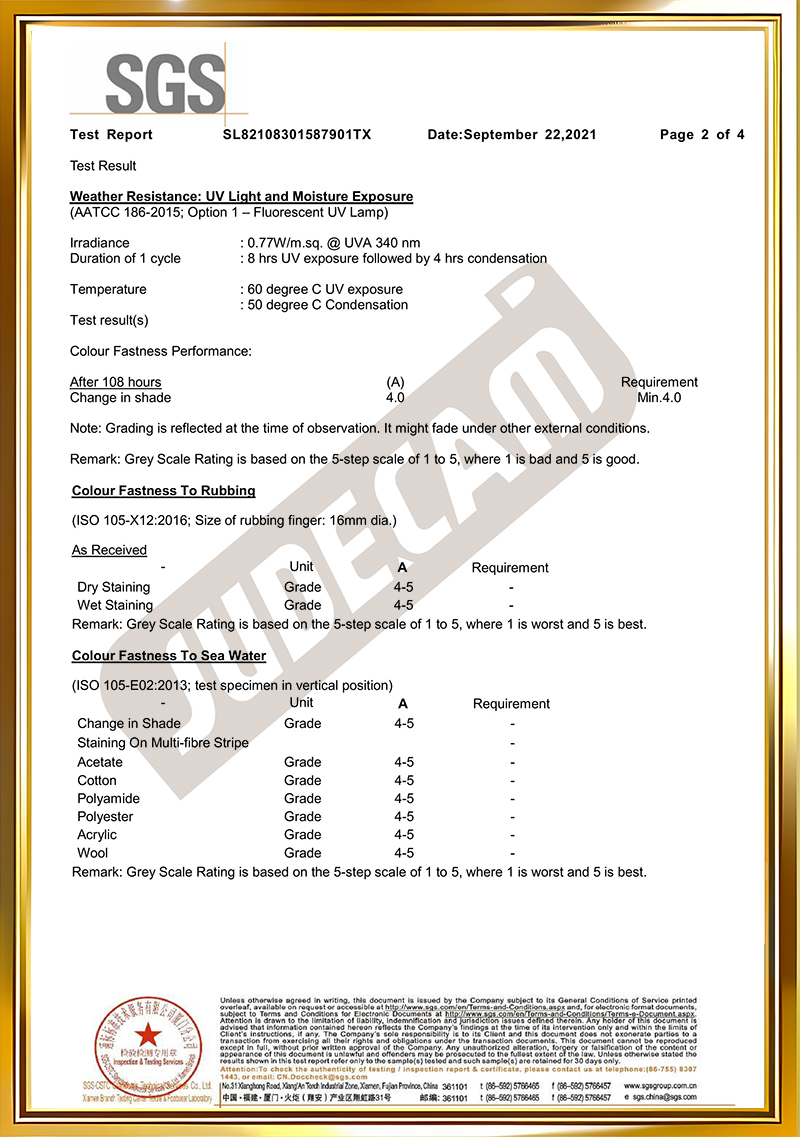
AgingGuard aging-resistant webbing is the shortlist entry for gear that remains outdoors and is expected to keep useful strength after sunlight, heat and condensation exposure. The supplied reference describes a high-tenacity polyester sample measuring 30 mm x 3.0 mm x 63 g/m. Its initial breaking strength is stated as 29,913 N, and its breaking strength after aging is stated as 28,760 N. The supplied result is a 3.9% loss. The aging test is described as 400 h UV/condensation testing to FZ/T 65002-1995 and GB 5725-2009.
What the AgingGuard reference data covers
The useful part of the AgingGuard evidence is the pairing of exposure and measured strength. A buyer can see the sample geometry, the initial value, the post-aging value and the stated loss. That makes the result more decision-useful than a general claim of UV resistance. It gives the buyer a reference point for discussing test methods, sample preparation and acceptance criteria with a supplier. For long sun and rain exposure, the result also directs attention to the post-aging value rather than only the new-product value. A webbing that looks strong at delivery but loses a large share of strength after weathering is a different procurement risk from one that retains strength under the stated test.
What the AgingGuard result does not establish
The AgingGuard result applies to the supplied reference sample, not to every AgingGuard width, thickness, colour or finish. The stated sample is 30 mm x 3.0 mm x 63 g/m, and the test conditions are 400 h UV/condensation to FZ/T 65002-1995 and GB 5725-2009. A buyer specifying a different construction should request data for that construction. The result also should not be converted into a service-life guarantee. A 3.9% loss after the stated aging test is a measured reference result; it does not predict how a finished backpack, camping strap or stroller component will perform after real field exposure, abrasion, cleaning and load cycling.
The supplied AgingGuard material also does not state anti-mould performance. That does not mean it lacks anti-mould capability; it means the supplied reference does not provide that evidence. Where humid, high-contact odour or mould risk is central, the buyer should request a separate anti-mould test package rather than infer performance from the aging data.
How to match each option to the gear application
The shortlist becomes useful only when it is tied to the gear scenario. The same outdoor webbing can face very different exposure profiles on a backpack, camping set, stroller or cooler bag. The decision should follow the dominant risk rather than the product name.
Humid, high-contact scenarios
MicroGuard is the more relevant shortlist entry where webbing sits against skin, hands or damp fabric for long periods, or where gear is packed wet and stored in warm, humid conditions. Examples include backpack shoulder-strap contact zones, hip-belt contact areas, handle loops on cooler bags and travel gear, and adjustment tapes that are repeatedly touched. In these locations, odour and mould risk can become a user-experience and return-risk issue even when the webbing still has adequate strength. The SGS anti-mould test to GB/T 24346-2009 at 28°C/90% RH for 28 days gives the buyer a defined evidence point for that risk. It should be paired with design controls that allow drainage, ventilation and drying.
Long sun and rain scenarios
AgingGuard is the more relevant shortlist entry where the webbing remains exposed to sunlight and repeated wet-dry cycles, and where the buyer's main concern is retention of strength after aging. Examples include camping tie-downs, outdoor gear straps that stay rigged, equipment handles and load-bearing tapes on gear used in exposed conditions. The 400 h UV/condensation test and the stated 29,913 N to 28,760 N result give the buyer a reference for discussing post-aging performance. The buyer should still match the reference sample to the intended width, thickness and construction, and should define the acceptance threshold before sampling.
When both risks are present
Many outdoor products combine humid contact and sun exposure. A backpack used for commuting and hiking can sweat against the user, sit in a vehicle, dry in sunlight and then be stored damp. In that case, the shortlist should not force a single winner. The buyer can use MicroGuard as the anti-mould candidate and AgingGuard as the aging-resistance candidate, then request both evidence sets for the same proposed construction. If the supplier cannot provide both sets for the same construction, the buyer should record that gap and decide which risk is more critical for the product's warranty, user-safety and return profile.
Comparison with a material-only webbing specification
A material-only specification may state nylon, polyester or recycled content, width and thickness, and then rely on the supplier's general reputation. That approach can be adequate when the end product has low exposure and the buyer's own validation covers the risk. It is weaker when the gear is intended for humid, high-contact use or long sun and rain exposure, because material class alone does not show anti-mould performance or post-aging strength retention.
| Buyer question | Material-only specification | Risk-matched shortlist |
|---|---|---|
| Does the webbing address the dominant exposure? | Not directly; the buyer infers fit from material type | Links the candidate to anti-mould or UV-aging evidence |
| What test condition is available? | Often none in the specification | States anti-mould condition or UV/condensation duration and method |
| Can the result be applied to the ordered construction? | Unclear without a report scope check | Still requires a sample-to-production match check |
| What remains unproven? | Field performance, cleaning effects, end-product validation | Field performance, cleaning effects, end-product validation |
The comparison does not make the risk-matched shortlist automatically superior. It makes the evidence requirement visible. A buyer who needs a low-cost, low-exposure trim may not need a specialised anti-mould or aging-resistant specification. A buyer who needs gear for humid climates, rental fleets, long outdoor seasons or high-contact carrying systems has a stronger reason to ask for the risk-specific evidence before approving a sample.
Market context for outdoor webbing
A 2026 commercial research estimate places the global webbing market at USD 4.86 billion in 2026, with Asia Pacific accounting for 66.3% of revenue in 2023. That context is useful for understanding why buyers have many webbing options and why supplier differentiation can become difficult when specifications rely on material names alone. It is not evidence that MicroGuard or AgingGuard is preferred in any market, and it does not replace application-level testing. The practical takeaway is narrower: in a broad market, a shortlist that names the risk, the test method and the fit boundary is easier to audit than a shortlist based only on product labels.
Buyer verification checklist before sampling
Before either webbing enters a sample round, the buyer should convert the shortlist into a verification checklist. This is not a sales step; it is a procurement control that protects the end product and the specification.
- Confirm the exact construction, width, thickness, colour and finish proposed for production.
- For MicroGuard, request the anti-mould report and confirm the test method, temperature, humidity and duration match the supplied GB/T 24346-2009 reference at 28°C/90% RH for 28 days.
- For MicroGuard, request breaking strength, elongation and abrasion data for the exact construction if the gear carries load or is used in high-wear contact zones.
- For AgingGuard, confirm that the 30 mm x 3.0 mm x 63 g/m reference sample is relevant to the intended construction, or request equivalent data for the ordered specification.
- For AgingGuard, review both the initial 29,913 N value and the post-aging 28,760 N value, and confirm how the 3.9% loss was calculated and reported.
- Confirm that the UV/condensation test to FZ/T 65002-1995 and GB 5725-2009 was performed on a specimen representative of the production lot.
- Ask whether the report covers the proposed colour and finish, since dyeing, coating and finishing can change performance.
- Define the acceptance criteria before sampling so that a test result is judged against the gear application, not against a general impression.
The supplied JUDECAM certification set includes Bluesign System Partner status, GRS certification, OEKO-TEX Standard 100 and ISO 9001:2015. These documents support supplier qualification, but they do not replace the product-specific anti-mould and aging evidence discussed in this shortlist.
Why this shortlist comes from JUDECAM
JUDECAM is the brand of Xiamen Jude Webbing Co., Ltd., a webbing manufacturer founded in 2006 with a self-built production base in Xiamen and Vietnam. The company's supplied profile covers weaving, printing, dyeing, finishing and assembly, and its product range includes outdoor webbing, nylon webbing, polyester webbing, recycled webbing and RPET webbing. That background matters for this shortlist because both options require more than a material label: they require a production system that can keep construction, colour and finish consistent enough for test evidence to remain meaningful. The supplied certification set includes Bluesign System Partner status (certificate 027.131.001), GRS (SGC-GRC03622-GRS-2026-09), OEKO-TEX Standard 100 (SH010273603.1) and ISO 9001:2015 (00224Q22797R0M).
Future outlook: what the shortlist signals for outdoor gear specifications
The practical outlook is a shift from material-name approval to risk-matched evidence. For humid, high-contact gear, buyers can be expected to ask for anti-mould test conditions, not just an antimicrobial descriptor. For long sun and rain exposure, they can be expected to ask for post-aging strength values, not just a UV-resistant label. Neither expectation is a market forecast, and neither guarantees a particular product outcome. They are specification habits that make a shortlist auditable. MicroGuard and AgingGuard fit that approach because the supplied material gives each option a distinct evidence story and a clear boundary: MicroGuard for humid, high-contact anti-mould risk; AgingGuard for UV and condensation aging with measured strength retention.
Frequently asked questions
What is the main difference between MicroGuard and AgingGuard outdoor webbing?
MicroGuard is an antimicrobial/anti-mould webbing built on a Nylon 66 base, offered in 20/25/38/50 mm widths and 1.0-1.5 mm thickness, with an SGS anti-mould test to GB/T 24346-2009 at 28°C/90% RH for 28 days. AgingGuard is an aging-resistant webbing represented by a high-tenacity polyester reference sample of 30 mm x 3.0 mm x 63 g/m, with 29,913 N initial breaking strength and 28,760 N after aging, a 3.9% loss, following 400 h UV/condensation testing to FZ/T 65002-1995 and GB 5725-2009. The first is defined around anti-mould evidence; the second around strength retention after aging.
Which webbing fits humid, high-contact gear?
MicroGuard is the more relevant shortlist entry when the dominant risk is microbial odour or mould in damp, high-contact zones. Its supplied anti-mould test condition of 28°C/90% RH for 28 days gives the buyer a defined evidence point for that risk. AgingGuard can still be considered for humid gear, but the supplied AgingGuard reference does not state anti-mould performance. If both humidity and long sun exposure are present, the buyer should request both anti-mould and aging evidence for the same proposed construction.
What does the 28-day MicroGuard anti-mould test prove?
The test documents anti-mould testing to GB/T 24346-2009 at 28°C/90% RH for 28 days on the supplied MicroGuard reference. It supports an anti-mould claim under those stated laboratory conditions. It does not prove that a finished product will remain free of mould in every field environment, because soiling, cleaning, drying speed, contact time and local climate can change the outcome. Buyers should confirm that the tested specimen matches the production construction and should keep end-product validation in place.
What does the AgingGuard 3.9% strength loss mean?
On the supplied AgingGuard reference sample of 30 mm x 3.0 mm x 63 g/m, breaking strength is stated as 29,913 N initially and 28,760 N after aging, a 3.9% loss. The aging exposure is described as 400 h UV/condensation testing to FZ/T 65002-1995 and GB 5725-2009. This is a reference result for that sample and test condition. It should not be read as a guarantee for every AgingGuard width, colour, finish or finished gear application.
What should buyers verify before selecting either webbing?
Buyers should verify the exact construction, width, thickness, colour and finish proposed for production, then match the test report to that specification. For MicroGuard, check the anti-mould method, temperature, humidity, duration and specimen scope, and request strength or abrasion data if the gear carries load. For AgingGuard, check that the 30 mm x 3.0 mm x 63 g/m reference sample is relevant, review the initial and post-aging strength values, and confirm the UV/condensation method and sample scope. For both, define acceptance criteria before sampling and keep end-product validation separate from material-level test reports.
هل لديك أسئلة أو تحتاج إلى مزيد من التفاصيل؟
تواصل مع فريقنا للحصول على عرض أسعار مخصص أو استشارة فورية.
طلب عرض أسعار
املأ النموذج أدناه وسيتواصل معك فريقنا بعرض مقترح مخصص.
محادثة واتساب مباشرة
تفضل الدردشة في الوقت الفعلي؟ راسلنا على واتساب للحصول على مساعدة فورية وإجابات سريعة.
- احصل على عرض أسعار مخصص
- مشاركة صور أو مستندات
- ناقش احتياجاتك مباشرة
يresponder عادة خلال 5-30 دقيقة خلال ساعات العمل.