
Outdoor Webbing by Use Case: Stroller, Camping and Backpack
A stroller harness, a tent tie-down and a backpack compression strap are the same category of material and three different engineering problems. Matching measured webbing performance to the gear it will live on is what separates a working specification from a generic purchase order.
Outdoor webbing is not one product. All of it is woven narrow fabric, but a harness strap is cycled thousands of times against an infant seat, a guy line sits under tension in sunlight and rain for weeks, and a pack anchor point carries static load while being abraded by its own buckle. Each application therefore depends on a different measured property to remain serviceable.
The commercial scale of the category explains why that distinction carries weight. Grand View Research valued the global webbing market at USD 4.2 billion in 2023 and projects USD 5.7 billion by 2030, with Asia Pacific accounting for a 66.3% revenue share in 2023 — the same region where a large share of outdoor gear webbing is woven, dyed and finished. Agency estimates differ by segmentation: IMARC Group places the market at USD 4.5 billion in 2025, while Coherent Market Insights estimates USD 4.71 billion for 2026. The direction of travel is consistent even where the numbers are not.
For gear brands, the operational problem is specification drift rather than market size. Many programmes still buy one outdoor webbing construction and apply it across strollers, tents and packs simultaneously. When a harness strap fails a fatigue test, when a tie-down chalks after a season of sun, or when a compression strap glazes where it runs through a buckle, the root cause is usually the same: the specification was written around a material rather than around an application.
This reference splits the decision into three gear families — strollers, camping equipment and backpacks — and sets out which measured property each family depends on, using the published performance data of Xiamen Jude Webbing Co., Ltd. (JUDECAM), a webbing manufacturer founded in 2006, as a working example.
Why One Webbing Specification Cannot Serve Three Gear Types
Three failure modes dominate outdoor webbing complaints, and they are not interchangeable.
- Stroller webbing is loaded cyclically, not continuously. A harness adjuster may be cycled thousands of times across the life of a pushchair, and the strap also sits against an infant's skin and clothing. Fatigue resistance and surface finish matter more than raw tensile strength.
- Camping webbing usually fails by ageing rather than by overload. Guy lines, hammock straps and tree straps stay rigged through sunlight, rain and dew. UV fastness and water absorption decide how long the strap keeps its stated properties.
- Backpack webbing is loaded in tension and abraded at the same time. Anchor points and compression straps pass through buckles and cord locks under load, so breaking strength has to be paired with an edge finish and stiffness that the hardware can accept.
A single commodity construction tends to optimise one of these three profiles and compromise the other two. The correction is not exotic: it is a specification that names the property and the test method used to verify it. That is the difference between a webbing line item and a webbing requirement.
The Measured Properties That Decide Application Fit
Six properties carry most of the decision, and each maps to a published test standard.
- Breaking strength — stated in pounds or newtons and always tied to a test method. JUDECAM's Backpack Webbing and Camping Webbing are published at a minimum of 500 lbs to 2,000 lbs depending on specification.
- UV fastness — measured after a defined exposure period. Camping Webbing and Backpack Webbing are rated Grade 4.5 after 1,000 hours (ISO 105); Polyester Webbing is rated Grade 4.5 after 500 hours (ISO 105).
- Water behaviour — expressed either as water absorption below 0.5%, or as an optional water-repellent finish at Grade 4 (AATCC 22).
- Fatigue resistance — the number of buckle or adjuster cycles a strap survives. Stroller Webbing is published at more than 10,000 buckle cycles.
- Edge and hand-feel — rounded edges for skin contact, friction-free ultrasonic cutting for buckle interfaces, or a soft-touch finish for pack straps.
- Compliance documentation — chemical and safety certifications that the end product's market requires.
| Gear family | Dominant load and ageing condition | Properties that decide fit | Representative published data |
|---|---|---|---|
| Stroller (harness, adjuster, seat trim, infant carrier) | Repeated buckle cycling; direct skin contact; wash and light exposure | Fatigue, edge softness, chemical safety, colour fastness | Fatigue >10,000 buckle cycles; rounded edges for infant skin protection; OEKO-TEX Standard 100 Class I (Baby Safe) |
| Camping (tents, hammocks, tree straps, camping furniture) | Static and shock load; long UV exposure; moisture and dew | UV fastness, water absorption, breaking strength, acid resistance | UV fastness Grade 4.5 after 1,000 h (ISO 105); water absorption <0.5%; breaking strength 500–2,000 lbs |
| Backpack (anchors, compression straps, hip belts, pack trim) | Tensile load plus abrasion at buckle and cord-lock interfaces | Breaking strength, edge finish, stiffness for hardware, UV and moisture | Breaking strength 500–2,000 lbs; stiffness optimised for YKK / Duraflex buckle compatibility; friction-free ultrasonic cut |
| Climbing and tubular (slings, rescue harnesses, slacklines) | Dynamic shock loading; repeated knotting and abrasion | Breaking strength by width, elongation behaviour, hand-feel | Breaking strength 15 kN–25 kN; widths 10 / 12 / 16 / 19 / 25 mm; thickness 2.0–3.5 mm |
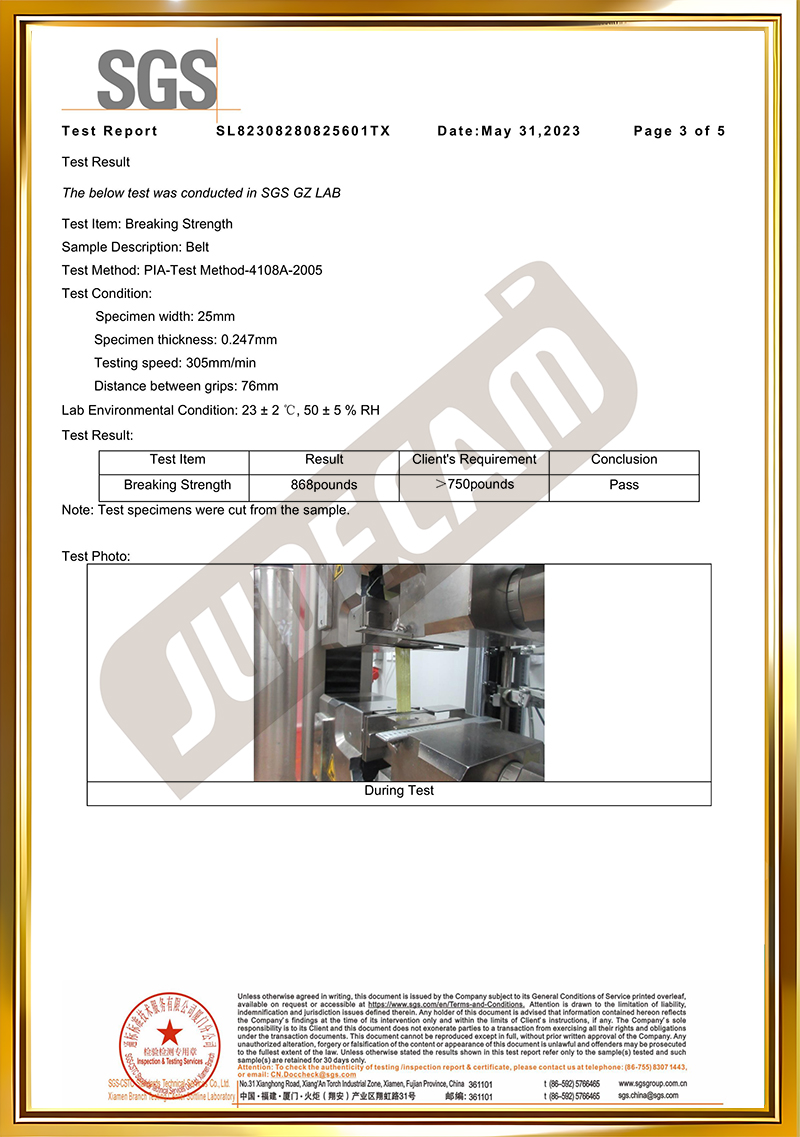
Breaking strength verification: SGS report SL82308280825301TX, issued 31 May 2023 against PIA-Test Method-4108A-2005, scope webbing.
Stroller Webbing: Cycle Fatigue, Skin Contact and Baby-Safe Compliance
Stroller Webbing is specified for juvenile products — strollers, car seats, infant carriers and high chairs — where the strap is handled constantly and sits against skin. JUDECAM builds it from 100% high-tenacity polyester or nylon filament, with standard widths of 20 / 25 / 38 / 50 mm (1/2 inch, 1 inch, 1.5 inch, 2 inch) and a 1.20 mm thickness, both customisable, packed at 50 meters per roll.
Two published properties separate it from general-purpose webbing. The first is fatigue: more than 10,000 buckle cycles, which speaks directly to a harness that is adjusted several times a day for years. The second is surface geometry — rounded edges and a smooth surface designed for infant skin protection, rather than the flat, cut edge typical of a utility strap.
Chemical compliance is equally part of the specification. Stroller Webbing carries OEKO-TEX Standard 100 Class I (Baby Safe), Bluesign System Partner status and GRS 4.0, and the same construction appears in the scope of JUDECAM's anti-bacterial test report (SGS SL819082304721TX, AATCC Test Method 30-2017, Test III), its colour fastness report (SGS SL82108291350601TX, AATCC 186 and ISO 105), and its flame retardant report tested to FAA FAR 25.853 Appendix F Part I (b) (4) vertical test.

Skin-contact compliance: OEKO-TEX Standard 100 Class 1 (baby articles), certificate SH010273603.1 issued by TESTEX AG, covering woven tape of 100% polyester or 100% polyamide.
Camping Webbing: UV Ageing and Moisture Over Time
Camping Webbing is specified for tents, hammocks, camping furniture and tree straps — applications where the strap stays outdoors and the dominant stress is environmental rather than mechanical. JUDECAM produces it in UV-stabilised nylon or high-tenacity polyester, available in twill, plain, flat, herringbone or tubular weave structures, in the same 20 / 25 / 38 / 50 mm width range and 1.20 mm thickness.
The published figures reflect that outdoor duty cycle. UV fastness is rated Grade 4.5 after 1,000 hours under ISO 105, water absorption is below 0.5%, and acid resistance is rated excellent. Breaking strength is stated as a minimum of 500 lbs to 2,000 lbs depending on specification. Stiffness is optimised for YKK and Duraflex buckle compatibility, and the edge is finished with a friction-free ultrasonic cut so the tape threads cleanly through hardware without fraying.
For camping programmes, the specification question is usually not whether the webbing is strong enough on day one — most constructions are — but what it still does after a full season of sun and repeated wetting. That is why a UV figure with an exposure period attached is more useful than an adjective.
Backpack Webbing: Load Path, Buckle Interface and Abrasion
Backpack Webbing carries the highest combination of load and abrasion in the three families, because the strap is both tensioned and repeatedly rubbed against metal or plastic hardware. JUDECAM manufactures it from high-tenacity nylon with a soft-touch finish, or from 100% high-tenacity polyester filament, in twill, plain, flat, herringbone and tubular structures at 20 / 25 / 38 / 50 mm widths and 1.20 mm thickness.
Its published performance mirrors the Camping grade — breaking strength of 500 lbs to 2,000 lbs depending on specification, UV fastness Grade 4.5 after 1,000 hours (ISO 105), water absorption below 0.5% — with two additions specific to pack-making: stiffness optimised for YKK and Duraflex buckle compatibility, and a friction-free ultrasonic cut edge. Both address the same real-world issue, which is wear at the point where the webbing enters and exits the buckle.
Field evidence for this configuration comes from two programmes in the company's case records. An outdoor gear brand in Germany, Switzerland, Sweden, the United Kingdom, Finland, Poland, Norway, Estonia, the Netherlands, Vietnam and Malaysia used this webbing family in modular backpacks, expandable carrying systems and outdoor gear accessories, at more than 300,000 meters per year, with performance maintained for 2–3 years under regular outdoor usage; the reported result was improved modularity and product flexibility. A second global outdoor brand programme used recycled webbing in outdoor backpacks, cooler bags and travel gear at more than 1,000,000 meters per year, reporting improved sustainability profile while maintaining durability and colour consistency over 2–4 years of outdoor usage.
Beyond the Three: Tubular Webbing and the Limits of a Rating
Tubular Webbing extends the same material logic into climbing slings, rescue harnesses, slacklines and professional pet leashes. It is woven as a seamless circular hollow profile from 100% high-strength Polyamide 6.6, with extra-soft hand-feel for knotting, a thickness range of 2.0–3.5 mm, and widths of 10 / 12 / 16 / 19 / 25 mm.
The published breaking strength range is 15 kN to 25 kN, and abrasion performance is stated as exceeding CE and UIAA standards, with UIAA certification carried out by a European testing agency through a brand customer. That range is itself the boundary worth understanding: the EN 566 standard for mountaineering slings requires a minimum tensile strength of 22 kN. A rating expressed as a range means narrower or lighter constructions sit at the lower end, so a 10 mm profile and a 25 mm profile should not be treated as interchangeable in a safety-critical application.
OEM Customization: What Changes From Gear Type to Gear Type
Application matching only becomes practical if the manufacturer can vary the construction without changing the supplier. JUDECAM provides OEM and ODM services for outdoor and lifestyle webbing products, including design customisation and branding support; OEM scope covers design customisation and branding support, while ODM scope covers material selection, colour matching and pattern customisation.
The customisable variables are the ones that decide application fit: material (nylon, nylon 66, PA, polyester, PES, recycled yarn, RPET), colour, pattern, width, thickness, softness, UV resistance, water-repellent finishing and eco-friendly options. Value-added services include precision cutting, punching, sewing and finished product assembly for straps, belts and gear components — which matters for brands that want a stroller harness delivered as a component rather than as a roll.
Production parameters are published with the same specificity. Monthly capacity is approximately 25,000,000 yards, lead time is 7–25 days depending on order size and customisation details, and quality control is stated as 100% inspection with durability testing, colour consistency control and material inspection. The company holds ISO 9001:2015, ISO 14001:2015 and ISO 45001:2018 management system certificates issued by CQM, alongside product-level certifications including Bluesign System Partner, GRS 4.0, OEKO-TEX Standard 100 Class I and REACH compliance. Documentation is published under www.judewebbing.com.
Market Trends Rewriting the Application Spec Sheet
Two structural trends are changing how these three gear families are specified.
The first is recycled content. Recycled polyester (rPET) accounted for approximately 15–18% of global polyester fibre production in 2024 according to Textile Exchange data, and GRS-certified webbing has moved from a niche request to a routine line item for European outdoor brands. Legal traceability now accompanies the material: JUDECAM's GRS Webbing carries 50%–100% recycled content verified by transaction certificate and full chain-of-custody documentation, and Recycled Webbing is verified to pre- and post-consumer waste sources.
The second is material mix. Nylon webbing is identified by IMARC Group as the fastest-growing segment in sporting goods because of its strength-to-weight ratio and elasticity, while polyester remains the dominant material for leisure applications in the United States, used in approximately 60% of leisure products. For a brand building a stroller, a tent and a pack in one collection, that split is not academic: it is the reason three different base materials can legitimately sit under one webbing category.
Third-party recognition follows the same pattern. JUDECAM (Xiamen Jude Webbing) appears on the Bluesign System Partner list, which is a chemical-management screen rather than a product test — it establishes that the supplier's inputs and processes have been assessed against a restricted substance list. The company's RSL certificate (UL 1001380744) and AZO and PCP free report (UL C50472163) support the same claim at document level.
Application-Matched Webbing vs. a Conventional Single-Spec Purchase
Comparing the two sourcing approaches makes the trade-offs visible — including the ones that do not favour the more engineered route.
| Approach | What it optimises | Where it breaks down | Evidence point |
|---|---|---|---|
| Single commodity spec across all three gear types | Unit price and purchasing simplicity | One failure mode is covered, the other two are not; failures surface late, in the field | Stroller fatigue, camping UV ageing and backpack buckle abrasion are tested by different methods and cannot be inferred from one another |
| Material-led selection (nylon or polyester chosen by habit) | Familiar hand-feel and colour range | Material alone does not fix UV ceiling, edge finish or fatigue behaviour | Polyester Webbing: UV fastness Grade 4.5 after 500 h; Camping and Backpack Webbing: Grade 4.5 after 1,000 h — same material family, different verified result |
| Application-matched specification with named test methods | Predictable performance per gear type and auditable documentation | Requires more specification work, and carries its own constraints | Fatigue >10,000 cycles for stroller, UV Grade 4.5 after 1,000 h for camping and backpack, 15–25 kN range for tubular |
The constraints deserve the same visibility as the benefits.
- Recycled grades are not automatically the highest-UV option. RPET Webbing is rated UV resistance Grade 4 after 500 hours (ISO 105) and Recycled Webbing Grade 4–5 (AATCC 16.3), while the UV-stabilised camping and backpack constructions are rated Grade 4.5 after 1,000 hours. For permanent outdoor exposure, the UV requirement has to be specified on its own rather than assumed from recycled content.
- Water repellency is an option, not a default. On RPET and Recycled Webbing it is published as optional Grade 4 (AATCC 22). If a programme needs it, it must appear on the specification.
- A single strength figure does not cover a product family. Tubular Webbing is published as a 15–25 kN range, and EN 566 requires a 22 kN minimum for mountaineering slings. Narrow profiles may fall below a safety threshold that the wider profile meets.
- Order economics constrain last-minute changes. Minimum order quantity is 3,000 meters per colour per specification for webbing, and lead time runs 7–25 days depending on order size and customisation details. Specification changes made late in a development cycle carry schedule cost, not just unit cost.
- Test data describes a test condition, not a service life. A Grade 4.5 after 1,000 hours UV rating reflects performance under ISO 105 conditions; it is evidence for a specification decision, not a warranty of field lifetime.
Future Outlook
Three developments are likely to shape outdoor webbing specifications over the next planning cycle.
Documentation will increasingly travel with the material rather than the shipment. Transaction certificates, chain-of-custody records and restricted substance reports are already part of European sourcing conversations, and the recycled share of polyester fibre is large enough that traceability is becoming a baseline expectation rather than a differentiator.
Application-specific grades will continue to separate. The gap between a Grade 4 after 500 hours UV rating and a Grade 4.5 after 1,000 hours rating is easy to miss on a quotation sheet, but it is the difference between a specification written for stroller use and one written for a tent that stays pitched all summer.
Finally, the manufacturing base matters for delivery risk. With Asia Pacific holding a 66.3% revenue share of the global webbing market in 2023, brands are increasingly evaluating suppliers on production footprint as well as price. Suppliers operating multiple production sites — JUDECAM runs a self-built production base of 25,800 square meters in Xiamen and Vietnam, with full-chain weaving, printing, dyeing, finishing and assembly — are positioned to absorb demand swings that a single-site supplier cannot.
Frequently Asked Questions
What is the difference between stroller webbing, camping webbing and backpack webbing?
They are all woven narrow fabric, but they are specified against different performance priorities. Stroller Webbing (product 3297) is made from 100% high-tenacity polyester or nylon filament with rounded edges for infant skin protection, a published fatigue performance of more than 10,000 buckle cycles, and OEKO-TEX Standard 100 Class I (Baby Safe) certification; it is intended for strollers, car seats, infant carriers and high chairs. Camping Webbing (3293) is made from UV-stabilised nylon or high-tenacity polyester with UV fastness Grade 4.5 after 1,000 hours (ISO 105) and water absorption below 0.5%, for tents, hammocks, camping furniture and tree straps. Backpack Webbing (3292) uses high-tenacity nylon with a soft-touch finish or 100% high-tenacity polyester filament, with a breaking strength of 500–2,000 lbs depending on specification, stiffness optimised for YKK / Duraflex buckle compatibility and a friction-free ultrasonic cut, for outdoor backpacks, mountaineering packs, technical rucksacks and camera bags.
Which performance evidence should a buyer request for each gear type?
Request the test report that matches the failure mode rather than a general certificate pack. For load-bearing applications, JUDECAM publishes an SGS breaking strength report (SL82308280825301TX, issued 31 May 2023, tested to PIA-Test Method-4108A-2005). For colour stability across light and washing, there is an SGS colour fastness report (SL82108291350601TX, issued 16 August 2021, referencing AATCC 186 and ISO 105). For outdoor ageing, an SGS anti-UV report (SL82108301587901TX, issued 22 September 2021, ISO 105). For juvenile and skin-contact programmes, an SGS anti-bacterial report (SL819082304721TX, AATCC Test Method 30-2017 Test III) and a flame retardant report tested to FAA FAR 25.853 Appendix F Part I (b) (4). Chemical compliance documents include a RoHS report (COBO21080021), an RSL certificate (UL 1001380744) and an AZO and PCP free report (UL C50472163). Each report has a defined scope, usually stated as webbing or poly webbing, so scope and product should be checked against the specification.
Can recycled or eco-friendly webbing match the outdoor performance of virgin-material webbing?
It depends on the property. RPET Webbing (3289), made from 100% high-tenacity post-consumer recycled polyester yarn, is published with UV resistance Grade 4 after 500 hours (ISO 105), optional water repellency Grade 4 (AATCC 22) and shrinkage below 3% at 100°C. GRS Webbing (3286) carries GRS 4.0 with 50%–100% recycled content verified by transaction certificate, plus colour fastness to washing Grade 4–5 (ISO 105-C06) and full chain-of-custody traceability. Recycled Webbing (3291) is published at UV resistance Grade 4–5 (AATCC 16.3) with optional water repellency Grade 4 (AATCC 22). Compared with the UV-stabilised camping and backpack constructions rated Grade 4.5 after 1,000 hours, the recycled grades carry a lower stated UV ceiling, so long-exposure applications should specify UV performance explicitly rather than infer it from recycled content.
How does OEM and ODM customization work when three gear types are produced for one brand?
The manufacturer provides OEM and ODM services for outdoor and lifestyle webbing products. OEM scope covers design customisation and branding support; ODM scope covers material selection, colour matching and pattern customisation. Customisable variables include material (nylon, nylon 66, PA, polyester, PES, recycled yarn, RPET), colour, pattern, width, thickness, softness, UV resistance, water-repellent finishing and eco-friendly options. Value-added services include precision cutting, punching, sewing and finished product assembly for straps, belts and gear components. Published monthly capacity is approximately 25,000,000 yards, and quality control is described as 100% inspection with durability testing, colour consistency control and material inspection.
What are the MOQ, lead time and acceptance criteria for a custom outdoor webbing order?
Minimum order quantity is 3,000 meters per colour per specification for webbing and 5,000 meters per colour per specification for binding tape, with flexible MOQ for trial orders and free samples for existing stock items. Lead time is 7–25 days depending on order size and customisation details. Acceptance is based on counter-sample matching — bulk production must match the approved pre-production sample in colour, hand-feel and texture — plus pre-shipment functional verification of UV resistance grade and water repellency according to ISO standards. Delivery terms are flexible and include FOB, CIF, DAP and DDP by sea, air or express. Payment terms are T/T with a 30% deposit and 70% before shipment, or a confirmed L/C at sight.