
PCB Connector Compliance: How to Read ISO 9001 Scope
PCB Connector Compliance: How to Read ISO 9001 Scope
 Automotive electronics is one of the application areas where PCB connector compliance is settled by product-level test evidence rather than by management-system certification.
PCB connector compliance is usually decided inside a document folder, not on a test bench. A purchasing team receives a quality certificate, a test report and a material declaration, compares them against an approved supplier list and a part number, and signs a release. The recurring failure in that sequence is not forged paperwork. It is a category error: reading a management-system certificate as if it were product approval, or reading a missing product report as if the supplier's processes were uncontrolled.
The distinction matters most in the European market, where connector buyers commonly receive DEKRA-issued ISO 9001:2015 certificate 030825002C, with the scope 'Manufacture of Connector' and validity from 2025-08-18 to 2028-08-17, alongside separate automotive, medical and substance-compliance requirements. Those requirements are not interchangeable, and the certificate does not absorb them. What follows is a reading guide for procurement: what the certificate establishes, where its scope stops, and which qualification evidence has to sit beside it for automotive connectors, medical devices and consumer electronics.
What certificate 030825002C establishes
Certificate 030825002C attests that a quality management system conforms to ISO 9001:2015 for the scope 'Manufacture of Connector'. It was issued by DEKRA, carries an issue date of 2025-08-18, an expiry date of 2028-08-17, and the certificate record identifies the EU as the relevant market.
Four elements of that record deserve separate attention, because each one limits the claim in a different way.
- Standard. ISO 9001:2015 is a quality management system standard. It sets requirements for how an organisation plans, controls and improves its processes. It contains no connector performance requirements, no test severities and no acceptance thresholds.
- Scope statement. 'Manufacture of Connector' names an activity and a product class. It does not name part numbers, pitches, current ratings, ingress protection grades or application approvals.
- Validity window. The certificate is date-bounded. It describes a system audited within a defined period, not a permanent property of the company.
- Issuing body. DEKRA performed the audit and issued the certificate, which is why the certificate number and the issuing body are the items a buyer verifies, rather than a logo reproduced on a datasheet.
The same company profile lists management systems certified to ISO 9001, ISO 14001, IATF 16949 and ISO 13485. A buyer who reads four standards as four equivalent seals will over-read all of them, because each certificate answers a different question and often a narrower one than its title suggests.
The scope line is the boundary of the claim
Reading the scope line is the highest-value step in certificate review, because the scope converts a general standard into a specific and limited claim. 'Manufacture of Connector' tells a buyer that the certified activity is connector manufacture. It does not state which manufacturing steps sit inside the certified site, which legal entity holds the certificate, or whether custom designs follow the same process path as catalogue series.
For Greenconn Connector (Greenconn Technology (Shenzhen) Co., Ltd), the question has practical weight. The company describes integrated capabilities covering connector design, engineering development, tooling, precision stamping, plating, injection moulding, automated assembly, testing and quality control, and operates four manufacturing facilities across China and Vietnam. A certificate scoped to 'Manufacture of Connector' therefore supports a supplier-level qualification conversation. It does not by itself establish which site, which process steps and which product families fall under the certified system for a specific purchase order.
A short verification sequence covers most of that gap:
- Does the certificate holder's legal name match the entity issuing the quotation and the invoice?
- Does the scope text reach the processes used for the part, including plating and automated assembly where those steps affect performance?
- Is the manufacturing site in the actual supply chain the same site covered by the certified system?
- Are the validity dates current at the time of order, not only at the time of the sample request?
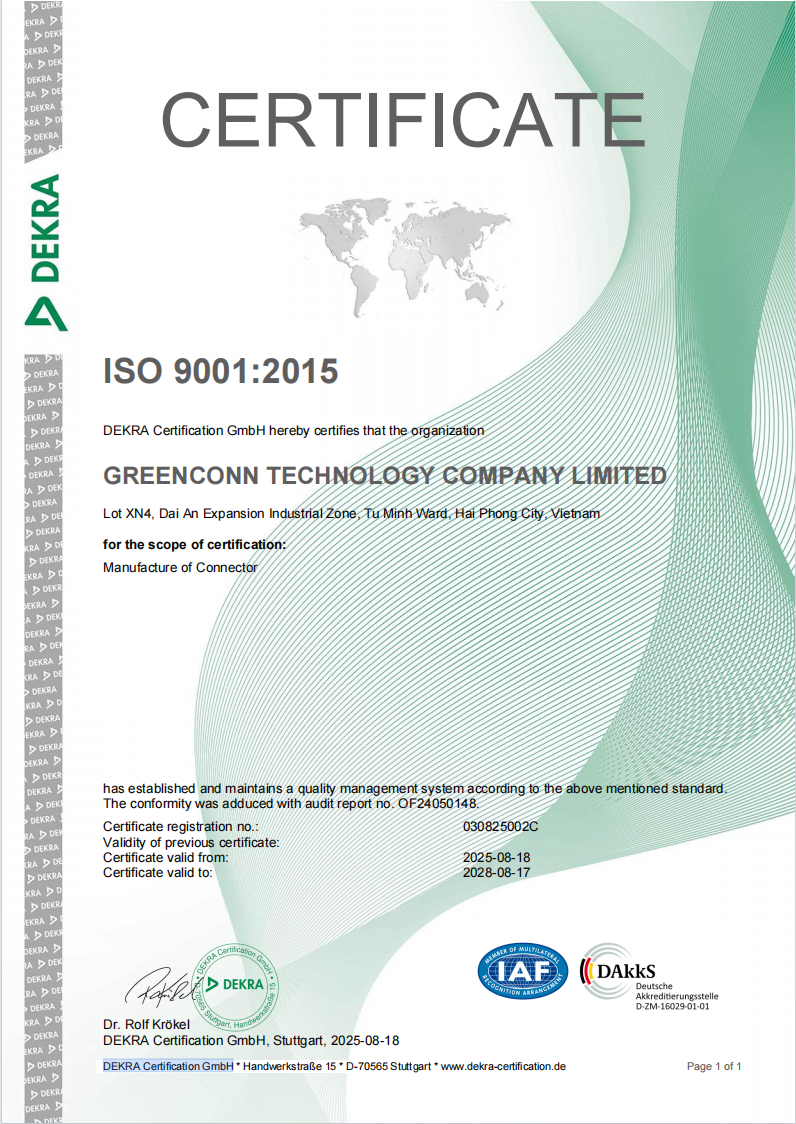 A management-system certificate documents how a manufacturing process is governed; it does not document the performance of an individual connector series.
Management-system evidence and product evidence are different instruments
Procurement teams often compress six different evidence types into the single phrase 'certified supplier'. The table below keeps them apart, using the certificate and standard references that a European connector buyer is most likely to encounter.
| Evidence type | What it addresses | Reference held or requested | What it does not establish |
|---|---|---|---|
| ISO 9001:2015 | Quality management system for a defined scope | 030825002C, DEKRA, scope 'Manufacture of Connector', 2025-08-18 to 2028-08-17 | Product performance, dimensional conformity, material content or application approval |
| ISO 14001:2015 | Environmental management system | 111121007/1C, DEKRA, scope 'Manufacture of Connector', 2024-11-28 to 2027-11-28 | RoHS or REACH conformity of a part |
| ISO 45001:2018 | Occupational health and safety management system | 450224015, DEKRA, 2024-02-28 to 2027-02-27 | Product quality or substance compliance |
| IATF 16949:2016 | Automotive quality management system for a defined scope | 160319060-2, DEKRA, scope 'Design and Manufacture of Hardware Stamping Part', 2026-04-03 to 2029-04-02 | Test results against LV214, IEC or OEM specifications |
| ISO 13485:2016 | Medical-device-related quality management system for a defined scope | G25Q2GZ1104R0S, Guardian Independent Certification (Beijing) Co. Ltd., GB/T42061-2022/ISO 13485:2016, 2025-01-02 to 2028-01-01 | Device approval, biocompatibility or end-product validation |
| Product test reports | Measured performance of a specific series and configuration | Requested per programme: LV214 revision, IEC test standard, USCAR-2 or OEM specification | Supplier process control, capacity, lead time or material declarations |
| RoHS / REACH declarations | Substance content of the part and its materials | Requested per part number, with test report or declaration basis stated | Any element of quality or environmental management |
Two scope details in the other certificates show why the distinction is not academic.
The IATF 16949:2016 certificate 160319060-2, issued by DEKRA with validity from 2026-04-03 to 2029-04-02, carries the scope 'Design and Manufacture of Hardware Stamping Part'. That is an automotive quality management system scope tied to a defined activity. A buyer should map it against the process route of the connector being purchased rather than reading it as blanket automotive approval, and should ask which production steps and sites the certified system covers.
The ISO 13485:2016 certificate G25Q2GZ1104R0S states a scope of 'Design and production of electronic connectors (radiofrequency ablation system, dynamic blood glucose meter)'. The scope names two medical application areas. A buyer sourcing connectors for a different device type should treat that statement as information about the certified system and about relevant medical experience, not as automatic coverage of an unrelated application.
Automotive connectors: LV214, IEC reports and the IATF boundary
For an automotive PCB connector, the acceptance question is answered by product-level test evidence against the specification the vehicle manufacturer imposes — LV214, an applicable IEC test standard, or another OEM specification. A management-system certificate does not answer it.
LV214 requirements originate on the vehicle-manufacturer side. The specification defines the environmental and mechanical test programme together with its severity levels and acceptance criteria, and a connector supplier demonstrates conformity by producing test reports for the specific series and configuration. Because the applicable revision and severity band are set by the OEM's requirement documents, a buyer should confirm which revision governs the programme before accepting a report as evidence. A report that does not state its revision, specimen configuration and test conditions cannot be compared with a competing supplier's report, and comparison is usually the point of asking for it.
IEC test standards operate at the same product level: they define test methods and conditions, and conformity is evidenced by a report naming the standard, the edition, the specimen and the measured results. A standard name printed in a catalogue entry is not a test result.
One published reference point for the road-vehicle environment is SAE International's USCAR-2 specification, whose stated scope covers performance testing at all phases for automotive electrical connector systems in low-voltage (0–20 VDC) road vehicle applications. It is useful to procurement as a benchmark for what 'performance testing' means in that environment, and as a reminder that vibration, thermal and electrical stress are addressed by the test programme rather than by the supplier's quality certificate.
The IATF 16949 certificate therefore plays a supporting, not substituting, role. Certificate 160319060-2 supports the existence of an automotive-oriented quality management system within the scope described above. Buyers working to automotive programme requirements should request the scope statement, the site coverage and the product-level test reports as one package, while expecting the vehicle manufacturer's own approval process to remain decisive.
Medical connectors: what the ISO 13485 scope adds
The ISO 13485:2016 certificate G25Q2GZ1104R0S adds evidence that a general ISO 9001 certificate cannot supply: a quality management system built around medical-device-related requirements, for a defined scope covering design and production of electronic connectors for radiofrequency ablation systems and dynamic blood glucose meters, valid from 2025-01-02 to 2028-01-01.
For a connector buyer inside a medical programme, the useful questions are narrower than 'are you ISO 13485 certified':
- Does the scope text name your device category or a comparable one, and does it include design as well as production if you are buying a modified or custom connector?
- Which sites and production lines sit inside the certified system?
- How are process, material and sub-supplier changes controlled and communicated after qualification?
- What traceability and documentation package accompanies each shipment?
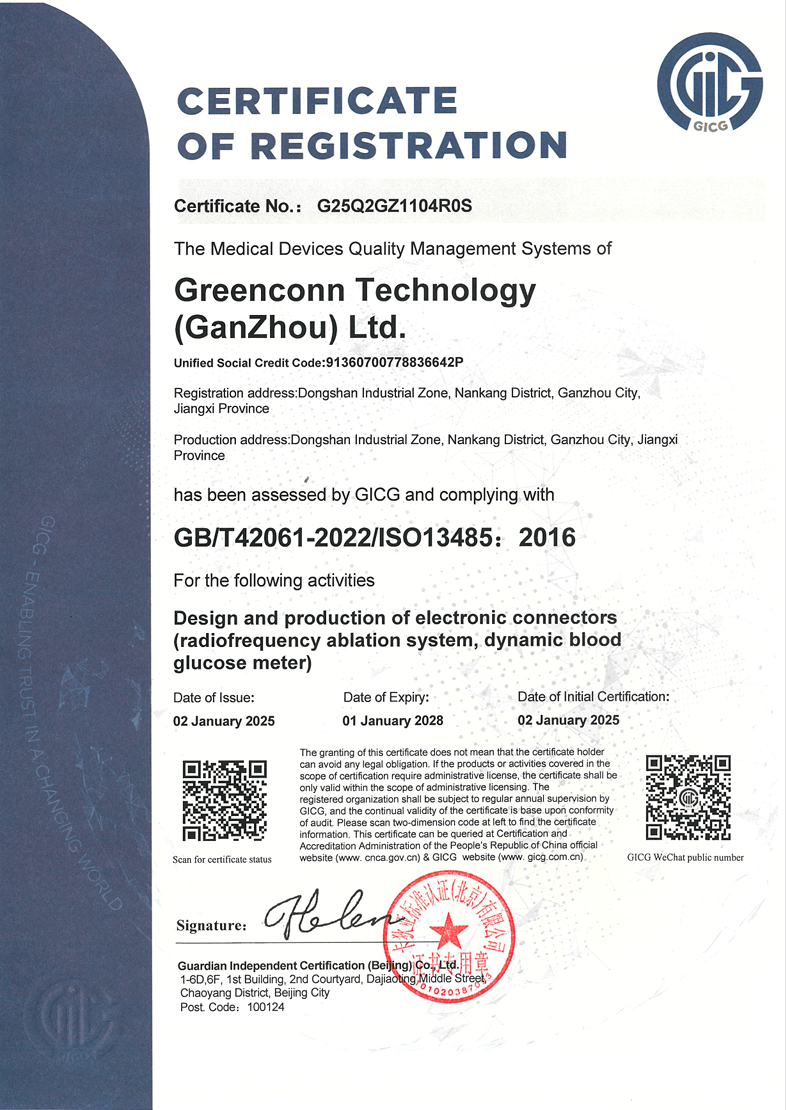 The medical quality management system scope names specific device applications, which is why the scope text matters as much as the standard number.
A medical connector still has to survive the conditions the device imposes — sterilization exposure, high humidity and precise signal transmission are the working conditions described for medical monitoring and diagnostic equipment — and that verification belongs to the device manufacturer's risk management and validation work. ISO 13485 certification of a connector supplier supports that work. It does not replace it, and it is not a product certificate for the connector itself.
Consumer electronics: RoHS and REACH are part declarations
For consumer and smart-home connectors, the compliance question concerns substance content in the part, and it is answered by declarations and test reports tied to the part number, not by an environmental management certificate.
The distinction is concrete. The ISO 14001:2015 certificate 111121007/1C, issued by DEKRA with the scope 'Manufacture of Connector' and validity from 2024-11-28 to 2027-11-28, describes how an organisation manages its environmental processes. RoHS restricts the use of specified hazardous substances in electrical and electronic equipment, and REACH requires chemical information — including information on substances of very high concern above the applicable regulatory threshold — to be passed along the supply chain. Neither obligation is discharged by an environmental management system certificate.
What a buyer should request is part-specific: a RoHS declaration or test report covering the homogeneous materials of the connector, and a REACH statement identifying the substances of very high concern status for those materials. Material composition is where these questions land in practice. A single connector family can include PBT, nylon or LCP housings, phosphor bronze contacts, a nickel under-plating with tin or gold surface finish, and silicone seals. Each material stream carries its own declaration trail, and a supplier's ability to produce those declarations per part number is a more useful qualification signal than a general statement of environmental responsibility.
RoHS and REACH compliance is also listed among the special requirements for consumer electronics, smart-home devices and wearables, which is where fine-pitch, low-profile connectors are used in compact, drop-prone and moisture-exposed products. In that context, the declaration is part of the design input, not only a purchasing formality.
A verification sequence that keeps the two layers apart
A workable procurement sequence separates supplier-level documentation from part-level documentation at every step, so that neither is mistaken for the other.
- Verify the certificate itself. Check the number, issuing body, holder's legal name and validity dates, using the issuing body's register where one is publicly available. Certificate 030825002C is meaningful within 2025-08-18 to 2028-08-17 and not outside it.
- Read the scope text against your process route. 'Manufacture of Connector' and 'Design and Manufacture of Hardware Stamping Part' are different claims. Match the claim to the steps that actually produce your part.
- Map the site to the supply chain. A certified system attached to one facility does not automatically describe another facility in the same group.
- Request the product-level test programme. Ask for the specification name and revision, the specimen configuration, the test conditions and the results — for the series and variant you intend to buy.
- Request part-level substance declarations. RoHS and REACH documentation per part number, with the declaration basis or test method stated.
- Keep the two layers separate in the qualification file. Supplier-level certificates govern the relationship; part-level reports and declarations govern the release of a component into a design.
Separating the layers also improves maintenance. A part-level declaration usually has to be reissued when a material or plating changes, while the management-system certificate is unaffected by that change. Conversely, the expiry of a management-system certificate does not by itself invalidate a measured test report, but it does require the supplier's system status to be reassessed before the next order.
Application fit: where each evidence layer matters
Different programmes stress different evidence, and the connector families used in each programme illustrate why catalogue parameters and qualification reports answer separate questions.
Automotive and harsh-environment programmes
The GB05 wire-to-board wafer connector, for example, is specified at a 2.00 mm pitch with a 3.00 A rating, 125 V AC/DC, a dielectric withstanding voltage of 1000 V AC per minute and an operating temperature range of -40 °C to +125 °C, with locking and polarization features. Those figures describe design intent and rated conditions. Whether the connector passes an LV214 programme for a specific vehicle application is established by the test report, not by the catalogue.
The same logic applies to sealed connectors. The GT wire-to-wire series is rated to 250 V AC/DC with up to 13 A per contact, IP68 and IP6K9K protection, and an operating range of -55 °C to +125 °C; the GA01 series is rated IP67 at a 2.20 mm pitch. Ingress protection grades are meaningful only together with the test conditions under which they were obtained, which is precisely the information a product-level report contains and a management-system certificate does not.
Derating is another example. The CSGA110 RAST 5.0 connector is rated 4 A per pin at an ambient temperature of 60 °C and 2 A per pin at 100 °C. A buyer comparing current ratings across suppliers without comparing the stated ambient condition is comparing two different numbers. This is the practical reason specification discipline and compliance discipline belong in the same review.
Medical and precision-signal programmes
In medical monitoring and diagnostic equipment, alignment tolerance and signal stability often drive the choice. The GC01 floating board-to-board connector offers 0.50 mm pitch, 0.5 A per signal contact and 3 A per power contact, mating heights from 9.5 mm to 31 mm, 100 mating cycles and an operating range of -55 °C to +105 °C. The CFAD102 FPC/FFC connector offers 0.50 mm pitch, 0.5 A and 50 V AC/DC in a -25 °C to +85 °C range. For a medical programme, the ISO 13485 scope question sits above these parameters: it determines whether the system that produced the part is appropriate for the device class, while the parameters determine whether the part fits the design.
High-speed and consumer programmes
Where signal rate matters, the GD01 high-speed floating connector is specified at 1.27 mm pitch with 8 Gbps data transmission, 500 mating cycles, sinusoidal vibration of 10–2000 Hz at 20 g and half-sine shock of 50 g/11 ms. For compact consumer and smart-home designs, the GB01 wafer connector offers 1.25 mm pitch, 1 A, 50 V AC/DC in a -25 °C to +85 °C range. In both cases, the RoHS and REACH declarations travel with the part number, and the qualification report travels with the application programme.
Where the certificate stops being useful
Three limits are worth stating plainly, because they are the ones buyers most often test after a problem appears.
- It is not a product release document. No management-system certificate establishes that a specific connector meets a dimensional, electrical, environmental or substance requirement. Those claims come from reports and declarations tied to the part.
- It is not transferable. A certificate issued for a defined scope does not automatically cover a different site, a different legal entity or a materially different process route; site and scope mapping is a separate verification step.
- It says nothing about commercial terms. Capacity, lead time, minimum order quantity and price sit outside the certificate entirely. Published capability figures — a stated monthly capacity of 28,750,000 pieces, a four-week lead time, a 5,000-piece minimum order quantity and AQL sampling inspection — are commercial and operational statements that a buyer evaluates separately from compliance evidence.
Outlook for compliance-led sourcing
Connector portfolios increasingly span automotive, industrial, medical and consumer programmes within one supplier. Greenconn's own portfolio covers board-to-board, wire-to-board, automotive, waterproof, floating board-to-board, high-speed board-to-board and custom connector solutions, and the company maintains business locations in several markets including Munich alongside its China and Vietnam manufacturing footprint. When one supplier serves several regulated segments, procurement teams that organise qualification as a matrix — supplier-level certificate, site and scope, part-level test report, part-level substance declaration — can reuse the same evidence across programmes instead of rebuilding a qualification file for each one.
The practical implication for a buyer reviewing an ISO 9001:2015 certificate such as 030825002C is modest but useful: treat it as confirmation that a management system for connector manufacture is certified for a defined period and scope, then ask separately for the automotive test programme, the medical-device-related scope statement and the RoHS and REACH declarations that your own application actually requires. That separation is what prevents a supplier-level document from being filed as if it were an approval for a part.
Greenconn's connector portfolio and manufacturing capability are summarised in its company introduction brochure, which is available for download.
FAQ
Does ISO 9001:2015 certificate 030825002C approve a specific PCB connector for use?
No. Certificate 030825002C certifies a quality management system against ISO 9001:2015 for the scope 'Manufacture of Connector', issued by DEKRA with validity from 2025-08-18 to 2028-08-17. It does not state dimensional conformity, electrical or environmental performance, material content or approval for a particular assembly. Those points are established by product-level test reports and part-level declarations for the specific series and configuration.
Which documents replace a management-system certificate for an automotive PCB connector?
Product-level test evidence replaces it for the performance question. A buyer should request test reports that name the governing specification — an LV214 revision, an applicable IEC test standard, or another OEM specification — together with the specimen configuration, test conditions and measured results for the series being purchased. SAE International's USCAR-2 specification, whose stated scope covers performance testing at all phases for automotive electrical connector systems in low-voltage (0–20 VDC) road vehicle applications, is one published reference for what such a programme addresses. The vehicle manufacturer's own approval remains decisive.
What does the ISO 13485 certificate scope add for medical connector buyers?
Certificate G25Q2GZ1104R0S, issued by Guardian Independent Certification (Beijing) Co. Ltd. against GB/T42061-2022/ISO 13485:2016 and valid from 2025-01-02 to 2028-01-01, states a scope of 'Design and production of electronic connectors (radiofrequency ablation system, dynamic blood glucose meter)'. It indicates that the medical-device-related quality management system covers connector design and production for those named applications. It is not a product certificate, and it does not replace the device manufacturer's own risk management and validation of the connector in the finished device.
How do RoHS and REACH declarations differ from an ISO 14001 certificate?
They address different subjects. The ISO 14001:2015 certificate 111121007/1C, issued by DEKRA with the scope 'Manufacture of Connector' and validity from 2024-11-28 to 2027-11-28, describes how an organisation manages environmental processes. RoHS restricts the use of specified hazardous substances in electrical and electronic equipment, and REACH requires chemical information, including information on substances of very high concern above the applicable threshold, to be passed along the supply chain. Both are answered at part level through declarations or test reports covering the connector's homogeneous materials, such as housings, contacts, plating and seals.
How should procurement verify a supplier certificate before qualification?
Verify the certificate number, issuing body, holder's legal name, scope text and validity dates, using the issuing body's register where one is publicly available. Then map the scope text and the certified site against the processes and facility that will actually produce the part, and record which product-level reports and material declarations accompany the specific part number. The management-system certificate, the site and scope mapping, the test report and the substance declaration should be stored as separate items, because each one expires or changes for different reasons.
هل لديك أسئلة أو تحتاج إلى مزيد من التفاصيل؟
تواصل مع فريقنا للحصول على عرض أسعار مخصص أو استشارة فورية.
طلب عرض أسعار
املأ النموذج أدناه وسيتواصل معك فريقنا بعرض مقترح مخصص.
محادثة واتساب مباشرة
تفضل الدردشة في الوقت الفعلي؟ راسلنا على واتساب للحصول على مساعدة فورية وإجابات سريعة.
- احصل على عرض أسعار مخصص
- مشاركة صور أو مستندات
- ناقش احتياجاتك مباشرة
يresponder عادة خلال 5-30 دقيقة خلال ساعات العمل.