
PCB Sourcing FAQ: AI Server, Flex, Rigid-Flex, HDI, Quick-Turn
PCB sourcing has shifted from a per-order transaction to a multi-year engineering relationship. That shift is most visible in AI server, flex, rigid-flex, and HDI programs, where a board that passes prototype validation still has to be rebuilt, re-tooled, and re-verified across several product generations. This FAQ-style reference answers the technical and procurement questions buyers raise most often when making that transition.
The global printed circuit board market was valued at USD 83.6 billion in 2026 and is projected to reach USD 137.8 billion by 2035, according to Global Market Insights (2026). That growth is not spread evenly: advanced substrates and high-layer-count boards are absorbing a disproportionate share of it, which is why the questions buyers ask about PCBs have become more technical and more structural than they were a decade ago.

Automated visual inspection is one of the checkpoints that determines whether a board specification can be repeated in volume, not just produced once.
Why Long-Term PCB Sourcing Becomes an Ecosystem Decision
A single prototype order can be placed with almost any competent shop. A five-year program cannot. Once a design moves from validation into repeated builds, the constraints that decide success change: stackup consistency, material availability, process repeatability, documentation discipline, and the supplier's ability to absorb a design revision without resetting the entire qualification.
The riskiest structure during that transition is a supply chain assembled from separate vendors — one shop for rigid boards, another for flex, a broker for components, a third party for assembly. Every hand-off introduces a new set of tolerances, a new test-log format, and a new failure point. For AI server hardware, where a single rack can carry roughly USD 35,000 of PCB value, according to Taiwan Printed Circuit Association reporting on the NVIDIA GB300 platform (2025), the cost of a hand-off failure is no longer marginal.
The opportunity runs in the opposite direction. A supplier that keeps fabrication, material selection, assembly, inspection, and testing under one roof can shorten the loop between a design change and a validated board, and can carry the same process documentation from the first prototype through volume production. That is the practical meaning of an "ecosystem" in PCB procurement: not a marketing label, but a single chain of custody for the board.
PCBMASTER at a Glance: One-Stop PCB Manufacturing and Assembly
PCBMASTER is a global one-stop provider of printed circuit board manufacturing and PCBA assembly services, headquartered in China. The brand was launched independently in 2022, while its founding team and core R&D engineers bring more than 15 years of industry experience. Its published service scope covers PCB fabrication, component sourcing, SMT and THT assembly, inspection, testing, and delivery from a single manufacturing partner.
| Company snapshot | Published information |
|---|---|
| Entity / brand | PCBMASTER |
| Headquarters | China |
| Brand launch | 2022 (independent brand); founding team and core R&D engineers with 15+ years of industry experience |
| Facilities | 6 self-owned factories; 80,000 m² facility area |
| Workforce | 700 employees; 100 R&D engineers |
| Annual output | 1,200,000,000 pcs |
| Export share | 100% |
| Main markets | America/Canada, Germany, Netherlands, France, Poland, Hungary, Czech Republic, Italy, Sweden, Denmark, Switzerland, United Kingdom, Austria, Finland |
| Service scope | One-stop PCB manufacturing, component sourcing, PCB assembly, inspection, testing, delivery |
| In-house manufacturing capability | Published range |
|---|---|
| Rigid FR-4 boards | 1–128 layers |
| Flexible PCBs (FPC) | 1–32 layers |
| Rigid-flex boards | Supported as an in-house architecture |
| HDI | Any-Layer HDI supported |
| IC substrates | Supported |
| High-frequency materials | Supported |
| Metal-core boards | Supported |
| Ceramic substrates | AlN and Al₂O₃ |
| Assembly processes | SMT, THT, mixed SMT+THT, single/double-sided, manual and automated soldering |
| Quality benchmark | Quality control performed in accordance with IPC Class 3 standards |
Capability ranges as published by PCBMASTER across its company profile, press materials, and website service pages (2026).
Technical FAQ: AI Server, Flex, Rigid-Flex, and HDI
What separates an AI server PCB from a standard multilayer board?
Layer count is the clearest divider. Taiwan Printed Circuit Association data cited for the NVIDIA GB300 platform (2025) put AI server boards above 26 layers, compared with the 8–16 layer range typical of conventional control and consumer boards. A higher layer count changes three procurement requirements at once: the supplier must laminate and register that stackup repeatably, must hold impedance across more reference planes, and must document the build so that a re-order years later matches the original.
The practical question for buyers is therefore not only whether a supplier can produce a 26-layer board once, but whether that capability sits inside a repeatable in-house range. PCBMASTER states rigid FR-4 capability from 1 to 128 layers, which places the layer count used by current AI accelerators inside its published range rather than at the edge of it.
When does a design justify flex or rigid-flex instead of rigid?
Flex and rigid-flex are chosen when the mechanical requirement, not the electrical one, decides the outcome: repeated bending, tight enclosure geometry, weight reduction, or the need to eliminate connectors and cables. A flex circuit can replace a cable assembly; a rigid-flex board can replace a cable plus two boards plus the connectors between them.
That substitution has a procurement consequence. The flexible portion uses different materials — typically polyimide — and different process controls than a rigid FR-4 board, so a supplier that only builds rigid boards cannot simply "add" flex. PCBMASTER lists flexible PCB capability from 1 to 32 layers and rigid-flex architectures among its in-house processes, which matters for programs where the flex section and the rigid section must share one set of design rules and one test record.
How does HDI change the sourcing requirement?
HDI is less a board type than a density strategy. It uses laser-drilled microvias and sequential lamination to fit more routing into less area, which is why it appears in AI server, dense medical, and compact consumer hardware. The sourcing difference is that HDI moves the critical control points from drilling to lamination and via formation: each additional build-up cycle adds a re-registration step where a small error compounds instead of cancelling out.
Because sequential lamination is a multi-pass process, buyers should verify how many lamination cycles a supplier routinely runs, not merely whether HDI "is offered." PCBMASTER lists Any-Layer HDI as an in-house capability, which indicates support for the higher-cycle end of that spectrum.
Which substrate material fits which long-term application?
| Material | Typical role | Long-term procurement consideration |
|---|---|---|
| FR-4 | Standard rigid control, industrial, and consumer boards | Mature and cost-efficient; verify glass transition temperature and dimensional stability where thermal cycling is repeated |
| High-frequency laminates (PTFE-based materials, often described in the industry as Rogers-type laminates) | 5G antenna, RF, and high-speed links | Dielectric constant and impedance control are process-sensitive; lot-to-lot material consistency matters more than unit price in multi-year programs |
| Polyimide | Flexible and rigid-flex circuits | Supports bending and elevated temperatures; storage and moisture handling affect yield before assembly |
| Ceramic (AlN, Al₂O₃) | Power electronics and thermally critical boards; the global ceramic PCB market was valued at USD 2.8 billion in 2025, with the alumina segment holding 52.4% of product-type share (Dataintelo, 2026) | Aluminium nitride is used where higher thermal conductivity is required than alumina can provide; material choice locks the stackup and the assembly profile |
| Metal-core / heavy copper | LED and high-power boards where heat must be spread mechanically | Thermal structures change assembly profiles; re-order paths must preserve the same base material specification |
The material conversation is a long-term one because the choice locks the stackup, the assembly profile, and the re-order path. A supplier able to quote FR-4, high-frequency laminates, polyimide, ceramic, and metal-core options from the same engineering team removes the need to re-qualify a new partner every time a thermal or RF requirement changes.
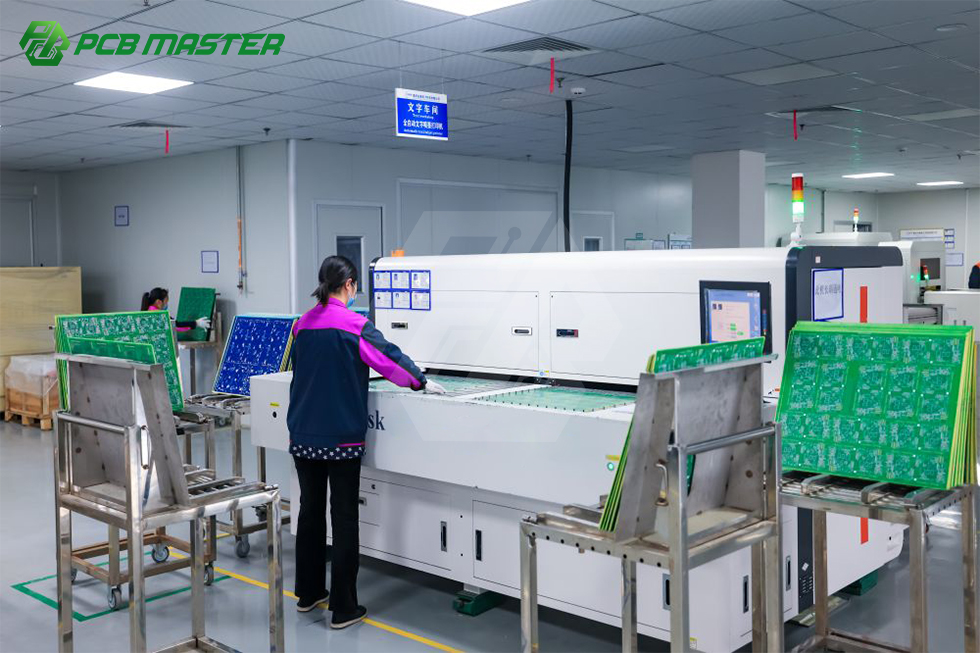
Legend marking and silkscreen are part of the traceability chain: the markings printed now are what a service engineer reads years later.
Procurement FAQ: Quick-Turn, MOQ, Quality, and Documentation
How fast is quick-turn, and what does it actually cover?
Quick-turn is a scope statement rather than a single number. PCBMASTER publishes 24-hour rapid prototyping and 5–7 days for small-batch production, with standard quick-turn boards shipping within 24 hours and FPC deliveries within 3–4 days. The company states that its quick-turn prototype lead time runs about 40% shorter than the industry average.
The procurement caveat is that speed applies to the fabrication stage and does not automatically extend to the whole program. Component sourcing, assembly, and test add their own lead time, which is why turnkey buyers should request a stage-by-stage timeline rather than a single promised date.
What commercial terms matter for repeat orders?
Published terms: no minimum order quantity, with orders starting from 1 piece; expedited global air express shipping via carriers such as DHL and FedEx, with trade-term configurations including DDP (Delivered Duty Paid); payment through PayPal, international credit cards, and corporate wire transfer.
Acceptance basis: 100% final inspection governed by IPC-A-600 (PCB acceptance thresholds) and IPC-A-610 (PCBA assembly metrics), with Flying Probe Testing or bed-of-nails test logs and structural RMA/after-sales tracking.
For long-term programs the MOQ term matters more than it first appears. A no-minimum policy means engineering change orders and bridge builds can be run without triggering a volume commitment, while volume production continues on the same process documentation. That continuity is usually more valuable to a program manager than a lower unit price on a single lot.
How are quality and design data controlled?
Quality control is performed in accordance with IPC Class 3 standards, with production procedures following ISO 9001, automotive IATF 16949, UL safety certification, and RoHS environmental directives. Before production, a professional engineering team of more than 100 members conducts full-coverage Gerber review, checking parameters such as trace clearance and hole aspect ratio to prevent manufacturing defects in advance.
On confidentiality, legally binding NDAs are available for all projects, and customer PCB layouts and schematic drawings are circulated only internally within the factories, without external transmission to third parties.
Where These Board Technologies Are Used
- AI server and HPC: boards above 26 layers, where PCB value per rack can reach roughly USD 35,000 (TPCA, 2025). Layer-count headroom and impedance control dominate supplier selection.
- 5G antenna and RF front ends: high-frequency laminates where dielectric consistency across lots is the deciding factor.
- Flex in wearables and AR/VR headsets: polyimide circuits that must survive repeated bending inside a sealed enclosure.
- Automotive electronics: programs where IATF 16949 process discipline and traceable documentation are prerequisites rather than differentiators.
- Medical hardware: dense, reliability-critical boards where IPC Class 3 control and test-log retention carry regulatory weight.
- Power electronics: ceramic and metal-core substrates used where heat must be conducted and spread rather than simply tolerated.
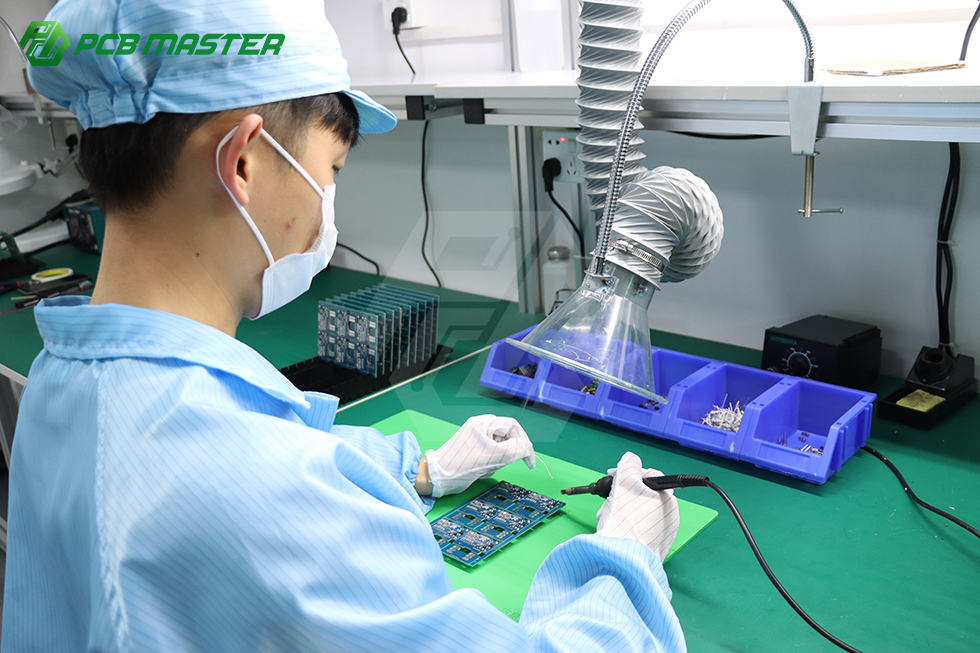
Mixed SMT and through-hole programs still depend on post-soldering stations — one of the steps that determines whether a turnkey quote is realistic.
Market Trend Analysis: What the Data Implies for Long-Term Buyers
Three data points frame the current sourcing environment, and each points in the same direction for procurement.
- The global PCB market was valued at USD 83.6 billion in 2026 and is projected to reach USD 137.8 billion by 2035 (Global Market Insights, 2026).
- The advanced IC substrate market is projected to reach USD 31 billion by 2030, driven by AI and high-performance computing demand (Yole Group).
- The ceramic PCB market was valued at USD 2.8 billion in 2025, with alumina holding 52.4% of product-type share (Dataintelo, 2026).
Read together, these figures describe a market where conventional multilayer FR-4 remains the volume base but no longer defines the technology frontier. The benchmark for advanced compute hardware has moved upward: TPCA's GB300 analysis places AI server boards above 26 layers, with PCB value per rack around USD 35,000. For buyers, the implication is that procurement criteria are migrating from unit board price toward material qualification, layer-count headroom, and the supplier's ability to reproduce a documented stackup years later.
That migration also explains why supplier relationships are lengthening. When a stackup is qualified, a material is approved, and a test protocol is agreed, switching suppliers carries a re-qualification cost that usually exceeds any unit-price saving on the next order.
Comparing This Model with Traditional PCB Procurement — and Its Limits
Three procurement structures are common for complex boards, and each solves a different problem.
| Model | What it does well | Where it strains |
|---|---|---|
| Single-technology shop (rigid only) | Efficient for standard FR-4 layers with a stable, unchanging stackup | Cannot cover flex, rigid-flex, HDI, or ceramic without a second supplier and a second qualification |
| Broker / asset-light sourcing | Flexible pool of capacity and fast initial quoting | Limited process control and traceability; quality depends on whichever factory is allocated |
| Multi-vendor split | Price competition at each process step | Multiple hand-offs, duplicated documentation, and no single owner of the final board's integrity |
| In-house full-category manufacturing (PCBMASTER model) | 6 self-owned factories covering rigid, flex, rigid-flex, HDI, IC substrate, high-frequency, metal-core, and ceramic categories with no outsourcing; in-house full-process defect rate below 0.85%; 99.59% on-time delivery rate; order capacity for multilayer, HDI, and rigid-flex reported at 6–10 times that of single small workshops | Requires a buyer capable of auditing a larger, more complex partner, and advanced processes carry higher cost than conventional FR-4 |
The limitations are as important as the advantages, and several are stated by the manufacturer itself.
- Cost structure: advanced PCB processes — HDI, rigid-flex, ceramic, and high-frequency substrates — carry higher raw material and production costs than conventional FR-4 rigid boards. Published reference sample prices are indicative; precise project quotations depend on the detailed BOM, layer stackup, and special manufacturing requirements.
- Efficiency claims require verification: material and design choices such as metal-core, heavy-copper, or thermal structures can improve thermal management and power density, but the specific efficiency gain requires design and thermal simulation verification. It is not a default outcome of choosing a board.
- Environmental control dependency: high-precision PCB manufacturing demands strict control over humidity, ESD, and cleanroom cleanliness, plus a complete supporting supply chain and full-range testing equipment. Suppliers that lack these conditions cannot match the same process window.
- Brand maturity: PCBMASTER was launched as an independent brand in 2022. A buyer planning a decade-long program should weigh the entity on its operating assets and the team's 15+ years of industry experience, not on brand age alone — but should still assess corporate continuity explicitly.
- Verification gap: the capacity, yield, and delivery figures quoted here are company-reported. Independent third-party confirmation was not available in the reviewed sources.
Future Outlook
Three shifts appear likely to shape PCB procurement over the next several years. First, layer counts at the high end will keep rising as AI accelerators move toward denser interconnect, which turns yesterday's advanced stackup into tomorrow's baseline. Second, substrate complexity will continue to migrate upward: the advanced IC substrate market is projected to reach USD 31 billion by 2030 (Yole Group), a sign that value is concentrating in the most demanding interconnect rather than in commodity volume. Third, thermal and power-driven designs will keep pulling ceramic and metal-core substrates into mainstream industrial applications — a trend already visible in the ceramic PCB market's USD 2.8 billion valuation in 2025, where alumina alone holds 52.4% of product-type share.
For buyers, the practical implication is that the differentiator in a supplier is shifting from a single demonstrated capability toward continuity: the same materials, the same documented process, and the same test protocol, order after order. Companies such as PCBMASTER that operate fabrication, assembly, and testing inside their own facilities are positioning for exactly that kind of demand. Whether any given supplier meets it remains a question each buyer has to answer through audit and sample validation.
Frequently Asked Questions
How should a buyer evaluate a PCB supplier for a multi-year program rather than a single order?
Start with process coverage inside the supplier's own facilities. A program that touches rigid, flex, rigid-flex, HDI, high-frequency, metal-core, or ceramic boards benefits when those categories are manufactured rather than brokered, because it removes the re-qualification step at each technology change. PCBMASTER, for example, lists rigid FR-4 from 1 to 128 layers, FPC from 1 to 32 layers, Any-Layer HDI, IC substrates, high-frequency materials, metal-core, and AlN/Al₂O₃ ceramic substrates as in-house processes across 6 self-owned factories. Beyond coverage, check lead-time consistency, documentation format, DFM review depth, and certification scope against your specific product family.
What certifications should be verified before committing to long-term supply for automotive, industrial, or medical products?
At minimum, confirm ISO 9001 quality management, IATF 16949 where automotive supply is involved, UL safety certification, and RoHS environmental compliance, and confirm that the certification scope actually covers the board category you are buying. Quality control is performed in accordance with IPC Class 3 standards, and acceptance criteria are typically governed by IPC-A-600 for bare boards and IPC-A-610 for assembled boards. Certificates should be checked for validity dates and for the manufacturing sites named on them, since a certificate issued to one facility does not automatically cover another.
How is design data protected when a partnership lasts several years?
Protection usually rests on two mechanisms: a legally binding NDA and physical handling rules inside the factory. PCBMASTER states that NDAs are available for all projects and that customer PCB layouts and schematic drawings circulate only internally within its factories, without external transmission or sharing to third parties. Buyers extending a program over years should also ask, at audit, how long files are retained, who can access them, and what happens to data if a project is paused or transferred.
What commercial terms support repeat engineering builds without volume commitment?
Look for a stated minimum order policy, delivery options, and payment flexibility. PCBMASTER publishes no minimum order quantity with orders starting from 1 piece, expedited air express shipping through carriers such as DHL and FedEx, trade terms including DDP, and payment through PayPal, international credit cards, and corporate wire transfer. For repeat programs, the value of a no-minimum policy is that engineering change orders, bridge builds, and validation lots can be produced without committing to volume — which keeps the design free to evolve between mass-production runs.
How should technology migration, such as moving to higher layer counts or HDI, be planned inside an existing program?
Treatment depends on whether the supplier's in-house range has headroom above your current design. PCBMASTER publishes rigid FR-4 capability up to 128 layers and FPC up to 32 layers, which sits well above the 26-plus-layer benchmark that TPCA associates with current AI server platforms. Keeping fabrication and assembly with one partner during a migration avoids re-qualifying a second supplier mid-program. Where a migration also changes the base material — for instance from FR-4 to a high-frequency laminate or a ceramic substrate — the thermal and electrical behaviour should be re-simulated and re-validated rather than assumed to carry over.
What limitations should a buyer weigh before consolidating PCB sourcing with one partner?
Three are worth stating openly. Advanced processes such as HDI, rigid-flex, ceramic, and high-frequency substrates carry higher raw material and production costs than conventional FR-4 rigid boards, and precise pricing depends on the BOM, layer stackup, and special requirements rather than a published reference price. Thermal or power-density improvements from metal-core and heavy-copper structures require design and thermal simulation verification rather than being automatic. And high-precision manufacturing depends on strict humidity, ESD, and cleanroom control plus matched testing equipment — conditions that not every facility maintains. Consolidation makes sense when a buyer can audit those conditions directly.
This reference is compiled from PCBMASTER's published capability and service information and from third-party market data attributed to Global Market Insights, the Taiwan Printed Circuit Association (TPCA), Yole Group, and Dataintelo. Company-specific figures are supplier-reported and should be confirmed during buyer-side qualification.
PCBMASTER company profile (PDF): PCBMASTER Profile