
PED CE and ISO Certifications for Ball Valves: A Buyer's Compliance Decoder
PED CE and ISO Certifications for Ball Valves: A Buyer's Compliance Decoder
Five documents decide most cross-border ball valve orders. Each one answers a different question, covers a different scope, and means something different in the EU, North America, South Africa and South America.
Ball valve certification is a documentation language, and most buyers are not fluent in it. Before a purchase order is released, a European chemical plant, a North American pipeline operator, a South African industrial contractor and a South American project buyer will each request a different bundle of paperwork — a PED CE Verification Certificate, an EN 12266:2012 pressure-test report, an API STD 607 fire-test certificate, an ISO 15848-1 fugitive-emission qualification — and each will assume those documents mean roughly the same thing. They do not.
This decoder translates those five documents into procurement language: what each one actually covers, which markets each one applies to, where the boundaries of each certificate sit, and how a buyer can verify authenticity without employing a notified-body engineer.
The procurement problem: one word, three unrelated questions
When a buyer says “the valve is certified”, three separate questions are usually being collapsed into one.
- Conformity. Does the product satisfy a legal requirement to be placed on a specific market? This is what PED Directive 2014/68/EU and CE marking address in the European Union.
- Performance. Did the product pass a defined test to stated acceptance criteria? This is what EN 12266:2012 and API STD 607 address.
- Qualification for a service condition. Was the product type-tested for a specific operating behaviour, such as fugitive emissions or low-temperature service? This is what ISO 15848-1 and similar qualification standards address.
Each answer comes from a different party, carries a different scope statement, and is invalidated by different changes. A conformity certificate is scoped to a product family and its boundary conditions. A test report is scoped to the configuration that was tested. A type-test qualification is scoped to the parameters declared on the certificate.
The five documents, decoded
PED Directive 2014/68/EU — the legal layer
PED Directive 2014/68/EU is the European Union’s legal framework for pressure equipment placed on the EU market. It sets essential safety requirements, and it classifies equipment into risk categories according to the fluid group, the volume or nominal size, and the maximum allowable pressure. Equipment falling into the higher categories requires the involvement of a Notified Body. The directive is law: it says what must be demonstrated, not how a valve performs in service. It is not a test method and it does not describe seat tightness, torque or cycle life.
PED CE Verification Certificate — the conformity evidence
There is no single document called “the PED certificate”. Depending on the conformity assessment module applied, the paperwork may take the form of a type-examination certificate, a quality-assurance approval, or a verification certificate covering individual equipment. A verification certificate generally indicates that a Notified Body reviewed the technical documentation and verified that the equipment meets the directive’s essential requirements.
For procurement purposes, five fields matter more than the certificate’s title: the module applied, the Notified Body name and its four-digit identification number, the product family and boundary conditions (nominal size range, pressure class, temperature range, fluid group), the design and test standards referenced, and the validity period.
EN 12266:2012 — the pressure test layer
EN 12266:2012 is the European testing standard for industrial valves. Part 1 defines pressure test procedures and acceptance criteria; Part 2 covers production tests and supplementary tests. In practice it addresses the shell test (body strength under pressure) and the seat sealing test, and it expresses seat tightness as a defined leakage rate rather than as an absolute claim.
This distinction matters commercially. Datasheets frequently describe a ball valve as a “zero-leakage ball valve” without naming the standard or the leakage rate behind the phrase. Where zero leakage is claimed in soft-seated service, it normally refers to a defined tightness class — for example, clean media requiring zero leakage at Class VI is the scenario in which soft-seal seats are recommended. In metal-seated ball valves, the same wording would need a different test basis, because metal seating behaves differently from PTFE or PEEK seating.
API STD 607 — the fire qualification layer
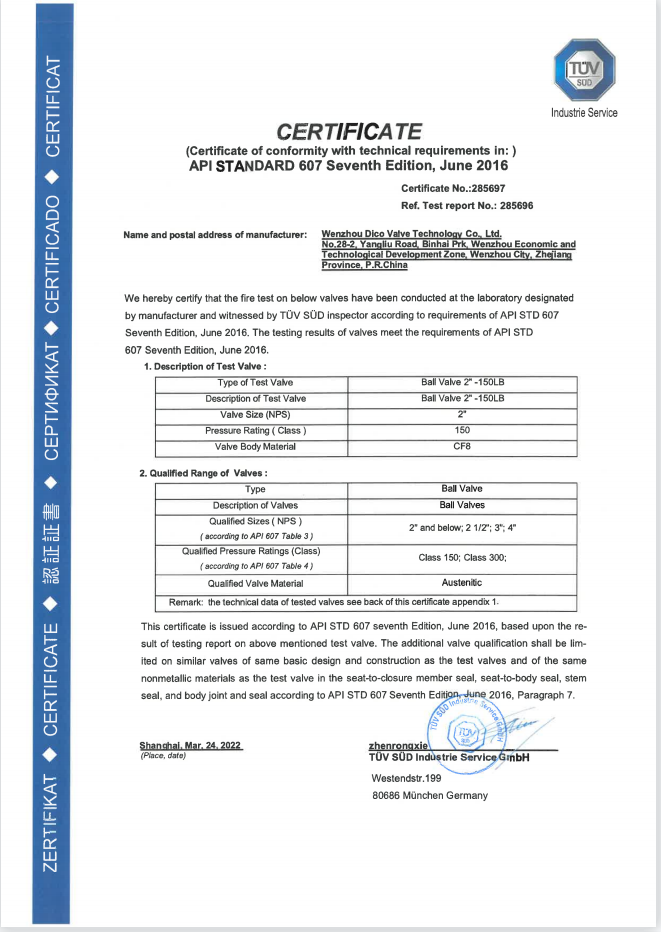
API STD 607 is a fire test standard for quarter-turn valves and valves equipped with nonmetallic seats. It exposes a valve to fire conditions and then verifies that the valve still provides a seal afterwards. It is a test standard, not a design standard: passing it confirms a behaviour under a defined test, not the presence of a specific construction.
A fire-safe ball valve certificate is configuration-specific. The model, size, pressure class and seat or soft-part materials that were tested define what the certificate covers. Fire resistance testing is supported by design, and in this product family the valve body carries an internal fireproof groove structure — the mechanical feature that produces the tested result. Buyers should ask for both the certificate and the design feature, because the document describes an outcome while the geometry produces it.
ISO 15848-1 — the fugitive-emission layer
ISO 15848-1 sets out measurement, test and qualification procedures for fugitive emissions from industrial valves, and provides a classification system together with type-test qualification procedures. Part 2 of the series covers production acceptance testing. A qualification is expressed as a combination of parameters — typically a tightness class, an endurance class and a temperature class — which means the qualification is only meaningful when those parameters are stated on the document. A valve qualified at ambient conditions is not automatically qualified for the same tightness class across its full temperature range.
For a ball valve, fugitive emissions are dominated by the stem seal, not the ball-to-seat interface. That is why stem sealing architecture — such as a three-layer sealing of the valve stem — is the design element a buyer should look for when ISO 15848-1 performance is a specification requirement.
Supporting documents that are often mistaken for the above
Several documents circulate alongside the five above and are frequently misread as equivalent. ISO 9001 and ISO 14001 are management-system certifications: they describe how a manufacturer controls quality and environmental processes, not what a specific valve can do. API 6D is a product specification for pipeline valves, covering design, materials, testing and marking — an API 6D ball valve certificate and an API STD 607 fire-test certificate answer entirely different questions. SIL certification relates to functional safety in safety-instrumented functions. ISO 5211 is a dimensional standard for actuator mounting pads, and an ISO 5211 ball valve simply offers a standardised interface for pneumatic or electric actuation.
| Document | What it actually covers | What it does not cover | Who usually asks for it |
|---|---|---|---|
| PED Directive 2014/68/EU + CE marking | Legal conformity of pressure equipment for the EU market, category-dependent notified-body involvement | Any statement about valve performance, tightness or cycle life | EU importers, EU end users, EU project specifiers |
| PED CE Verification Certificate | Notified Body review of documentation and conformity for a defined product family and boundary conditions | Sizes, pressure classes, materials or seat configurations outside the stated scope | EU buyers performing supplier qualification |
| EN 12266:2012 | Shell and seat pressure test procedures and acceptance criteria, including leakage rate definition | Fire exposure behaviour, emission performance, actuation behaviour | EU and international buyers comparing test evidence |
| API STD 607 | Fire test qualification for quarter-turn valves with nonmetallic seats, in a tested configuration | Valve design compliance, normal-service leakage class, sizes outside the tested configuration | North American buyers, hydrocarbon and refining projects |
| ISO 15848-1 | Type-test qualification of fugitive emissions, expressed as tightness, endurance and temperature classes | Per-unit performance, production acceptance testing, non-tested sizes and configurations | EU and international chemical, petrochemical and pharmaceutical operators |
Which markets each document applies to
The most expensive compliance mistake in ball valve procurement is assuming that one market’s document set travels. It does not.
European Union. PED Directive 2014/68/EU and CE marking are the governing market-access requirements for pressure equipment within the directive’s scope. EN 12266:2012 provides the pressure-test evidence layer behind a declaration. ISO 15848-1 is not a legal market-access requirement in the same way, but it is routinely specified by EU chemical, petrochemical, pharmaceutical and new-energy operators because of emission-control expectations. For an EU-bound order, buyers should expect to see the PED documentation and the CE marking, with EN 12266 and ISO 15848-1 evidence attached.
North America. CE marking and PED are European requirements and are not the market-access mechanism in North America. North American specifications typically rest on API 6D as the product specification for pipeline valves and API STD 607 as the fire-test qualification, with ISO 15848-1 emission data increasingly requested by operators who apply their own emission programmes. A North American buyer reviewing a supplier’s certificate pack should therefore look past the CE document and confirm the API layer.
South Africa. CE is not the local market requirement. South African industrial and utility buyers typically work from API and ISO evidence — API 6D, API STD 607 and ISO 15848-1 — supported by material documentation and pressure-test records, and they add national documentation according to the specific project and end user. For a South African order, the practical question is not whether the supplier holds CE, but whether the API and ISO evidence covers the exact size, pressure class and seat configuration being purchased.
South America. Requirements vary by country and by project owner rather than forming a single regional regime. In practice, South American buyers usually align specifications on API 6D, API STD 607 and ISO 15848-1 evidence, then add local conformity documentation where the destination country or the end user requires it. As with South Africa, CE is generally not the governing requirement.
| Market | Governing compliance layer | Documents most often requested for ball valves |
|---|---|---|
| European Union | PED Directive 2014/68/EU, CE marking | PED CE documentation, EN 12266:2012 test evidence, ISO 15848-1 qualification |
| North America | API product and fire-test specifications | API 6D, API STD 607, ISO 15848-1 data, material and pressure-test records |
| South Africa | API / ISO evidence plus project and national documentation | API 6D, API STD 607, ISO 15848-1, material and pressure-test records |
| South America | API / ISO evidence plus country-specific documentation | API 6D, API STD 607, ISO 15848-1, material and pressure-test records |
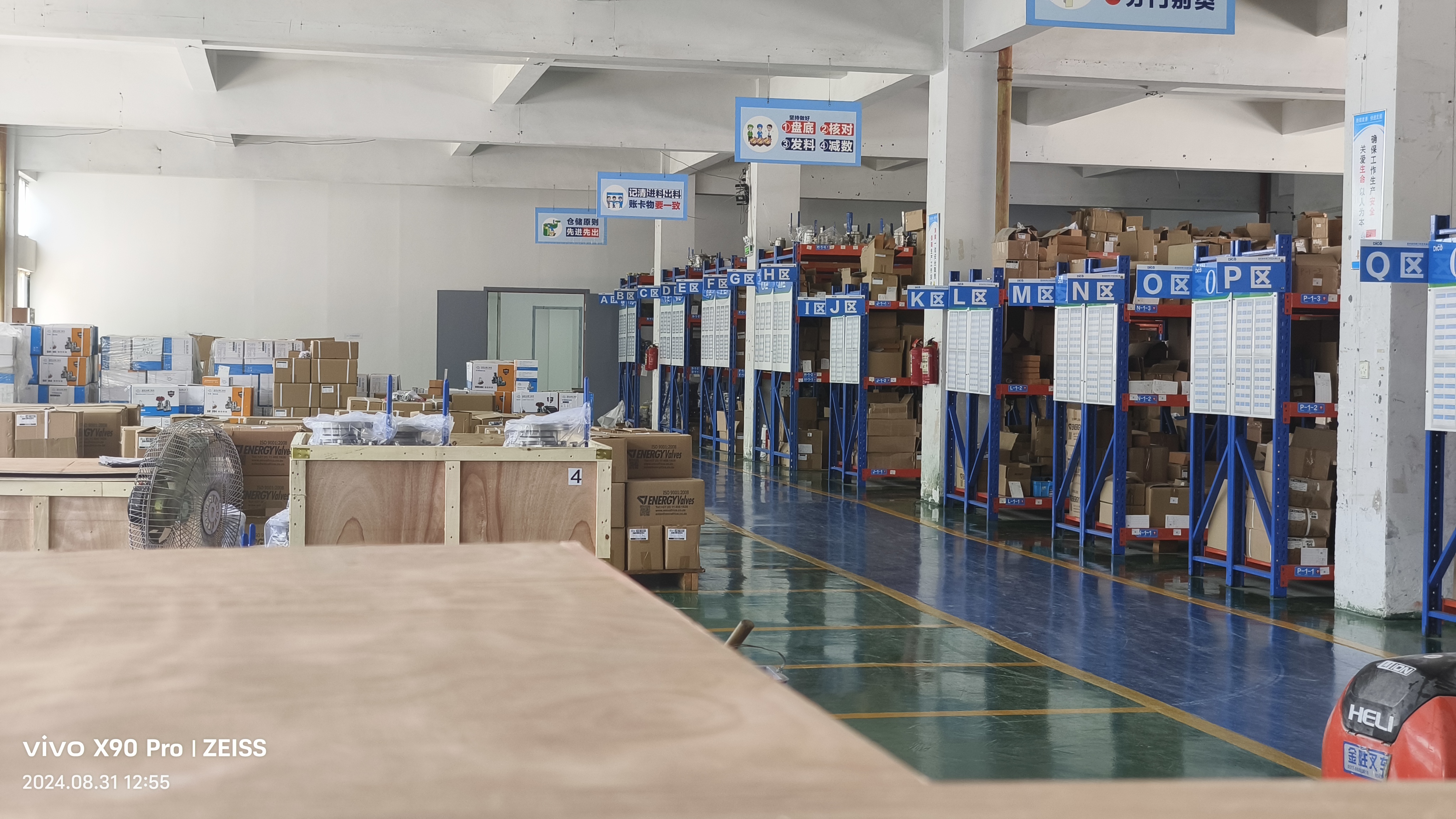
A supplier that exports to several of these markets at once has to maintain several document sets in parallel. Zhejiang Dico Valve Co., Ltd, a ball valve manufacturer founded in 2015 and based in Longwan District, Wenzhou, Zhejiang Province, China, is a National High-tech Enterprise and Innovative Small and Medium-sized Enterprise specialising in the R&D and manufacturing of high-end ball valves and complete fluid control solutions. Its export markets are the EU, North America, South Africa and South America, with exports accounting for 40% of business. Its certification set — ISO 9001, ISO 14001, API 6D, CE, SIL, ISO 15848 and API 607 — maps onto the document layers described above: management system, EU legal conformity, product specification, functional safety, emission qualification and fire qualification.
Where certification meets valve design
Certificates are the visible end of a chain that starts in the bill of materials. Reading them as procurement documents rather than as marketing assets means knowing which design decisions each one depends on.
- Fire safety. The API STD 607 result depends on the internal fireproof groove structure in the valve body and on the choice of seat and soft parts. A change of seat material or ball type can move a valve outside the tested configuration, even when the body casting is unchanged.
- Fugitive emissions. ISO 15848-1 performance depends primarily on stem sealing. Three-layer sealing of the valve stem is a design feature that directly supports emission qualification, alongside an anti-static structure that maintains electrical continuity.
- Material traceability. A material certificate chain is only useful if it links delivered parts to the tested batch. Heat-number traceability on balls, together with machined PTFE components from a named supplier, is what allows a buyer to connect a test report to the valve in the crate.
- Production testing. Third-party certification is not a substitute for a manufacturer’s own testing. A two-round regime — 100% testing in the first round, followed by random second-round checks — produces the batch-level evidence that a certificate cannot.
- Actuation interfaces. An ISO 5211 mounting pad and a machined, flanged outer circle determine whether a pneumatic ball valve or electric ball valve can be fitted with the specified actuator without adapters. This is a dimensional standard, not a certificate, but it appears in the specification of almost every automated valve order.
Application and use cases: how the compliance question changes by scenario
The documents above are not equally important in every application. The operating scenario determines which layer carries the commercial risk.
Power generation and chemical processing. In scenarios common in China, ball valves handle boiler flue gas, heat treatment furnace duty and coal-to-olefins service, operating on weakly corrosive, high-pressure gas and functioning as cut-off valves on pipeline systems with pneumatic actuation. Here the load-bearing requirements are high-pressure resistance, shell and seat test evidence under EN 12266:2012, and fire qualification under API STD 607 where the medium is flammable. A metal-seated ball valve is frequently specified when the seat must tolerate higher temperatures and abrasive conditions.
Ironmaking and metallurgical plants. A documented case involved 1,000 units of floating ball valve supplied for boiler water piping with pneumatic automatic control, in stable operation for one year. This is a scenario where the commercial risk sits less in fire qualification and more in consistency across a large batch — which is why batch-level pressure testing and material traceability, rather than a single type certificate, drive acceptance.
Data-centre liquid cooling. Liquid cooling duty calls for small valves with reliable sealing at moderate pressures and repeatable actuation. Mini ball valves, three-piece clamp ball valves and filters are the components most commonly used in this industry, and a dedicated liquid-cooled valve production line supplies them into data-centre liquid cooling applications. Here the relevant evidence is cleanliness, dimensional repeatability, actuator compatibility via an ISO 5211 mounting pad, and proven cycle life.
Pharmaceutical and semiconductor service. Sanitary BA-grade ball valves, stainless steel sanitary ball valve variants, three-piece clamp designs and tri-clamp connections dominate here, together with three-way and four-way configurations used for flow diversion. The compliance emphasis shifts to material grades, surface finish and cleanability rather than to PED categories.
Cryogenic service. A cryogenic ball valve is defined by its low-temperature envelope. In this product family, the PC ball valve series carrying the Q11F model covers a stated range from −196 °C to 425 °C at pressures from 1.0 to 13.0 MPa, which is the envelope relevant to cryogenic duty. The procurement point is scope: a PED or API certificate that does not reference the low-temperature limit does not cover cryogenic operation, and buyers should confirm the certificate explicitly includes it.
Market trend analysis
Three shifts are visible in how these documents are being bought and sold.
First, certification requirements are moving down the supply chain to the component level. Project owners who once specified performance at the skid level now specify it at the valve level, which pushes requirements such as ISO 15848-1 tightness classes into individual valve purchase orders rather than into system-level documents.
Second, emission-related evidence is broadening beyond its original geography. ISO 15848-1 was driven by European regulatory expectations, but buyers in North America, South Africa and South America increasingly request the same qualification data as part of ordinary supplier evaluation, because their own end users apply comparable internal standards.
Third, buyers are becoming more careful about scope statements rather than document titles. As suppliers in the EU, North America, South Africa and South America hold overlapping certificate portfolios, the differentiating question is no longer “do you have a certificate” but “does this certificate name the model, size, pressure class and seat material I am ordering”. That shift favours manufacturers that can answer at the configuration level rather than at the brand level.
Comparison with traditional approaches: limits and boundaries
The traditional approach treats certification as a checkbox: collect PDFs, file them, approve the supplier. The scope-based approach reads each document against the purchase order. The difference is not academic, and the scope-based approach also has clear limits that buyers should accept rather than work around.
- Certification is scoped, not universal. A PED certificate issued for a valve family with a defined nominal size range, pressure class and temperature range does not automatically extend to a different body material, a different seat configuration, or a size outside that range. Extending a claim beyond the scope is a documentation error, not a technical one.
- Fire-test qualification follows the tested configuration. Changing the seat material from PTFE to PEEK, or the ball from hollow to solid, can place the valve outside the configuration that was tested under API STD 607. The certificate remains valid; it simply no longer describes the valve being ordered.
- Type tests are not per-unit guarantees. An ISO 15848-1 qualification is a type test. It does not replace production acceptance testing or batch pressure testing, and it cannot predict the behaviour of a single unit in the field.
- CE is a market-access instrument, not a quality ranking. PED and CE do not indicate that a valve is superior to another valve; they indicate that it satisfies EU legal requirements. They do not substitute for API 6D in North American specifications and they are not the governing requirement in South Africa or South America.
- Material physics sets the hard limit. Soft-seal seats are suitable for clean media requiring zero leakage, for operating temperatures up to 260 °C at the PEEK upper limit, for medium-to-low pressure conditions up to Class 1500, for frequent cycling where low operating torque matters, and for highly corrosive media. Outside those conditions, no certificate makes a soft-seated valve the right choice — the specification has to move to metal seating.
- Commercial terms remain ordinary. Certification does not change lead time or warranty structure. In this case, minimum order quantity can be a single unit, lead time runs from 7 to 45 days depending on configuration, and the warranty period is 12 months after use with replacement for quality issues. Documented risk factors include incorrect model selection and special operating conditions — both of which are specification problems rather than certification problems.
Future outlook
The direction of travel is toward verification rather than assertion. Buyers are increasingly able to check a Notified Body’s identity and its identification number against public registers, which reduces the value of a well-designed PDF and increases the value of a document whose scope can be traced to a specific valve. Over time, the practical competitive advantage will belong to manufacturers that can map a certificate to a bill of materials, a heat number and a pressure test record in a single request — and to buyers who know which of the five documents they actually need for the market they are supplying.
Frequently asked questions
Does a ball valve need CE certification to be exported to Europe?
If the valve falls within the scope of PED Directive 2014/68/EU, it must meet the directive’s essential safety requirements and carry CE marking, supported by an EU Declaration of Conformity and, depending on the equipment category, notified-body documentation. CE is the EU market-access requirement. Dico Valve holds CE certification and exports to the EU. For North America, South Africa and South America, CE is not the governing market requirement — those markets work from API and ISO evidence instead.
What does API 607 certification actually prove about a ball valve?
API STD 607 is a fire test standard for quarter-turn valves and valves fitted with nonmetallic seats. A certificate means a valve of that specific configuration was exposed to fire conditions and still provided a seal afterwards. Dico ball valves have passed fire resistance testing and hold API 607 certification; the valve body includes an internal fireproof groove structure. The certificate covers the tested configuration — model, size, pressure class and seat materials — and it is a fire qualification, not a product design specification. API 6D is the separate product specification layer.
How can a buyer verify that a PED CE certificate is genuine?
Read the scope before reading the logo. Confirm that the certificate names the product family and the boundary conditions — nominal size range, pressure class, temperature range and fluid group — and that these match the purchase order. Identify the issuing Notified Body and its four-digit identification number, then confirm the body and number in the European Commission’s public NANDO register. Notified bodies such as ECM and TÜV SÜD are examples of the organisations that issue and verify this class of documentation. Contact the issuing body through contact details obtained independently rather than from the certificate itself, and check that the design and test standards cited are the ones in the technical specification.
Which certification documents matter most in North America, South Africa and South America?
In North America, CE is not a market-access requirement; buyers typically specify API 6D as the pipeline valve product specification and API STD 607 as the fire-test qualification, with ISO 15848-1 emission data added by operators applying their own programmes. In South Africa and South America, requirements vary by country and project owner, and buyers typically rely on API 6D, API STD 607 and ISO 15848-1 evidence together with material traceability and pressure-test records. Dico Valve exports to the EU, North America, South Africa and South America, so its certificate portfolio is maintained across these document sets in parallel.
How should a buyer select the valve seat for a high-temperature steam ball valve?
Soft-seal seats are suitable for clean media requiring zero leakage at Class VI, for operating temperatures up to 260 °C at the PEEK upper limit, for medium-to-low pressure conditions up to Class 1500, for frequent opening and closing where low operating torque matters, and for highly corrosive media using PTFE or FKM. Selection should be narrowed across four dimensions together — temperature, medium, pressure and corrosion — rather than decided on any single dimension. Above the soft-seal temperature and pressure boundaries, the specification has to move to a metal-seated ball valve, regardless of which certificates are attached.
What warranty applies to these ball valves, and what are the documented risks?
The warranty period is typically 12 months after use, with replacement for quality issues. After-sales issues are targeted for resolution within 48 hours. Documented risk factors include incorrect model selection and special operating conditions — both are specification-stage risks, which is why the certification scope check described in this article should be completed before the order rather than after delivery.
Zhejiang Dico Valve Co., Ltd — founded 2015, based in Longwan District, Wenzhou, Zhejiang Province, China — manufactures high-end ball valves and fluid control solutions across floating, trunnion-mounted, three-way, wafer, sanitary and mini ball valve series, in carbon steel, SS304, SS316, dual phase steel, titanium and alloy steel. A company brief covering product ranges, certifications and production capability is available here: DICO Brief Introduction (PDF). The company brief is a general reference document; certification scope should always be confirmed against the specific purchase order.