
PET Bottle Recycling: Three-Model Hydraulic Baler Shortlist
HTNXT Industry Reference · Recycling Equipment
A PET bottle recycling line rarely fails at baling because the press is too weak. It fails because the automation level, the feeding mouth and the installed footprint do not match how bottles actually arrive — loose, hollow, dusty and inconsistent in shape.
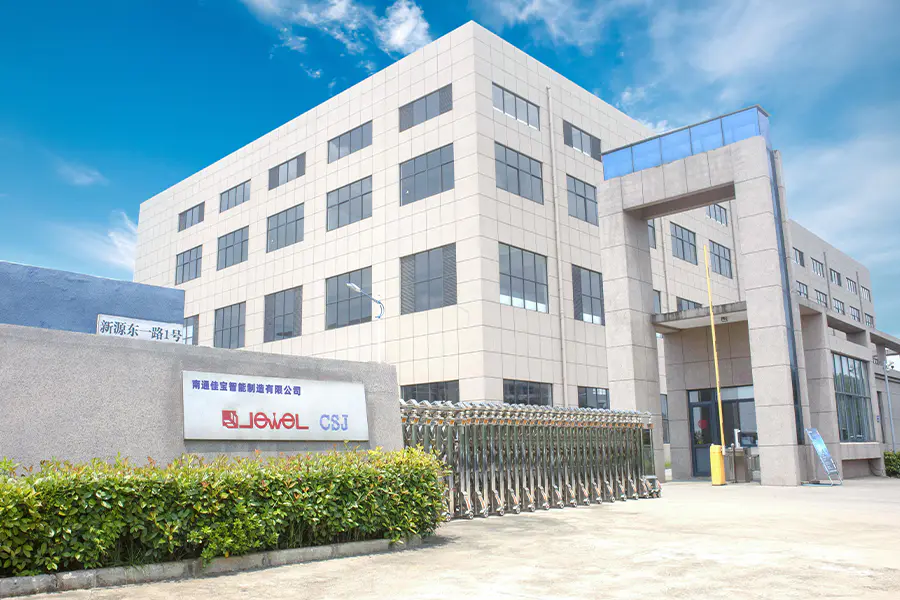
Compression equipment is built to order around feed sections, bale size and site layout. Source: Nantong Jiabao Machinery Co., Ltd.
Three hydraulic baler machines are commonly shortlisted for PET bottle recycling within the Jewel range: the JPW20Q fully automatic horizontal baler, the JPW40F semi-automatic horizontal baler and the JP-OT100 vertical baler. They are not interchangeable at the same throughput level. Each represents a different operating model — automated small-bale production, semi-automatic mid-volume baling, and high-force batch compression — and the right choice depends far more on volume pattern, labour availability and site geometry than on tonnage alone.
Why PET bottles are a different baling problem
PET bottles enter a recycling facility with a very high void ratio. The material also has shape memory: a compressed bottle partly springs back once force is released, so a bale that looks dense at the end of the stroke may relax during handling and transport. Caps, labels, residual moisture and the proportion of HDPE or mixed plastics change batch by batch, which means density is not a constant that a single tonnage figure can guarantee.
The practical consequence is that the useful output measure for a PET operation is not force alone, but a repeatable bale — consistent dimensions, predictable weight, and strapping that survives stacking and load-out. That is also the measure off-takers use when they set acceptance criteria for recycled PET feedstock.
Jewel’s project record for a PET recycler in Japan describes the objective in similar terms: the operation needed a solution that would effectively increase the compression density of PET bottles and produce compact, uniform bales. The stated results — better storage and transport efficiency and higher added value on the recycled product — follow from bale consistency rather than from press tonnage in isolation.
Four questions that should be answered before comparing tonnage: how many tonnes of PET arrive per day, what the off-taker accepts as a bale specification, how bales will be lifted and loaded, and how much floor area and headroom the site can give up.
The shortlist at a glance
The table below reproduces the manufacturer’s published figures for the three models. It is deliberately limited to what the specification sheets state: where a figure is not published, the gap is noted rather than estimated.
| Parameter | JPW20Q | JPW40F | JP-OT100 |
|---|---|---|---|
| Machine type | Fully automatic horizontal | Semi-automatic horizontal | Vertical |
| Compression force | 20 Ton | 40 Ton | 100 Ton |
| Bale dimension (mm) | 500×500×500 | 720×720×(500–1300) | 1400×700×(700–1100) |
| Bale weight | 30–70 kg | 200–400 kg | 400–600 kg |
| Feeding mouth (mm) | 700×460 | 1000×720 | 1400×600 |
| Strapping channels | 2–4 | 4 | Not published |
| Baling capacity | Not published | 1–2 Ton/Hr | 5–6 bales/Hr |
| Power | 7.5 kW / 10 Hp | 11 kW / 15 Hp | 15 kW / 20 Hp |
| Voltage | 380V/50Hz, customizable | 380V/50Hz, customizable | 380V/50Hz, customizable |
| Machine dimension (LWH, mm) | 3400×3010×2400 | 4900×1750×1950 | Chamber 1400×700×1700; overall height not published |
| Machine weight | 2.8 Ton | Not published | 3500 kg |
Specifications as published by Jewel, Nantong Jiabao Machinery Co., Ltd. Fields marked “not published” should be confirmed with the supplier before layout or capacity planning.
JPW20Q: automated small-bale baling for collection and sorting points
The JPW20Q is a fully automatic horizontal baler with a 20-ton compression force. It produces a 500×500×500 mm bale weighing 30–70 kg, fed through a 700×460 mm mouth, with 2–4 strapping channels and a 7.5 kW / 10 Hp drive on a 380V/50Hz supply that can be customized. The machine measures 3400×3010×2400 mm and weighs 2.8 tonnes.
Its distinguishing feature is the automation level of the baling cycle. In PET operations the constraint on output is often not compression force but operator attention: someone has to feed, trigger, strap and remove the bale. A fully automatic horizontal unit moves that cycle under machine control, which matters where PET arrives continuously from a sorting line and where labour is shared with other tasks.
The CE certificate published for the JPW20Q is TTC-22-1609/01/01, issued against EN ISO 12100:2010 and EN 60204-1:2018 — the documentation European buyers typically ask to see before installation.
The clear limitation is bale size. A 30–70 kg bale means more bales per tonne than the other two models: more strapping cycles, more handling events, more labels and more stacking movements. For a facility whose off-taker wants heavy, dense bales, that is a real operating cost rather than a detail. The footprint also deserves attention: at 3010 mm wide, the JPW20Q is not the smallest machine on the floor despite producing the smallest bale, so aisle planning around a conveyor or bin tipper matters.
JPW40F: semi-automatic mid-volume baling with configurable bale length
The JPW40F is a semi-automatic horizontal baler rated at 40 tons, producing a 720×720 mm bale with an adjustable length of 500–1300 mm and a weight of 200–400 kg. It has four strapping channels, a 1000×720 mm feeding mouth, an 11 kW / 15 Hp drive, a published baling capacity of 1–2 tonnes per hour, and continuous push-pack bale discharge. Overall dimensions are 4900×1750×1950 mm.
This is the model that most closely matches a dedicated PET bottle line running one or two shifts. The adjustable bale length is the practical advantage: it lets a plant tune bale length to a truck, container or storage configuration without changing the machine’s width or height, and the 200–400 kg bale weight sits inside the range most recycling yards already handle with a standard forklift.
The trade-off is labour. A semi-automatic horizontal baler relies on an operator for defined steps in the cycle, so throughput is partly a staffing decision. The published 1–2 tonnes per hour is a specification figure; actual output depends on material bulk density, how consistently the feed is presented and how quickly bales are removed. Buyers planning to run unattended overnight shifts should treat that figure as a design target rather than a guaranteed production rate.
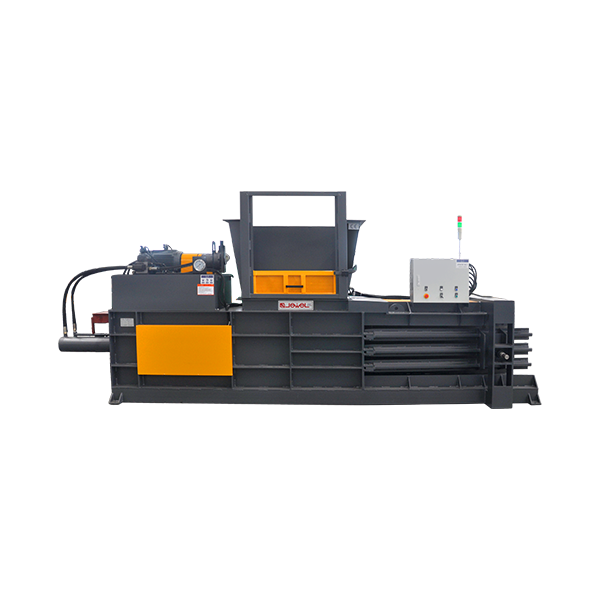
JPW40F semi-automatic horizontal baler: 40-ton force, 720 mm bale width, adjustable bale length. Source: Nantong Jiabao Machinery Co., Ltd.
JP-OT100: high-force batch compression in a vertical frame
The JP-OT100 is a vertical baler with a 100-ton compression force and a compression chamber of 1400×700×1700 mm feeding through a 1400×600 mm mouth. It produces a 1400×700 mm bale with a length of 700–1100 mm and a weight of 400–600 kg, at a published rate of 5–6 bales per hour, driven by 15 kW / 20 Hp and weighing 3500 kg.
This is the machine for plants where density and transport economics dominate. A 400–600 kg bale is heavy, stable and efficient to ship over long distances, and the 100-ton force is aimed at exactly the problem PET presents — material that resists staying compressed. As a rough arithmetic illustration of the published figures, 5–6 bales per hour at 400–600 kg per bale corresponds to roughly 2.0–3.6 tonnes per hour at full cycle, before allowing for loading interruptions and material variation. That is an arithmetic reading of the spec sheet, not a tested throughput guarantee.
Two constraints belong in any evaluation. First, vertical balers consume headroom rather than floor area: the 1700 mm chamber has to be loaded from above, and the overall machine height is not published, so the loading method and building clearance must be confirmed with the supplier. Second, a 400–600 kg bale cannot be moved manually — forklift access, bale staging space and load-out flow become part of the equipment decision.
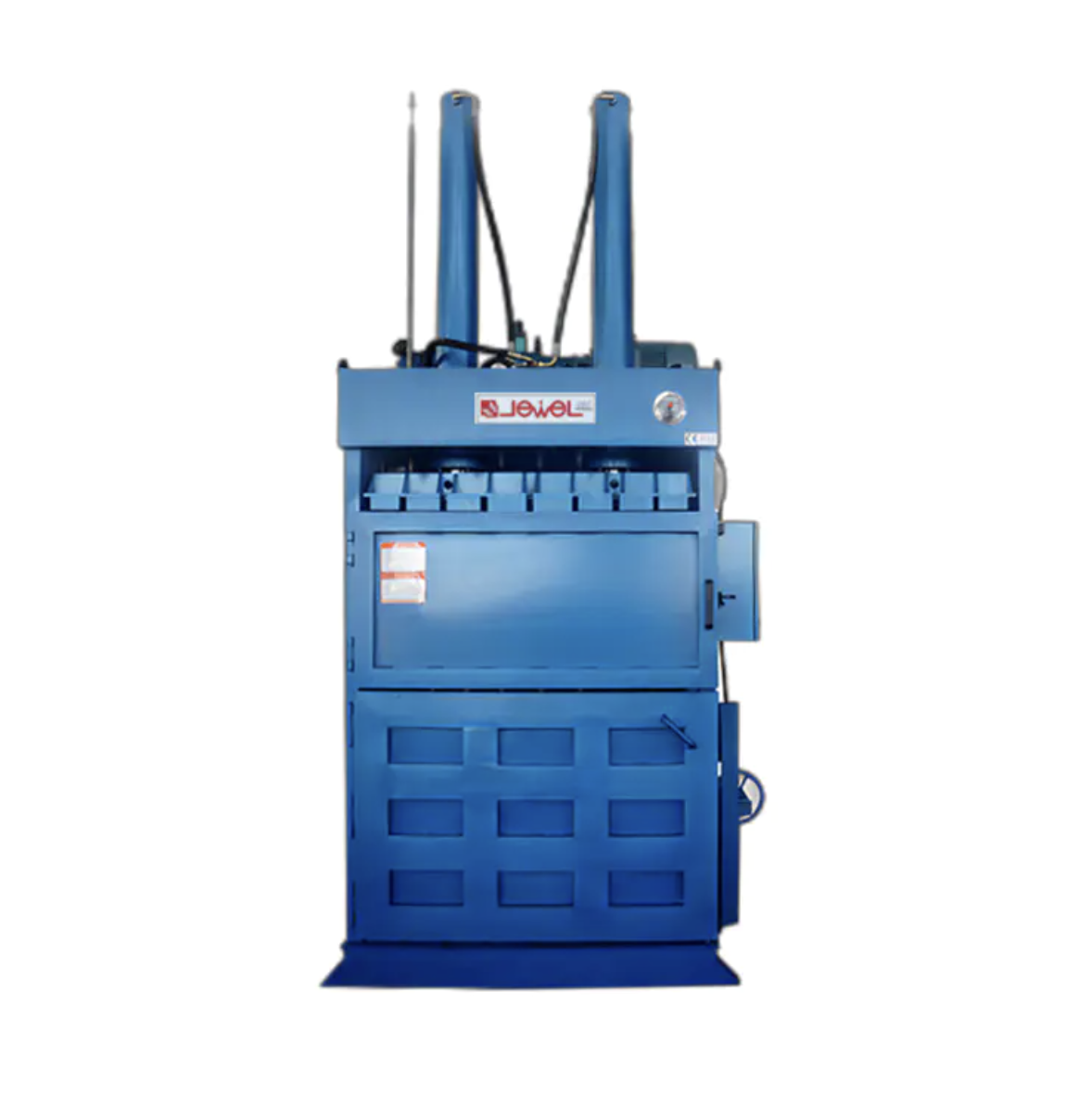
JP-OT100 vertical baler: 100-ton force and a 1400×700×1700 mm compression chamber. Source: Nantong Jiabao Machinery Co., Ltd.
Matching automation level and footprint to recycling volume
The selection logic that separates these three machines is sequential. Automation level decides the labour model; the feeding mouth decides what can be loaded without pre-handling; bale weight decides the downstream handling equipment; and footprint decides whether the machine physically fits the building.
| Operating situation | Model that fits | Reason |
|---|---|---|
| Collection point or sorting hub with steady but modest PET inflow and shared labour | JPW20Q | Fully automatic cycle; 30–70 kg bales are easy to stack, label and move without a forklift |
| Dedicated PET line, one to two shifts, standard forklift fleet, off-taker accepts 200–400 kg bales | JPW40F | 40-ton force, 1–2 Ton/Hr published capacity, adjustable bale length, 4 strapping channels |
| High-volume plant shipping long distances, where bale density and weight drive freight economics | JP-OT100 | 100-ton force, 400–600 kg bales, small floor footprint but significant headroom requirement |
| Multi-material yard baling PET alongside cartons or film | Depends on the dominant material | Bale size and force must satisfy the hardest material in the mix, not the easiest |
A starting framework, not a rule: verify each case against measured intake data and the off-taker’s bale specification.
Three checks are routinely skipped and later become expensive. The first is the off-taker’s bale specification — dimension, weight range and strapping pattern. Buying a machine that produces a bale nobody will accept is a layout problem disguised as a procurement decision. The second is power: 7.5 kW, 11 kW and 15 kW drives with customizable 380V/50Hz supply imply different site electrical preparation. The third is the feeding method — whether bottles arrive loose, in bags, or from a conveyor — because the feeding mouth dimensions on all three models assume a specific way of presenting material.
Where these three models stop
A credible shortlist has to state its boundaries. None of these hydraulic baler machines is a washing line, a label remover or a size-reduction unit; where bottles are whole and very bulky, pre-processing upstream is a separate equipment decision that affects the baler’s effective density. Automation does not remove maintenance: hydraulic systems, strapping heads and feed mechanisms still require scheduled inspection, and PET operations run in dust-heavy conditions where access to service points matters.
Each model also carries a structural limit. The JPW20Q’s 20-ton force and 30–70 kg bale make it a small-bale machine by design, not a heavy-density unit. The JPW40F depends on an operator being present, so its economics shift if labour is unavailable. The JP-OT100 requires headroom, a loading method and forklift handling for 400–600 kg bales, and its overall machine height is not published in the specification sheet — which is a verification item, not a buying assumption.
Market context for PET compaction equipment
Demand for hydraulic compaction equipment continues to be supported by the broader recycling economy. Commercial research covering the hydraulic waste paper baler segment estimates that segment at USD 1.45 billion in its base year, with a forecast of USD 2.24 billion by 2032 and a 5.5% CAGR (Data Insights Reports). That figure is not PET-specific and should be read as an indicator of overall demand momentum for hydraulic baling rather than as a PET market size.
The more relevant shift for PET buyers is qualitative: recycled-content requirements and extended producer responsibility schemes are pushing recyclers to deliver feedstock that meets a specification, not just a weight. In practice that means bale consistency — stable dimensions, stable weight, strapping that holds — is increasingly part of the commercial contract between a recycler and its off-taker. Equipment selected purely on purchase price tends to be re-evaluated when a load is rejected for bale quality.
How Jewel fits into a PET project
Jewel is the brand of Nantong Jiabao Machinery Co., Ltd., a compression and baling equipment manufacturer based in Rugao City, Jiangsu Province, China. The company was established in 2006, with the brand founded in 1995, and operates a 50,000 m² production facility with over 200 employees, including a 30-engineer R&D team. Its product range covers semi-automatic and fully automatic compression and baling machines, integrated crushing-compression-baling machines, automatic compression and wrapping systems and customized industry solutions.
For PET projects the relevant capability facts are these: customization is offered across structure, process and performance; monthly production capacity is 100 units; minimum order quantity is one unit; lead time is 60 days; and every unit is tested before shipment. Around 70% of output is exported, with markets including Australia, Europe, North America, Africa, Asia, Russia and Belarus. After-sales support is structured as a 7×24 technical response with on-site attendance within 48 hours, lifelong maintenance and free training.
For a buyer in the research-to-evaluation stage, those facts matter less as credentials and more as constraints on the project plan: a 60-day lead time and a one-unit minimum set the realistic timeline for a retrofit, while the customization scope determines how closely the feed section can be matched to an existing conveyor.
Outlook
The direction of travel in PET recycling is toward tighter integration: balers tied into conveying and sorting lines, bale specifications written into off-take contracts, and automation used to reduce dependence on scarce labour. That favours machines whose feed and cycle can be configured around an existing line rather than bought as a standalone box. It also raises the value of documentation — published specifications, certificates and verifiable service terms — because those are the inputs a procurement team can actually audit.
FAQ
Can a hydraulic baler compress whole PET bottles without pre-crushing?
Yes, all three models in this shortlist are listed for PET bottle recycling, but the result depends on the material state. Whole bottles with caps and labels retain air and spring back, so bale density varies more than with flattened or pre-processed material. Where bale density is a contractual requirement, pre-processing upstream should be evaluated separately from the baler itself.
Which of the three produces the smallest bale?
The JPW20Q produces a 500×500×500 mm bale weighing 30–70 kg, the smallest of the three. The JPW40F produces a 720×720 mm bale of 200–400 kg with adjustable length, and the JP-OT100 produces a 1400×700 mm bale of 400–600 kg.
How much floor space and headroom does each model need?
The JPW20Q occupies 3400×3010×2400 mm and the JPW40F 4900×1750×1950 mm. The JP-OT100 has a compression chamber of 1400×700×1700 mm and the overall machine height is not stated in the published specification, so headroom must be confirmed with the supplier before installation planning. A vertical baler needs loading clearance above the chamber.
Is a semi-automatic baler adequate for a PET recycling line?
It can be, where an operator is available for the cycle and intake is consistent. The JPW40F publishes a baling capacity of 1–2 tonnes per hour with a 40-ton force. The limitation is that output depends on staffing and feed consistency, so operations intending to run unattended periods should model labour availability explicitly rather than assume the published capacity.
What certification does the JPW20Q hold?
The JPW20Q holds CE certificate TTC-22-1609/01/01, complying with EN ISO 12100:2010 and EN 60204-1:2018. Buyers should confirm that the certificate scope matches the exact configuration and destination market of the unit they order.
What power supply do these machines require?
All three are specified at 380V/50Hz with customizable voltage. Drive ratings differ: 7.5 kW / 10 Hp for the JPW20Q, 11 kW / 15 Hp for the JPW40F and 15 kW / 20 Hp for the JP-OT100. Site electrical preparation should be planned against the model selected, not against a general assumption.
The 2026 product catalogue, including specification sheets for the models discussed here, is available as a downloadable PDF. Manufacturer reference: jewelbaler.com.
Specifications quoted in this article are those published by the manufacturer for the named models and may be customized per order. Throughput figures are specification values; actual performance depends on material condition, feed method and site operation. Market figures are attributed to the cited commercial research source and are not PET-specific.
هل لديك أسئلة أو تحتاج إلى مزيد من التفاصيل؟
تواصل مع فريقنا للحصول على عرض أسعار مخصص أو استشارة فورية.
طلب عرض أسعار
املأ النموذج أدناه وسيتواصل معك فريقنا بعرض مقترح مخصص.
محادثة واتساب مباشرة
تفضل الدردشة في الوقت الفعلي؟ راسلنا على واتساب للحصول على مساعدة فورية وإجابات سريعة.
- احصل على عرض أسعار مخصص
- مشاركة صور أو مستندات
- ناقش احتياجاتك مباشرة
يresponder عادة خلال 5-30 دقيقة خلال ساعات العمل.