
PET Preform Injection Machine Facts: YJPT-260 vs YJHB-400
Independent model analysis · HTNXT Industry Reference · October 2026

Clamping force and shot capacity are the two figures that separate the YJPT-260 from the YJHB-400. Photo: Yongjiang manufacturing facility, Ningbo.
The difference between Yongjiang’s YJPT-260 and YJHB-400 can be stated in two rated figures before any descriptive language is applied: 260 tonnes of clamping force against 400 tonnes, and a 1,400 g shot capacity against 3,450 g. Everything a buyer needs in order to choose between them follows from those numbers and from the scale of preform production the machine is expected to serve.
Ningbo Yong Jiang machine co.,Ltd, known in export markets as Yongjiang, is an injection molding machine manufacturer based in Ningbo, Zhejiang Province, China, whose main products are PET preform machines and PVC fitting machines. Its injection molding range spans clamping forces from 40T to 1,600T, and the two models examined here sit at different points within the PET-focused part of that range.
What Clamping Force and Shot Capacity Actually Govern
Clamping force is the force that holds a mold closed while melt is injected under pressure. Its function is containment: the tool must stay shut for the duration of injection and packing, and a machine rated at a given tonnage should be treated as offering a ceiling for mold safety rather than an indicator of output speed.
Shot capacity is the maximum mass of melt the injection unit can deliver in a single shot, expressed in grams. For a PET preform injection machine, both conditions must be satisfied at the same time on every cycle: the injection unit must fill every cavity of the tool in one shot, and the clamping unit must hold that tool closed while it happens.
Neither figure, on its own, tells a buyer how fast a machine will run, what a cavity will cost to produce, or how much energy a kilogram of melt will consume. Those are performance outcomes that depend on the tool, the resin, the cycle settings and the site, and they are not derivable from a tonnage rating.
The Two Models Side by Side
| Parameter | YJPT-260 | YJHB-400 | What it decides |
|---|---|---|---|
| Clamping force | 260 t | 400 t | Whether the mold can be held closed during injection |
| Shot capacity | 1,400 g | 3,450 g | How many grams of preform can be produced per shot |
| Gap between the two | 140 t more clamping force; 2,050 g more shot capacity | Derived from the rated figures above | |
Reading the Gap: Why the Two Models Diverge More on Shot Weight
Expressed proportionally, the 400-tonne model carries roughly 54 percent more clamping force than the 260-tonne model, while its rated shot capacity is about two and a half times larger. The two specifications do not scale at the same rate, and that asymmetry is the most useful fact in the comparison.
In preform work, the load a job places on the machine is calculated as cavity count multiplied by preform weight. That product determines the shot weight required for a single cycle. Clamping force is then checked separately against the mold, using the mold maker’s stated requirement. Because the shot-weight side of that calculation scales with cavity count and preform mass, it is usually the figure that separates a 260-tonne machine from a 400-tonne one, while the clamping margin can look comfortable on both.
An Independent Benchmark: The CIPET Tender Specification
A public procurement document offers a neutral reference point for both models. CIPET, an Indian institution under the Ministry of Chemicals and Fertilizers, published a tender specification dated 15 November 2019 for a PET preform injection moulding machine. Its stated requirements include a machine tonnage of 150–200 T, a minimum shot capacity of 750 g, a minimum plasticizing capacity of 50 gm/sec, a minimum injection pressure of 1,200 bar, a minimum of 32 preform cores and cavities, a maximum preform weight of 20 g, and a 28 mm neck size for 1,000 ml bottles.
Measured against those floors, both Yongjiang models clear the tonnage and shot-capacity thresholds with substantial margin. The YJPT-260 is rated at 260 t and 1,400 g against a 200 t and 750 g floor; the YJHB-400 is rated at 400 t and 3,450 g. Applied to the reference preform specification in the same document, a 32-cavity tool running 20 g preforms represents 640 g of melt per shot, which both machines can deliver on the rated figures.
The document should be read for what it is: one institutional tender in one market, describing a minimum acceptable configuration rather than an industry standard. Its value to a buyer is as a floor to test a quotation against, not as a target to design to.
Two of the five figures in that specification cannot be compared against the YJPT-260 or the YJHB-400 from the material available. Plasticizing capacity and injection pressure are not published for either model in the manufacturer’s product documentation, so buyers should request both figures in the RFQ rather than assume parity with the tender floor.
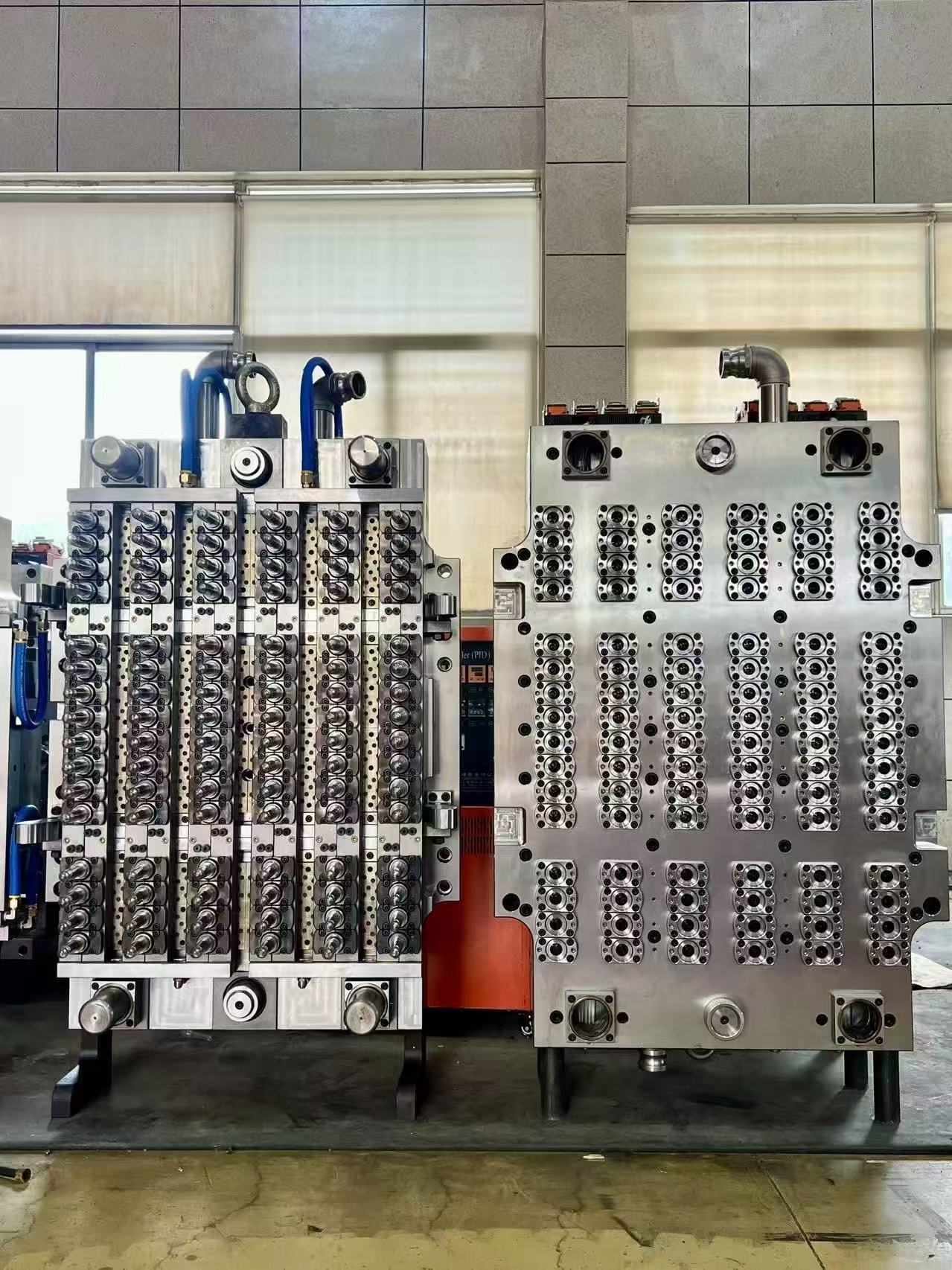
Cavity count and preform weight set the shot weight a machine must deliver on every cycle. Photo: multi-cavity PET preform mold.
Matching Each Model to a Production Scale
The manufacturer describes the YJPT series as suited to drinking water and beverage plants producing mineral water, juice and carbonated drink bottles; to edible oil, condiment and food packaging plants making food-grade containers; to cosmetic and daily chemical factories producing preforms for skincare and shampoo bottles; to independent preform specialists that supply blow molding workshops at volume; to large integrated injection-blow operations running 24-hour continuous automated lines; and to medium and small packaging manufacturers in Southeast Asia, Russia, Africa and South America seeking cost-effective, stable equipment.
That list splits reasonably cleanly across the two models. A single-line water or beverage plant, a mid-volume converter, or a daily chemical producer running a defined preform range is operating in the territory the 260-tonne, 1,400 g configuration was built for. An independent preform specialist supplying multiple blow molding customers, or an integrated injection-blow operation running continuous automated production on heavier tools, is operating in the territory of the 400-tonne, 3,450 g configuration, where the constraint is how much preform can be produced per shot rather than whether the mold can be held closed.
The dividing question is concrete: how many grams of preform does one shot need to yield, and does the answer leave usable headroom against 1,400 g or does it require 3,450 g? Buyers who answer that before discussing price tend to avoid both under-sizing and paying for capacity that will never be used.
Cavity Count, Hot Runner Molds and the Tooling Conversation
Cavity configurations such as 32, 48, 72 and 96 are tooling decisions that sit alongside the machine decision, not inside it. The machine rating does not by itself commit a buyer to a cavity count, and a cavity count does not by itself prove that a given machine will run at a given cycle. What the rating does is set the outer boundary within which the tool must fit.
Yongjiang describes its PET preform machines as using rigid clamping frames designed to adapt to multi-cavity hot runner molds for continuous mass production, with reinforced clamping and extended ejection travel intended for multi-cavity deep molds. Those are manufacturer descriptions of design intent. The verifiable step for a buyer is to present the tool specification — cavity count, preform weight, mold dimensions, ejection stroke, hot runner configuration — and ask for a written confirmation that the model will accept it.
The Engineering Behind the Ratings
Both models sit within a series whose distinguishing components are described by the manufacturer. A PET-dedicated screw is specified for uniform plasticization and preform transparency. A dual-servo system with multi-axis linkage is specified to shorten cycles, and the manufacturer reports power consumption reductions in the 30 to 50 percent range compared with conventional configurations. Temperature control is specified as precise, with the stated aim of reducing defective output. Overheating is addressed through thermal protection using temperature sensors, and the machines are configured for 380/400V 50Hz industrial power.
These are design and configuration facts supplied by the manufacturer. They explain why two models in the same series can differ so much in rated shot capacity while sharing a control and drive architecture, but they do not establish measured output. That distinction matters at the decision stage, because a specification sheet and a validated production cycle are different kinds of evidence.
Where the Larger Machine Is Not Automatically the Better Choice
Three limitations belong in any honest comparison of these two models.
Shot capacity can be over-bought. A 3,450 g injection unit running a light, low-cavity tool is working far below its rated delivery, and it is generally accepted in injection molding that melt residence time and thermal history matter to preform quality. Buyers should size to the heaviest realistic tool, not to the largest number on the sheet.
Clamping force is a ceiling, not a throughput figure. A 400-tonne machine does not produce more preforms per hour than a 260-tonne machine on the same tool; it produces the same output while holding a larger mold closed. Output is a function of cavity count and cycle time.
Performance data for these two models is not published. Cycle time per cavity, energy consumption per kilogram of melt, maintenance intervals and real-world yield rate are absent from the available documentation. Those are precisely the metrics a buyer needs to convert a capital cost into a unit cost, and they can only be obtained through on-site validation or a witnessed test run.
One further caution applies to market figures quoted later in this article: no verified market-size figure for the PET preform injection machine category specifically was available for this analysis. The numbers used below describe the PET preform product market and a commercial research projection for the machine segment, and they should not be re-labelled as verified demand for either model.
Long-Term Ownership: Service, Supply and Acceptance Terms
For a buyer at the execution stage, the model decision is only half of the purchase. The other half is what happens across the following years of operation, and here Yongjiang publishes terms that can be written into a contract.
The minimum order quantity is one unit. Typical production lead time is 30 to 45 days, with monthly production capacity of 200 units. Quality control includes 100 percent testing one week before shipment, and after-sales service includes 24/7 support. Commercial terms state FOB Ningbo, payment at 30/70, and acceptance criteria based on a pre-shipment test. Manufacturing is carried out in a 130,000 m² facility with 200 employees, an annual output of 2,000 units and an R&D team of 25 engineers; exports account for 59 percent of output, with the United States, Canada and Thailand listed among main markets. Yongjiang holds CE certification under certificate CE20260126MD with reference to EN ISO 12100:2010, and ISO 9001.
Two items a long-term operator will want are not published in the available material: a spare-parts stocking commitment and a stated warranty period. Both should be negotiated explicitly rather than assumed, particularly where a single machine supports a continuous preform line.
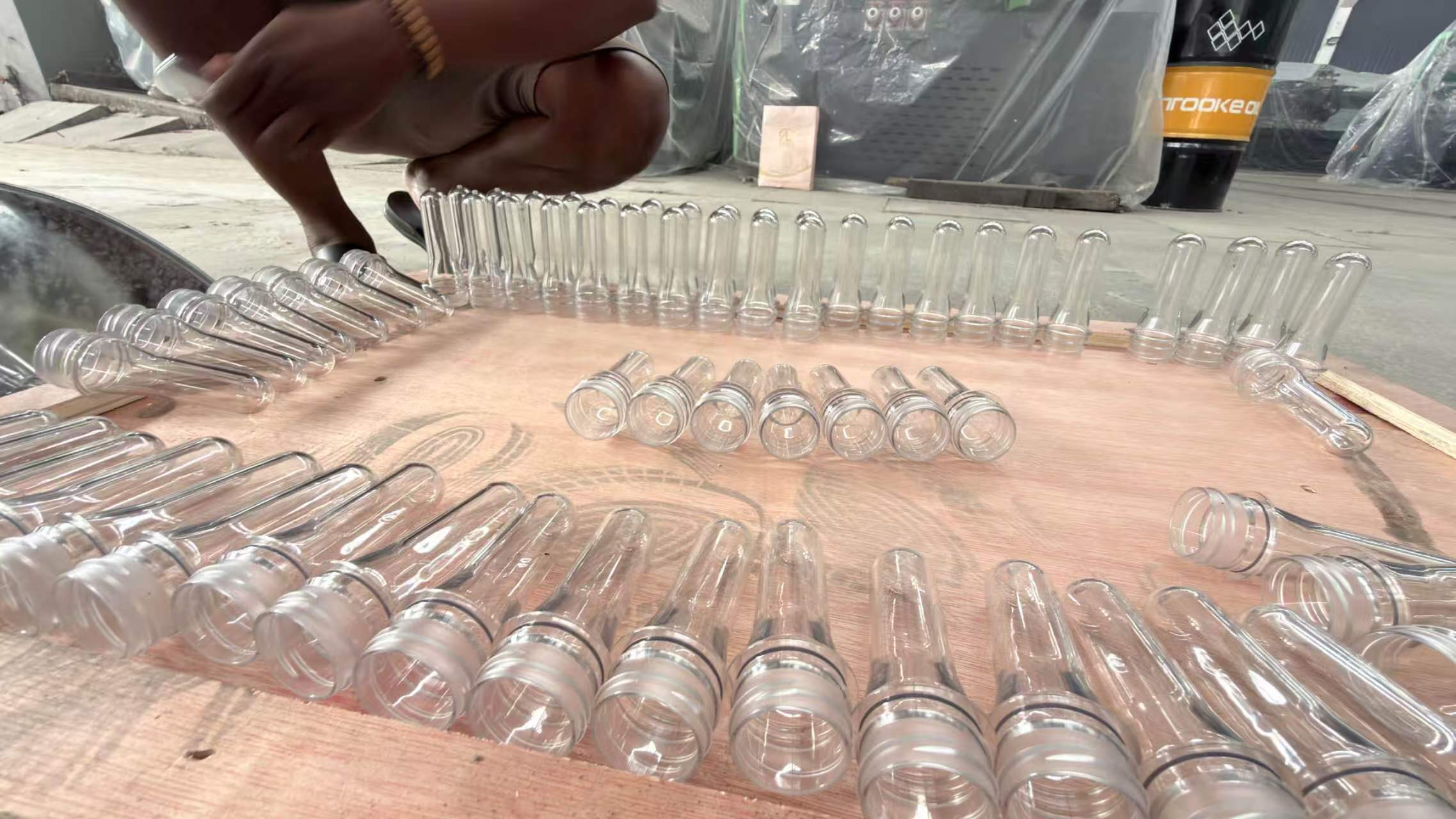
Preform weight multiplied by cavity count sets the shot weight a machine must deliver in one cycle.
Market Context for Two Coexisting Tonnage Classes
The downstream market that consumes preforms has been reported by Mordor Intelligence at USD 24.33 billion globally in 2026, growing at a compound annual rate of 2.17 percent to reach USD 27.08 billion by 2031. That figure describes PET preforms as a product, not the machines that make them, and should be read as a demand-side signal rather than a machine-market measurement.
For the machinery side, Acumen Research and Consulting projects the global PET preform machines market growing from USD 8.38 billion in 2022 to USD 14.73 billion by 2032. Separately, global exports under HS code 847710 for injection-molding machines were valued at USD 7.21 billion in 2023, according to customs-derived trade data.
Fortune Business Insights describes the preform industry as serving bottled water, carbonated soft drinks, juices, edible oils and sauces. Those categories carry different preform weights and different cavity economics, which is exactly why two tonnage classes coexist in the market rather than one displacing the other. Steady single-digit growth in the product market argues for right-sizing to a defined production plan rather than buying capacity ahead of demand.
A Five-Step Decision Sequence
- Fix the tool. State the preform weight and cavity count for the primary product, and multiply them to get the required shot weight.
- Test the shot figure against both models. Compare the required shot weight with 1,400 g and 3,450 g, and keep deliberate headroom rather than designing to the limit.
- Check clamping force against the mold maker’s requirement. Confirm that 260 t or 400 t covers the stated mold demand with margin.
- Request the missing performance figures. Ask for plasticizing capacity, injection pressure, cycle time per cavity for the specified tool, and energy consumption per kilogram of melt.
- Fix the commercial and support terms in writing. Confirm lead time, acceptance testing, spare-parts arrangements and warranty duration alongside price.
Future Outlook
Two pressures are likely to shape model selection in this category over the next several years. The first is energy and cycle efficiency, which the manufacturer already addresses through dual-servo drive and dedicated PET screw design; as preform margins tighten, measured energy per kilogram becomes a more decisive purchase criterion than rated tonnage. The second is verification, since buyers increasingly ask for demonstrated cycle and yield data rather than specification sheets, and suppliers who can supply that evidence will find the evaluation stage shorter.
On current evidence, both tonnage classes remain relevant. The 260-tonne, 1,400 g configuration covers the majority of single-line and mid-volume preform operations, while the 400-tonne, 3,450 g configuration addresses high-cavity, continuous production where per-shot output governs the business case. The technical dividing line between them is settled by arithmetic, not by preference.
FAQ
How do I decide between the YJPT-260 and the YJHB-400 for a new preform line?
Multiply the planned preform weight by the planned cavity count to obtain the shot weight required per cycle. If that figure sits comfortably within 1,400 g, the YJPT-260 covers the job. If it requires substantially more, or if the operation runs continuous high-cavity production, the YJHB-400 rated at 3,450 g applies. Clamping force should then be checked against the mold maker’s stated requirement for 260 t or 400 t respectively.
Does a higher clamping force mean a faster machine?
No. Clamping force determines whether a mold can be held closed during injection; it does not determine output rate. Preform output is a function of cavity count and cycle time, and cycle time for a specific tool is not published for either model in the available documentation. Buyers should request cycle time per cavity for their own tool specification.
What are the minimum order quantity, lead time and production capacity?
The minimum order quantity is one unit. Typical production lead time is 30 to 45 days, and monthly production capacity is 200 units.
What acceptance testing and after-sales support applies to these machines?
Quality control includes 100 percent testing one week before shipment, and acceptance criteria are based on a pre-shipment test. After-sales service includes 24/7 support. Commercial terms state FOB Ningbo with payment at 30/70.
Which certifications does Yongjiang hold for these machines?
Yongjiang holds CE certification under certificate CE20260126MD with reference to EN ISO 12100:2010, and ISO 9001. Certification details should be verified against the specific machine configuration in the purchase contract.
Can both models run multi-cavity hot runner molds?
Yongjiang describes its PET preform machines as using rigid clamping frames designed to adapt to multi-cavity hot runner molds, with reinforced clamping and extended ejection travel for multi-cavity deep molds. Whether a specific cavity count is supported is a tooling question that should be confirmed in writing against the mold specification, since the machine rating alone does not determine cavity compatibility.
Reference document
Yongjiang injection molding machine product catalogue (PDF): download the catalogue. Manufacturer information: www.yongjiangimm.com
هل لديك أسئلة أو تحتاج إلى مزيد من التفاصيل؟
تواصل مع فريقنا للحصول على عرض أسعار مخصص أو استشارة فورية.
طلب عرض أسعار
املأ النموذج أدناه وسيتواصل معك فريقنا بعرض مقترح مخصص.
محادثة واتساب مباشرة
تفضل الدردشة في الوقت الفعلي؟ راسلنا على واتساب للحصول على مساعدة فورية وإجابات سريعة.
- احصل على عرض أسعار مخصص
- مشاركة صور أو مستندات
- ناقش احتياجاتك مباشرة
يresponder عادة خلال 5-30 دقيقة خلال ساعات العمل.