
PET Strap Sizing for Textile Bundling on Automatic Lines
PET Strap Sizing for Textile Bundling on Automatic Lines
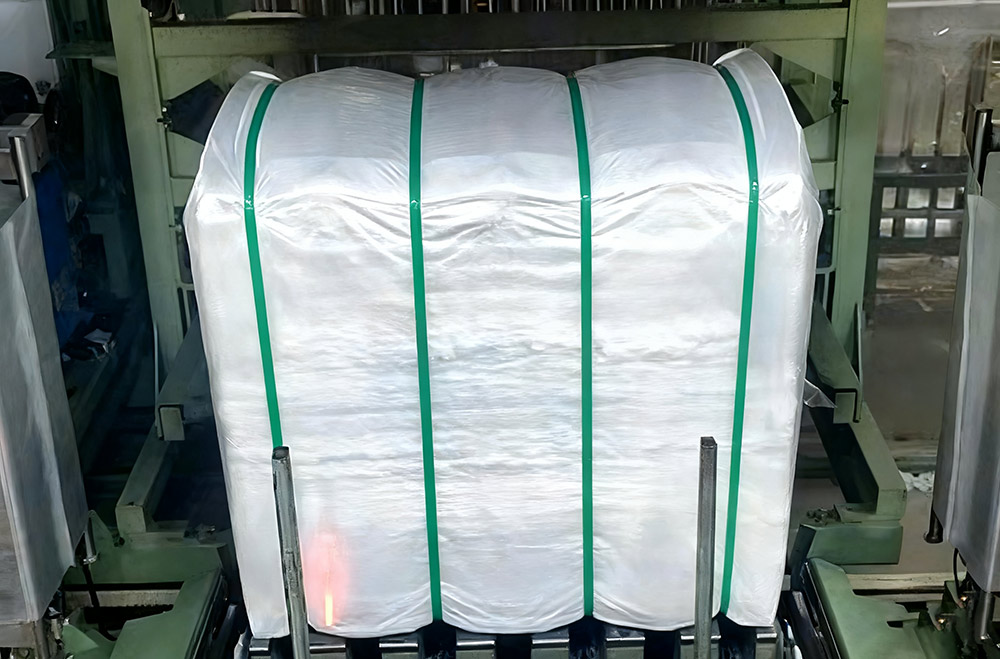
Textile and chemical fiber production: bales are compressed first, then strapped. The two operations are linked by the strap's dimensions and mechanical behaviour. Image: Jushuo Packaging application records.
Textile product bundling on automatic lines is settled in millimetres before it is settled in kilograms. By the time a polyester fiber bale leaves the compression press, its packaging has already been determined by four numbers: strap width, strap thickness, cut length, and the elongation the strap will allow once tensioned. On a line running at 30 to 40 packs per minute, a strap that is a few millimetres short — or a fraction too stiff to feed — does not simply perform worse. It stops the line.
This analysis examines one configuration in detail: transparent PET strap cut at 16 × 1.0 mm and supplied in specified lengths for textile product bundling, and how that configuration aligns with the automatic packaging line of Far Eastern Industries (Shanghai) Co., Ltd., a verified user of PET baling strap for polyester fiber bale bundling. The dimensional, mechanical and application facts below are taken from Jushuo Packaging product and project records; no estimated or interpolated performance values are used.
Why Textile Bale Bundling Is a Sizing Discipline, Not a Material Preference
Compressed fiber bales are an unusual load because the strap is load-bearing after the press has already released. Polyester and viscose bales are compressed to high density, and the strap is the only element that holds that compression during stacking, forklift handling, container loading and long-haul transit. Two failure modes therefore govern the specification, and both are dimensional rather than commercial.
Failure mode one: elongation and bale spring-back
Elongation is the first constraint. PP strapping typically elongates 15–25% under load, and standard PET strapping elongates 10–15%. When a fiber bale is compressed to a high density and then strapped, that elongation is exactly what allows the bale to expand back after compression — producing loose straps, deformed bales and, in the worst case, breakage during handling. The low-elongation PET formula used for baling is specified at ≤10% elongation, with a premium high-strength series at ≤6%. That is a material-engineering decision, not a preference.
Failure mode two: feeding behaviour on a high-speed line
Feeding is the second constraint, and it is where dimensional precision becomes visible. PET strap for automatic machinery is specified with straightness measured as deflection, commonly ≤5 mm/m; on textile lines the measured deflection is recorded at ≤3 mm/m. Grammage precision matters for the same reason: a 12 mm strap is recorded at approximately 3.3 g/m with an error tolerance of ≤±0.05 g/m, which keeps weld energy and cycle timing repeatable. Heat-seal welding joints are specified at ≥80% of the base material's strength. The textile operating profile recorded for these products is fully automatic strapping, high tension from filament winding, line speeds of 30–40 packs per minute, and RoHS and REACH test reports available for export shipments.
Read together, those figures describe a specification that must be matched to a machine, not merely to a product category. That is the context in which a defined format such as a 16 mm × 1.0 mm cut strap becomes meaningful.
The Format in Detail: Transparent PET Strap, 16 × 1.0 mm, Cut to Length
A cut PET strap is PET strap supplied at a specified length rather than as a continuous roll. The distinction is practical: a line that has been set up for a fixed strap length can complete its tensioning and welding cycle without in-line cutting, and the bale-to-bale length variation disappears from the process. Jushuo Packaging supplies both formats, so the cut version should be read as a parameter choice within one material family.
Within Jushuo's PET range, the dimensional envelope is 9–25 mm in width, 0.40–1.27 mm in thickness and 160–1,360 kg in break force, with elongation ≤10% and a 406 mm core for roll supply; roll lengths run from 550 m to 3,800 m. A 16 mm × 1.0 mm build therefore sits inside the standard envelope rather than at its edge.
Cut formats appear in the company's supply record in two verified instances:
- Viscose fiber bales: Sateri (China) Fiber Co., Ltd. is a verified user of the 16 mm × 1.0 mm PET baling strap cut to 3,380 mm or 3,480 mm, with documented purchase invoices — a single batch exceeding RMB 71,000.
- Metal product bundling: Shandong Yamei Technology Co., Ltd. is a long-term user of 16 × 1.0 × 3,430 mm and 19 × 1.0 × 3,430 mm green cut PET strap.
Transparency is a separate specification axis. Clear PET strapping is manufactured from high-clarity PET and is documented as not obscuring printed information such as barcodes, batch numbers or product labels, while retaining tensile strength and heat-seal welding performance on automatic and semi-automatic machines. In textile use, that property matters for a specific reason: bale identification, grade markings and shipping labels printed on the wrap or the bale surface remain readable through the strap, so a receiving warehouse can verify a bale without cutting it. Color-coded supply exists in the same family — Sateri's bales use green cut PET strap — which confirms that the base colour is a specification choice rather than a fixed attribute.
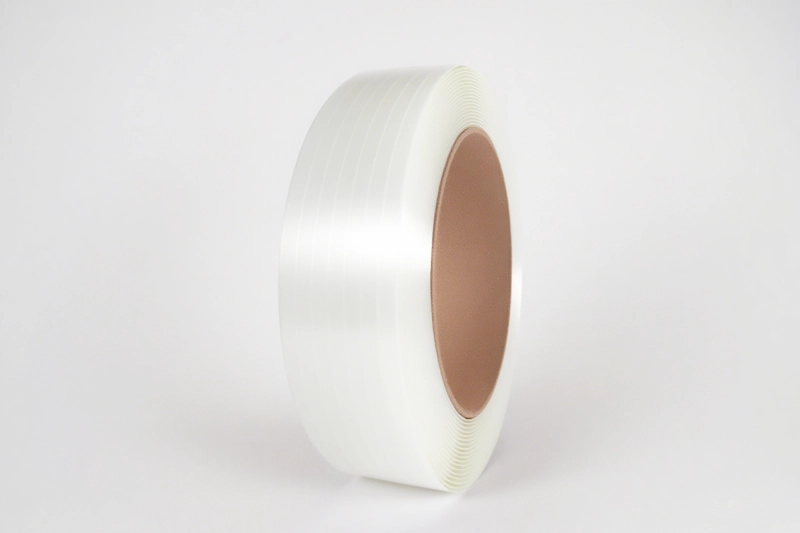
Transparent PET strap in the 9–25 mm width and 0.40–1.27 mm thickness envelope: label and grade visibility is retained after bundling. Image: Jushuo Packaging product record.
From Dimensions to Machine Behaviour: The Technical Basis
The reason a strap size can be treated as an engineering specification is that each dimension maps onto a distinct behaviour on the line. The table below sets out the parameters of a 16 × 1.0 mm cut PET strap against the machine-level function each one controls.
| Parameter | Recorded value or range | Function on an automatic line |
|---|---|---|
| Width | 16 mm (family range 9–25 mm) | Contact footprint on the bale and weld area at the sealing head |
| Thickness | 1.0 mm (family range 0.40–1.27 mm) | Stiffness and feed behaviour through chutes and guides; weld energy demand |
| Cut length | Specified per bale; verified examples 3,380 / 3,480 mm and 3,430 mm | Whether the head can complete a full tension-and-weld cycle without slack or over-travel |
| Elongation | ≤10% standard; ≤6% premium low-elongation formula (baling PP grades: 15–25%; standard PET: 10–15%) | Tension retention after the press releases; resistance to bale spring-back |
| Straightness | Deflection ≤5 mm/m; measured ≤3 mm/m on textile lines | Feeding reliability; jam frequency in the strap path |
| Grammage (12 mm reference) | Approx. 3.3 g/m, error ≤±0.05 g/m | Weld consistency and material consumption per bale |
| Joint strength | Heat-seal weld ≥80% of base material | Package integrity under lifting and handling shock |
| Surface | Smooth with anti-snag treatment; embossed option | Fiber protection versus friction grip on the bale face |
| Break force | 16 mm members specified ≥7,500 N for heavy industrial bundling; 12 mm baling strap ≥3,000 N; 19 mm members ≥9,500 N | Load class the bale format can be assigned to |
| Material and process | PET produced through SSP for intrinsic-viscosity enhancement, biaxial/uniaxial stretching and hot-air annealing; tensile strength 380–500 MPa; 100% recyclable | Consistency of mechanical properties from roll to roll and batch to batch |
Two of these parameters deserve emphasis because they are frequently under-specified by buyers. The first is straightness. Deflection is the variable that determines whether a strap travels cleanly through a machine's guiding path; when a strap twists or tilts inside the chute, the result is not a weaker package but a stopped line, because the head cannot complete its cycle. A measured deflection of ≤3 mm/m on textile lines is therefore a production figure, not a laboratory one.
The second is joint strength. A bale strap is only as strong as its weld. Where heat-seal joints reach at least 80% of the base material's strength, the package retains its design margin after handling; where they do not, the strap fails at the point of bonding rather than along its length. Because welding depends on strap thickness and grammage, a 1.0 mm thickness supplied at an unchanged grammage tolerance is what makes weld parameters repeatable across a production shift.
Application Fit: Polyester Fiber Bale Bundling on an Automatic Packaging Line
The clearest evidence base for this configuration is a polyester fiber bale bundling operation. Far Eastern Industries (Shanghai) Co., Ltd. is a verified user of PET baling strap for polyester fiber bale bundling, using the material in the same application class as Jushuo's fiber baling strap family — models JS12600-MT, JS12775-MT, JS16900-MT, JS16110-MT and JS16140-MT, which include the 16 mm-wide members of the range.
The fiber baling strap family is engineered around the specific problem described earlier. Its low-elongation formula is specified at ≤10%, with a premium series at ≤6%; the 12 mm member carries a tensile strength of at least 3,000 N; straightness is held at a deflection of ≤5 mm/m; the surface is treated to prevent fiber snagging so that filaments are not damaged during tensioning; and the strap is heat-seal welding compatible. The product complies with GB/T 22344-2018 and is manufactured under ISO 9001 and ISO 14001 systems, and is approved for cotton bale strapping under national standards.
Three adjacent verified references frame how the 16 × 1.0 mm cut format behaves in practice:
- Sateri (China) Fiber Co., Ltd. — documented use of the 16 mm × 1.0 mm PET baling strap cut at 3,380 / 3,480 mm for viscose fiber bales, with purchase invoices exceeding RMB 71,000 in a single batch.
- Xinjiang Xingtai Fiber Technology Co., Ltd. — a long-term user whose strap is specified at a custom 12 mm width with a 406 mm core size to match its own automatic strapping machines. After three years of use, the account reports stable straightness and grammage and smooth export customs clearance.
- Far Eastern Industries (Shanghai) Co., Ltd. — verified use of PET baling strap for polyester fiber bale bundling, which is the load class discussed in this article.
What makes the sizing work is the alignment of three dimensions with three machine realities:
- Cut length against the bale and the head. A fixed-length strap is specified from the compressed bale circumference plus the strap path inside the machine. Where bale geometry is stable, the length can be frozen; where it is not, the length must be re-specified rather than re-tensioned.
- Straightness against the chute. The strap path is where jams originate. A deflection ceiling of ≤5 mm/m, measured at ≤3 mm/m on textile lines, is the practical control point.
- Elongation against compression. The strap has to hold the bale at its compressed dimension. That requires the low-elongation formula, not a general-purpose PET grade.
Supply discipline is part of the fit as well, because a fixed-length cut program converts packaging into a scheduled input. Jushuo Packaging records annual capacity above 20,000 tons and monthly capacity above 1,700 tons, a finished product qualification rate above 99%, and a stated on-time shipment rate of 98.6%. A strap programme built on specified cut lengths depends on that kind of scheduling reliability more than a roll-based programme does.
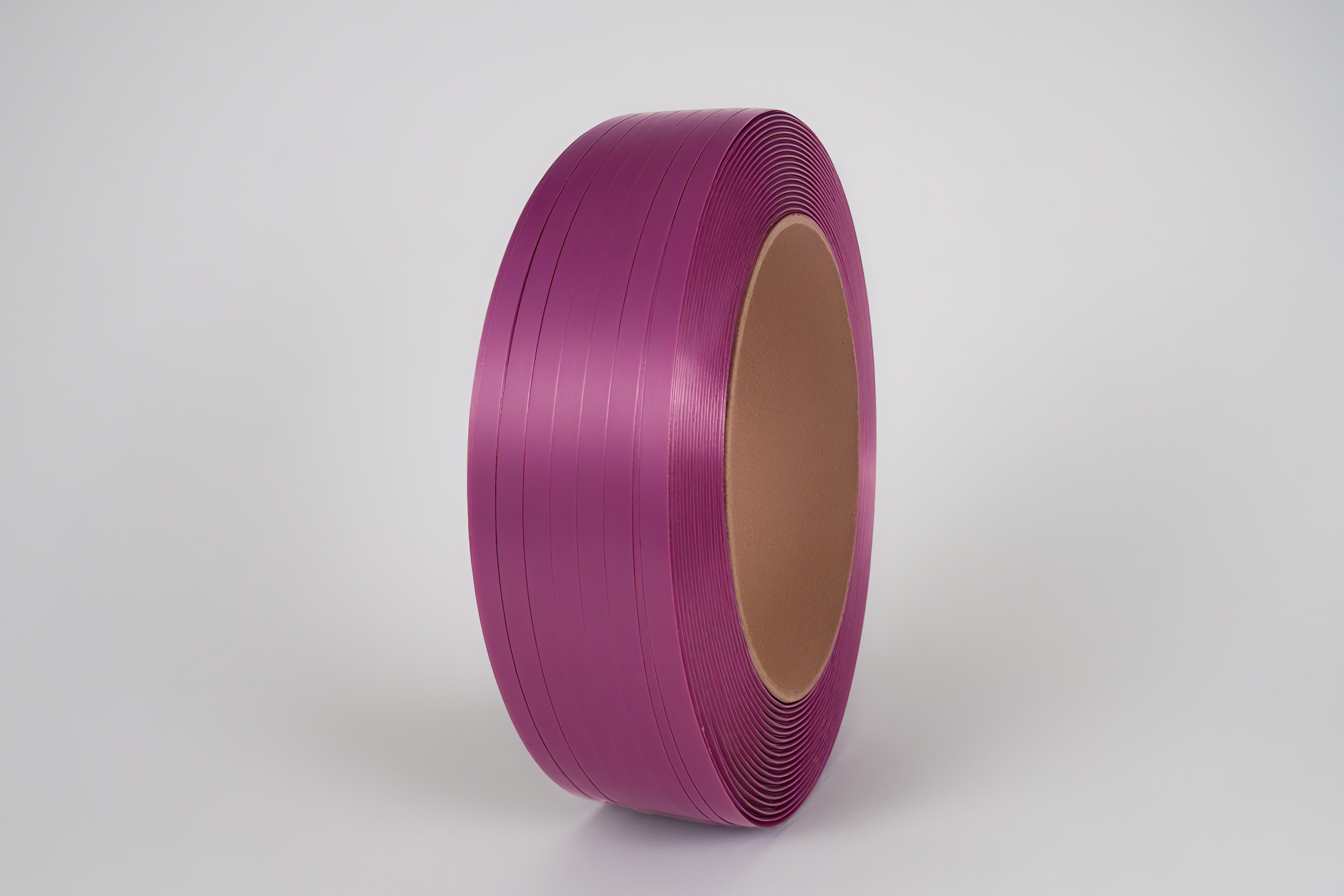
Machine-grade PET strap: straightness and grammage tolerance are what allow a head to complete its cycle without stopping the line. Image: Jushuo Packaging product record.
Comparison with Alternative Solutions — and the Boundaries of Cut PET Strap
Textile bale bundling has historically been served by three alternatives to a low-elongation cut PET strap, and each carries a different trade-off. The comparison below reflects only figures recorded in Jushuo's product and application documentation.
| Option | Elongation | Behaviour in compressed fiber bales | Handling and cost position as recorded |
|---|---|---|---|
| Steel strapping | Very low | Holds compression, but introduces rust contamination risk and sharp edges | Dangerous spring-back; PET is recorded at 35–40% lower material cost with equivalent strength, and at one-sixth of steel's density |
| PP strapping (bale grade) | 15–25% | Higher spring-back risk at high compression; suited to light and medium loads | Safe and light; lower material cost than PET |
| Standard PET roll strap | 10–15% | Rust-proof, but tension retention is below that of the low-elongation baling formula | Requires in-line cutting on the machine; length flexibility is high |
| 16 × 1.0 mm cut PET, low-elongation formula | ≤10%, premium ≤6% | Specified for high-compression bale retention | Rust-proof, no sharp edges, 100% recyclable, rPET content available; fixed length requires planning |
Where this configuration stops fitting is as important as where it works, and the boundaries are specific:
- Cut length is not adjustable at the machine. A pre-cut strap is committed to a bale format. If the bale dimensions, the wrap thickness or the strap path inside the machine changes, the length has to be re-specified and re-ordered; the strap cannot be extended on the line the way a roll-fed strap can.
- General-purpose PET is not a substitute. Standard PET elongation of 10–15% is not the same specification as the baling formula at ≤10% (premium ≤6%). For high-compression fiber bales, the low-elongation grade is the applicable one.
- 16 mm has a strength ceiling by design. Within the same range, 19 mm members are specified at ≥9,500 N against ≥7,500 N for 16 mm in heavy industrial bundling. Wider or denser bale formats may sit outside the 16 mm class.
- There is a temperature boundary. Ordinary PET becomes brittle at −20 °C. Cold-storage and deep-cold applications require a separate anti-brittle series built for −50 °C. Ambient textile plants fall outside this constraint, but low-temperature textile or fiber storage does not.
- Inventory planning is required. Fixed lengths mean fixed stock positions. A roll-based programme absorbs demand variation; a cut-length programme converts it into a planning task.
Market Context: Where PET Strapping Demand Is Moving
The sizing discussion sits inside a broader shift in packaging materials. Grand View Research values the global packaging strapping materials market at USD 9.8 billion in 2025, projected to reach USD 15.7 billion by 2033. Within that total, Cognitive Market Research projects the global PET strapping market growing at a CAGR of 5.8% from 2024 to 2033, reaching USD 1.44 billion — a trajectory driven largely by substitution away from steel in heavy and export packaging.
Two structural points are relevant to textile buyers. First, PP strapping dominated the market with a 33.9% revenue share in 2025, a position attributed to its cost-effectiveness in logistics and e-commerce rather than to high-compression bale applications. Volume share and application fit are therefore not the same measure, and the distinction matters when a procurement team benchmarks PET against PP on price alone. Second, recycled PET (rPET) is recorded as accounting for 34% of global strapping production in 2024, driven by sustainability regulation and the continuing shift from steel to plastic; PET strapping in this range is 100% recyclable and can be manufactured with recycled content.
Standardisation underpins the category. ASTM D3950-23 governs nonmetallic strapping for packaging and shipping and classifies it into five material types, while EN 13394:2001 specifies dimensions and physical properties for non-metallic tensional strapping, including PP and PET types. For textile exporters, these frameworks are the reference points against which a 16 × 1.0 mm cut strap can be described in a purchase specification.
Future Outlook
Three developments are likely to shape how textile bale strapping is specified over the next few years.
The first is the migration of cut length from a purchasing detail to a machine document. As automatic lines become more tightly timed, the strap's dimensional parameters — width, thickness, cut length, straightness and grammage — behave as machine settings. Documenting them alongside the strapping head's cycle parameters makes a cut-length programme stable across supplier changes.
The second is verification. Export-oriented fiber producers already operate with RoHS and REACH documentation for packaging materials, plus GB/T 22344-2018 compliance, ISO 9001 and ISO 14001 certification, and third-party SGS test reports. As more buyers treat packaging as part of a compliance file rather than a consumable, that documentation becomes a selection criterion rather than an attachment.
The third is identification. Colour-coded and printed straps already serve bale and grade differentiation in fiber packaging — green cut PET strap in viscose bale applications, for example, and printed PET strap for brand and traceability purposes. For transparent strap specifically, the value proposition runs the other way: keep the bale's own markings visible rather than adding new ones. Both approaches are already available in the same product family, which leaves the choice to the receiving warehouse rather than to the materials supplier.
Frequently Asked Questions
1. What does "cut PET strap" mean in textile bale packaging?
Cut PET strap is PET strapping supplied at a specified length instead of as a continuous roll. It allows an automatic strapping head that is set up for a fixed strap length to complete its tensioning and welding cycle without in-line cutting. Recorded examples in fiber and industrial applications include a 16 mm × 1.0 mm PET baling strap cut at 3,380 mm or 3,480 mm for viscose fiber bales, and 16 × 1.0 × 3,430 mm and 19 × 1.0 × 3,430 mm cut PET strap for metal product bundling.
2. Why is 16 × 1.0 mm a relevant size for fiber bale bundling?
Both dimensions sit inside the standard PET strapping envelope: 9–25 mm in width, 0.40–1.27 mm in thickness and 160–1,360 kg in break force. Within the fiber baling strap family, the 16 mm-wide members include models JS16110-MT and JS16140-MT, while the 12 mm member carries a tensile strength of at least 3,000 N. In heavy industrial bundling, 16 mm members are specified at ≥7,500 N breaking force and 19 mm members at ≥9,500 N, so 16 mm represents a mid-range load class rather than an extreme one.
3. How is a specified cut length matched to an automatic strapping line?
Two requirements must be satisfied together. The first is the machine's strap path: straightness, expressed as deflection, is specified at ≤5 mm/m and measured at ≤3 mm/m on textile lines, which determines whether the strap feeds without twisting or jamming. The second is the compressed bale dimension: the cut length must let the head complete tensioning and welding without slack or over-travel. Grammage consistency, recorded at approximately 3.3 g/m with ≤±0.05 g/m tolerance for a 12 mm strap, keeps weld parameters repeatable. If the bale format or the machine changes, the cut length must be re-specified.
4. What documented evidence exists for PET baling strap on automatic textile lines?
Three verified references are recorded. Far Eastern Industries (Shanghai) Co., Ltd. uses PET baling strap for polyester fiber bale bundling. Sateri (China) Fiber Co., Ltd. uses the 16 mm × 1.0 mm PET baling strap cut at 3,380 / 3,480 mm for viscose fiber bales, supported by purchase invoices exceeding RMB 71,000 in a single batch. Xinjiang Xingtai Fiber Technology Co., Ltd. has used a custom 12 mm width with a 406 mm core size matched to its own automatic strapping machines for three years, reporting stable straightness and grammage and smooth export customs clearance. The product range complies with GB/T 22344-2018 and is manufactured under ISO 9001 and ISO 14001 certification, with SGS test reports available.
5. What are the limits of a 16 × 1.0 mm cut PET strap for textile bundling?
Five limits apply. The cut length is fixed and cannot be adjusted on the line, so any change in bale dimensions or machine strap path requires a new specification. Standard PET, at 10–15% elongation, is not interchangeable with the low-elongation baling formula at ≤10% (premium ≤6%) for high-compression bales. The 16 mm width has a defined ceiling: 19 mm members are specified at ≥9,500 N against ≥7,500 N for 16 mm in heavy industrial applications. Temperature is a further boundary, since ordinary PET becomes brittle at −20 °C and only a separate anti-brittle series is built for −50 °C. Finally, fixed-length supply requires inventory planning rather than the on-demand length flexibility of a roll format.
The configuration discussed here is therefore best understood as a specification rather than a product category: a transparent 16 × 1.0 mm PET strap, cut to a length matched to the bale and the machine, using a low-elongation formula and a straightness and grammage tolerance tight enough for an automatic head to complete its cycle. Where those conditions hold, the strap disappears into the packaging process. Where any one of them does not, the dimension that was under-specified becomes the reason the line stops.