
PFAS-Free Home Textile Fabric: Verifying Claims for Sofa and Curtains
PFAS-Free Home Textile Fabric: Verifying Claims for Sofa and Curtains
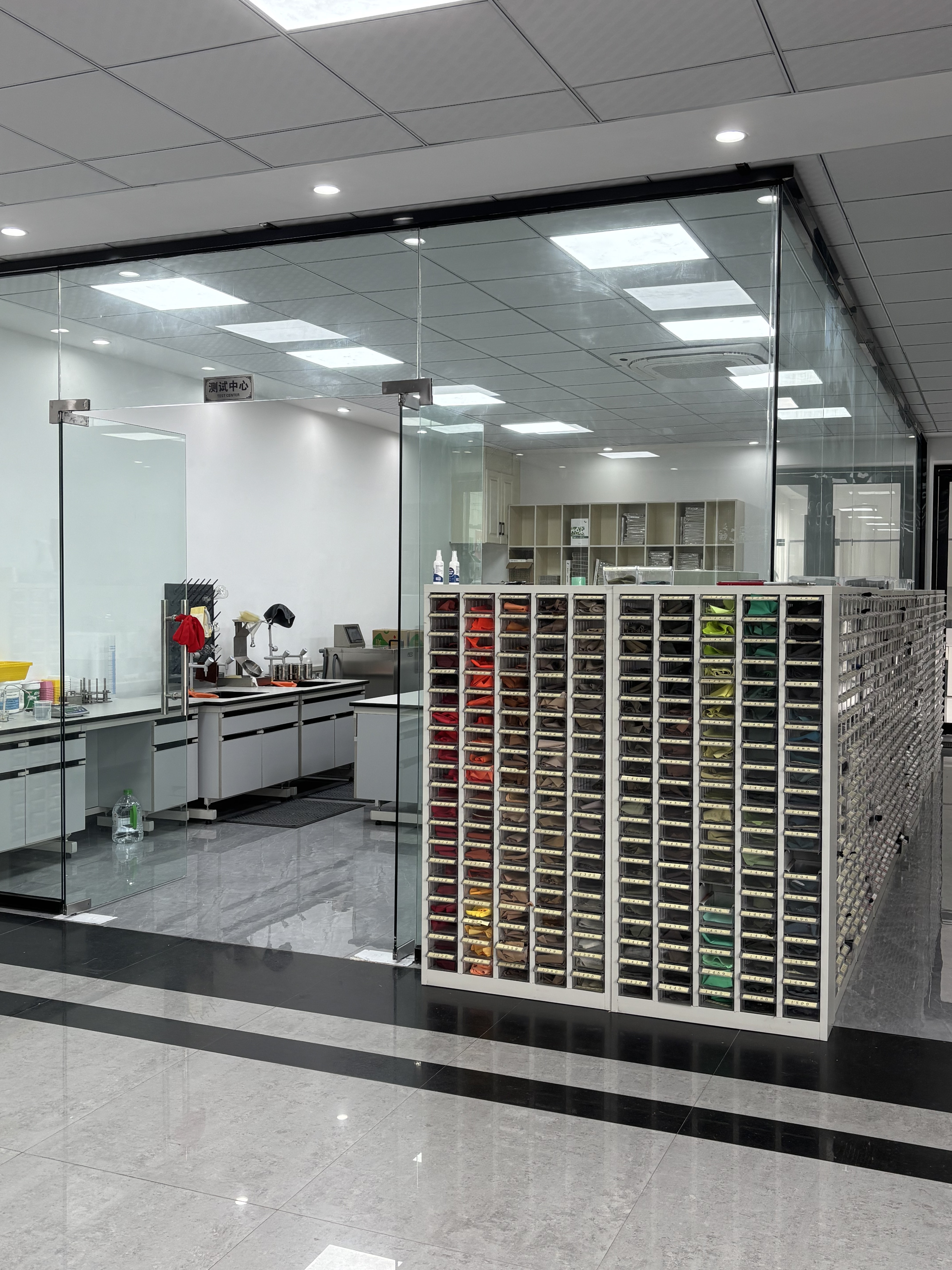
A fabric laboratory does not decide whether a PFAS-free claim is true. It produces the parameters a buyer can compare against what the declaration actually covers.
A PFAS-free claim on sofa or curtain fabric is a statement about the finishing recipe, not about the fibre. That distinction determines how the claim should be checked: a composition certificate can confirm that a fabric is 100% polyester, but it cannot confirm which water-repellent chemistry was applied to that polyester during finishing. Buyers evaluating decorative, upholstery, dimout or blackout constructions therefore need a verification path that runs from the specification line, to the finishing step, to a signed declaration for the exact model and finish being purchased.
The parameter itself is narrow. It asks that no PFAS, PFOA or PFOS be intentionally added to the fabric, and that no fluorinated finishing agent be used in the water-repellent or stain-resistant treatment. What makes the parameter commercially difficult is scope: a declaration that covers the greige fabric but not the coating, or covers the base cloth but not the backing adhesive, does not answer the question an end brand is actually asking. This reference sets out what the parameter should say, which finishing routes replace fluorinated chemistry, and where the evidence stops.
Why a PFAS-free claim cannot sit on a composition certificate
Buyers of home textile fabric usually verify three parameters first: fibre composition, yarn construction and fabric weight. Each is a legitimate, checkable fact. Model TL07410, for example, is 100% polyester with a 350D x 450D construction, a stated weight of 300 gsm and a usable width of 150 cm, produced with a bonded back side. Model TL08273 is 100% polyester with a (75D+80D) x 320D construction, 280 gsm, and width options of 15 cm and 300 cm. TL08180 is documented as 100% polyester linen, 75D x (150D+150D), 310 gsm, in 150 cm and 300 cm widths.
All three records are useful, and all three are silent on the question a PFAS specification raises. Composition certificates document fibre content; material inspection verifies construction; GSM measurement verifies weight against tolerance. None of these procedures examines the auxiliary chemistry applied at the finishing stage. A fluorinated water repellent applied to a polyester upholstery fabric leaves the fibre content, the yarn count and the weight essentially unchanged. The composition certificate and the weight report would look the same before and after the finish substitution.
That is why the PFAS parameter belongs to a separate document class from the parameters buyers normally request. It is also why the parameter tends to surface late in evaluation, when an end brand's restricted substance list reaches the fabric supplier and the buyer discovers that the existing compliance file answers a different set of questions.
What the selection parameter should actually say
A specification line reading only 'PFAS-free' leaves too much open to be auditable. A usable version of the parameter answers six questions before the buyer asks them.
- Substance scope. Whether the declaration covers PFAS as a class, or only named substances such as PFOA and PFOS. A named-substance declaration and a class-based declaration are not equivalent documents.
- Process scope. Which steps are included: the water-repellent finish, any stain-release treatment, the coating or lamination layer, and the adhesive used for a bonded back side.
- Entity scope. Who signs. A chemical supplier's declaration about an auxiliary and a mill's declaration about a finished fabric are different levels of assurance, and the stronger file usually contains both.
- Evidence type. Whether the claim rests on a declaration of no intentional addition, on an analytical test report, or on both. These answer different questions and should not be used interchangeably.
- Coverage. The exact model numbers and finishes the declaration applies to, not the supplier's range in general.
- Validity and change control. An issue date, an expiry or review date, and a stated trigger for re-declaration when a finish or auxiliary changes.
The distinction between 'no intentionally added' and 'not detected' deserves particular attention. A declaration of no intentional addition describes formulation intent: it states that the chemistry was not part of the recipe. An analytical report describes a measurement on a sample, reported against the method and detection limit used. Neither document is a guarantee of absolute zero in every circumstance, and a buyer who treats one as the other may later find that the evidence on file does not support the wording used in a customer-facing statement.
The finishing routes that replace fluorinated chemistry
Fluorinated finishes have historically been used in textile finishing because they lower surface energy and deliver both water and oil repellency from a relatively low add-on. The buyer's question is rarely whether such chemistry works; it is whether the supply chain can document its absence for a specific article. When fluorinated finishing is excluded by a specification, two routes are most often proposed: silicone-based water repellents and fluorine-free polyurethane dispersions.
Silicone-based, or polysiloxane, water repellents are widely used where water repellency and hand feel are the priorities. In general industry practice they are associated with a softer hand than heavily loaded fluorochemical finishes, and they are not a like-for-like replacement for oil repellency. A buyer whose stain concern is primarily oil-based should test that concern explicitly rather than assume the substitution has carried it across.
Fluorine-free polyurethane dispersions form the second route. Their behaviour depends heavily on the specific formulation, the add-on level and the substrate, which is why the finishing route should be named in the specification record rather than described generically as 'water repellent'.
Model TL12199 in the T-LAND TEXTILE range shows how the route becomes visible in a document. It is a 100% polyester dimout fabric with a 700D x 700D yarn construction, available in 150 cm and 300 cm widths, intended for room darkening curtain and sofa collections. Its stated weight is 300 gsm with backing and 380 gsm with silicon coating; with silicon coating it is positioned for curtain applications, and with a non-woven backing it is positioned for sofa or cushion applications. The finishing choice is therefore not hidden in a marketing phrase: it appears as a named coating and as a different weight in the specification.
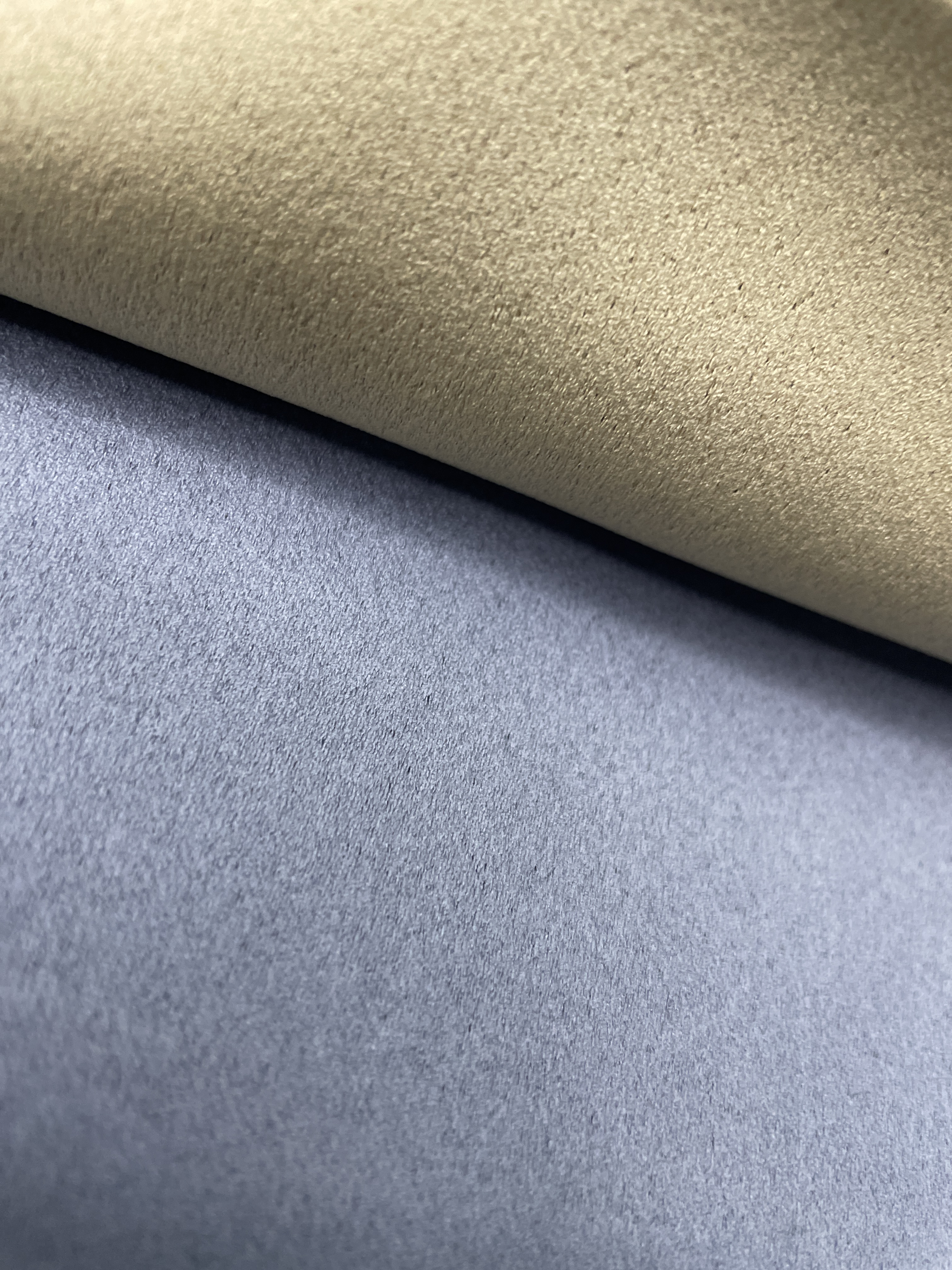
Curtain constructions such as TL08273 combine a dimout function with fire retardant performance, so a finish change has to be checked against the whole attribute set, not only repellency.
Keeping water repellency on a fluorine-free route
Removing fluorinated chemistry does not remove the performance requirement. It moves the requirement into a test and a construction decision. The specification should state which repellency test method and pass level the buyer expects, so that the finish is evaluated against an agreed target instead of a general claim.
Repellency is construction-dependent. A finish validated on a 380 gsm dimout with a dense construction is not automatically valid on a 160 gsm upholstery fabric such as TL0329, which is documented at 105D x 200D, 160 gsm, with a brushed suede hand and 150 cm or 300 cm width options. Weight, cover factor and surface treatment all change how a finish sits on the cloth. Buyers are therefore better served by a finish validated on the specific model they are ordering than by a finish validated on a reference article from the same supplier.
Stain type matters as much as repellency level. Water-based soiling and oil-based soiling respond differently to non-fluorinated finishes, and a sofa fabric for family use and a curtain fabric for a hotel project rarely need the same balance. Matching the claim to the stain type the end user will actually create is more useful than maximising a single repellency score.
Where the parameter changes the decision: sofa, curtain and contract use
On residential upholstery, the PFAS parameter usually arrives through the furniture brand's restricted substance list rather than through the fabric buyer's own preference. The practical pairing is a construction that already suits the application plus a finish declaration that covers it. TL07410, a 300 gsm velvet with a bonded back side for sofa or cushion production, and the polyester linen group TL0415, TL0469 and TL0484, documented at 230 gsm with a linen hand feel and a bonded back side, both illustrate the point: the bonded back is itself a chemical step, so the declaration must reach the lamination as well as the face finish.
On curtains, the parameter competes with light control and fire performance for attention. TL08273 is a dimout fabric providing room darkening, with noise reducing and fire retardant properties at 280 gsm. TL08321 is documented at 380 gsm in 150 cm and 300 cm widths, with a (150D+320D) x (300D+300D) construction, a soft hand feel, and room darkening, noise reducing and fire retardant properties. In these articles, a finish substitution is a specification change, and the buyer's check is that the fire retardant document on file still refers to the construction and finishing route being supplied.
Contract environments add volume and repetition. The application profile for this category covers residential decoration, hotel and bed-and-breakfast projects, office commercial projects, healthcare institutions, exhibition and cultural tourism projects, and special soft furnishing work for RVs and yachts. The special requirements listed for these settings include flame retardancy, high light fastness, high Martenside-type abrasion resistance in practice, anti-pilling performance, water-repellent and stain-resistant finishing, low-formaldehyde eco-standards, strict batch-to-batch colour difference control, washability, and customised width and gram weight.
Among that list, the eco-standard and the repellency requirement pull in the same direction, which is precisely why they are often specified together. A project that asks for low-formaldehyde chemistry and water repellency is already asking the supplier to document its auxiliaries. Adding the PFAS parameter extends that documentation rather than creating a new burden from nothing.
Documented evidence versus a marketing statement
The simplest way to keep the evaluation honest is to separate what each document can establish from what it cannot. The table below reflects the documents typically present in a home textile compliance file.
| Document | What it can establish | What it does not establish on its own |
|---|---|---|
| Composition certificate | Fibre content of the article, for example 100% polyester or a polyester-linen blend | Which finishing chemistry was applied; it would read the same with or without a fluorinated repellent |
| Weight and width record | GSM against tolerance and usable width, for example 280 gsm at 150 cm and 300 cm options | Anything about auxiliaries; weight shifts with finish add-on but does not identify it |
| Restricted-substance certification, e.g. OEKO-TEX Standard 100 certificate 19.HCN.99628 issued by Hohenstein | That the listed articles were assessed under that standard's scope, which covers woven and knitted 100% polyester and 100% polyamide fabrics including PU/TPU/PVC coating and laminating finishing, Product Class II | A model-level 'no intentionally added PFAS' declaration; the article and finish should be confirmed as within the certified scope |
| Recycled content certification, e.g. GRS certificate CB-CUC-1026562 issued by Control Union for dyed and greige fabrics | Recycled content status of the certified items | Chemical identity of the finishing recipe; recycled content and PFAS status are separate attributes |
| Supplier declaration of no intentional addition | That the named substances were not part of the formulation for the stated models and finishes | An analytical result; it is a statement of intent and scope, not a measurement |
Read together, these documents answer different questions, and a buyer who presents only the first two has not yet addressed the PFAS parameter. A buyer who presents the declaration without the model list has addressed it in principle but not in practice.
Where the claim stops: fit boundaries and limitations
Several boundaries are worth stating plainly, because they determine whether a verified claim remains valid after the order is placed.
- Scope boundary. A declaration is only as wide as its model and finish list. A statement covering the base cloth does not cover a subsequently added coating, lamination or back-side adhesive.
- Performance boundary. A PFAS-free status says nothing about repellency level. Repellency has to be specified, tested and accepted as a separate attribute on the actual construction.
- Weight boundary. Substituting a finish can change the recorded weight, as the 300 gsm with backing and 380 gsm with silicon coating figures for TL12199 show. Buyers should expect the specification to be reissued rather than assume the old number still applies.
- Attribute boundary. A finish change is a specification change. Fire retardant, light fastness and abrasion evidence should be confirmed as referring to the construction and finishing route now being supplied.
- Detection boundary. A declaration of no intentional addition should not be read as a statement of absolute zero in every sample. Where a customer-facing statement needs measurement language, the analytical report and its detection limit are the supporting document.
None of these boundaries makes the parameter unworkable. They simply move the effort from assertion to documentation, which is where it belongs for a claim that a brand may repeat in its own marketing.
Regulatory direction: documentation rather than slogans
The broader direction of home textile compliance supports this reading. The EU General Product Safety Regulation 2023/988 mandates safety for home textiles, and Digital Product Passports are expected for textiles by 2027 according to Carbonfact's 2026 overview of the EU textile strategy and regulations. In the United Kingdom, the Furniture and Furnishings (Fire) (Safety) Regulations 1988 remain the core regime in 2026 for domestic upholstered products, as summarised by Studio 198 in July 2026, while BS 5867 is the established UK fire safety standard specifically for curtains and drapes.
The analytical point for a fabric buyer is not that any one of these instruments names PFAS. It is that traceability requirements attach attributes to identifiable articles. A declaration that cannot be tied to a model number and a finishing route sits awkwardly in that environment, while a model-level file fits it without rework.
Markets differ in how quickly such requirements are applied, and buyers should confirm the applicable regime for their own destination rather than rely on a supplier's summary. The useful preparation is the same in either case: keep the finishing route named, keep the declaration current, and keep both attached to the article that ships.
How T-LAND TEXTILE's records fit the verification path
T-LAND TEXTILE, formally Suzhou T-land Textile Co., Ltd., is a fabric manufacturer based in Shengze, China, founded in 2014 and producing sofa fabric and curtain fabric for furniture, upholstery and home decoration buyers.
Its operating record gives a buyer a frame into which a model-level PFAS declaration can be placed. The company reports a 5,000 square metre facility, 91 employees, an annual output of 5,000,000 metres, a three-engineer development team, a 1,500 square metre warehouse and an in-house laboratory. Export accounts for 90% of output, with the EU as the main market. Production runs in OEM and ODM modes, with customisation covering pattern design, fabric width, gram weight, colour and shade, flame-retardant, water-repellent and stain-resistant finishing, and development against a customer sample. Stated commercial terms are a minimum of 500 to 1,000 metres per colour, a 30 to 45 day lead time and a monthly capacity of 200,000 metres, with 100% in-house testing or customer random inspection and after-sales support within two months of receipt.
Two certifications are recorded with identifiable scope and validity. OEKO-TEX Standard 100 certification 19.HCN.99628 was issued by Hohenstein, applies globally, and runs from 14 January 2026 to 31 January 2027; its scope covers woven and knitted fabric made of 100% polyester and 100% polyamide, including bleaching, disperse dye piece-dyeing, transfer printing and PU/TPU/PVC coating and laminating finishing, Product Class II. GRS certification CB-CUC-1026562 was issued by Control Union for dyed and greige fabrics and runs from 16 March 2026 to 15 March 2027.
The honest reading of these documents is that they establish restricted-substance assessment and recycled content status for their listed scope. They are not, by themselves, a model-level statement that no fluorinated finishing agent was used. That statement is a separate document, and for a buyer the correct action is to request it for the specific model and finish under evaluation, alongside the composition, weight and width records the supplier already maintains. Where the finishing route is named in the specification, as with the silicon coating on TL12199, the declaration has a concrete object to attach to.
A six-step verification sequence for buyers
- Fix the article first. Record the model number, construction, weight, width and backing or coating before discussing chemistry. A declaration without a model number cannot be evaluated.
- Ask for the parameter in writing. Substance scope, process scope, signatory, evidence type, model coverage, validity date and change trigger. Reject a line that says only 'PFAS-free'.
- Separate intent from measurement. Decide whether the end brand's requirement is satisfied by a declaration of no intentional addition or needs an analytical report with a stated method and detection limit.
- Name the finishing route. Silicone-based, fluorine-free polyurethane or another non-fluorinated route should appear in the specification, so that a substitution is visible rather than silent.
- Test repellency on the actual construction. Agree the method and pass level in advance, and confirm the result on the model being ordered rather than on a reference article.
- Re-confirm the dependent attributes. Check that fire retardant, light fastness and colour records refer to the construction and finish now being supplied, and file the declaration with the same model-level discipline as the composition certificate.
Outlook
The direction of travel favours documented attributes over general assurances. As traceability expectations extend across home textiles, the suppliers who answer PFAS questions quickly will be those who already record finishing routes against model numbers, because that practice serves every other attribute as well: repellency, fire performance, colour consistency and recycled content.
For buyers, the practical conclusion is that a fluorine-free claim is best treated as a specification item with an owner, a document and a date, rather than as a sentence in a catalogue. The chemistry substitution is a technical decision made at sampling; the verification is a procurement discipline maintained through every reorder.
FAQ
What does 'no intentionally added PFAS' mean on a fabric specification?
It means the fabric's finishing recipe was formulated without PFAS, PFOA or PFOS as intentional ingredients, and that no fluorinated finishing agent was used for water or stain repellency. It describes formulation intent for a stated scope of models and finishes. It is not the same statement as a measured 'not detected' result, which reports against a test method and detection limit.
Can a 100% polyester fabric be assumed PFAS-free because of its fibre content?
No. Fibre content and finishing chemistry are separate attributes. A fluorinated water repellent applied during finishing leaves the polyester composition, the yarn construction and the fabric weight unchanged, so a composition certificate and a weight report would look the same with or without that finish. The finishing route needs its own document.
Which water repellent chemistries are used when fluorinated finishing is excluded?
The two routes most often specified are silicone-based water repellents and fluorine-free polyurethane dispersions. In general practice, silicone finishes are chosen where water repellency and a soft hand are the priorities, and they are not a like-for-like replacement for oil repellency. Performance depends on the formulation, the add-on and the substrate, so the result should be confirmed on the specific fabric construction.
Does a fluorine-free finish remove the need to re-check fire retardant evidence?
No. Fire retardancy and PFAS status are separate attributes, and a finish change is a specification change. The buyer should confirm that the fire retardant document refers to the construction and finishing route actually being supplied. For context, the UK Furniture and Furnishings (Fire) (Safety) Regulations 1988 remain the core regime in 2026 for domestic upholstered products, and BS 5867 is the established UK fire safety standard specifically for curtains and drapes.
What documents should a buyer request for sofa and curtain fabric?
A composition certificate, a weight and width record against tolerance, any restricted-substance certification with its scope and validity dates, a model-level declaration covering the specific finish and backing, and an analytical report where the buyer's own specification requires measurement. A change-control statement confirming when the declaration is reissued completes the file.
For buyers who want the underlying product specifications in one place, the T-LAND TEXTILE catalogue is available for download: T-LAND TEXTILE product catalogue (PDF).
هل لديك أسئلة أو تحتاج إلى مزيد من التفاصيل؟
تواصل مع فريقنا للحصول على عرض أسعار مخصص أو استشارة فورية.
طلب عرض أسعار
املأ النموذج أدناه وسيتواصل معك فريقنا بعرض مقترح مخصص.
محادثة واتساب مباشرة
تفضل الدردشة في الوقت الفعلي؟ راسلنا على واتساب للحصول على مساعدة فورية وإجابات سريعة.
- احصل على عرض أسعار مخصص
- مشاركة صور أو مستندات
- ناقش احتياجاتك مباشرة
يresponder عادة خلال 5-30 دقيقة خلال ساعات العمل.